Opening your dashboard
Class 11 Physics Chapter 9 Work, Energy and Power: Practice Questions
135 questions on Chapter 9, each worked through on its own page with the AI tutor. Class 11 Physics, ICSE 2026-27.
135 questions
1–3 marks · Mixed difficulty
- 11 mark
Question 1
A student pulls a wheeled suitcase along a level airport floor. The student pulls the handle with a steady force of directed along the handle, which makes an angle of with the floor, and the suitcase moves as shown. (Hypothetical data.)
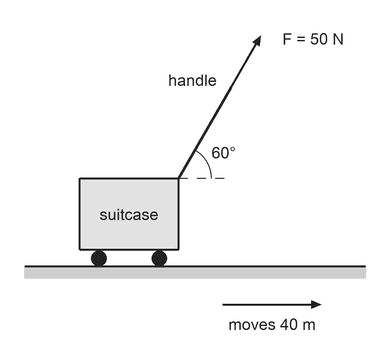
The work done by the student's pull on the suitcase is
- 23 marks
Question 2
A crate of mass slides down a rough ramp inclined at to the horizontal. It moves at a constant speed from to , a distance of along the ramp, as shown. Take . (Hypothetical data.)
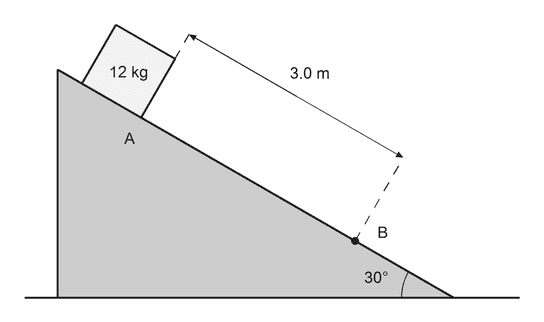
Find the work done on the crate between and by
(a) its weight,
(b) the normal reaction of the ramp,
(c) friction, and
(d) all the forces together.
- 31 mark
Question 3
A forklift raises a box of mass straight up through at a steady speed. Keeping the box at that height, it then drives across a level warehouse floor at a steady speed. Take and ignore air resistance. (Hypothetical data.) The total work done on the box by the fork is
- 43 marks
Question 4
A narrow boat is towed along a straight canal by a rope pulled from the towpath, as horse-drawn boats once were. The rope makes an angle of with the direction of the canal and the tension in it is a steady . The boat moves along the canal at a constant speed, as shown in the top view. (Hypothetical data.)
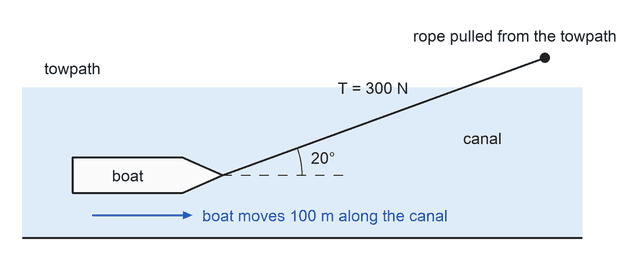
(a) Find the work done by the tension on the boat.
(b) Find the work done on the boat by the water's resistance along the canal.
(c) The sideways part of the pull tends to drag the boat towards the towpath. What stops it, and how much work does that sideways force do? Give a reason.
- 51 mark
Question 5
A crate of mass stands on the flat, level bed of a truck. The truck starts from rest and accelerates uniformly at along a straight road for , and the crate does not slip on the bed. Take . (Hypothetical data.) As measured by a person standing on the road, the work done on the crate by the friction force of the truck bed is
- 63 marks
Question 6
A stretched elastic cord pushes a toy car along a smooth, level track. The table gives the force of the cord on the car when the car has moved a distance from its starting point. The cord goes slack at . (Hypothetical data.)
(cm) 0 2 4 6 8 10 (N) 12.0 10.4 8.4 6.0 3.2 0 (a) Taking to change linearly between neighbouring readings, find the work done by the cord on the car from to .
(b) The car starts from rest. Find its speed when the cord goes slack, ignoring friction.
- 71 mark
Question 7
A force acting on a body along the -axis varies with position as , where is in newton and in metre. The work done by this force as the body moves from to is
- 82 marks
Question 8
A bucket of water is hauled up a well, deep, at a steady speed by a light rope. The bucket leaks steadily, so that its mass (bucket and water) falls uniformly with height, from at the bottom to at the top. Take . (Hypothetical data.)
Find the work done by the rope in raising the bucket to the top.
- 91 mark
Question 9
The outlet of a bicycle pump is sealed and its piston is pushed in slowly, so that the temperature of the trapped air stays constant. The force exerted by the air on the piston is then , where is the distance of the piston from the closed end, as shown, and . (Hypothetical data.)
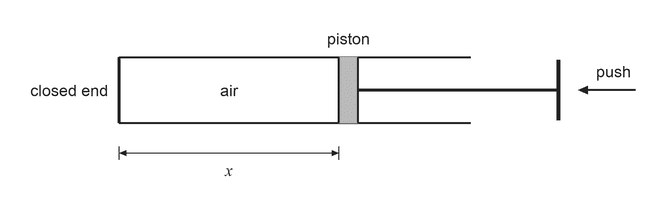
The work done by the piston on the air as is reduced from to is about
- 103 marks
Question 10
In a crash test, a car of mass hits a rigid wall head-on. As the front crumple zone is crushed, the force of the wall on the car rises uniformly from zero to over the first of crushing and then stays at for the next . The crumple zone can be crushed by at most. (Hypothetical data.)
(a) Sketch the force–crush distance graph and use it to find the work done by the wall on the car over the full .
(b) Find the greatest speed at which the car can hit the wall and still be stopped within the crumple zone.
(c) Find the average force on the car over the .
- 111 mark
Question 11
A ball of mass is thrown straight up. It rises and falls back into the thrower's hand at the point from which it was thrown. Air resistance is not negligible. Take . For the whole up-and-down trip,
- 123 marks
Question 12
A box of mass is pushed across a rectangular floor , with and , as shown. The coefficient of kinetic friction between the box and the floor is and the box keeps sliding throughout. Take . (Hypothetical data.)
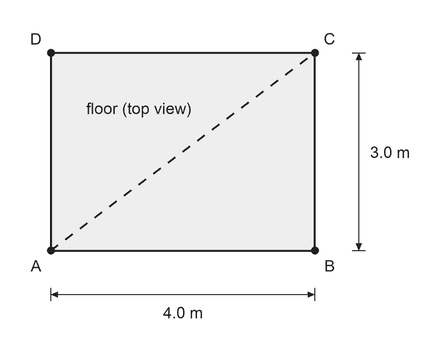
(a) Find the work done by friction on the box when it is pushed from to along the diagonal .
(b) Find the work done by friction when it is pushed from to along and then .
(c) The box is then pushed back from to along and , after going out along . Find the work done by friction on this round trip, and say what your answers show about friction.
- 131 mark
Question 13
A force that depends only on position acts on a particle. When the particle moves from point to point , the force does of work along path 1, along path 2 and along path 3. Which conclusion is correct?
- 143 marks
Question 14
A small block of mass is taken from point , above the ground, to point , above the ground, along two different paths, as shown. Path 1 is straight; path 2 is curved and dips below the level of before rising to it. Take .
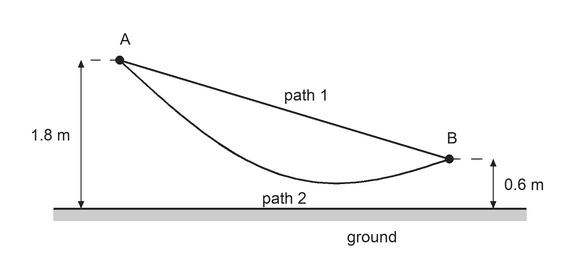
(a) Find the work done by gravity on the block along path 1.
(b) By dividing path 2 into small steps, show that gravity does the same work along path 2.
(c) The block is then carried back from to along any path. Find the work done by gravity on this return trip and on the whole round trip, and state what this shows about gravity.
- 152 marks
Question 15
A book of mass is given a push across a level desk and slides before it stops. The coefficient of kinetic friction between the book and the desk is . Take . (Hypothetical data.)
(a) Find the work done by friction on the book while it slides.
(b) Find the speed with which the book started sliding, and say what has become of its kinetic energy.
- 163 marks
Question 16
A car of mass travelling at on a level road is brought to rest by gentle, steady braking in a braking distance of . (Hypothetical data.)
(a) Find the braking force, assuming it is constant.
(b) With the same braking force, find the braking distance from .
(c) Explain why a 50% increase in speed more than doubles the braking distance.
- 173 marks
Question 17
A car of mass speeds up from to while travelling along a straight, level road. The total resistance to its motion (air drag and rolling resistance) is a steady . (Hypothetical data.)
(a) Find the change in the car's kinetic energy.
(b) Find the work done on the car by the resistance.
(c) Using the work–energy theorem, find the work done by the driving force, and hence the average driving force.
- 181 mark
Question 18
An ice-hockey puck of mass is struck so that it slides across level ice at . It comes to rest after sliding . (Hypothetical data.) The average friction force of the ice on the puck is
- 192 marks
Question 19
In a sports-science demonstration, an iron ball of mass is dropped from rest from a height of into a pit of loose sand, and sinks into the sand before stopping. Take and ignore air resistance. (Hypothetical data.)
(a) Find the speed of the ball just before it reaches the sand.
(b) Using the work–energy theorem for the whole motion, find the average resistive force of the sand on the ball.
- 203 marks
Question 20
A block of mass is sent up a rough plane inclined at to the horizontal with a speed of along the plane, as shown. The coefficients of kinetic and static friction between the block and the plane are and . Take , and . (Hypothetical data.)
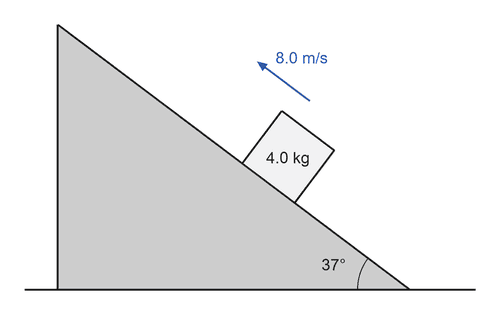
(a) Using the work–energy theorem, find how far up the plane the block slides before it stops.
(b) Show that the block then slides back down, and find its speed when it returns to its starting point.
- 211 mark
Question 21
A light spring lies on a smooth table with one end fixed. A steady horizontal pull of on its free end keeps it stretched by . The elastic potential energy stored in the same spring when it is stretched by is
- 222 marks
Question 22
A door closer contains a spring of spring constant . When the door is shut, the spring is already stretched by ; opening the door fully stretches it to . (Hypothetical data.)
(a) Find the work done in stretching the spring as the door is opened fully.
(b) A student says the answer should be the same as the work needed to stretch the unstretched spring by . Find that work and explain why it is different.
- 231 mark
Question 23
A flowerpot of mass stands on a balcony above the street and below the roof, as shown. Take . (Hypothetical data.)
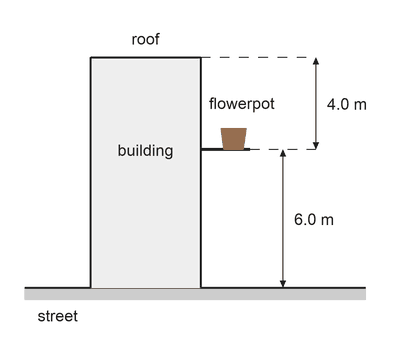
Taking the roof as the zero of gravitational potential energy, the potential energy of the pot, and the change in its potential energy if it falls to the street, are
- 243 marks
Question 24
Two light springs, of spring constants and , are joined end to end. The free end of the first spring is fixed to a wall, and the free end of the second is pulled until the pair is stretched by in all, as shown.
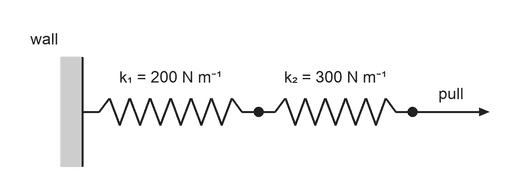
(a) Find the force needed to hold the pair in this position.
(b) Find the extension of each spring.
(c) Find the potential energy stored in each spring. Which spring stores more energy?
- 253 marks
Question 25
A light spring of spring constant hangs from a fixed support. A mass of is hooked onto its lower end and is lowered slowly by hand until it hangs at rest, the spring then being stretched by , as shown. Take .
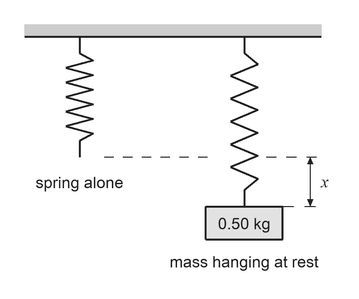
(a) Find the extension .
(b) Find the elastic potential energy stored in the spring and the gravitational potential energy lost by the mass.
(c) Explain why these two energies are not equal, and find the work done by the hand.
- 261 mark
Question 26
(Hypothetical data.) A block on a smooth horizontal floor is fixed to one end of a light spring of spring constant ; the other end of the spring is fixed to a wall. The block is pulled from its equilibrium position and released, so that it oscillates with an amplitude of . What is the speed of the block when it is from its equilibrium position?
- 271 mark
Question 27
(Hypothetical data.) A particle moves along the -axis under a single conservative force. The graph shows its potential energy against : has a minimum of at , a maximum of at and another minimum of at . The total mechanical energy of the particle is , and at it is moving in the direction.
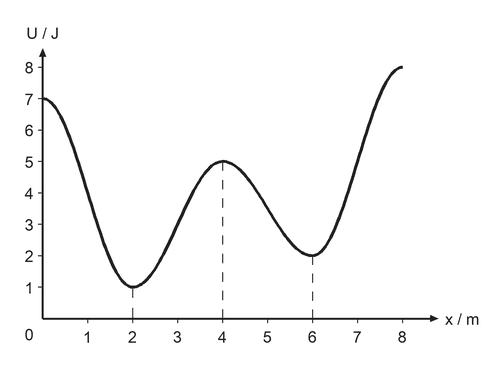
Which statement describes its motion correctly?
- 283 marks
Question 28
(Hypothetical data.) A small bob hangs from a fixed point O on a light, inextensible string long. A thin nail N is fixed vertically below O. The bob is pulled aside until the string makes an angle of with the vertical (position A) and is released from rest. When the string reaches the vertical, it catches on the nail, and the bob swings on along a smaller circle on the lower of the string. Neglect air resistance and take .
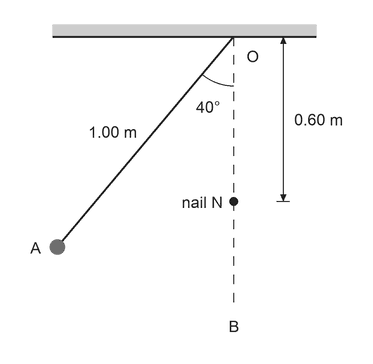
(a) Find the speed of the bob at its lowest point B.
(b) How high above B does the bob rise on the other side? Explain why the nail does not change this height.
(c) Find the angle that the lower part of the string makes with the vertical when the bob comes momentarily to rest.
- 291 mark
Question 29
On a level road, the air drag on a fast car is very nearly proportional to the square of its speed, and at top speed almost all of the power delivered to the wheels is used against this drag. Take the drag to be exactly proportional to the square of the speed and ignore every other resistance. By about how much must the power delivered to the wheels be increased to raise the car's top speed by ?
- 303 marks
Question 30
(Hypothetical data.) A car of mass has an engine that can deliver a power of to the wheels. Assume that this full power is delivered right from the start and that all of it goes into increasing the car's kinetic energy (ignore friction, air drag and wheel spin).
(a) Find the shortest time in which the car could reach from rest.
(b) Find the driving force on the car at the moment its speed is .
(c) Find its acceleration at that moment.
- 311 mark
Question 31
(Hypothetical data.) At one instant a body moving with velocity is acted on by a force . The power delivered to the body by this force at that instant is
- 323 marks
Question 32
(Hypothetical data.) A lift car and its passengers have a total mass of . The car hangs from a steel rope that passes over a pulley driven by a motor at the top of the shaft, and the other end of the rope carries a counterweight of mass , as shown. Neglect friction, the mass of the rope and the energy needed to turn the pulley, and take .

(a) Find the power the motor must supply to raise the loaded car at a steady .
(b) Find the power needed for the same job without a counterweight.
(c) Later the empty car, of mass , comes down at a steady . Must the motor drive the pulley or hold it back? Find the rate at which it does work.
- 331 mark
Question 33
(Hypothetical data.) An electric winch hauls a boat up a slipway. The graph shows the power delivered by the winch during one haul: it rises steadily from zero to in the first , stays at until , and then falls steadily to zero at .
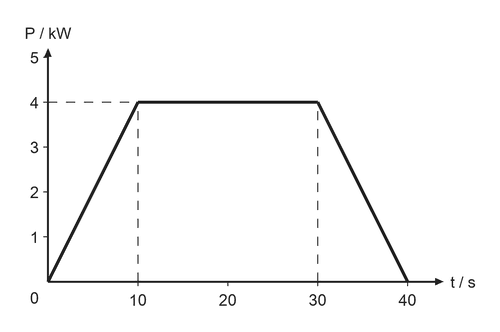
How much work does the winch do during the haul?
- 341 mark
Question 34
(Hypothetical data.) A bowling ball of mass moving at hits a pin of mass standing at rest. Treat the collision as head-on and perfectly elastic. The speed of the pin just after the collision is
- 351 mark
Question 35
(Hypothetical data.) On smooth ice, a skater of mass gliding at catches hold of a second skater of mass who is standing still, and the two glide off together. What fraction of the first skater's kinetic energy is changed into other forms during the catch?
- 363 marks
Question 36
(Hypothetical data.) On a level air track, glider P of mass moving at catches up with glider Q of mass moving at in the same direction. Repelling magnets fixed to the gliders make the collision perfectly elastic.
(a) Find the velocities of both gliders after the collision.
(b) Show that the total kinetic energy is the same before and after the collision, and that the gliders separate at the same relative speed at which they approached.
(c) Find the change in momentum of each glider, and comment on your answers.
- 372 marks
Question 37
(Hypothetical data.) Two trolleys run towards each other along a straight, level track: trolley A of mass at and trolley B of mass at . A lump of putty on the front of A makes the trolleys stick together when they collide head-on. Neglect friction. Find their velocity just after the collision and the kinetic energy changed into other forms.
- 381 mark
Question 38
Two identical lumps of putty, each of mass and speed , slide on a smooth horizontal table towards the same point O along straight lines that make an angle of with each other, as shown. They meet at O and stick together.
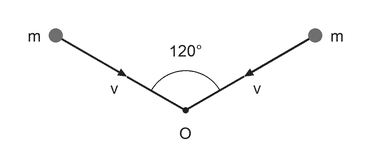
What is the speed of the combined lump just after the collision?
- 391 mark
Question 39
(Hypothetical data.) A bullet of mass is fired horizontally into a block of mass hanging from a light string, and stays inside it. The block (with the bullet) then swings up through a height , as shown.

A student finds the bullet's speed by writing , as if no energy were lost. Compared with the true speed of the bullet, the student's value is
- 403 marks
Question 40
A snooker ball moving with speed strikes an identical ball at rest. The collision is perfectly elastic but not head-on, so the balls move off with speeds and at angles and to the original line, on opposite sides of it, as shown. Treat the balls as particles that slide without spinning. Show that , so that the two balls move off at right angles to each other.

- 411 mark
Question 41
(Hypothetical data.) A nuclear power station delivers electrical power at . Its efficiency (electrical power out divided by the rate at which nuclear energy is released in the reactor) is one-third. Using with , about how much mass is converted into energy in the reactor each day?
- 423 marks
Question 42
(Hypothetical data.) A car of mass travelling at is braked to rest on a level road. It has four steel brake discs, each of mass ; the specific heat capacity of steel is . The heat needed to raise the temperature of a mass by is , where is the specific heat capacity. Take .
(a) Find the kinetic energy of the car before braking.
(b) Assume that all of this energy ends up as internal energy of the four discs, shared equally. Find the rise in their temperature.
(c) An electric car of the same mass uses regenerative braking: its motor works as a generator and stores of the kinetic energy in the battery. Through what height could this stored energy lift the car?
- 431 mark
Question 43
In which one of the following is the main energy change stated wrongly?
- 442 marks
Question 44
When of coal burns completely, about of heat is released. Using with , find the mass equivalent of this energy. A good laboratory balance reads to . Explain why chemists can treat mass as conserved when coal burns.
- 453 marks
Question 45
(Hypothetical data.) At a pumped-storage power station, of water is pumped at night from a lower reservoir to an upper reservoir whose water surface is, on average, higher. During the day the water flows back down through turbines that drive generators. The pumps are efficient and the turbine-generators efficient. Take and .
(a) Find the gravitational potential energy stored in the raised water, in kWh.
(b) Find the electrical energy used to pump the water up.
(c) Find the electrical energy given back during the day, and the overall efficiency of storing energy in this way.
- 461 mark
Question 46
What is the work done by the Earth's gravitational force in keeping the moon in the orbit?
- 472 marks
Question 47
A light body and a heavy body have equal kinetic energy. Which will have a greater momentum?
- 482 marks
Question 48
A light body and a heavy body have the same momentum. Which one has more kinetic energy?
- 492 marks
Question 49
Can a body have (1) energy without momentum and (2) momentum without energy?
- 502 marks
Question 50
Explain the energy conversion (1) in a hydroelectric power plant (2) in a thermal power plant.
- 511 mark
Question 51
How does an arrow shoot from a bow get energy?
- 522 marks
Question 52
Mountain roads are curved and not straight up the slope, why?
- 532 marks
Question 53
What is the sign of work done (i) by a man lifting a bucket out of a well by means of a rope tied to the bucket and (ii) gravitational force in the above case?
- 541 mark
Question 54
Energy can be neither created nor be destroyed. Then what happens to the energy spent against friction?
- 552 marks
Question 55
When a ball is thrown up the magnitude of its momentum decreases and then increases. Does it violate the law of conservation of momentum principle?
- 562 marks
Question 56
In a perfect inelastic collision, the momentum is conserved even though the K.E. of the colliding body decreases. Explain.
- 571 mark
Question 57
A compressed spring is placed in acid and dissolved. Where does the P.E. go?
- 582 marks
Question 58
What change is produced in the K.E. of a body if its mass and velocity are doubled?
- 592 marks
Question 59
A car and a bus having the same K.E. are brought to rest by the application of brakes, which provide equal retarding forces. Which will come to rest in a shorter distance?
- 602 marks
Question 60
Explain how fast neutron can be slowed down by sending them through heavy water.
- 612 marks
Question 61
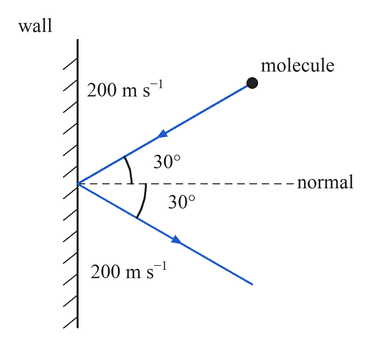
A molecule in a gas container hits the wall with a speed at an angle 30° with the normal and rebounds with the same speed. Is momentum conserved in the collision? Is the collision elastic or inelastic?
- 622 marks
Question 62
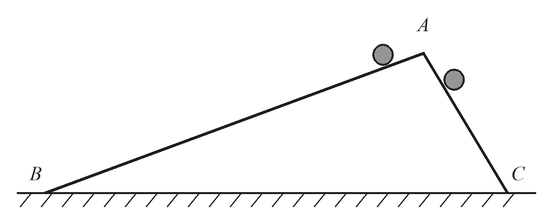
Two inclined frictionless tracks, one gradual and the other steep meet at , from where two stones are allowed to slide down from rest, one on each track. Will the stones reach the bottom at the same time? Will they reach there with the same speed? Explain.
- 631 mark
Question 63
The casing of a rocket in flight burns up due to friction. At whose expense is the heat energy required for burning obtained? The rocket or the atmosphere?
- 642 marks
Question 64
An artificial satellite orbiting the Earth in a very thin atmosphere loses its energy gradually due to dissipation against atmospheric resistance, however small. Why then does its speed increase progressively as it comes closer and closer to the Earth?
- 652 marks
Question 65
In an elastic collision of two billiard balls, is the total K.E. conserved during the short time of collision of the balls (i.e. when they are in contact)?
- 663 marks
Question 66
A coolie carries a suitcase weighing 50 kg over his head and travels a distance of 15 m along (a) a horizontal direction and (b) a vertical direction. Calculate the work done in each case.
- 673 marks
Question 67
A ladder 15 m long resting against a vertical wall is inclined at 45° to it. A man weighing 60 kg ascends to the top of the ladder. What is the work done?
- 683 marks
Question 68
A cricket ball of mass 500 g travelling at a speed of 20 m s is caught by a fielder and in doing so he withdraws his hands back through 40 cm. Calculate the work done by him.
- 693 marks
Question 69
A particle moving in the plane undergoes a displacement m, while a constant force N acts on the particle. What is the work done?
- 703 marks
Question 70
A position dependent force newton acts on a small body of mass 2 kg and displaces it from to . Calculate the work done.
- 713 marks
Question 71
Calculate the potential energy of a body of mass 0.3 kg at rest at a vertical height of 3 m.
- 723 marks
Question 72
A stone of mass 0.4 kg is thrown vertically up with a speed of 9.8 m s. Find the potential and kinetic energy after half a second.
- 733 marks
Question 73
A stone falls from a height of 10 m on a hard horizontal surface. If 25% of the energy is lost due to impact how high will it rise?
- 743 marks
Question 74
A 4 kg mass falls from a height of 6 m and rebound to a height of a 4 m. Calculate the loss of energy due to impact.
- 753 marks
Question 75
The momentum of a body is 850 kg m s and its mass is 40 kg. Find its kinetic energy.
- 763 marks
Question 76
While catching a cricket ball of mass 200 g moving with a velocity 20 m/s, the player draws his hands back through 20 cm. Find the work done in catching the ball and the average force exerted by the ball on the hand.
- 773 marks
Question 77
A body of mass 10 kg moving with a speed of 4 m s on a frictionless table impinges on a mounted spring of force constant N m. What is the compression of the spring when the body comes to rest?
- 783 marks
Question 78
A running man has half the K.E. as that of a boy of half his mass. The man increases his speed by 1 m s and then he has the same K.E. as that of the boy. What are the original speeds of the man and the boy?
- 793 marks
Question 79
How much high a body be lifted to gain an amount of potential energy equal to the kinetic energy it has, when moving at a speed of 20 m s. ( m s)
- 803 marks
Question 80
A body of mass 1 kg initially at rest is moved by a horizontal force of 0.5 N on a smooth frictionless table. Calculate the work done by the force in 10 s and show that this is equal to the change in kinetic energy of the body.
- 813 marks
Question 81
Under the action of a force, a 2 kg body moves such that its position as a function of time is given by , where is in metre and is in second. Calculate the work done by the force in the first two seconds.
- 823 marks
Question 82
A block of mass 5.0 kg, initially at rest is pulled to the right along a frictionless horizontal surface by a constant horizontal force of 100 N. What is the speed of the block after it has moved through a distance of 4 m?
- 833 marks
Question 83
A metre scale weighing 90 g is fixed at one end and is hung in the vertical plane. If the free end is displaced by 30° from the vertical, calculate the work done.
- 843 marks
Question 84
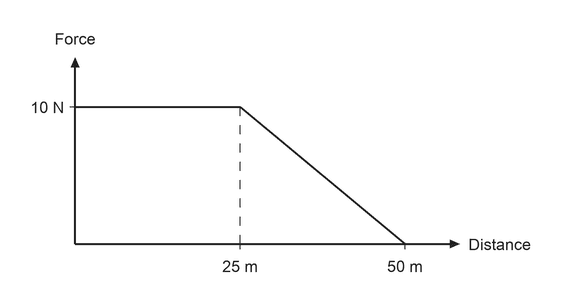
A body of mass 5 kg is acted upon by a variable force. The force varies with distance covered by the body as shown in the given figure. What is the speed of the body when the body has covered 25 m? Assume that the body starts from rest.
- 853 marks
Question 85
A particle of mass 40 g slides along a track with elevated ends and a flat horizontal bottom. At the bottom, where the horizontal portion begins, a spring is kept. When the particle falls from a height of 19.6 m, slides and reaches it, the spring gets compressed by 19.6 cm. What is the spring constant of the spring? Assume that the track and the flat horizontal portion are frictionless.
- 863 marks
Question 86
A man weighing 60 kg climbs up a staircase carrying a load of 20 kg on his head. The staircase has 20 steps each of height 0.2 m. If he takes 10 s to climb, find his power.
- 873 marks
Question 87
A machine gun fires 600 bullets per minute. If the mass of each bullet is 50 g and its muzzle velocity is 400 m s, find the power of the gun.
- 883 marks
Question 88
An engine pulls a body of mass 1000 kg on a level road at a constant velocity 8 m s. If the frictional force is 400 N, what power does the engine generate?
- 893 marks
Question 89
A motor car weighing 1120 kg is going up an inclination of 1 in 56 at 10 m s, the frictional force equal to 64 N. Find the horsepower of the engine.
- 903 marks
Question 90
A cyclist climbing up a hill whose slope is 1 in 20, maintains a constant speed of 7 km h. If the mass of the cycle and the cyclist is 160 kg, find the power.
- 913 marks
Question 91
An engine develops 10 kW of power. How much time will it take to lift a mass of 200 kg through a height of 40 m? ( m s)
- 923 marks
Question 92
A lift pump of power 2000 W pumps water to an average height of 15 m to fill a tank 3 m × 2 m × 1 m. The efficiency of the pump is 75%. What is time required to fill the tank? m s.
- 933 marks
Question 93
A ball is dropped on the ground from a height of 1 m. What is the height to which the ball would rebound? Given the coefficient of restitution = 0.6.
- 941 mark
Question 94
The area of the acceleration–displacement curve of a body gives
- 951 mark
Question 95
Which of the following is not a perfectly inelastic collision?
- 961 mark
Question 96
A pump motor is used to deliver water at a certain rate from a given pipe. To obtain twice as much water from the same pipe in the same time, power of the motor has to be increased to
- 971 mark
Question 97
The potential energy function for the force between two atoms in a diatomic molecule is approximately given by , where and are constants and is the distance between the atoms. If the dissociation energy of the molecule is , is
- 981 mark
Question 98
A cord is used to lower vertically a block of mass by a distance with constant downward acceleration . Work done by the cord on the block is
- 991 mark
Question 99
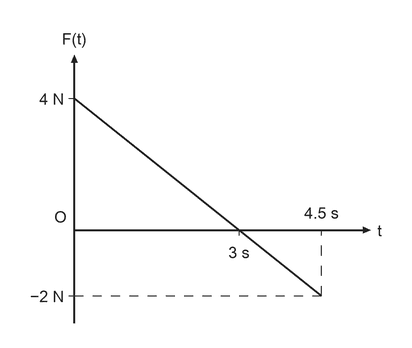
A block of mass 2 kg is free to move along the -axis. It is at rest and from onwards it is subjected to a time-dependent force in the -direction. The force varies with as shown in the given figure. The kinetic energy of the block after 4.5 seconds is
- 1001 mark
Question 100
The potential energy of a conservative system is given by joule. Then its equilibrium position is at
- 1011 mark
Question 101
A ball dropped from a height of 2 m rebounds to a height of 1.5 m after hitting the ground. Then the percentage of energy lost is
- 1021 mark
Question 102
The shape of the curve representing the relation between the speed and kinetic energy of a moving object is
- 1031 mark
Question 103
A tennis ball is dropped on a horizontal smooth surface. It bounces back to its original position after hitting the surface. The force on the ball during the collision is proportional to the length of compression of the ball. Which one of the following sketches describes the variation of its kinetic energy with time most appropriately? The figures are only illustrative and not to the scale.

- 1041 mark
Question 104
A particle moves from a point to when a force of N is applied. How much work has been done by the force?
- 1051 mark
Question 105
Consider a drop of rainwater having mass 1 g falling from a height of 1 km. It hits the ground with a speed of 50 m/s. Take '' constant with a value . The work done by the (i) gravitational force and the (ii) resistive force of air is
- 1061 mark
Question 106
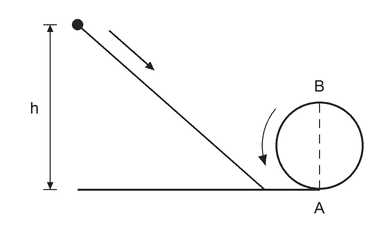
A body initially at rest and sliding along a frictionless track from a height just completes a vertical circle of diameter . The height is equal to
- 1071 mark
Question 107
A force acts on a 2 kg object so that its position is given as a function of time as . What is the work done by this force in first 5 seconds?
- 1081 mark
Question 108
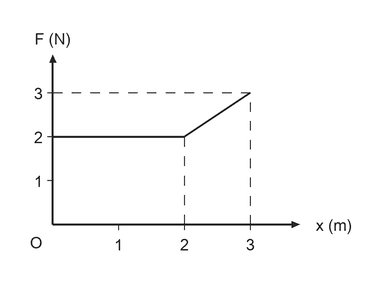
A particle moves in the one dimension from rest under the influence of a force that varies with the distance travelled by the particle as shown in the given figure. The kinetic energy of the particle after it has travelled 3 m is
- 1091 mark
Question 109
A body of mass moving with an unknown velocity of , undergoes a collinear collision with a body of mass moving with a velocity . After collision, and move with velocities of and , respectively. If and , then is
- 1101 mark
Question 110
A particle which is experiencing a force, given by , undergoes a displacement of . If the particle had a kinetic energy of 3 J at the beginning of the displacement, what is its kinetic energy at the end of the displacement?
- 1111 mark
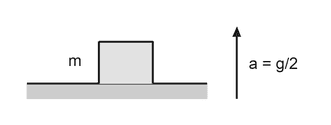
Question 111
A block of mass is kept on a platform which starts from rest with constant acceleration upward, as shown in the given figure. Work done by normal reaction on block in time is
- 1121 mark
Question 112
A particle of mass '' is moving with speed '' and collides with a mass '' moving with speed '' in the same direction. After collision, the first mass is stopped completely while the second one splits into two particles each of mass '', which move at angle 45° with respect to the original direction. The speed of each of the moving particle will be
- 1131 mark
Question 113
A uniform cable of mass '' and length '' is placed on a horizontal surface such that its part is hanging below the edge of the surface. To lift the hanging part of the cable upto the surface, the work done should be
- 1141 mark
Question 114
Body of mass moving with speed collides with another body of mass , at rest. The collision is head-on and elastic in nature. After the collision, the fraction of energy lost by the colliding body is
- 1151 mark
Question 115
A force acts on a particle in -direction where is in newton and in meter. Work done by this force to move the particle from to m is
- 1161 mark
Question 116
An elevator in a building can carry a maximum of 10 persons, with the average mass of each person being 68 kg. The mass of the elevator itself is 9200 kg and it moves with constant speed 3 m/s. The frictional force opposing the motion is 6000 N. If the elevator is moving up with its full capacity, the power delivered by the motor to the elevator () must be at least
- 1171 mark
Question 117
A 60 HP electric motor lifts an elevator having a maximum total load capacity of 2000 kg. If the frictional force on the elevator is 4000 N, the speed of the elevator at full load is close to (1 HP = 746 W, )
- 1181 mark
Question 118
Consider a force . The work done by this force in moving a particle from point to along the line segment is (all quantities are in S.I. units)

- 1191 mark
Question 119
A block of mass 1.9 kg is at rest at the edge of a table, of height 1 m. A bullet of mass 0.1 kg collides with the block and sticks to it. If the velocity of the bullet is 20 m/s in the horizontal direction just before the collision, then the kinetic energy just before the combined system strikes the floor is
[Take . Assume there is no rotational motion and loss of energy after the collision is negligible.]
- 1201 mark
Question 120
A particle of mass with an initial velocity collides perfectly elastically with a mass at rest. It moves with velocity after collision, then is given by
- 1211 mark
Question 121
A particle is moving unidirectionally on a horizontal plane under the action of a constant power supplying energy source. The displacement ()–time () graph that describes the motion of the particle is (graphs are drawn schematically and are not to scale)
- 1221 mark
Question 122
A person pushes a box on a rough horizontal platform surface. He applies a force of 200 N over a distance of 15 m. Thereafter, he gets progressively tired and his applied force reduces linearly with distance to 100 N. The total distance through which the box has been moved is 30 m. What is the work done by the person during the total movement of the box?
- 1231 mark
Question 123
A block moving horizontally on a smooth surface with a speed of 40 m/s splits into two parts with masses in the ratio of 1:2. If the smaller part moves at 60 m/s in the same direction, then the fractional change in kinetic energy is
- 1241 mark
Question 124
An automobile of mass '' accelerates starting from origin and initially at rest, while the engine supplies constant power . The position is given as a function of time by
- 1251 mark
Question 125
A porter lifts a heavy suitcase of mass 80 kg and at the destination lowers it down by a distance of 80 cm with a constant velocity. Calculate the work done by the porter in lowering the suitcase (take )
- 1261 mark
Question 126
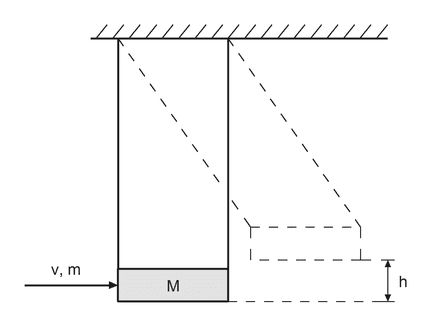
A large block of wood of mass kg is hanging from two long massless cords. A bullet of mass g is fired into the block and gets embedded in it. The (block + bullet) then swing upwards, their centre of mass rising a vertical distance cm before the (block + bullet) pendulum comes momentarily to rest at the end of its arc. The speed of the bullet just before collision is (take )
- 1271 mark
Question 127
A body of mass '' dropped from a height '' reaches the ground with a speed of . The value of work done by the air friction is
- 1281 mark
Question 128
An object of mass collides with another object of mass , which is at rest. After the collision, the objects move with equal speeds in opposite direction. The ratio of the masses is
- 1291 mark
Question 129
A particle experiences a variable force in the horizontal – plane. Assume distance in metre and force in newton. If the particle moves from a point (1,2) to a point (2,3) in the – plane, the kinetic energy changes by
- 1301 mark
Question 130
Potential energy as a function of of a particle is given by , where is the interatomic distance, and are positive constant. The equilibrium distance between the two atoms will be
- 1311 mark
Question 131
Identify the correct statements from the following:
P. Work done by a man in lifting a bucket out of a well by means of a rope tied to the bucket is negative.
Q. Work done by gravitational force in lifting a bucket out of a well by a rope tied to the bucket is negative.
R. Work done by friction on a body sliding down an inclined plane is positive.
S. Work done by an applied force on a body moving on a rough horizontal plane with uniform velocity is zero.
T. Work done by the air resistance on an oscillating pendulum is negative.
Choose the correct answer from the options given below.
- 1321 mark
Question 132
Read the assertion and reason carefully to mark the correct option out of the options given below:
Assertion: A quick collision between two bodies is more violent than slow collision, even when initial and final velocities are identical.
Reason: The rate of change of momentum determines that force is small or large.
- 1331 mark
Question 133
Read the assertion and reason carefully to mark the correct option out of the options given below:
Assertion: The change in kinetic energy of a particle is equal to work done on it by the net force.
Reason: Change in kinetic energy of a particle is equal to the work done only in the case of a system of one particle.
- 1341 mark
Question 134
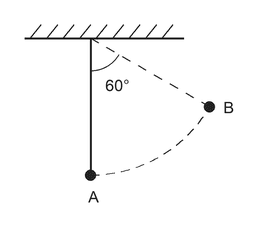
A pendulum is suspended by a string of length 250 cm. The mass of the bob of the pendulum is 200 g. The bob is pulled aside until the string is at 60° with vertical as shown in the given figure. After releasing the bob, the maximum velocity attained by the bob will be ______ . (Take )
- 1351 mark
Question 135
An object of mass initially at rest on a smooth horizontal plane starts moving under the action of a force N. In the process of its linear motion, the angle between the direction of force and the horizontal varies as , where is a constant and is the distance covered by the object from its initial position. The expression of kinetic energy of the object will be . The value of is ______.