
Question 765 marksHard
Derive the equations for the final velocities of two bodies undergoing a head-on elastic collision in one dimension. Hence show that for two bodies of equal mass, they nearly exchange their velocities after collision.
Confirming your payment
Sign up now and get 250 free tokens.
Work, Energy and Power · Question 76 of 77
Derive the equations for the final velocities of two bodies undergoing a head-on elastic collision in one dimension. Hence show that for two bodies of equal mass, they nearly exchange their velocities after collision.
Solution:
Concept: In an elastic collision both the total momentum and the total kinetic energy are conserved. In a head-on (one-dimensional) collision all the velocities lie along one line, so they can be treated as signed numbers.
Step 1 — Set up the collision. Let bodies of masses and move along the same line with velocities and (, so that they collide). After the collision their velocities are and .
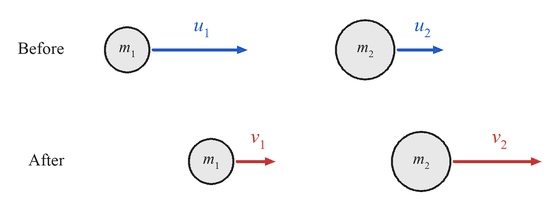
Step 2 — Conserve momentum. The total momentum before equals that after:
Step 3 — Conserve kinetic energy. The total kinetic energy before equals that after:
Step 4 — Divide the two equations. We divide equation (2) by equation (1); the factors and cancel:
This also shows that : the speed of separation equals the speed of approach.
Step 5 — Find . We put from (3) into (1):
Step 6 — Find . The same working with the roles of the two bodies swapped gives
Step 7 — Put in equal masses. When both masses equal , the terms with vanish:
In the same way, the second body's final velocity is
So the two bodies exchange their velocities. If the second body was at rest, the first stops dead and the second moves off with the first one's velocity.
Note: For exactly equal masses and a perfectly elastic collision the exchange is exact; it is only "nearly" an exchange in practice, because real masses are only nearly equal and real collisions are only nearly elastic.
Therefore, and ; for equal masses and , so the bodies exchange their velocities.