
Question 81 markMCQMedium
1 kg body explodes into three fragments. The ratio of their masses is 1:1:3. The fragments of same mass move perpendicular to each other with speed 30 m/s. The speed of heavier part is
Confirming your payment
Sign up now and get 250 free tokens.
Work, Energy and Power · Question 8 of 77
1 kg body explodes into three fragments. The ratio of their masses is 1:1:3. The fragments of same mass move perpendicular to each other with speed 30 m/s. The speed of heavier part is
(A) m/s
(B) m/s
(C) m/s
(D) m/s
Answer: (B) m/s
Concept: In an explosion only internal forces act, so the total momentum is conserved. Take the body to be at rest before it explodes; then the momenta of the three fragments must add up to zero.
Step 1 — Find the masses. The mass of 1 kg is shared in the ratio 1 : 1 : 3, that is, into 5 equal parts of 0.2 kg:
and the second light fragment also has .
Step 2 — Find the momentum of each light fragment. Each light fragment moves at 30 m/s:
and is also , at right angles to .
Step 3 — Find the momentum of the heavy fragment. The heavy fragment must cancel the resultant of and , so it moves opposite to that resultant with a momentum equal to it in size:
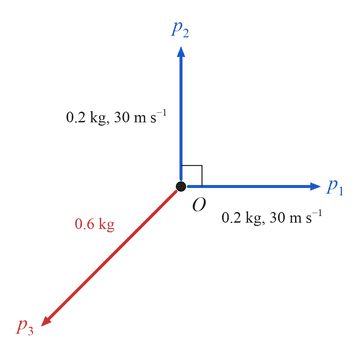
Step 4 — Find its speed. We divide its momentum by its mass:
This is about .
Step 5 — Check the other options. Each of the other speeds comes from a slip:
Therefore, the heavier part moves with a speed of m/s.