
Opening your dashboard
Class 11 Physics Chapter 9 Work, Energy and Power: Competency-Based Questions (CBQ)
58 questions on Chapter 9, each worked through on its own page with the AI tutor. Class 11 Physics, ICSE 2026-27.
58 questions
1–4 marks · Mixed difficulty
- 14 marks
Question 1
Competency: Application
A delivery company tests a drone of mass that carries no parcel. It flies at a constant velocity from point A to point B. With pointing east, north and vertically upward, its displacement from A to B is . During the flight a steady wind pushes on the drone with a horizontal force . The only other forces on the drone are its weight and the force of the air driven by its rotors (the rotor force). Take . (Hypothetical data.)
(a) Find the work done on the drone by its weight and by the wind.
(b) Use the work–energy theorem to find the work done by the rotor force.
(c) The rotor force is constant during the flight. Find it as a vector, and use it to check your answer to (b).
- 21 mark
Question 2
Competency: Analysis & Evaluation
A passenger stands still on a step of an escalator that carries the passenger from the ground floor up to the first floor at a constant speed. The top surface of each step stays horizontal.
Assertion (A): The force exerted on the passenger by the step does positive work on the passenger.
Reason (R): The step exerts no friction force on the passenger.
- 34 marks
Question 3
Competency: Analysis & Evaluation
A small boat is pulled towards a jetty by an electric winch fixed on the jetty. The rope runs straight from the winch drum W to a ring on the boat's bow, and W is above the ring. The winch keeps the tension in the rope at a steady . The bow moves in a straight horizontal line from P, from W measured horizontally, to Q, from W, as shown. Treat W and the ring as points. (Hypothetical data.)
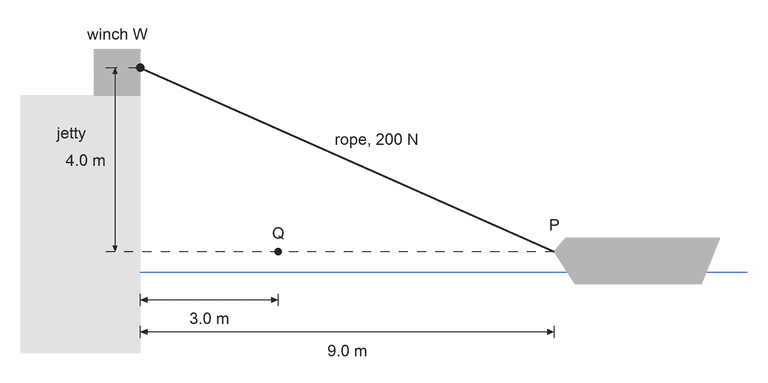
(a) A student says that the work done by the rope on the boat is , or . Explain why this is wrong.
(b) Find the work done by the rope on the boat as the bow moves from P to Q.
(c) Find the horizontal pull of the rope on the boat at P and at Q, and use these values to explain why the answer to (b) is less than .
- 41 mark
Question 4
Competency: Analysis & Evaluation
An archery coach compares two bows, P and Q. Each is drawn back through , and each needs a largest pull of . The graph shows how the pull needed to hold each bow varies with the draw : for bow P it rises steadily from zero to over the whole draw; for bow Q it rises steadily to in the first and then stays at . (Hypothetical data.)
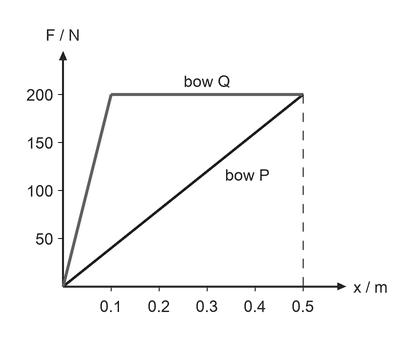
The elastic potential energy stored in bow Q at full draw, as a multiple of that stored in bow P, is
- 54 marks
Question 5
Competency: Analysis & Evaluation
A child on a sledge starts from rest at the top A of a straight snow slope and slides down without being pushed. A is above the level snow at the bottom. The slope meets the level snow at B through a short, gentle curve, and the sledge comes to rest at C on the level snow, as shown. C is from A, measured horizontally. The coefficient of kinetic friction between the sledge and the snow is the same everywhere. Ignore air resistance and any extra effect of the short curve at B. (Hypothetical data.)
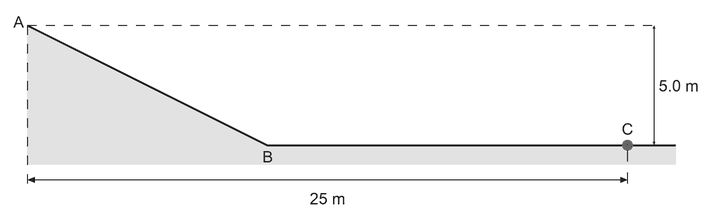
(a) Show that, on a straight slope, the work done against friction equals multiplied by the horizontal distance travelled.
(b) Find the coefficient of kinetic friction .
(c) The next day the child starts from rest at a point of the same height on a steeper part of the hill, with the same snow. Where does the sledge stop now? Explain.
- 61 mark
Question 6
Competency: Analysis & Evaluation
In one experiment a ball tied to a light spring moves to and fro on a smooth, level table. In another, an identical ball falls through the air in a tall stairwell, and air drag acts on it.
Assertion (A): A potential energy can be defined for the spring's force on the first ball, but not for the drag force on the second ball.
Reason (R): The spring's force depends only on the position of the ball (through the extension of the spring), while the drag force depends on the ball's velocity and always opposes its motion.
- 73 marks
Question 7
Competency: Application
A javelin has a mass of . During the throwing action the athlete's hand pushes it forward along a straight path long, with an average force of along the path. Ignore gravity and air resistance during this short throwing action. (Hypothetical data.)
(a) In a standing throw the javelin starts from rest. Find its speed when it leaves the hand.
(b) In a competition throw the athlete runs up first, so the javelin is already moving at when the same push begins. The push again acts over of the javelin's path. Find its speed at release now.
(c) A team-mate expects the release speed in (b) to be the answer to (a) plus . Use the work–energy theorem to explain why the push adds less speed after the run-up.
- 81 mark
Question 8
Competency: Analysis & Evaluation
A car on a level road slows down from to (stage 1) and then from to rest (stage 2), using only its brakes. Ignore air resistance.
Assertion (A): The magnitude of the work done by the braking force in stage 1 is three times that in stage 2.
Reason (R): The magnitude of the work done by the braking force is proportional to the decrease in the car's speed.
- 91 mark
Question 9
Competency: Analysis & Evaluation
A data logger on a bicycle records the kinetic energy of the cyclist and bicycle together as they ride along a straight, level road. Over one stretch of , the graph of against the distance travelled is a straight line that rises from to , as shown. (Hypothetical data.)
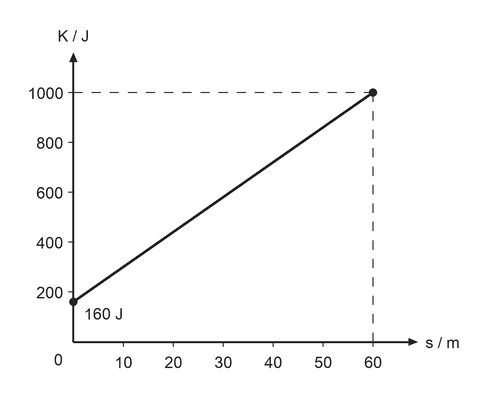
The resultant (net) force on the cyclist and bicycle along the road during this stretch is
- 103 marks
Question 10
Competency: Application
Ten identical bricks, each of mass and thickness , lie flat, side by side, on level ground. A worker stacks them one on top of another into a single vertical pile, lifting each brick slowly. Take . (Hypothetical data.)
(a) Find the least work the worker must do to build the pile.
(b) Show that the same answer follows from the rise of the centre of mass of the ten bricks.
(c) A friend says that building two piles of five bricks each would need half this work. Find the least work for two piles of five, and say whether the friend is right.
- 111 mark
Question 11
Competency: Analysis & Evaluation
A light spring of spring constant obeys Hooke's law. In a first test the whole spring is stretched by a small amount . The spring is then cut into two equal halves, and one half is stretched by the same amount .
Assertion (A): The half spring stores twice as much elastic potential energy as the whole spring did.
Reason (R): Each half of the spring has a spring constant equal to half that of the whole spring.
- 123 marks
Question 12
Competency: Application
A basketball player throws the ball from a height of above the floor, with a speed of at above the horizontal. The ball rises and then drops through the ring, which is above the floor, as shown. Treat the ball as a particle, ignore air resistance and take . (Hypothetical data.)
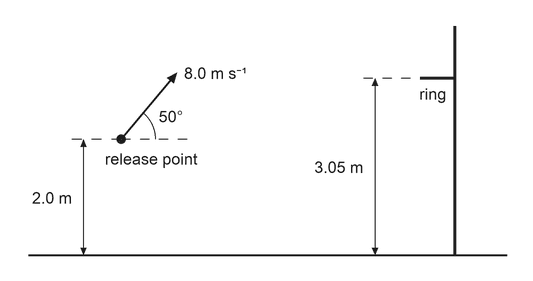
(a) Use the conservation of mechanical energy to find the speed of the ball as it passes through the ring.
(b) Find the greatest height above the floor reached by the ball.
(c) A team-mate standing at another spot throws a ball from the same height with the same speed, but at above the horizontal, and it also drops through the ring. Without working out its path, state its speed at the ring and explain.
- 131 mark
Question 13
Competency: Analysis & Evaluation
From a point at the edge of a sea cliff, above the sea, a person throws three identical stones, each with a speed of : stone 1 at above the horizontal, stone 2 horizontally and stone 3 at below the horizontal, as shown. Ignore air resistance and take . (Hypothetical data.)
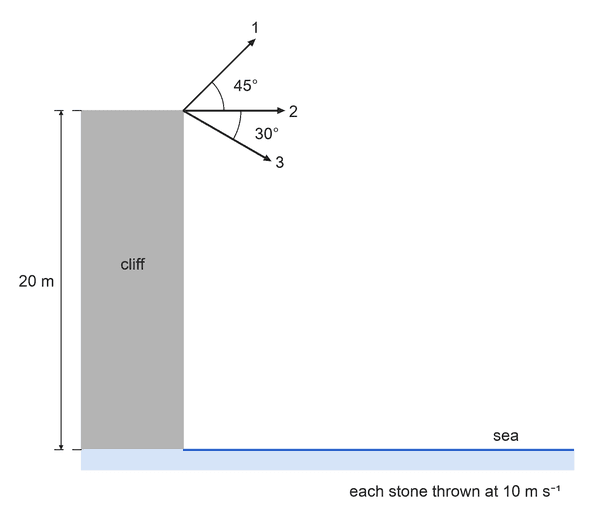
Which statement about their speeds just before they hit the sea is correct?
- 144 marks
Question 14
Competency: Application
The blades of a wind turbine sweep out a circle of radius . On one day the wind blows steadily at straight towards the turbine, and the density of the air is . (Hypothetical data.)
(a) Show that the kinetic energy carried by the wind through the swept circle each second is , where is the area of the circle and the wind speed, and find its value.
(b) The turbine delivers 40% of this kinetic energy as electrical power. Find the electrical power.
(c) The turbine is built to give at most (its rated power). With the same 40%, find the least wind speed at which it reaches this power.
- 151 mark
Question 15
Competency: Analysis & Evaluation
A car drives along a level road and then climbs a long, steep hill, in each case at a steady speed with the engine delivering its greatest power to the wheels.
Assertion (A): The car's steady speed on the hill is lower than its steady speed on the level road.
Reason (R): For a given power , the driving force and the speed are related by , and at any given speed a steady climb needs a larger driving force than steady motion on the level.
- 161 mark
Question 16
Competency: Analysis & Evaluation
At a quarry, sand falls vertically from a hopper onto a horizontal conveyor belt at a steady rate of per second. The belt moves at a constant , and each lump of sand slides briefly on the belt before it moves along with it. Ignore friction in the rollers and the power needed to run the empty belt. (Hypothetical data.)
The power the motor must supply to keep the belt moving at constant speed is
- 174 marks
Question 17
Competency: Analysis & Evaluation
A Newton's cradle has five identical steel balls, each of mass , hanging in a row so that neighbouring balls just touch, as shown. Ball 1 is pulled aside and released, and it strikes ball 2 at . Ball 5 then swings out at , while balls 1 to 4 stay almost at rest. Treat every collision as head-on and perfectly elastic. (Hypothetical data.)

(a) Show that ball 5 leaving at conserves both momentum and kinetic energy.
(b) A student suggests that balls 4 and 5 could instead leave together at . Show that this conserves momentum but not kinetic energy, and so cannot happen in a perfectly elastic collision.
(c) Balls 1 and 2 are now pulled aside together and released, so that they strike ball 3 together at . Predict which balls swing out, and at what speed, and justify your prediction.
- 181 mark
Question 18
Competency: Analysis & Evaluation
In a railway yard, a moving goods wagon runs into an identical wagon standing at rest on a level track, and the automatic couplings lock the two wagons together.
Assertion (A): In this collision all the kinetic energy of the moving wagon is changed into other forms of energy.
Reason (R): After a perfectly inelastic collision, the colliding bodies move on together with a common velocity.
- 191 mark
Question 19
Competency: Analysis & Evaluation
On a frozen pond, a table-tennis ball of mass sliding at strikes an athletics shot (a metal ball) of mass that is at rest on the smooth ice. Assume that the collision is head-on and that no kinetic energy is lost in it. (Hypothetical data.)
Which statement is very nearly correct?
- 204 marks
Question 20
Competency: Analysis & Evaluation
At a crossroads, a car of mass travelling east collides with a van of mass travelling north. The vehicles lock together and skid in a straight line, in a direction north of east, before coming to rest, as shown. Tests on the road give the coefficient of kinetic friction between the locked tyres and the road as . The speed limit at the crossroads is . Take , and treat the collision as so brief that friction from the road during it can be ignored. (Hypothetical data.)

(a) Find the speed of the locked vehicles just after the collision.
(b) Find the speed of each vehicle just before the collision.
(c) Say which driver, if either, was over the speed limit, and find the fraction of the kinetic energy lost in the collision itself.
- 211 mark
Question 21
Competency: Analysis & Evaluation
In a game of carrom, the striker slides across the smooth board and hits a coin at rest slightly off-centre, so that the coin moves off at an angle to the striker's original direction of motion.
Assertion (A): After the collision, the striker and the coin move off on opposite sides of the line along which the striker was moving.
Reason (R): The total momentum at right angles to the striker's original direction is zero before the collision, and it stays zero because no external horizontal force acts during the brief collision.
- 221 mark
Question 22
Competency: Application
In a forensic laboratory, a bullet of mass , moving horizontally at , passes straight through a wooden block of mass that hangs at rest from long, light strings. The bullet comes out at , as shown, and the block loses no mass. The bullet passes through so quickly that the block has hardly moved by the time it leaves. Take . (Hypothetical data.)
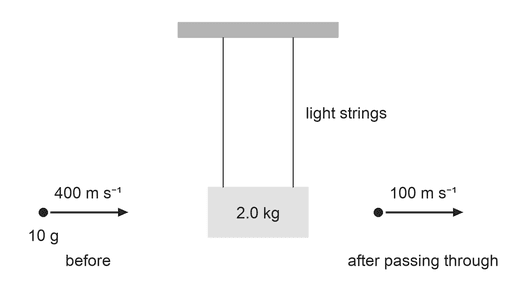
Through what height does the block swing up?
- 234 marks
Question 23
Competency: Application
At a science fair, a student pedals an exercise bicycle that drives an electric generator, and the generator charges a mobile phone. The student's legs deliver a steady mechanical power of to the pedals. The generator changes 70% of this into electrical power, and 85% of the electrical energy that reaches the phone is stored in its battery. The phone's battery stores when full, where . (Hypothetical data.)
(a) Name the main energy change that takes place in (i) the student's muscles, (ii) the generator and (iii) the phone's battery while it charges.
(b) Find how long the student must pedal to charge the empty battery fully.
(c) The student's muscles turn about 24% of the food energy they use into mechanical work. Find the food energy used during the charging, in kilojoules, and say where the rest of it goes.
- 241 mark
Question 24
Competency: Analysis & Evaluation
A battery-powered toy car runs across a level floor at a constant speed.
Assertion (A): Because the car's speed does not change, its battery supplies no energy while it runs at this speed.
Reason (R): The net work done on a body that moves with a constant velocity is zero.
- 251 mark
Question 25
Competency: Application
A farmer runs a water pump from a solar panel of area . Sunlight delivers to each square metre of the panel, and the panel changes 20% of this into electrical energy. The motor and pump together use this electrical energy to raise water through , with an efficiency of 50%. Take . (Hypothetical data.)
About how much water does the pump raise in one hour of steady sunshine?
- 264 marks
Question 26
(Hypothetical data.) A bungee jumper of mass steps off a bridge above a river. One end of an elastic cord is tied to the bridge and the other end to the jumper's ankles. The cord has a natural length of . Once it is stretched it obeys Hooke's law with spring constant , and while it is slack it exerts no force. Treat the jumper as a particle, neglect air resistance and the mass of the cord, and take .
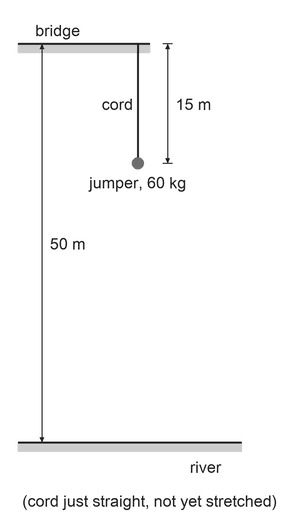
(a) Find the jumper's speed at the moment the cord becomes straight.
(b) Find the greatest extension of the cord, and how far above the river the jumper is at the lowest point.
(c) At what extension of the cord is the jumper's speed greatest? Find this greatest speed.
- 273 marks
Question 27
(Hypothetical data.) A smooth dome in the shape of a hemisphere of radius stands with its flat face on level ground. A small block of ice is placed at the very top of the dome and given a tiny push, so that it starts to slide down the outside of the dome from (almost) rest, as shown. Neglect friction and air resistance, and take .

(a) Let be the angle between the vertical and the radius to the block. Show that the block leaves the surface of the dome when .
(b) Find the height above the ground at which the block leaves the dome, and its speed at that moment.
- 284 marks
Question 28
(Hypothetical data.) A tennis ball of mass rests on top of a basketball of mass , and the pair is dropped from rest with the bottom of the basketball above the floor, as shown. Assume that the basketball bounces elastically off the floor and that, an instant later, it collides head-on and elastically with the tennis ball, which is still falling. Treat the balls as particles (ignore their sizes), neglect air resistance and take .
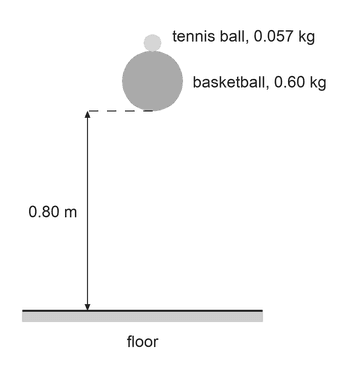
(a) Find the speed of the balls just before the basketball hits the floor.
(b) Find the velocity of the tennis ball just after it collides with the basketball.
(c) How high does the tennis ball rise? Compare this with the height from which it fell.
- 294 marks
Question 29
(Hypothetical data.) In a school laboratory, a toy dart of mass is fired horizontally into a wooden block of mass that hangs at rest on a light string. The distance from the support to the centre of the block is . The dart sticks in the block, and the block swings aside until its centre is to one side of where it started, as shown. Take .
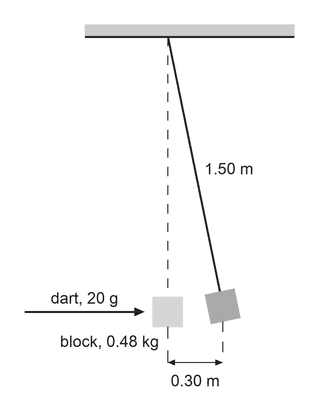
(a) Find the height through which the block rises.
(b) Find the speed of the block (with the dart) just after the impact.
(c) Find the speed of the dart just before it hit the block.
(d) What fraction of the dart's kinetic energy is lost in the impact?
- 304 marks
Question 30
(Hypothetical data.) On a level air table, puck A of mass moving at strikes puck B of mass , which is at rest. After the collision A moves at in a direction to one side of its original line, as shown.
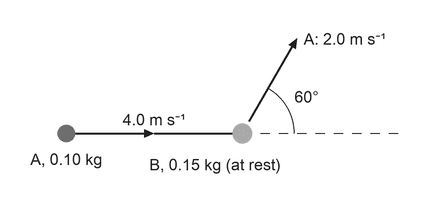
(a) Find the speed of B after the collision and the angle its path makes with A's original line.
(b) Is the collision elastic? Find the kinetic energy changed into other forms.
- 313 marks
Question 31
A flexible chain of length and mass is slowly pulled at constant speed up over the edge of a table by a force parallel to the edge of the table. Assume that there is no friction between the table and the chain, calculate the work done.
- 323 marks
Question 32
A body is subjected to a force that varies with position as shown in the given figure. What is the work done by the force (a) from m to m and (b) from to m?

- 333 marks
Question 33
The mass of a pendulum bob is 100 g and the string is one metre long. The bob is held so that the string is horizontal and it is then allowed to fall. Find the K.E. when the string makes an angle of (i) 0° and (ii) 30° with the vertical.
- 343 marks
Question 34
What is the percentage change in the kinetic energy of a body if its momentum is increased by 2%?
- 353 marks
Question 35
A particle of mass 272 g is moved along half the circumference of a circle of radius 0.5 m. The force acting on the particle at any point has a magnitude of 10 N and is inclined at 30° to the tangent at that point. What is the velocity acquired by the particle?
- 363 marks
Question 36
When the 8 kg shown in the system is released, what is its kinetic energy just before hitting the ground? Assume that the pulley is frictionless and weightless.

- 373 marks
Question 37
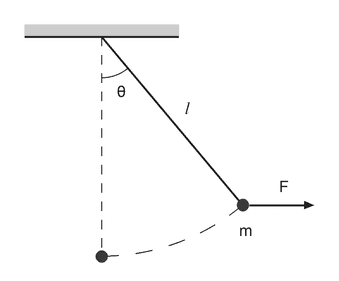
The given figure shows a small sphere of mass hanging from a string of length . A variable horizontal force is applied to the sphere in such a way that it moves slowly from the vertical position until the string makes an angle , with the vertical. Assuming the sphere to be in equilibrium always, show that the work done by the force is .
- 383 marks
Question 38
A body of mass 8 kg is moving with a velocity and compresses a horizontal spring of force constant N/m through 3 m. What is the velocity of the body? The coefficient of friction between the body and the surface is 0.25.
- 393 marks
Question 39
An iron ball of mass 50 kg initially at rest at the top of an incline 4.5 m high and 10 m long is allowed to slide down the hill. Calculate the speed attained by the sphere at the bottom of the plane if the average retarding force due to friction is 20 kgwt.
- 403 marks
Question 40
An engine of weight 6.5 metric ton is going up an incline of 5 in 13 at the rate of 9 km h. Calculate the power of the engine if and m s.
- 413 marks
Question 41
An engine draws a train of mass 400000 kg up an incline of 1 in 20 at a constant speed. If the resistance due to friction is 0.01 N kg and the power of the engine is W, find the speed of the engine.
- 423 marks
Question 42
Find the power of a pumpset in filling a tank 3 m breadth, 5 m long and 2 m deep on the top of a building 50 m high, from a well in which water is constantly at a depth of 16 m in two hours time.
- 433 marks
Question 43
A pump on the ground floor of a building can pump up water to fill a tank of volume 60 m in 25 minutes. If the tank is 30 m above the ground and the efficiency of the pump is 40%, how much electric power is consumed by the pump?
- 443 marks
Question 44
A motor develops 5 kW and is used to pump water from a well. If the motor is 60% efficient, how many litres of water can it raise through a mean height of 10 m in 30 s and project horizontally with a speed of 6 m s. Given one litre of water weighs 1 kg.
- 454 marks
Question 45
The mass of an elevator is 1100 kg and it carries a load of 700 kg. The frictional force acting on the elevator is 3000 N against its motion upward. (i) Calculate the minimum power delivered by the motor to lift the elevator at a constant speed of 2.50 m/s. (ii) If the elevator has an upward acceleration of 0.5 m/s, what power must the motor deliver at any instant? What conclusion can you draw from this?
- 464 marks
Question 46
A lift of mass 400 kg ascends from rest with uniform acceleration through a height of 15 m in 5 s. What is the power developed at the end of the fourth second? Also calculate the average power during five seconds.
- 473 marks
Question 47
Water is pumped through a pipe at 120 litres per minute and issues out with a velocity of 20 m/s. What is the force of reaction on the mouth of the pump? What is the useful power of the pump?
- 483 marks
Question 48
An automobile is moving at 100 km h and is exerting a tractive force of 400 kgf. What horsepower must the engine develop, if 20% of the power developed is wasted?
- 493 marks
Question 49
A spherical metal ball of mass 1 kg moving with a speed of 1 m s on a frictionless straight track collide head-on with another similar ball at rest. If the collision is perfectly elastic, what are their speeds after collision?
- 503 marks
Question 50
A railway carriage of mass 9000 kg moving with a speed of 36 km h collide with a stationary carriage of the same mass. After the collision, the carriages get coupled and move together. What is the common speed after collision? What type of collision is this?
- 513 marks
Question 51
A ball of 0.1 kg makes an elastic head-on collision with a ball of unknown mass that is initially at rest. If the 0.1 kg ball rebound at 1/3 of its original speed, what is the mass of the other ball?
- 523 marks
Question 52
A moving particle of mass makes a head-on elastic collision with a particle of mass which is initially at rest. What fraction of the kinetic energy is lost by the colliding particle?
- 533 marks
Question 53
A body of mass 5 kg moves along the -axis with a velocity of 2 m s. A second body of mass 10 kg moves along the -axis with a velocity of m s. They collide at the origin and stick together. Calculate (i) the final velocity of the combined mass after collision and (ii) the amount of heat liberated in the collision.
- 544 marks
Question 54
A bullet of mass 0.02 kg is fired horizontally with a speed of 20 m/s into a 2 kg block of wood suspended by a string 1 m long. The bullet is embedded in the block. Calculate the maximum inclination of the string to the vertical.
- 553 marks
Question 55
A bullet of mass 0.01 kg travelling horizontally with a velocity of 500 m/s strikes a block of wood of mass 0.24 kg which rests on a rough horizontal floor. After impact, the block and bullet move together and come to rest when the block has travelled a distance of 40 m. Calculate the coefficient of sliding friction.
- 563 marks
Question 56
Two bodies of masses 5 kg and 10 kg approach each other with velocities 10 m s and 5 m s respectively. Calculate their velocities after collision assuming the collision to be elastic.
- 574 marks
Question 57
A ball moving with a speed of 9 m/s, strikes an identical stationary ball such that after the collision, the direction of each ball makes an angle of 30° with the original line of motion. Find the speeds of the two balls after the collision. Is the kinetic energy conserved in the collision process?
- 583 marks
Question 58
What percentage of K.E. of a moving particle is imparted to a stationary particle when it strikes (i) times its mass and (ii) th of its mass?