
Question 264 marksHard
(Hypothetical data.) A bungee jumper of mass steps off a bridge above a river. One end of an elastic cord is tied to the bridge and the other end to the jumper's ankles. The cord has a natural length of . Once it is stretched it obeys Hooke's law with spring constant , and while it is slack it exerts no force. Treat the jumper as a particle, neglect air resistance and the mass of the cord, and take .
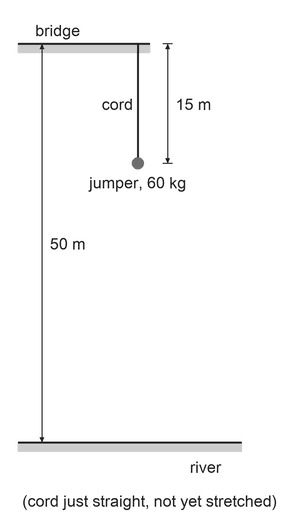
(a) Find the jumper's speed at the moment the cord becomes straight.
(b) Find the greatest extension of the cord, and how far above the river the jumper is at the lowest point.
(c) At what extension of the cord is the jumper's speed greatest? Find this greatest speed.