
Competency: Analysis & Evaluation
A child on a sledge starts from rest at the top A of a straight snow slope and slides down without being pushed. A is above the level snow at the bottom. The slope meets the level snow at B through a short, gentle curve, and the sledge comes to rest at C on the level snow, as shown. C is from A, measured horizontally. The coefficient of kinetic friction between the sledge and the snow is the same everywhere. Ignore air resistance and any extra effect of the short curve at B. (Hypothetical data.)
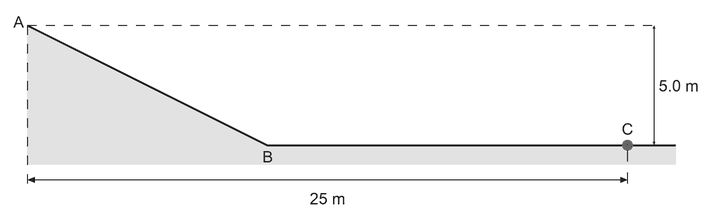
(a) Show that, on a straight slope, the work done against friction equals multiplied by the horizontal distance travelled.
(b) Find the coefficient of kinetic friction .
(c) The next day the child starts from rest at a point of the same height on a steeper part of the hill, with the same snow. Where does the sledge stop now? Explain.