
Opening your dashboard
Class 11 Physics Chapter 4: Motion in a Straight Line Solutions
58 textbook questions with step-by-step answers, free to read, for ISC 2026-27.
Get talked through Ch 4, not just shown the answer
Reading a finished solution is not the same as being able to do it. The AI tutor takes one question at a time and works it with you, in your own words, until you can.
- Ask it out loud, in your own words
- It gives you the next step, not the answer
- Stuck on part (ii)? Start there
58 questions with solutions
1–5 marks · Mixed difficulty
The first 31 solutions are on this page. This chapter is a long one, so the rest open on their own page to keep this one quick to load.
- 11 mark
Question 1
The position of a particle varies with time () as . The acceleration at time of the particle will be equal to zero when is
Solve with AIAnswer
(A)
(B)
- Correct
(C)
(D) zero
Answer: (C)
Concept: Velocity is the first derivative of position, , and acceleration is the second derivative, .
Step 1 — Differentiate once for the velocity. The derivative of is and that of is :
Step 2 — Differentiate again for the acceleration. The derivative of is and that of is :
Step 3 — Set the acceleration to zero. We solve for :
- (A) This is the time at which the velocity is zero (setting to zero gives ), not the acceleration.
- (B) This is the time at which the position is zero (setting to zero gives ).
- (D) At the acceleration is , which is not zero.
Therefore, the acceleration is zero at , option (C).
- 21 mark
Question 2
The displacement of a particle along a straight line at time is given by . The acceleration of the particle is
Solve with AIAnswer
(A)
(B)
- Correct
(C)
(D)
Answer: (C)
Concept: The acceleration is the second derivative of the displacement with respect to time.
Step 1 — Differentiate once for the velocity. The constant has zero derivative:
Step 2 — Differentiate again for the acceleration. The constant drops out:
- (A) is the position of the particle at .
- (B) is the size of the velocity at (the velocity then is ).
- (D) is only half the acceleration, because the term of is .
Therefore, the acceleration of the particle is , option (C).
- 31 mark
Question 3
A person travels along a straight road for the first half time with a velocity and the second half time with a velocity . Then, the mean velocity is given by
Solve with AIAnswer
- Correct
(A)
(B)
(C)
(D)
Answer: (A)
Concept: Mean (average) velocity is the total displacement divided by the total time.
Step 1 — Find the displacement in each half. Let each half of the time be . In the first half the person covers , and in the second half (same direction).
Step 2 — Divide by the total time. The total time is :
- (B) This harmonic mean is the answer when the two distances are equal (half the distance at each speed), not the two times.
- (C) The geometric mean is smaller than whenever (for and it gives , not ), and it does not come from either case.
- (D) A ratio of two velocities has no unit, so its square root cannot be a velocity.
Therefore, the mean velocity is , option (A).
- 41 mark
Question 4
A car accelerates from rest at a constant rate for some time after which it decelerates at a constant rate to come to rest. If the total time elapsed is , the maximum velocity acquired by the car is
Solve with AIAnswer
(A)
(B)
(C)
- Correct
(D)
Answer: (D)
Concept: The car's speed rises from zero to a maximum and then falls back to zero. With uniform acceleration, links each part's time to .
Step 1 — Draw the velocity–time graph. The car speeds up for a time (slope ) and then slows down for a time (slope ), with .
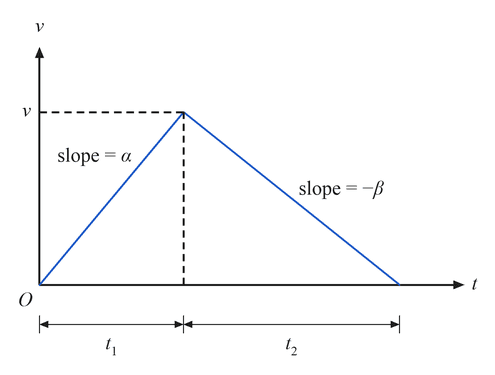
Step 2 — Write each time in terms of . Starting from rest, the speed reaches after , and it then falls from to zero in :
Step 3 — Add the two times. Their sum is the total time :
- (A) The bracket has no unit, so this expression has the unit of time, not of velocity.
- (B) For the same reason this has the unit of time; it would also be negative whenever .
- (C) The bracket has the unit , so the expression has the unit , not .
Therefore, the maximum velocity is , option (D).
- 51 mark
Question 5
A train accelerates from rest at a constant rate for some time and then it retards to rest at the constant rate . If the total distance covered by the train is , then the velocity of the train is
Solve with AIAnswer
(A)
(B)
- Correct
(C)
(D)
Answer: (C)
Concept: The "velocity of the train" here is its greatest velocity , reached at the end of the speeding-up part. For each part, links to the distance covered.
Step 1 — Picture the motion. The train speeds up from rest to with acceleration , covering , and then slows from to rest with retardation , covering . The area under the velocity–time graph is the total distance .
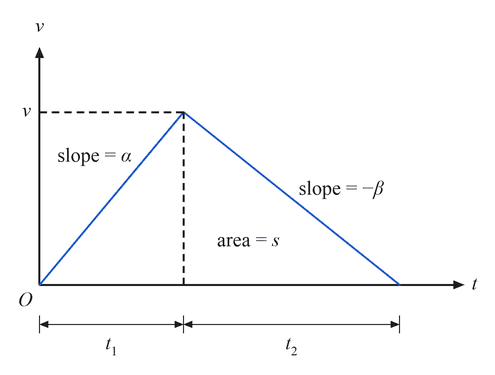
Step 2 — Find each distance. We use for each part; the first part starts from rest and the second part ends at rest:
Step 3 — Add the two distances. Their sum is :
Step 4 — Solve for . We multiply both sides by and take the square root:
- (A) This is the reciprocal of the correct bracket; has the unit , so its square root is a time, not a velocity.
- (B) This also has the unit of time, and the quantity under the root is negative whenever .
- (D) The unit is right, but the minus sign is wrong: the two distances add, so appears; with the result would be infinite for .
Therefore, the greatest velocity of the train is , option (C).
- 61 mark
Question 6
The acceleration of a moving body can be found from
Solve with AIAnswer
(A) area under velocity–time graph
(B) area under distance–time graph
- Correct
(C) shape of the velocity–time graph
(D) slope of distance–time graph
Answer: (C) shape of the velocity–time graph
Concept: Acceleration is the rate of change of velocity, , which is the slope of the velocity–time graph at each instant.
Step 1 — Link acceleration to the graph. The slope (steepness) of the velocity–time graph tells how fast the velocity changes, so the way the graph rises or falls (its shape) gives the acceleration: a straight line means uniform acceleration, and its slope is the value.
Step 2 — Check the other choices. None of the other quantities is a rate of change of velocity.
- (A) The area under a velocity–time graph gives the displacement, not the acceleration.
- (B) The area under a distance–time graph (unit metre × second) is not used to describe motion; it gives neither velocity nor acceleration.
- (D) The slope of a distance–time graph gives the speed, not the acceleration.
Note: More precisely, the acceleration is the slope of the velocity–time graph; "shape" here means its slope.
Therefore, the acceleration is found from the shape (slope) of the velocity–time graph, option (C).
- 71 mark
Question 7
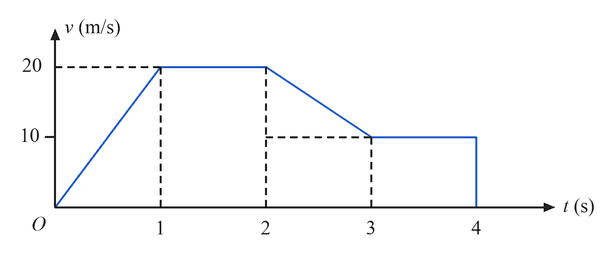
The variation of velocity of a particle moving along a straight line is illustrated in the following figure. The distance traversed by the particle in 4 seconds is
 Solve with AI
Answer
(A) 60 m
(B) 25 m
- Correct
(C) 55 m
(D) 30 m
Answer: (C) 55 m
Concept: The area between a velocity–time graph and the time axis gives the displacement. Here the velocity is never negative, so this area is also the distance travelled.
Step 1 — Split the area into simple shapes. The figure shows the four parts: a triangle from 0 to 1 s, a rectangle from 1 s to 2 s, a trapezium from 2 s to 3 s and a rectangle from 3 s to 4 s.
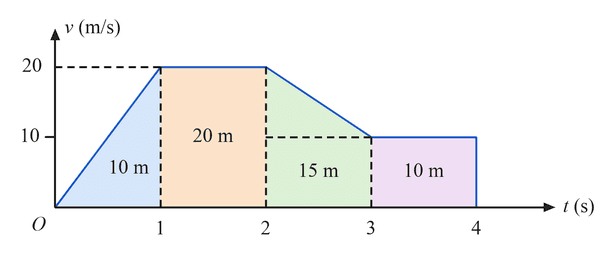
Step 2 — Find the area of the triangle (0 to 1 s). The velocity rises from 0 to 20 m/s in 1 s:
Step 3 — Find the area of the first rectangle (1 s to 2 s). The velocity stays at 20 m/s for 1 s:
Step 4 — Find the area of the trapezium (2 s to 3 s). The velocity falls from 20 m/s to 10 m/s in 1 s:
Step 5 — Find the area of the last rectangle (3 s to 4 s). The velocity stays at 10 m/s for 1 s:
Step 6 — Add the four parts. The total distance is:
- (A) 60 m comes from taking the part from 2 s to 3 s as a full rectangle at 20 m/s (), ignoring the fall in velocity.
- (B) 25 m adds only the parts where the velocity changes () and leaves out the two rectangles.
- (D) 30 m adds only the two rectangles (), where the velocity is constant.
Therefore, the particle travels 55 m in 4 s, option (C).
- 81 mark
Question 8
A particle starting from rest, moves with uniform acceleration. It covers a distance during third second and in the fifth second. Then, the ratio is
Solve with AIAnswer
(A) 3/5
- Correct
(B) 5/9
(C) 9/25
(D) 25/81
Answer: (B) 5/9
Concept: The distance covered in the th second is . Starting from rest, .
Step 1 — Distance in the third second. We put :
Step 2 — Distance in the fifth second. We put :
Step 3 — Take the ratio. The factor cancels:
- (A) is the ratio of the times, but distances do not grow in proportion to time when the body accelerates.
- (C) is the ratio of the total distances covered in 3 s and in 5 s (), not of the distances in the third and fifth seconds.
- (D) is the square of the correct ratio.
Therefore, , option (B).
- 91 mark
Question 9
A car starts from rest moves with uniform acceleration for second and then retards uniformly at a rate for second. Then is equal to
Solve with AIAnswer
(A)
- Correct
(B)
(C)
(D)
Answer: (B)
Concept: The car starts from rest and (as the question implies) ends at rest, so the speed gained in the first part is lost in the second. For uniform acceleration, change in speed = acceleration × time.
Step 1 — Draw the velocity–time graph. The speed rises to with slope in time and falls back to zero with slope in time .
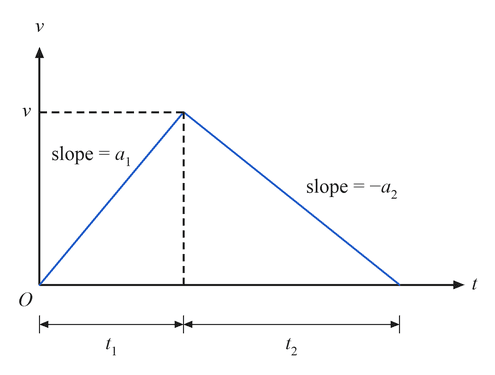
Step 2 — Write for each part. The speed gained equals the speed lost:
Step 3 — Equate and rearrange. Setting the two equal and dividing by :
- (A) This is the correct ratio turned upside down: the larger acceleration needs the shorter time.
- (C) This is the square of the correct ratio; the times depend on the first power of the accelerations.
- (D) This is the square of the inverted ratio, so it is wrong on both counts.
Therefore, , option (B).
- 101 mark
Question 10
A car can be stopped within a distance of when its speed is . What is the minimum distance within which the car can be stopped during the same time when its speed is ?
Solve with AIAnswer
(A)
(B)
- Correct
(C)
(D)
Answer: (C)
Concept: The minimum stopping distance is set by the greatest retardation the brakes can give, which is the same at both speeds. From with final speed zero, the stopping distance is , so it grows as the square of the speed.
Step 1 — Stopping distance at speed . The car stops from speed with the greatest retardation :
Step 2 — Stopping distance at speed . We replace by :
- (A) is the distance if the car had to stop in the same time as before, using a retardation times larger; it is not the minimum distance with the brakes' greatest retardation.
- (B) would mean a faster car stops in a shorter distance, which is the wrong way round.
- (D) inverts the square law: the stopping distance increases with speed.
Note: The words "during the same time" are best read as "under the same braking"; read literally as the same stopping time, the distance would be . The printed key, , uses the same greatest retardation.
Therefore, the minimum stopping distance at speed is , option (C).
- 111 mark
Question 11
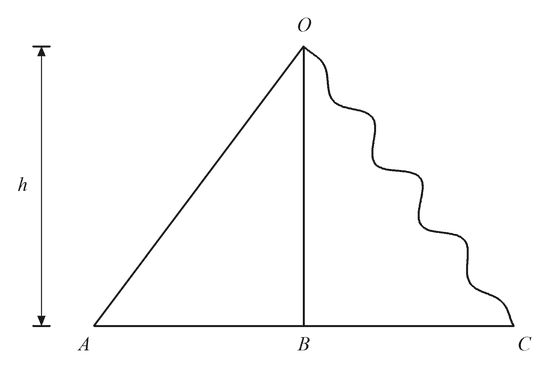
Three different balls of masses , and are allowed to roll from rest on three frictionless path , and respectively from . The height of above the ground is . The respective speeds , and of , and at the bottom , and are
 Solve with AI
Answer
(A)
- Correct
(B)
(C)
(D)
Answer: (B) The three speeds are equal
Concept: On a frictionless path only gravity does work. A body starting from rest and descending a height gains kinetic energy , whatever the shape of the path, so its speed at the bottom is .
Step 1 — Equate the energy gained. For each ball, the loss of potential energy equals the gain of kinetic energy:
Step 2 — Solve for the speed. The mass cancels:
Step 3 — Compare the three paths. All three balls start from rest at and end at ground level, so all fall through the same height . Their speeds at the bottom are therefore equal. (The times taken differ, because the paths have different lengths and slopes.)
- (A) The speed does not depend on the mass, so the ratios are not equal unless the masses are equal.
- (C) This assumes the speed depends on the path; on frictionless paths it depends only on the height fallen.
- (D) For the same reason, a longer or wavier path does not give a greater final speed.
Therefore, the three speeds , and are equal, option (B).
- 121 mark
Question 12
For a body thrown vertically upward, if the air resistance is taken into consideration, then the time of rise is
Solve with AIAnswer
(A) equal to time of fall
- Correct
(B) less than time of fall
(C) greater than the time of fall
(D) (3/2) times the time of fall
Answer: (B) less than time of fall
Concept: Air resistance acts opposite to the velocity: downward while the body goes up, upward while it comes down.
Step 1 — Rise. Gravity and air resistance both act downward, so the body slows down at more than and reaches the top quickly.
Step 2 — Fall. Air resistance now acts upward, against gravity, so the body speeds up at less than and takes longer to fall through the same height.
- (A) The two times are equal only when there is no air resistance.
- (C) This is the wrong way round: the rise is the faster part of the motion.
- (D) There is no fixed ratio; how much longer the fall takes depends on the size of the air resistance.
Therefore, the time of rise is less than the time of fall, option (B).
- 131 mark
Question 13
A wooden ball and an iron ball are dropped from the same height in vacuum. If their radii are the same, then the times taken by them to reach the ground are
Solve with AIAnswer
(A) approximately equal
- Correct
(B) exactly equal
(C) not equal
(D) zero
Answer: (B) exactly equal
Concept: In a vacuum there is no air resistance, and every body falls with the same acceleration , whatever its mass or material.
Step 1 — Write the time of fall. From for a body dropped from rest:
Step 2 — Compare the two balls. This time contains only and , which are the same for both balls; it does not contain the mass.
- (A) "Approximately" suggests a small difference; in a vacuum there is none. (In air, the lighter wooden ball would be slowed a little more and would arrive slightly later.)
- (C) The times would differ only if something other than gravity, such as air resistance, acted on the balls.
- (D) A fall through a height always takes some time.
Therefore, the two balls take exactly equal times, option (B).
- 141 mark
Question 14
An airtight cage with a parrot sitting in it is suspended from the spring balance. The parrot starts flying. The reading of the spring balance will
Solve with AIAnswer
(A) increase
(B) decrease
- Correct
(C) not change
(D) be zero
Answer: (C) not change
Concept: A spring balance reads the total downward force on it. A bird stays up by pushing air downward; in a closed cage that air presses on the floor of the cage.
Step 1 — Follow the force. To stay in the air, the parrot pushes air down with a force equal to its own weight. In an airtight cage this air cannot escape, so the same push reaches the floor of the cage.
Step 2 — Compare with the parrot sitting. When the parrot sits, its weight acts on the perch; when it flies steadily, an equal force acts on the floor through the air. The total downward force on the balance, the weight of cage, air and parrot, is the same.
- (A) The reading rises only for a moment while the parrot pushes off and speeds up upward; once it flies steadily, the reading returns to the same value.
- (B) The reading would fall for an open (wire) cage, where the air pushed down by the wings can escape sideways; the cage here is airtight.
- (D) The cage, the air and the parrot all still have weight, so the reading cannot be zero.
Note: The key refers to steady flight; during the brief take-off the reading rises and falls for a moment.
Therefore, the reading of the spring balance does not change, option (C).
- 151 mark
Question 15
The distance travelled by a body falling from rest in the first, second and third seconds are in the ratio
Solve with AIAnswer
(A) 1 : 2 : 3
- Correct
(B) 1 : 3 : 5
(C) 1 : 4 : 9
(D) none of the above
Answer: (B) 1 : 3 : 5
Concept: For a body falling from rest, the distance in the th second is .
Step 1 — Distance in the first second. We put :
Step 2 — Distance in the second second. We put :
Step 3 — Distance in the third second. We put :
Step 4 — Form the ratio. The common factor cancels:
- (A) 1 : 2 : 3 is the ratio of the speeds at the ends of the first, second and third seconds (), not of the distances.
- (C) 1 : 4 : 9 is the ratio of the total distances fallen in 1 s, 2 s and 3 s ().
- (D) Option (B) is correct, so "none of the above" is wrong.
Therefore, the distances are in the ratio 1 : 3 : 5, option (B).
- 161 mark
Question 16
A stone is thrown vertically upward with an initial velocity from the top of a tower, reaches the ground with a velocity . The height of the tower is
Solve with AIAnswer
(A)
- Correct
(B)
(C)
(D)
Answer: (B)
Concept: Take downward as positive. The stone starts with velocity (upward), has acceleration , and its displacement from the top of the tower to the ground is . Then applies to the whole flight.
Step 1 — Write . The square of the starting velocity is whichever way it points, and the final speed is :
Step 2 — Solve for . We subtract and divide by :
Step 3 — Check the other options. We put each option's into and see which final speed it gives:
- (A) With the term adds to , so and , not .
- (C) With the term adds , so and .
- (D) With the term adds , so and .
Therefore, the height of the tower is , option (B).
- 171 mark
Question 17
A body is released from the top of a tower of height metres. It takes seconds to reach the ground. Where is the ball at the time seconds?
Solve with AIAnswer
(A) at metre from the ground
(B) at metre from the ground
(C) depends upon the mass and volume of the ball
- Correct
(D) at metre from the ground
Answer: (D) at metre from the ground
Concept: A body released from rest falls a distance in time , so the distance fallen is proportional to the square of the time.
Step 1 — Use the whole fall. In time the body falls the full height:
Step 2 — Find the distance fallen in half the time. We put in place of :
Step 3 — Find the height above the ground. The body has fallen from the top, so its height above the ground is:
- (A) The body does not fall half the height in half the time, because it speeds up as it falls.
- (B) is the distance fallen, measured from the top, not the height above the ground.
- (C) In free fall (no air resistance) the motion does not depend on the mass or the volume of the body.
Therefore, at time the ball is above the ground, option (D).
- 181 mark
Question 18
Is it possible that a body has (i) zero speed and non-zero velocity and (ii) non-zero speed and zero velocity?
Solve with AIWritten solution
Solution:
Concept: At any instant the speed is the size (magnitude) of the velocity. Over an interval, the average speed is distance ÷ time and the average velocity is displacement ÷ time, and these can differ.
Step 1 — Part (i). If the speed is zero, the size of the velocity is zero, so the velocity itself is zero. A body cannot have zero speed and a non-zero velocity, at an instant or on average (zero distance means zero displacement).
Step 2 — Part (ii) at one instant. At an instant a non-zero speed means the velocity has a non-zero size, so the instantaneous velocity cannot be zero.
Step 3 — Part (ii) on average. Over an interval it is possible. When a particle goes once round a circle, it covers a distance (non-zero average speed) but comes back to its starting point (zero displacement), so its average velocity over that time is zero.
Therefore, (i) no: zero speed always means zero velocity; (ii) yes, for average values: after one complete round, the average speed is non-zero while the average velocity is zero (at a single instant it is not possible).
- 191 mark
Question 19
A ball is thrown straight up. What is velocity and acceleration at the top?
Solve with AIWritten solution
Solution:
Concept: At the top of its flight a ball thrown up stops rising and starts falling; gravity acts on it all the time.
Step 1 — Velocity at the top. The ball stops for an instant before turning back, so its velocity there is zero.
Step 2 — Acceleration at the top. Gravity still acts, so the acceleration is (about ), directed vertically downward.
Therefore, at the top the velocity is zero and the acceleration is , directed vertically downward.
- 201 mark
Question 20
Two balls of different masses (one lighter and the other heavier) are thrown vertically upward with the same initial speed. Which one will rise to the greater height?
Solve with AIWritten solution
Solution:
Concept: Neglecting air resistance, a ball thrown up with speed stops at its highest point, and the equation then gives its maximum height .
Step 1 — Find the maximum height. At the top the velocity is zero, so we put in the equation:
The maximum height depends only on the speed of projection and on ; the mass does not appear in it.
Step 2 — Compare the two balls. Both have the same and the same , so both have the same .
Therefore, both balls rise to the same height, because the maximum height reached does not depend on the mass.
- 211 mark
Question 21
Can a body have a constant speed but a varying velocity?
Solve with AIWritten solution
Solution:
Concept: Velocity has size and direction; a change of direction alone changes the velocity.
Step 1 — Give the case. In uniform circular motion the speed is the same at every point, but the direction of motion (along the tangent) is different at different points.
Step 2 — Draw the conclusion. Since the direction changes, the velocity changes even though the speed is constant.
Therefore, yes: in uniform circular motion the speed is constant but the velocity varies, because its direction keeps changing.
- 221 mark
Question 22
The direction in which an object moves is given by the direction of the velocity of the object and not by the direction of acceleration. Explain with an example.
Solve with AIWritten solution
Solution:
Concept: Velocity tells which way a body is moving at that instant; acceleration only tells which way the velocity is changing.
Step 1 — Take a body thrown vertically upward. While it rises its velocity points upward, but its acceleration points downward.
Step 2 — See which way it moves. The body moves upward (the direction of its velocity), even though its acceleration is downward; the acceleration only makes the upward velocity smaller.
Therefore, a body thrown vertically upward moves upward, the direction of its velocity, while its acceleration is downward; so the direction of motion is given by the velocity, not by the acceleration.
- 231 mark
Question 23
Under what circumstances, does the relation hold good?
Solve with AIWritten solution
Solution:
Concept: For a body moving with uniform acceleration and velocity at the start of a small interval , the displacement in that interval is .
Step 1 — Divide by the time interval. Dividing the displacement by :
Step 2 — Uniform velocity. If the velocity is uniform, , and then exactly, for an interval of any size.
Step 3 — Changing velocity. If the velocity changes, the extra term becomes negligible only when ; then gives the instantaneous velocity at that moment. For a finite interval it gives only the average velocity.
Therefore, holds exactly when the velocity is uniform; for changing velocity it gives the instantaneous velocity only in the limit .
- 241 mark
Question 24
Speed of a body is never negative. Why?
Solve with AIWritten solution
Solution:
Concept: Speed is distance covered per unit time.
Step 1 — Look at the distance. Distance is the length of the path covered. It is a scalar with no direction, so it is never negative.
Step 2 — Look at the time. Time taken is also positive, so their ratio cannot be negative.
Therefore, speed is never negative because it is distance ÷ time, and distance is a scalar that is never negative.
- 251 mark
Question 25
“The average velocity of a particle over an interval of time is either smaller than or equal to the average speed of the particle over the same interval”. Explain.
Solve with AIWritten solution
Solution:
Concept: Average velocity is displacement ÷ time; average speed is distance ÷ time. The statement compares the size of the average velocity with the average speed.
Step 1 — Compare displacement and distance. The displacement is the straight-line distance from the starting point to the end point, which is the shortest path between them. The actual path length (distance) is never shorter, so the size of the displacement is less than or equal to the distance.
Step 2 — Divide both by the same time. Dividing by the same time interval keeps the inequality, so the size of the average velocity is less than or equal to the average speed. They are equal only for motion along a straight line without turning back.
Therefore, since the size of the displacement is never more than the distance, the size of the average velocity is less than or equal to the average speed over the same interval.
- 261 mark
Question 26
The average velocity of a particle is equal to its instantaneous velocity. What is the shape of the displacement–time graph?
Solve with AIWritten solution
Solution:
Concept: The slope of a displacement–time graph at any point is the instantaneous velocity; the slope of the chord over an interval is the average velocity.
Step 1 — Use the given condition. If the average velocity over every interval equals the instantaneous velocity, the velocity never changes: the motion has uniform velocity.
Step 2 — Describe the graph. A constant velocity means a constant slope, so the displacement–time graph is a straight line. For a moving body the line is inclined to the time axis, and its slope is the velocity.

Note: In the special case of a body at rest, both velocities are zero and the straight line is parallel to the time axis.
Therefore, the displacement–time graph is a straight line, inclined to the time axis for a body moving with uniform velocity.
- 271 mark
Question 27
Is it possible that a body is at rest and at the same time in motion?
Solve with AIWritten solution
Solution:
Concept: Rest and motion are relative: they are always stated with respect to a chosen frame of reference.
Step 1 — Choose two frames. We sit at rest with respect to the Earth (our position on the ground does not change).
Step 2 — Change the frame. With respect to the Sun, we move with the Earth along its orbit.
Therefore, yes: a body can be at rest with respect to one frame and in motion with respect to another; for example, we are at rest with respect to the Earth but in motion with respect to the Sun.
- 281 mark
Question 28
“An iron ball and a wooden ball of same radius are released from a height in vacuum. Which of the two balls would take more time”?
Solve with AIWritten solution
Solution:
Concept: In a vacuum every body falls with the same acceleration .
Step 1 — Write the time of fall. A body released from rest falls a height in a time given by:
Step 2 — Compare. This contains only and , not the mass , so both balls take the same time.
Therefore, neither: both balls take the same time, because the time of fall in a vacuum does not depend on the mass.
- 291 mark
Question 29
Can an object be accelerated without speeding up or slowing down?
Solve with AIWritten solution
Solution:
Concept: Acceleration is any change of velocity, and velocity changes if its direction changes, even when the speed stays the same.
Step 1 — Give the case. In uniform circular motion the speed is constant, but the direction of motion changes continuously.
Step 2 — Conclude. The changing direction means a changing velocity, so there is an acceleration (towards the centre).
Therefore, yes: by changing only its direction of motion, as in uniform circular motion, an object is accelerated without speeding up or slowing down.
- 301 mark
Question 30
Two balls of different masses (one lighter and the other heavier) are thrown vertically upwards with the same speed. Which one will pass through the point of projection in their downward direction with the greater speed?
Solve with AIWritten solution
Solution:
Concept: Neglecting air resistance, the speed of a body depends on its height, not on its mass: from , when it comes back to the point of projection its displacement is zero.
Step 1 — Use at the point of projection. Taking upward as positive, the displacement there is :
Step 2 — Read the result. Each ball passes the point of projection with speed (moving downward), whatever its mass.
Therefore, both balls pass the point of projection with the same speed, equal to their speed of projection, because the result does not depend on the mass.
- 312 marks
Question 31
Give an example of a body which is at rest with respect to one body, but is in motion with respect to another.
Solve with AIWritten solution
Solution:
Concept: A body is at rest with respect to another if its position relative to that body does not change with time; otherwise it is in motion relative to it.
Step 1 — Choose the body. Take the pilot of an aeroplane in flight.
Step 2 — Compare two reference bodies. The pilot's position does not change relative to the passengers in the same plane, so the pilot is at rest with respect to them. Relative to the ground, the pilot moves with the plane, so the pilot is in motion with respect to the ground.
Therefore, the pilot of a moving plane is at rest with respect to the passengers but in motion with respect to the ground.
- 322 marks
Question 32
While dealing with translatory motion of extended bodies, why do we treat them as point object?
- 332 marks
Question 33
Under what conditions can we treat a train as a point object?
- 342 marks
Question 34
“Motion of a planet around the Sun in its orbit is considered as an example of two-dimensional motion.” Why?
- 352 marks
Question 35
“Distance travelled by a body cannot be negative”. Why?
- 362 marks
Question 36
Give an example of body for which there is change of position, but displacement is zero.
- 372 marks
Question 37
A body is moving along a circular path. When it completes one rotation, what is (i) the distance travelled and (ii) the displacement of the body?
- 382 marks
Question 38
Average velocity and instantaneous velocities are generally not the same. Is it possible that they are equal for any type of motion? If so, give an example.
- 392 marks
Question 39
Is it possible that the velocity and acceleration of a body have opposite signs? Give an example.
- 402 marks
Question 40
Is it possible that the velocity of a body is zero and still the body has acceleration?
- 412 marks
Question 41
The average velocity of a body is not zero for some time interval. Does this mean that the instantaneous velocity is never zero during this time? Explain.
- 422 marks
Question 42
The average velocity of a particle is zero during some interval of time. What is the displacement of the particle during that time interval?
- 432 marks
Question 43
Can a particle have a magnitude of the instantaneous velocity greater than the magnitude of its average velocity?
- 442 marks
Question 44
Rest and motion are relative terms. Explain with two examples.
- 452 marks
Question 45
What is a point object?
- 462 marks
Question 46
Which of the following motions is one, two or three dimensional?
(a) A ship in a rough sea.
(b) Insat-IIB revolving round the Earth
(c) A person running along a straight track.
- 472 marks
Question 47
Distinguish between distance and displacement.
- 482 marks
Question 48
Can a body have variable velocity when its speed is constant?
- 492 marks
Question 49
What does the area enclosed by the velocity–time graph with the time axis give?
- 502 marks
Question 50
Define acceleration, uniform acceleration and instantaneous acceleration.
- 512 marks
Question 51
Derive the equation, graphically.
- 523 marks
Question 52
(a) What is a frame of reference?
(b) Distinguish between
(i) distance and displacement
(ii) speed and velocity?
- 533 marks
Question 53
Draw the –, – and – graphs for uniform acceleration. What are the conclusions drawn from these graphs?
- 543 marks
Question 54
Derive the equation of motion by graphical method.
- 555 marks
Question 55
Derive the equation of motion by calculus method.
- 565 marks
Question 56
(a) Define instantaneous velocity and instantaneous acceleration.
(b) Draw the velocity–time graph of a particle moving with uniform acceleration. Using the graph derive the equations of motion.
- 575 marks
Question 57
(a) Write down the equations of motion of an object under gravity.
(b) Draw the displacement–time graph and velocity–time graph of a body thrown into air vertically upwards.
- 585 marks
Question 58
(a) Prove that if the distance covered by a particle is directly proportional to the square of the time taken, it is moving with uniform acceleration.
(b) Derive the equations of motion by calculus method.
What Class 11 Physics Ch 4 covers
The sections of the chapter, in the order the book takes them. Every question above comes from one of these.
- 01Rest, Motion and Frame of Reference
- 02Distance and Displacement
- 03Speed and Velocity
- 04Position-Time Graphs
- 05Acceleration and Velocity-Time Graphs
- 06Equations of Uniformly Accelerated Motion
More ways to study this chapter
The same chapter asked three other ways. Practise it, revise it, and see what the board has set on Ch 4 before.
Class 11 Physics Ch 4 questions students ask
How many questions are there in Class 11 Physics Ch 4?
58 questions. Every one is solved step by step on this page.
Are these Class 11 Physics solutions free?
Yes. Every question and its full working is free to read, with no account needed.
Can I download the Class 11 Physics Ch 4 solutions as a PDF?
There is no PDF to download. Every solution is on this page instead, which means it is searchable, always the current syllabus, and readable on a phone. Use your browser's print option if you want it on paper.