
Opening your dashboard
Class 11 Physics Chapter 4 Motion in a Straight Line: Practice Questions
124 questions on Chapter 4, each worked through on its own page with the AI tutor. Class 11 Physics, ICSE 2026-27.
124 questions
1–4 marks · Mixed difficulty
- 11 mark
Question 1
Riya and Kabir describe the motion of a cyclist on a straight east–west road, and both take east as the positive direction. Riya takes her origin at the school gate. Kabir takes his origin at a bus stop east of the school gate. The cyclist rides from a point east of the gate to a point east of the gate. Which of these do Riya and Kabir agree on?
- 21 mark
Question 2
A communication satellite in a geostationary orbit goes once round the Earth's axis in the same time as the Earth turns once, and in the same direction, so it always stays above the same point on the equator. Which statement about the satellite is correct?
- 32 marks
Question 3
A book lies on a desk in a classroom in Chennai. Because the Earth spins, the desk is carried round a circle of radius about the Earth's axis once every 23 h 56 min (one turn of the Earth measured against the distant stars).
(a) Find the speed of the book in a frame of reference whose origin is on the Earth's axis and whose axes point towards fixed distant stars.
(b) One student says the book is at rest; another says it is moving faster than a jet airliner. Explain how both can be right.
- 43 marks
Question 4
(Hypothetical data.) A train moves due east along a straight track at a steady . A passenger walks from the front of their coach towards the back at a steady relative to the coach, for . Take east as positive.
(a) Find the passenger's displacement in the frame of reference of the coach.
(b) Find the passenger's displacement in the frame of reference of the ground.
(c) Find the passenger's velocity relative to the ground. In which frame is the passenger moving towards the west?
- 51 mark
Question 5
A parcel lies at rest on the floor of a goods wagon that moves along a straight, level track at a steady . In a frame of reference fixed to the ground, the parcel has
- 61 mark
Question 6
(Hypothetical data.) In an office building the floors are apart, so the 8th floor is above the ground floor. A lift starts at the ground floor, goes up to the 8th floor and then comes down to the 3rd floor. Treating the lift as a point moving along a vertical line, the distance it travels and its displacement are
- 72 marks
Question 7
In a cricket match the two batting creases are apart. A batter starting at one crease completes three runs; one run is a dash from one crease to the other. Treat the batter as a point that moves along a straight line and turns round exactly at each crease.
(a) Find the distance covered and the magnitude of the displacement after the three runs.
(b) Find both quantities after four runs. What does this show about distance and displacement?
- 83 marks
Question 8
(Hypothetical data.) A toy car is pushed up a long, straight ramp. It slows down, stops for an instant and rolls back. Its position along the ramp, measured from the starting mark, is ( in metres, in seconds) for .
(a) Show that , and use this form to find the farthest point the car reaches and when it gets there.
(b) Find the displacement of the car in the first .
(c) Find the distance it covers in the first .
- 91 mark
Question 9
In which of these motions is the distance travelled equal to the magnitude of the displacement?
- 103 marks
Question 10
(Hypothetical data.) A security guard walks along the boundary of a rectangular school campus , in which and . The guard walks from corner to corner and then on to corner , as shown in the figure.

(a) Find the distance the guard walks and the magnitude of the guard's displacement.
(b) Find the angle that the displacement makes with .
- 113 marks
Question 11
(Hypothetical data.) On a straight section of a metro line, ten stations are equally spaced apart. A train takes to run between neighbouring stations and stops for at each of the eight stations between the first and the last.
(a) Find the train's average speed from the first station to the last, in .
(b) Find its average speed while it is actually moving, in .
(c) If each of the eight stops were cut to , by how much would the average speed in (a) increase?
- 122 marks
Question 12
(Hypothetical data.) In a laboratory, a card wide is fixed on top of a trolley that runs down a sloping track. As the trolley passes a light gate, the card cuts off the light beam for , and an electronic timer works out a speed from these readings.
(a) What speed does the timer calculate?
(b) The trolley is speeding up as it passes the gate. Is the value in (a) its instantaneous speed? Explain why a narrower card would give a value closer to the instantaneous speed at the gate.
- 132 marks
Question 13
(Hypothetical data.) A student stands in front of a tall, flat cliff and claps once. The student hears the echo after the clap.
(a) Find the speed of sound in air from this measurement.
(b) Following the part of the sound that travels straight to the cliff and straight back, find its average velocity between the clap and the moment the echo reaches the student. Explain why this differs from your answer to (a).
- 143 marks
Question 14
(Hypothetical data.) The positions of two cyclists P and Q on a straight road, measured from the same starting line, are noted every :
(s) 0 2 4 6 8 Position of P (m) 0 10 20 30 40 Position of Q (m) 0 3 10 21 36 (a) Find the average velocity of each cyclist in every interval, and say which cyclist is in uniform motion.
(b) Find each cyclist's average velocity over the whole .
(c) What is P's instantaneous velocity at ? Can Q's instantaneous velocity at be found exactly from this table? Explain.
- 151 mark
Question 15
A particle moves along the x-axis. At one instant its velocity is . Which statement must be true at that instant?
- 161 mark
Question 16
(Hypothetical data.) The figure shows the position–time graph of a toy robot moving along a straight line.
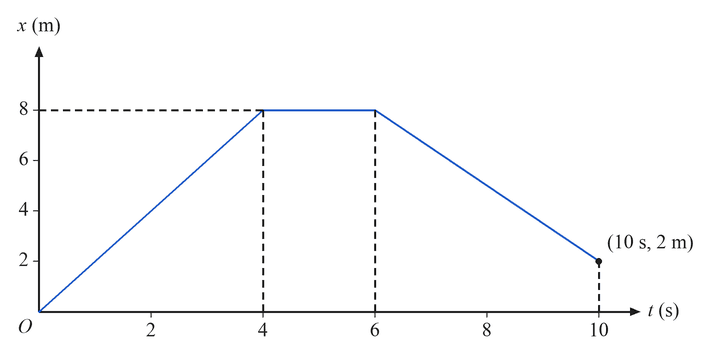
Its average velocity and its average speed over the whole are, respectively,
- 173 marks
Question 17
(Hypothetical data.) The figure shows the position–time graph of a car that starts from rest. The straight line is the tangent to the curve at the point (, ); it passes through the points (, ) and (, ).

(a) Use the tangent to find the instantaneous velocity of the car at .
(b) Find the average velocity of the car from to .
(c) Explain from the graph how you can tell that the car is speeding up.
- 181 mark
Question 18
Each graph in the figure shows the position of a body against time .
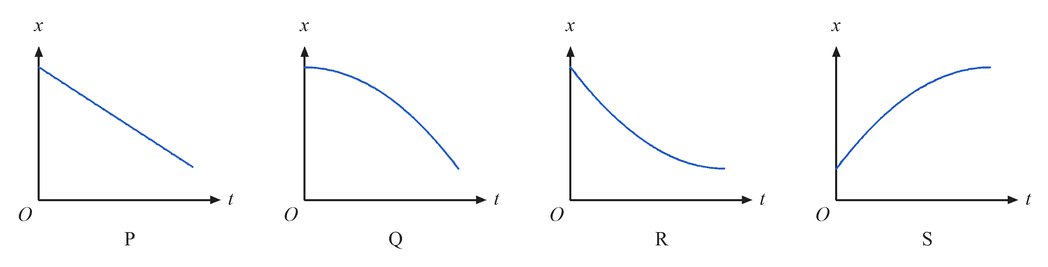
Which graph shows a body moving in the negative x-direction while slowing down?
- 193 marks
Question 19
(Hypothetical data.) Anu walks due east from her home along a straight road. She walks at a steady to a friend's gate, waits there for minutes, and then walks a further east at a steady to the library.
(a) Draw her position–time graph, taking her home as the origin and east as positive. Mark the times and positions at the corners of the graph.
(b) What does the slope of each part of the graph tell you?
(c) Find her average velocity for the whole trip.
- 201 mark
Question 20
(Hypothetical data.) The figure shows the position–time graph of a particle moving along the x-axis from to .
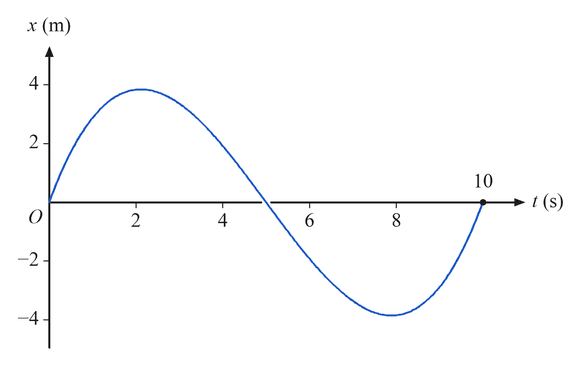
At how many instants in this interval is the particle momentarily at rest?
- 213 marks
Question 21
(Hypothetical data.) Four bodies P, Q, R and S move along the x-axis, each with a constant acceleration. Their velocities at and their accelerations are:
Body P Q R S (m s⁻¹) (m s⁻²) (a) Which bodies are speeding up at , and which are slowing down?
(b) Find the velocity and the speed of each body at .
- 223 marks
Question 22
(Hypothetical data.) A car starts from rest on a straight, level road. A passenger notes its speedometer reading every :
(s) 0 2 4 6 8 (km h⁻¹) 0 36 63 81 90 (a) Change each reading into .
(b) Find the average acceleration in each interval. Is the acceleration uniform?
(c) Plot the velocity–time graph from your values, and find the average acceleration over the whole .
- 231 mark
Question 23
(Hypothetical data.) The figure shows the velocity–time graph of a particle moving along a straight line.

At what time does the particle reverse its direction of motion, and what is its acceleration at that instant?
- 243 marks
Question 24
(Hypothetical data.) The figure shows the velocity–time graph of a metro train running between two stations on a straight track.

(a) Find the acceleration of the train in each of the three parts of its journey.
(b) Draw the acceleration–time graph for the .
(c) Find the average acceleration over the whole , and explain your answer.
- 251 mark
Question 25
(Hypothetical data.) A skydiver steps out of a helicopter that is hovering at rest and falls in a flat, face-down position. The figure shows the skydiver's velocity–time graph until just before the parachute opens.
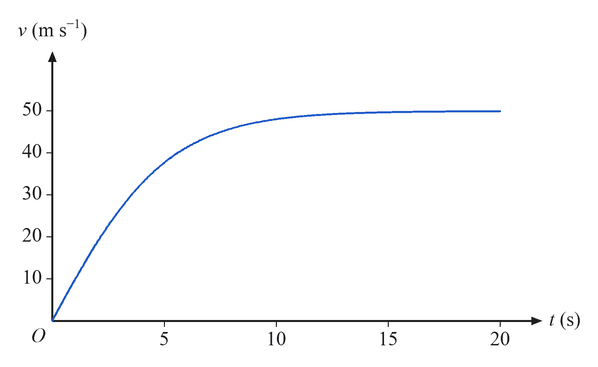
How does the skydiver's acceleration change during this time?
- 262 marks
Question 26
(Hypothetical data.) On a straight stretch of track, an express train speeds up uniformly from to while it covers .
(a) How long does the train take to cover this stretch?
(b) Find the acceleration of the train, and check it with the equation that links , , and .
- 274 marks
Question 27
(Hypothetical data.) A car is moving at on a straight, level road when its driver sees a broken-down cart standing ahead. The driver's reaction time is , and during this time the car keeps its speed. The brakes then give the car a uniform retardation of .
(a) How far does the car travel during the reaction time?
(b) Find the total stopping distance of the car.
(c) Show that the car cannot stop in time, and find its speed when it reaches the cart.
(d) What is the highest speed, in , from which this driver could just stop at the cart?
- 281 mark
Question 28
(Hypothetical data.) After a crash, the police measure straight skid marks long, at the end of which the car had stopped. Tests show that a car skidding with locked wheels on this road has a uniform retardation of . The speed of the car when the skid began was about
- 293 marks
Question 29
(Hypothetical data.) A passenger jet starts from rest at one end of a straight runway long and accelerates uniformly at . It lifts off when its speed reaches .
(a) Find the time taken to reach the lift-off speed and the length of runway used.
(b) On another day the pilot abandons the take-off when the speed is , and the brakes then give a uniform retardation of . How far from the start does the jet stop, and is the runway long enough?
- 301 mark
Question 30
A car moving at on a straight road brakes with a uniform retardation of until it stops. How far does the car travel in the after the brakes are applied?
- 311 mark
Question 31
(Hypothetical data.) A test car starts from rest on a straight track. For the first its acceleration is , where is in seconds. Its speed at is
- 323 marks
Question 32
(Hypothetical data.) A toy robot moves along a straight track. Its velocity is , where is in and is in seconds. It starts from the zero mark of the track () at . For the interval from to :
(a) find the instants at which the robot is momentarily at rest;
(b) find its displacement;
(c) find the total distance it travels.
- 331 mark
Question 33
(Hypothetical data.) A particle moves along the -axis so that its velocity at position is , where . When the particle is at , its acceleration is
- 344 marks
Question 34
(Hypothetical data.) A lift starts from rest at the ground floor and stops at a higher floor later. During the trip, for , its upward velocity (in ) at time (in seconds) is given by the formula below.
(a) Find the greatest speed of the lift and the time at which it occurs.
(b) Find the acceleration of the lift at the start and at the end of the trip.
(c) Using integration, find the height through which the lift rises.
(d) Find the average speed of the lift for the trip.
- 351 mark
Question 35
(Hypothetical data.) A particle moving along the -axis has acceleration , where is in and is in seconds. At the particle is at and its velocity is . At the particle is
- 361 mark
Question 36
In a reaction-time test, one student holds a metre rule vertically, and a second student holds an open finger and thumb level with its mark, without touching it. The rule is released without warning, and the second student catches it as quickly as possible at the mark, as shown in the figure. Take and neglect air resistance. The reaction time of the second student is about

- 373 marks
Question 37
(Hypothetical data.) A ball is thrown vertically upwards from a point O on the ground. On the way up it passes a window ledge P, above O, and it passes P again on the way down later, as shown in the figure. Take and neglect air resistance.
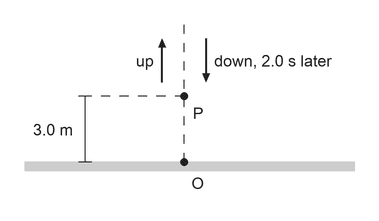
(a) Find the speed of the ball as it passes P.
(b) How high above the ground does the ball rise?
(c) With what speed was the ball thrown?
- 381 mark
Question 38
(Hypothetical data.) An astronaut standing on the Moon holds a hammer and a feather above the ground and releases them together from rest. The Moon has no atmosphere, and the acceleration due to gravity there is . Which statement is correct?
- 393 marks
Question 39
(Hypothetical data.) A ball is dropped from rest from a height of onto a hard floor. Each time it hits the floor it rebounds straight upwards with of the speed it had just before the impact. Take , and neglect air resistance and the short time the ball is in contact with the floor.
(a) Find the speed of the ball just before it first hits the floor.
(b) How high does the ball rise after the first bounce?
(c) How long after it was dropped does the ball hit the floor for the second time?
- 402 marks
Question 40
(Hypothetical data.) To measure , a steel ball is held by an electromagnet with its lowest point above the beam of a light gate, as shown in the figure. When the magnet is switched off a timer starts, and it stops when the ball cuts the beam. The timer reads . Neglect air resistance.
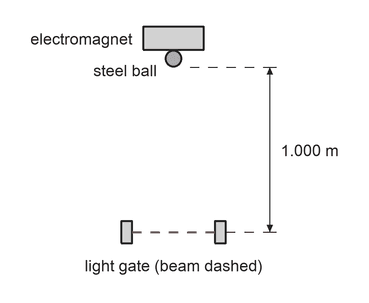
(a) Find the value of given by this measurement.
(b) Find the speed of the ball as it reaches the beam.
- 411 mark
Question 41
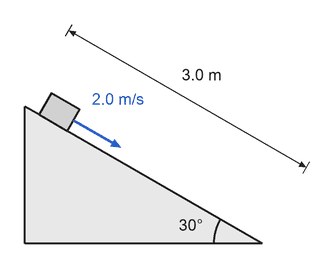
A small block is pushed so that it starts down a smooth plane inclined at to the horizontal with a speed of . It slides the full length of the plane, as shown in the figure. Take . The speed of the block at the bottom of the plane is about
- 423 marks
Question 42
(Hypothetical data.) In a school laboratory an air track long is tilted by resting one end on a block high, as shown in the figure. A glider released from rest slides down the track to a light gate in . Treat the air track as frictionless.
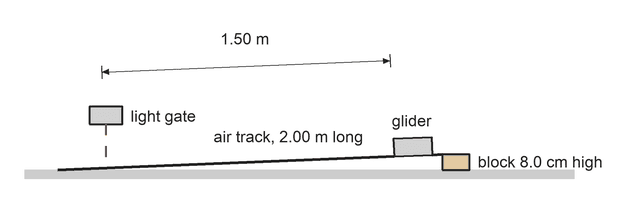
(a) Find the acceleration of the glider.
(b) Use your answer to find .
(c) Galileo also slowed down falling motion by using a gentle slope. Why does a gentle slope make this measurement easier than timing a free fall through the same height?
- 433 marks
Question 43
(Hypothetical data.) A skateboarder rolls up a long, smooth ramp inclined at to the horizontal, where . At the foot of the ramp the skateboarder's speed is up the ramp, as shown in the figure. Treat the motion as frictionless and take .
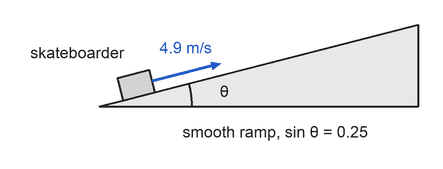
(a) How long after passing the foot does the skateboarder come to a momentary stop?
(b) Find how far up the ramp the skateboarder is and after passing the foot. Explain why the two answers are the same.
(c) With what speed does the skateboarder arrive back at the foot of the ramp, and when?
- 441 mark
Question 44
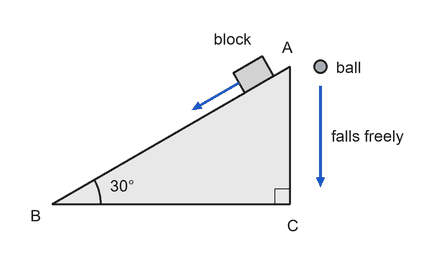
In the figure, AB is a smooth plane inclined at to the horizontal, and AC is vertical. A small block is released from rest at A and slides down to B. At the same instant a ball is released from rest at A and falls freely through the height AC. The ratio is
- 452 marks
Question 45
(Hypothetical data.) At a warehouse, parcels are sent down a straight chute. A parcel released from rest at the top slides the length of the chute in . Treat the chute as smooth and take .
(a) Find the angle that the chute makes with the horizontal.
(b) Find the speed of the parcel at the bottom of the chute.
- 461 mark
Question 46
(Hypothetical data.) The position of a small mass vibrating on a spring is , where is in metres, is in seconds and the angle is in radians. The velocity of the mass at is
- 473 marks
Question 47
(Hypothetical data.) A particle moves along the -axis so that its position at time is , where is in metres and is in seconds.
(a) Using differentiation, find when the particle is momentarily at rest.
(b) Find the greatest positive value of , and use the second derivative to show that it is a maximum.
(c) When does the particle return to the origin, and what is its velocity then?
- 481 mark
Question 48
(Hypothetical data.) The velocity of a particle moving along a straight line is , where is in and is in seconds. The displacement of the particle between and is
- 492 marks
Question 49
(Hypothetical data.) A particle moves along a straight line so that its position is , where is in metres and is in seconds.
(a) Use the product rule to find the velocity of the particle at , and check your answer by expanding first.
(b) Find the acceleration of the particle at .
- 503 marks
Question 50
(Hypothetical data.) A particle starts from rest at the origin at and moves along the -axis with acceleration , where is in , is in seconds and the angle is in radians.
(a) Find the velocity as a function of , and the greatest speed of the particle.
(b) Find the position as a function of .
(c) How far from the origin does the particle get, and at what time does it first get there?
- 511 mark
Question 51
The speed of a body is constant. Can it accelerate?
- 521 mark
Question 52
The instantaneous velocity of a particle is zero. Does it mean that its acceleration is zero?
- 531 mark
Question 53
Is it possible that the velocity of a body changes and its acceleration remains constant?
- 541 mark
Question 54
In the unit of acceleration, why does the unit of time occur twice?
- 551 mark
Question 55
What does the speedometer of car measure?
- 561 mark
Question 56
When will a cyclist appear to be stationary w.r.t. another moving cyclist?
- 572 marks
Question 57
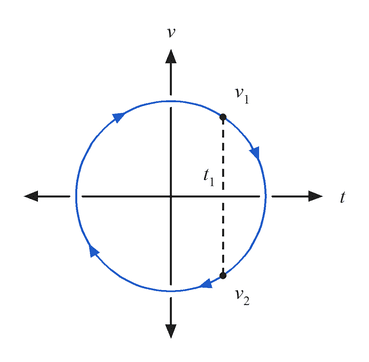
The given figure shows the velocity–time graph of a particle. Does it represent one-dimensional motion?
- 582 marks
Question 58
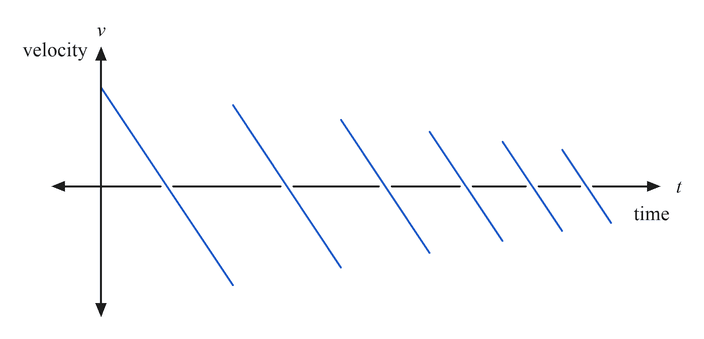
Suggest a suitable physical situation for the velocity–time graph shown in the following figure.
- 592 marks
Question 59
The distance covered by a body is directly proportional to the square of time. Is it moving with uniform velocity or uniform acceleration?
- 602 marks
Question 60
Is it possible to measure velocity of a body by measuring only its time of travel?
- 611 mark
Question 61
If air resistance is taken into consideration then do you think that time of rise is equal to time of fall?
- 623 marks
Question 62
What is the distance in km of a quasar from which light takes years to reach the Earth. The speed of light .
- 633 marks
Question 63
A train 100 m long is moving with a speed of . Calculate the time taken by the train to cross a bridge 0.5 km long.
- 643 marks
Question 64
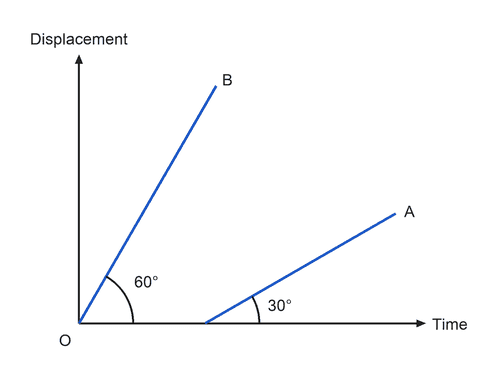
Two straight lines drawn on the same displacement–time graph make angles 30° and 60° with time axis respectively as shown in the given figure. Which line represents greater velocity? What is the ratio of the two velocities?
- 653 marks
Question 65
A body travels a distance with velocity and distance with velocity in the same direction. What is the average velocity of the body?
- 663 marks
Question 66
The North American and European continents are drifting apart at an average speed of about 3 cm per year. At this speed, how long (in years) will it take for them to drift apart by another 1500 m?
- 673 marks
Question 67
When a person sneezes his eyes remain shut for about 0.5 s. If the person is driving a race car at 108 km/h how far does it move during that time?
- 683 marks
Question 68
The velocity of a bullet is reduced from to while travelling through a wooden plank of thickness 50 mm. Find the retardation assuming it to be uniform.
- 693 marks
Question 69
A car is travelling on a straight level road with a uniform speed of 60 km/h. It is followed by another car which is moving with a speed of 70 km/h. When the distance between them is 2.5 km, the car is given a deceleration of 20 km/h². After what distance and time will catch up with ?
- 703 marks
Question 70
The speed of a train is reduced from 60 km/h to 15 km/h whilst it travels a distance of 450 m. If the retardation is uniform, find how much further it will travel before coming to rest.
- 713 marks
Question 71
A rocket is fired vertically from the ground with a resultant vertical acceleration of . The fuel is finished in one minute and it continues to move up. After how much time from then will the maximum height be reached?
- 723 marks
Question 72
A body starting from rest was observed to cover 20 m in one second and 40 m during the next second. How far did the body travel before the first observation was taken?
- 733 marks
Question 73
Brakes are applied to a train travelling at 72 km/h. After passing 200 m, its velocity is reduced to 36 km/h. At the same rate of retardation, how much further will it go before it is brought to rest?
- 743 marks
Question 74
A ball rolls down an inclined track 2 m long in 4 s. Find (i) acceleration, (ii) the time taken to cover the second metre of the track and (iii) speed of the ball at the bottom of track.
- 753 marks
Question 75
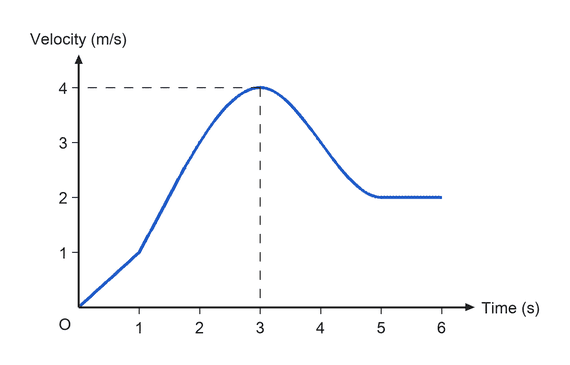
The velocity–time graph of a particle starting from rest and moving along a straight line is as shown in the given figure. (i) What is the average acceleration for the interval to s? (ii) When is the acceleration zero?
- 763 marks
Question 76
A particle moves along a straight line such that its displacement at any instant is given by m, is in second. Calculate the velocity when the acceleration is zero.
- 773 marks
Question 77
The acceleration in m/s² of a particle is given by where is the time in second. If the particle starts out with a velocity m/s at , then find the velocity at the end of 2 s.
- 783 marks
Question 78
A stone is projected vertically upwards with a velocity of 19.6 m/s. Find (a) the maximum height attained and (b) the time of ascent.
- 793 marks
Question 79
From the top of a tower of height 44.1 m, a stone is dropped. How long does it take and what is its velocity when it reaches the ground?
- 803 marks
Question 80
For a stone freely falling from rest, the distance covered by it in the last second is equal to the distance covered by it in the first three seconds. Calculate the time taken by the stone to reach the ground.
- 813 marks
Question 81
Stones are thrown upwards one after the other with the same speed at an interval of 1 s. The next stone is thrown when the velocity of the previous stone is zero. Calculate the maximum height attained by the stone.
- 823 marks
Question 82
A bomb is dropped from an aircraft when it is directly above a target at a height of 1000 m. The aircraft is moving with a velocity of 500 km/h. Will the bomb hit the target and if not, by how much distance will it miss the target?
- 833 marks
Question 83
An elevator in which a man is standing is moving upwards with a constant speed of 10 m/s. If the man drops a ball from a height 2.45 m, find the time taken by it to reach the floor of the elevator.
- 843 marks
Question 84
A ball dropped from a cliff travels 34.3 m in the last second before it reaches the ground at the foot of the cliff. Find the height of the cliff.
- 853 marks
Question 85
A stone is thrown vertically upwards with a speed of from the ground and at the same time a second stone is thrown vertically downwards from a height of 40 m along the same line of motion. Find the point of collision.
- 863 marks
Question 86
A stone is dropped from the top of a tower. One second later another stone is dropped from a point 25 m below the top. The stones reach the ground simultaneously. Calculate the height of the tower.
- 873 marks
Question 87
A jet aeroplane travelling at the speed of ejects its products of combustion at the speed of relative to the jet plane. What is the speed of the latter with respect to an observer on the ground?
- 881 mark
Question 88
An aeroplane flies 400 m north and 300 m south and then flies 1200 m upwards, then net displacement is
- 891 mark
Question 89
A graph is drawn between velocity and time for the motion of a particle. The area under the curve between the time intervals and gives
- 901 mark
Question 90
Preeti reached the metro station and found that the escalator was not working. She walked up the stationary escalator in time . On other days, if she remains stationary on the moving escalator, then the escalator takes her up in time . The time taken by her to walk up on the moving escalator will be
- 911 mark
Question 91
A particle is constrained to move on a straight-line path. It returns to the starting point after 10 s. The total distance covered by the particle during this time is 30 m. Which of the following statements about the motion of the particle is false?
- 921 mark
Question 92
A particle starts its motion from rest under the action of a constant force. If the distance covered in first 10 second is and that covered in the first 20 seconds is , then
- 931 mark
Question 93
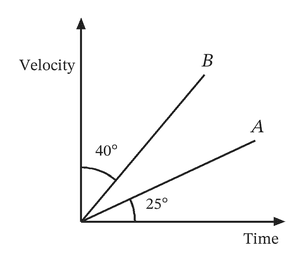
The velocity–time graph for two bodies, A and B are shown in the given figure. Then, the acceleration of A and B are in the ratio
- 941 mark
Question 94
What determines the nature of the path followed by the particle?
- 951 mark
Question 95
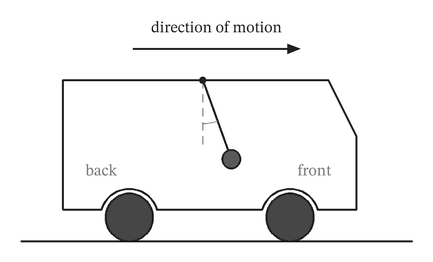
A ball is hung by a string from the ceiling of a car moving on a straight and smooth road. If the string is inclined towards the front side of the car making a small constant angle with the vertical, then the car is moving with
- 961 mark
Question 96
An object moving with a speed of 6.25 m/s, is decelerated at a rate given by where is the instantaneous speed. The time taken by the object, to come to rest, would be
- 971 mark
Question 97
The velocity of a particle is . If its position is at , then its displacement after unit time () is
- 981 mark
Question 98
A body A starts from rest with an acceleration . After 2 seconds, another body B start from rest with an acceleration . If they travel equal distances in the 5th second after the start of A, then the ratio is equal to
- 991 mark
Question 99
A ball is dropped from a high-rise platform at starting from rest. After 6 seconds, another ball is thrown downward from the same platform with a speed . The two balls meet at s. What is the value of (take )?
- 1001 mark
Question 100
Two identical metal spheres are released from the top of a tower after seconds of each other such that they fall along the same vertical line. If air resistance is neglected, then at any instant of time during their fall,
- 1011 mark
Question 101
A stone falls freely under gravity. It covers distances , and in the first 5 seconds, the next 5 seconds and the next 5 seconds respectively. The relation between , and is
- 1021 mark
Question 102
Two balls A and B of same masses are thrown from the top of the building. A, thrown with velocity and B, thrown downward with velocity , then
- 1031 mark
Question 103
Three different object of masses , and are allowed to fall from rest and from the same point 'O' along three different frictionless paths. The speeds of the three objects, on reaching the ground, will be in the ratio of

- 1041 mark
Question 104
Free fall of an object (in vacuum) is a case of motion with
- 1051 mark
Question 105
A particle starts from the origin at time and moves along the positive x-axis. The graph of velocity with respect to time is shown in the given figure. What is the position of the particle at time s?

- 1061 mark
Question 106
A particle is moving with speed along positive x-axis. Calculate the speed of the particle at time (assume that the particle is at origin at )
- 1071 mark
Question 107
A small block slides without friction down an inclined plane starting from rest. Let be the distance travelled from time to . Then, is
- 1081 mark
Question 108
A particle located at at time , starts moving along the positive x-direction with a velocity '' that varies as . The displacement of the particle varies with time as
- 1091 mark
Question 109
Starting from the origin at time , with initial velocity , a particle moves in the – plane with a constant acceleration of . At time , its coordinates are . The values of and , are respectively
- 1101 mark
Question 110
A ball is thrown vertically downward with a velocity of 20 m/s from the top of a tower. It hits the ground after some time with a velocity of 80 m/s. The height of the tower is ()
- 1111 mark
Question 111
An engine of a train, moving with uniform acceleration, passes the signal-post with velocity and the last compartment with velocity . The velocity with which middle point of the train passes the signal post is
- 1121 mark
Question 112
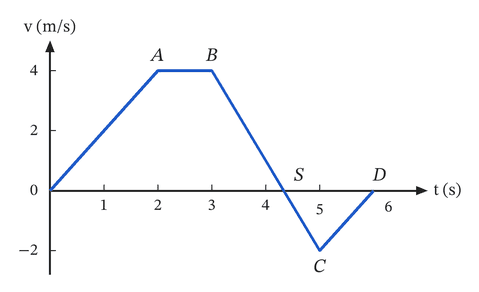
The velocity () and time () graph of a body in a straight-line motion is shown in the given figure. The point is at 4.333 seconds. The total distance covered by the body in 6 s is
- 1131 mark
Question 113
The instantaneous velocity of a particle moving in a straight line is given as , where and are constant. The distance travelled by the particle between 1 s and 2 s is
- 1141 mark
Question 114
A stone is dropped from the top of a building. When it crosses a point 5 m below the top, another stone starts to fall from a point 25 m below the top. Both stones reach the bottom of building simultaneously. The height of the building is
- 1151 mark
Question 115
A scooter accelerates from rest for time at constant rate and then retards at constant rate for time and comes to rest. The correct value of will be
- 1161 mark
Question 116
A car accelerates from rest at a constant rate for some time after which it decelerates at a constant rate to come to rest. If the total time elapsed is seconds, the total distance travelled is
- 1171 mark
Question 117
A bomb is dropped by a fighter plane flying horizontally. To an observer sitting in the plane, the trajectory of the bomb is a
- 1181 mark
Question 118
A balloon was moving upwards with a uniform velocity of 10 m/s. An object of finite mass is dropped from the balloon when it was at a height of 75 m from the ground level. The height of the balloon from the ground when object strikes the ground was around (take the value of as )
- 1191 mark
Question 119
The position, velocity and acceleration of a particle moving with a constant acceleration can be represented by
- 1201 mark
Question 120
Read the assertion and reason carefully to mark the correct option out of the options given below:
Assertion: The average velocity of the object over an interval of time is either smaller than or equal to the average speed of the object over the same interval.
Reason: Velocity is a vector quantity and speed is a scalar quantity.
- 1211 mark
Question 121
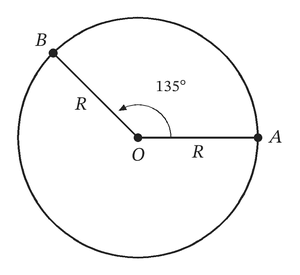
A person moved from to on a circular path as shown in the given figure. If the distance travelled by him is 60 m, then the magnitude of displacement would be (Given )
- 1221 mark
Question 122
A ball is released from a height . If and be the time required to complete first half and second half of the distance respectively, then choose the correct relation between and .
- 1231 mark
Question 123
A car travels a distance with speed and then the same distance with speed in the same direction. The average speed of the car is
- 1241 mark
Question 124
The distance travelled by a particle is related to time as . The velocity of the particle at s is