
Question 565 marksMedium
(a) Define instantaneous velocity and instantaneous acceleration.
(b) Draw the velocity–time graph of a particle moving with uniform acceleration. Using the graph derive the equations of motion.
Confirming your payment
Sign up now and get 250 free tokens.
Motion in a Straight Line · Question 56 of 58
(a) Define instantaneous velocity and instantaneous acceleration.
(b) Draw the velocity–time graph of a particle moving with uniform acceleration. Using the graph derive the equations of motion.
Solution:
Concept: Instantaneous quantities are limits of average quantities over shorter and shorter time intervals. On a velocity–time graph, the slope is the acceleration and the area under the graph is the displacement.
Step 1 — Part (a): instantaneous velocity. The instantaneous velocity is the velocity of a particle at a given instant. It is the limit of the average velocity as the time interval tends to zero:
Step 2 — Part (a): instantaneous acceleration. The instantaneous acceleration is the acceleration of a particle at a given instant, the limit of the average acceleration as the time interval tends to zero:
Step 3 — Draw the velocity–time graph. A body moves with uniform acceleration . At time its velocity is (point P, ) and at time it is (point Q, , ). Since the acceleration is uniform, the graph PQ is a straight line. PR is drawn parallel to the time axis, so , and .
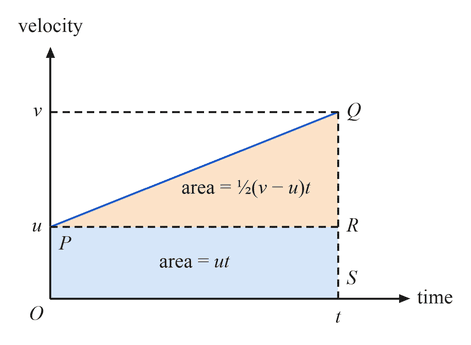
Step 4 — Derive from the slope. The slope of the velocity–time graph is the acceleration, and the slope of PQ is :
Step 5 — Derive from the area. The displacement is the area under PQ, that is, the area of the trapezium OPQS. This area is the rectangle OPRS plus the triangle PQR:
We use from Step 4:
Step 6 — Derive . The same area can be written with the trapezium formula, half the sum of the parallel sides times the distance between them:
From Step 4, . We put this in:
Therefore, (a) instantaneous velocity is and instantaneous acceleration is ; (b) the straight-line velocity–time graph gives , and .