
Question 575 marksMedium
(a) Write down the equations of motion of an object under gravity.
(b) Draw the displacement–time graph and velocity–time graph of a body thrown into air vertically upwards.
Confirming your payment
Sign up now and get 250 free tokens.
Motion in a Straight Line · Question 57 of 58
(a) Write down the equations of motion of an object under gravity.
(b) Draw the displacement–time graph and velocity–time graph of a body thrown into air vertically upwards.
Solution:
Concept: Near the Earth's surface, and neglecting air resistance, every body moves vertically with the constant acceleration (about ) directed downward. So the equations of uniformly accelerated motion apply, with replaced by or according to the sign convention.
Step 1 — Part (a): body moving upward. Take the upward direction as positive, so . For a body projected upward with speed , its velocity and height after time are:
Step 2 — Part (a): body falling downward. Take the downward direction as positive, so . For a body thrown downward with speed , after falling a height in time :
For a body simply dropped, , so , and .
Step 3 — Part (b): find the key points. For a body thrown up with speed and caught at the point of projection (upward positive), the velocity becomes zero at the top, after . The greatest height is:
The body is back at the point of projection after , when its velocity is , or .
Step 4 — Part (b): draw the graphs. The figure shows both graphs.
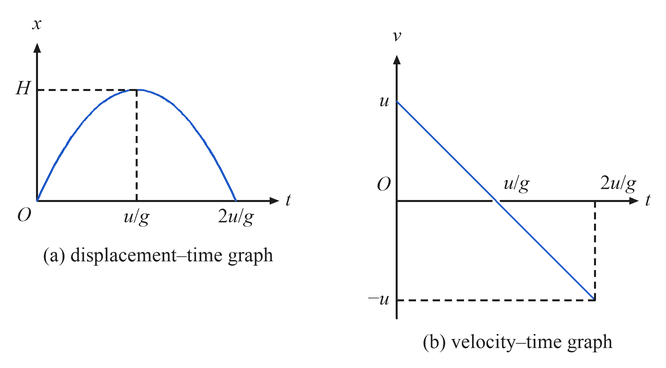
Step 5 — Part (b): describe the graphs. The displacement–time graph is a parabola: the height rises from zero to at and falls back to zero at , symmetric about the top. The velocity–time graph is a straight line of slope : it starts at , crosses the time axis at (the top) and ends at at .
Therefore, (a) under gravity , and (upward positive); (b) the displacement–time graph is a parabola with its peak, of height , reached at time , and the velocity–time graph is a straight line from to with slope .