
Opening your dashboard
Class 11 Physics Chapter 4 Motion in a Straight Line: Competency-Based Questions (CBQ)
40 questions on Chapter 4, each worked through on its own page with the AI tutor. Class 11 Physics, ICSE 2026-27.
40 questions
1–4 marks · Mixed difficulty
- 14 marks
Question 1
Competency: Application
A ferry runs on a straight stretch of a river between jetty P and jetty Q, which is upstream of P. Relative to the water, the ferry always moves at , and the river flows at a steady . (Hypothetical data.)
(a) Find the speed of the ferry relative to the bank when it goes upstream and when it comes downstream, and the time each trip takes.
(b) Find the ferry's average speed, relative to the bank, for the round trip from P to Q and back to P without stopping at Q. Is it more or less than ?
(c) On one trip a life ring falls overboard at P just as the ferry leaves for Q, and floats away with the water. The crew notice only when the ferry reaches Q, and the ferry turns back at once. Using the frame of reference of the water, find how long after leaving P the ferry reaches the ring, and how far from P this happens.
- 21 mark
Question 2
Competency: Analysis & Evaluation
Meera runs on a treadmill in a gym for minutes. The belt moves at a steady , and she stays level with the front panel of the machine the whole time. At the end, the panel shows “distance ”. (Hypothetical data.) Which statement about her motion is correct?
- 31 mark
Question 3
Competency: Application
Two metro trains run in opposite directions on parallel straight tracks, each at relative to the ground. Riya sits at a window in one train and watches the other train, which is long, go past her window. (Hypothetical data.) How long does the other train take to pass her window?
- 43 marks
Question 4
Competency: Application
At a village fair, a contestant climbs a greased pole high to reach a prize at the top. Starting from the foot, the contestant climbs in each odd-numbered minute (the 1st, 3rd, 5th, …) and slides down in each even-numbered minute, each at a steady rate. Treat the contestant as a point moving along a vertical line. (Hypothetical data.)
(a) Find the distance the contestant has covered and the displacement at the end of the 4th minute.
(b) At what time does the contestant first reach the top?
(c) From the start until the contestant first reaches the top, find the total distance covered, the displacement, the average speed and the average velocity (in ).
- 51 mark
Question 5
Competency: Application
In a motorcycle engine, the piston moves up and down along a straight line between two end positions apart (the stroke). The engine turns at a steady revolutions per minute, and in each revolution the piston makes one complete trip up and back down. (Hypothetical data.) For any interval of exactly , the distance covered by the piston and its displacement are
- 64 marks
Question 6
Competency: Analysis & Evaluation
On an expressway, two cameras apart read the number plate of every car and record the time at which it passes. The speed limit is . A car passes the first camera at 10:02:15 and the second camera at 10:09:00. (Hypothetical data.)
(a) Find the average speed of the car between the cameras, in .
(b) The driver says that the speedometer read at each camera, so the car never went above the limit. Explain, with a calculation, why this claim cannot be true.
(c) Another car covers the first at a steady . What is the greatest steady speed it can keep over the remaining if its average speed between the cameras is not to exceed the limit?
- 71 mark
Question 7
Competency: Analysis & Evaluation
A school bus leaves its depot, runs along a straight road to pick up children, and comes back to the depot at the end of its round. The conductor notes the speedometer reading every minutes during the round, and the readings average . (Hypothetical data.)
Assertion (A): The average velocity of the bus for the whole round is zero.
Reason (R): The average velocity for a trip is equal to the average of the speedometer readings taken at equal time intervals during the trip.
- 84 marks
Question 8
Competency: Application
Towns A and B are apart on a straight highway. Bus 1 leaves A for B at 8:00 a.m. and travels at a steady ; on reaching B it stays there. Bus 2 waits at B and leaves for A at 8:30 a.m., travelling at a steady . Take A as the origin, the direction from A to B as positive, and at 8:00 a.m. (Hypothetical data.)
(a) Draw the position–time graphs of both buses on the same axes, from to .
(b) Use the slopes of the graphs to find the velocity of each bus while it is moving.
(c) Find the time and the place at which the buses meet.
(d) At what times are the buses apart?
- 91 mark
Question 9
Competency: Analysis & Evaluation
On a straight cycle track, Rohan overtakes Sameer. A student plots the position–time graphs of both cyclists, measured from the same starting line, on one set of axes.
Assertion (A): At the point where the two position–time graphs meet, they must have the same slope.
Reason (R): Two position–time graphs meet at a point when the two bodies are at the same position at the same instant.
- 103 marks
Question 10
Competency: Application
An e-rickshaw starts from rest on a straight, level road. A phone fixed to it records its acceleration, and the figure shows the acceleration–time graph for the trip. (Hypothetical data.)
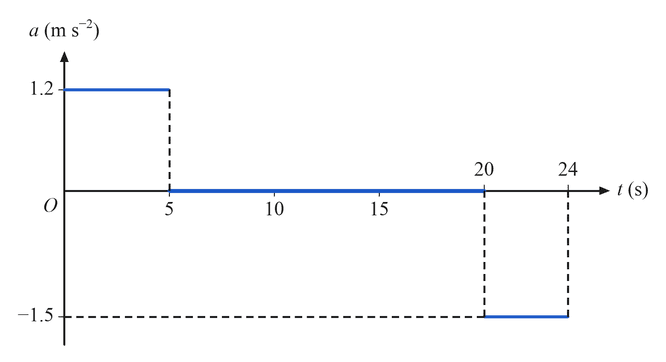
(a) Explain what the area between an acceleration–time graph and the time axis represents. Use it to find the velocity of the e-rickshaw at , at and at .
(b) Draw the velocity–time graph for the trip.
(c) Find the total distance covered in the .
- 111 mark
Question 11
Competency: Analysis & Evaluation
Cricket coaches teach fielders to let their hands move back along with the ball while taking a catch, instead of holding the hands rigid.
Assertion (A): Moving the hands back with the ball makes the average deceleration of the ball during the catch smaller.
Reason (R): During the catch, the ball is brought to rest.
- 121 mark
Question 12
Competency: Application
A ticker timer makes dots every second on a paper tape that is pulled along by a trolley running down a ramp. The tape is divided into sections of five dot-spaces each, as shown in the figure. In the order in which they were made, the sections are , , and long. (Hypothetical data.)
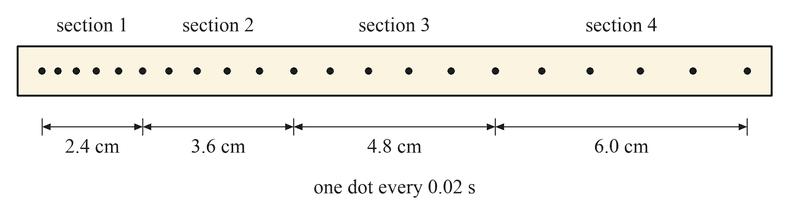
The acceleration of the trolley is
- 134 marks
Question 13
Competency: Analysis & Evaluation
Road-safety advice asks drivers to keep at least a “two-second gap”: the car behind should pass a roadside post at least after the car in front. Two cars travel one behind the other on a straight expressway at (), exactly apart. Suddenly the front car brakes with a uniform retardation of . The rear driver starts braking later, because of the driver's reaction time. Treat the cars as points. (Hypothetical data.)
(a) Find the distance between the cars before the braking begins.
(b) If the rear car also brakes at , find the distance between the cars when both have stopped.
(c) On a wet day the front car can still brake at , but the rear car, with worn tyres, only at . Show that a two-second gap is then not enough, and find the smallest time gap that would let the rear car stop without hitting the front car.
- 143 marks
Question 14
Competency: Application
A car speeding at a steady () on a straight city road passes a traffic-police motorcyclist waiting at rest. Exactly later the motorcyclist sets off after the car with a uniform acceleration of , until the motorcycle's speed reaches ; after that the motorcyclist keeps this speed. Take at the instant the car passes the motorcyclist. (Hypothetical data.)
(a) When is the gap between the car and the motorcyclist greatest, and how large is it?
(b) When, and how far from the point where the motorcyclist was waiting, does the motorcyclist catch up with the car?
(c) Sketch the velocity–time graphs of the car and the motorcyclist on the same axes, and use them to explain your answers to (a) and (b).
- 151 mark
Question 15
Competency: Analysis & Evaluation
A student records a car moving along a straight road with uniform acceleration. The student finds that its average velocity from to is equal to its velocity at .
Assertion (A): For a body moving along a straight line with uniform acceleration, the average velocity over any time interval is equal to its instantaneous velocity at the middle instant of that interval.
Reason (R): With uniform acceleration the velocity changes by equal amounts in equal times, so the average velocity over an interval is the mean of the initial and final velocities, , and the velocity has this mean value at the middle instant.
- 161 mark
Question 16
Competency: Application
A truck whose brakes have failed is steered into a level gravel arrester bed beside a hill road, entering it at . The gravel gets deeper along the bed, so the truck's retardation grows in proportion to the distance it has travelled into the bed: its acceleration is , with . (Hypothetical data.) How far into the bed does the truck come to rest?
- 171 mark
Question 17
Competency: Analysis & Evaluation
On a straight test track, a car that moves forward all the time first speeds up and then slows down. Its velocity changes smoothly with time.
Assertion (A): At the instant the car reaches its greatest speed, its acceleration is zero.
Reason (R): Acceleration is , the slope of the velocity–time graph, and the slope of a smooth graph is zero at its highest point.
- 183 marks
Question 18
Competency: Application
A basketball player jumps straight up to block a shot. A video shows that the player's feet leave the floor and land back on it later; this time is called the player's “hang time”. Treat the player as a point that leaves and returns to the same height, neglect air resistance and take . (Hypothetical data.)
(a) Find the player's take-off speed.
(b) Find how high the player rises.
(c) The coach says that to double the hang time the player would need to jump only twice as high. Is the coach right? Find the height the player would have to reach for a hang time of .
- 191 mark
Question 19
Competency: Analysis & Evaluation
Two identical balls are thrown straight up with the same speed, one on the Earth () and one on Mars (). Neglect air resistance on both planets.
Assertion (A): The ball on Mars stays in the air about times as long as the ball on the Earth.
Reason (R): The atmosphere of Mars is much thinner than the atmosphere of the Earth.
- 201 mark
Question 20
Competency: Analysis & Evaluation
To find the height of a building, Arjun lets a small stone fall from rest from the roof and starts a stopwatch at the same instant. He stops the watch when he sees the stone hit the ground, and it reads . His friend points out that Arjun's reaction in stopping the watch probably made the reading about too long. Neglect air resistance and take . (Hypothetical data.) If the friend is right, Arjun's value for the height is too large by about
- 213 marks
Question 21
Competency: Application
A science museum shows a working model of Galileo's experiment. A small trolley is released from rest at a mark O on a straight track inclined at an angle to the horizontal, where . Small bells are fixed beside the track so that the trolley strikes one bell every after it is released. Treat the trolley as sliding without friction (ignore the turning of its wheels) and take . (Hypothetical data.)
(a) Find the acceleration of the trolley along the track.
(b) Find how far from O, along the track, the first four bells must be fixed.
(c) The track is long. How many bells can be fitted on it, and how fast is the trolley moving when it strikes the last one?
- 221 mark
Question 22
Competency: Analysis & Evaluation
A block slides down a smooth inclined plane. A student makes the plane steeper, changing its angle with the horizontal from to .
Assertion (A): Doubling the angle of the smooth plane doubles the acceleration of the block down the plane.
Reason (R): The acceleration of a block sliding down a smooth plane inclined at to the horizontal is .
- 233 marks
Question 23
Competency: Application
The tip of a robotic arm moves along a straight guide towards a target. Its position , in centimetres and measured from its starting point, depends on the time , in seconds (), as follows:
(Hypothetical data.)
(a) Use the quotient rule to find the velocity of the tip, and its value at and at .
(b) Find the acceleration of the tip at . Is the tip speeding up or slowing down?
(c) Show that the tip never reaches , and find the time after which it stays within of that point.
- 241 mark
Question 24
Competency: Application
A small bead is pulled along a straight wire by a motor. Its position is , where is in metres and in seconds. (Hypothetical data.) The velocity of the bead at is
- 251 mark
Question 25
Competency: Analysis & Evaluation
A particle moves along the -axis with velocity , where is in and is in seconds. (Hypothetical data.) A student evaluates the integral of with respect to from to .
Assertion (A): The value of is zero, and it is the particle's displacement from to , even though the particle moves during this time.
Reason (R): The integral of velocity with respect to time over an interval always gives the total distance travelled in that interval.
- 264 marks
Question 26
A man walks on a straight road from his home to a market 2.5 km away with a speed of . Finding the market closed, he instantly turns and walks back home with a speed of . What is (a) the magnitude of average velocity and (b) average speed of the man over an interval of time from (i) 0 to 30 min and (ii) 0 to 50 min?
- 273 marks
Question 27
A particle starts with a velocity of 200 cm/s and moves in a straight line with a retardation of 10 cm/s². Find the time it takes to describe 1500 cm and explain the double answer.
- 284 marks
Question 28
A car accelerates from rest at a constant rate for some time, after which it accelerates at a constant rate to come to rest. If the total time lapsed is , calculate (a) the maximum velocity reached and (b) the total distance travelled.
- 293 marks
Question 29
Starting from rest, a car moves with uniform acceleration and attains a velocity of 72 km/h in 15 s. It then moves with uniform speed for 20 s and is then brought to rest in 10 s under uniform retardation. Find the total distance travelled using velocity–time graph.
- 304 marks
Question 30
A motor car starts from rest and accelerates uniformly for 10 s to a velocity of 8 m/s. It then runs at a constant velocity and is finally brought to rest in 53 m with a constant retardation. The total distance passed over is 584 m. Find the value of acceleration, retardation and the total time taken.
- 313 marks
Question 31
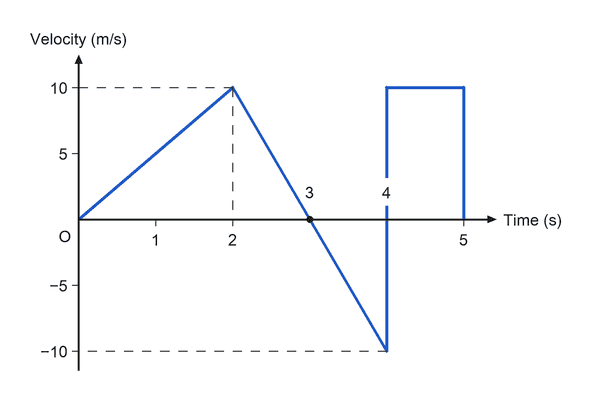
The velocity–time graph of a particle moving along a straight line is shown in the following figure. Calculate the distance travelled by the particle in the interval between and s?
- 323 marks
Question 32
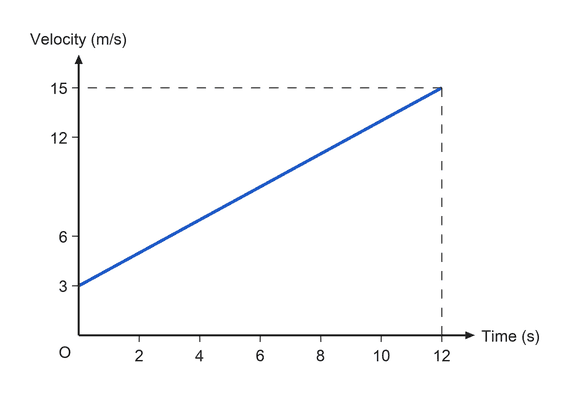
The velocity–time graph of a particle moving along the -axis is as shown in the given figure. Calculate (i) the acceleration (ii) the distance travelled and the displacement of the particle in 10 s.
- 333 marks
Question 33
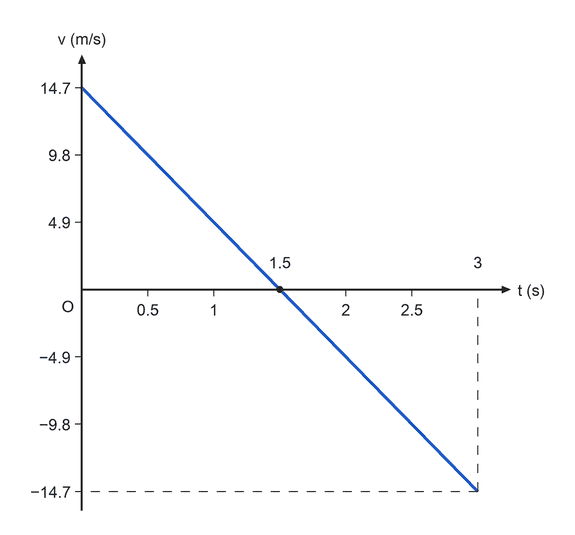
The velocity–time graph of a body projected vertically upwards is as shown in the following figure. Calculate (i) the displacement of the body in the interval 0 to 3 s, (ii) the distance travelled during the same interval and (iii) the acceleration of the body.
- 343 marks
Question 34
The deceleration experienced by a moving motor boat after its engine is cut off is given by , where is a constant. If is the magnitude of the velocity at cut off, then calculate the magnitude of the velocity at a time after the cut off.
- 353 marks
Question 35
A ball thrown up is caught back by the thrower after 4 seconds. How high did it go and with what velocity was it thrown? How far below its highest point was it 3 s after start?
- 363 marks
Question 36
A stone is projected vertically upwards with a velocity of 19.6 m/s from the top of a tower 20.4 m height. Find (i) the greatest elevation and (ii) its velocity at the moment it strikes the ground.
- 373 marks
Question 37
A stone is allowed to fall from the top of a tower 300 m high and at the same time another is projected vertically upward with a velocity of 75 m/s. Find when and where the two will meet.
- 383 marks
Question 38
A man in a balloon rising vertically with an acceleration of 4.9 m/s², releases a ball 2 s after the balloon is let go from the ground. Calculate the greatest height above the ground reached by the ball.
- 393 marks
Question 39
A balloon is rising with a velocity of and a bag is dropped from it when its height from the ground is 39.2 m. Calculate the time taken by the bag to reach the ground.
- 403 marks
Question 40
A parachutist, after bailing out falls a distance of 19.6 m after which the parachute opens and he decelerates at 1.1 m/s². He reaches the ground with a speed of 2 m/s. (a) Find how long the parachute was in air? (b) At what height did he bail out?