
Question 91 markMCQEasy
A car starts from rest moves with uniform acceleration for second and then retards uniformly at a rate for second. Then is equal to
Confirming your payment
Sign up now and get 250 free tokens.
Motion in a Straight Line · Question 9 of 58
A car starts from rest moves with uniform acceleration for second and then retards uniformly at a rate for second. Then is equal to
(A)
(B)
(C)
(D)
Answer: (B)
Concept: The car starts from rest and (as the question implies) ends at rest, so the speed gained in the first part is lost in the second. For uniform acceleration, change in speed = acceleration × time.
Step 1 — Draw the velocity–time graph. The speed rises to with slope in time and falls back to zero with slope in time .
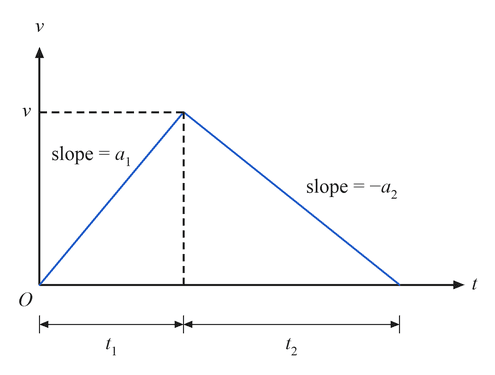
Step 2 — Write for each part. The speed gained equals the speed lost:
Step 3 — Equate and rearrange. Setting the two equal and dividing by :
Therefore, , option (B).