
Question 71 markMCQMedium
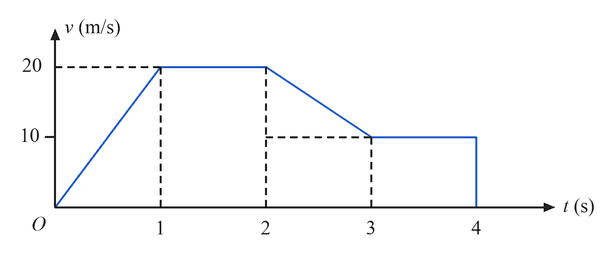
The variation of velocity of a particle moving along a straight line is illustrated in the following figure. The distance traversed by the particle in 4 seconds is
Confirming your payment
Sign up now and get 250 free tokens.
Motion in a Straight Line · Question 7 of 58
The variation of velocity of a particle moving along a straight line is illustrated in the following figure. The distance traversed by the particle in 4 seconds is
(A) 60 m
(B) 25 m
(C) 55 m
(D) 30 m
Answer: (C) 55 m
Concept: The area between a velocity–time graph and the time axis gives the displacement. Here the velocity is never negative, so this area is also the distance travelled.
Step 1 — Split the area into simple shapes. The figure shows the four parts: a triangle from 0 to 1 s, a rectangle from 1 s to 2 s, a trapezium from 2 s to 3 s and a rectangle from 3 s to 4 s.
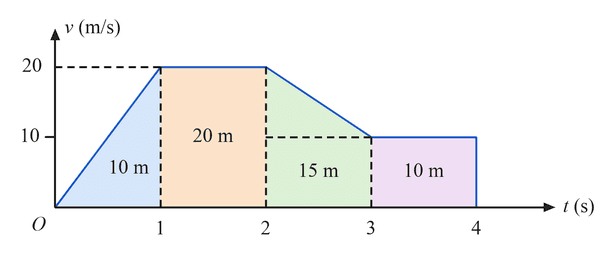
Step 2 — Find the area of the triangle (0 to 1 s). The velocity rises from 0 to 20 m/s in 1 s:
Step 3 — Find the area of the first rectangle (1 s to 2 s). The velocity stays at 20 m/s for 1 s:
Step 4 — Find the area of the trapezium (2 s to 3 s). The velocity falls from 20 m/s to 10 m/s in 1 s:
Step 5 — Find the area of the last rectangle (3 s to 4 s). The velocity stays at 10 m/s for 1 s:
Step 6 — Add the four parts. The total distance is:
Therefore, the particle travels 55 m in 4 s, option (C).