
Question 41 markMCQMedium
A car accelerates from rest at a constant rate for some time after which it decelerates at a constant rate to come to rest. If the total time elapsed is , the maximum velocity acquired by the car is
Confirming your payment
Sign up now and get 250 free tokens.
Motion in a Straight Line · Question 4 of 58
A car accelerates from rest at a constant rate for some time after which it decelerates at a constant rate to come to rest. If the total time elapsed is , the maximum velocity acquired by the car is
(A)
(B)
(C)
(D)
Answer: (D)
Concept: The car's speed rises from zero to a maximum and then falls back to zero. With uniform acceleration, links each part's time to .
Step 1 — Draw the velocity–time graph. The car speeds up for a time (slope ) and then slows down for a time (slope ), with .
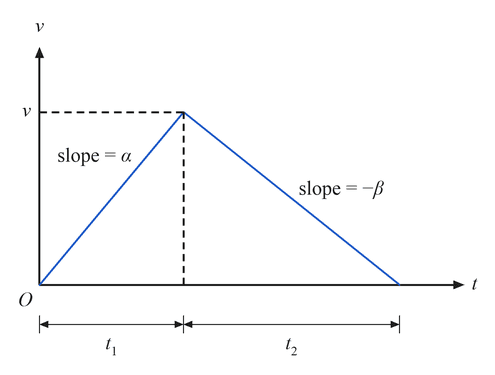
Step 2 — Write each time in terms of . Starting from rest, the speed reaches after , and it then falls from to zero in :
Step 3 — Add the two times. Their sum is the total time :
Therefore, the maximum velocity is , option (D).