
Question 51 markMCQMedium
A train accelerates from rest at a constant rate for some time and then it retards to rest at the constant rate . If the total distance covered by the train is , then the velocity of the train is
Confirming your payment
Sign up now and get 250 free tokens.
Motion in a Straight Line · Question 5 of 58
A train accelerates from rest at a constant rate for some time and then it retards to rest at the constant rate . If the total distance covered by the train is , then the velocity of the train is
(A)
(B)
(C)
(D)
Answer: (C)
Concept: The "velocity of the train" here is its greatest velocity , reached at the end of the speeding-up part. For each part, links to the distance covered.
Step 1 — Picture the motion. The train speeds up from rest to with acceleration , covering , and then slows from to rest with retardation , covering . The area under the velocity–time graph is the total distance .
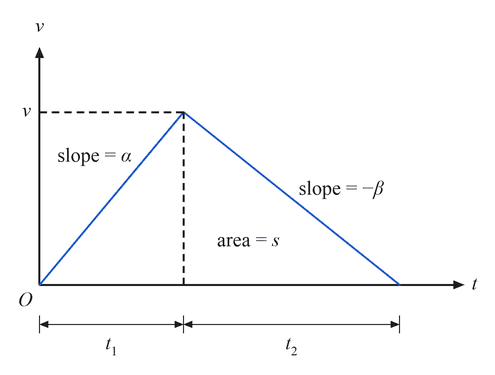
Step 2 — Find each distance. We use for each part; the first part starts from rest and the second part ends at rest:
Step 3 — Add the two distances. Their sum is :
Step 4 — Solve for . We multiply both sides by and take the square root:
Therefore, the greatest velocity of the train is , option (C).