
Opening your dashboard
Class 11 Physics Chapter 16: Thermal Properties of Matter Solutions
61 textbook questions with step-by-step answers, free to read, for ISC 2026-27.
Get talked through Ch 16, not just shown the answer
Reading a finished solution is not the same as being able to do it. The AI tutor takes one question at a time and works it with you, in your own words, until you can.
- Ask it out loud, in your own words
- It gives you the next step, not the answer
- Stuck on part (ii)? Start there
61 questions with solutions
1–5 marks · Mixed difficulty
The first 46 solutions are on this page. This chapter is a long one, so the rest open on their own page to keep this one quick to load.
- 11 mark
Question 1
The temperature of a body on Kelvin scale is found to be K. When it is measured by Fahrenheit thermometer, it is found to be °F, then the value of is
Solve with AIAnswer
(A) 40
(B) 313
- Correct
(C) 574.25
(D) 301.25
Answer: (C) 574.25
Concept: Readings on the Fahrenheit and Kelvin scales are linked through the fraction of the interval between the ice point and the steam point: , or .
Step 1 — Put both readings equal to . The same number appears on both scales, so
Step 2 — Cross-multiply. Multiplying both sides by 45 removes the fractions:
Step 3 — Solve for . Collecting the terms in on one side gives
With the more exact ice point , the same working gives , still closest to option (C).
- (A) 40 is not a solution: is the temperature at which the Celsius and Fahrenheit readings are equal, and is about .
- (B) is , or , so the two readings are not equal.
- (D) is about , or about , so the readings differ.
Therefore, the answer is (C): x = 574.25.
- 21 mark
Question 2
The coefficient of apparent expansion of a liquid when determined using two different vessels and are and respectively. If the coefficient of linear expansion of the vessel is , the coefficient of linear expansion of the vessel is
Solve with AIAnswer
(A)
(B)
(C)
- Correct
(D)
Answer: (D)
Concept: The real expansion of a liquid is its apparent expansion plus the expansion of the vessel: . For a solid vessel, (coefficient of linear expansion).
Step 1 — Write the real expansion with vessel A. The coefficient of real expansion of the liquid does not depend on the vessel. With vessel A,
Step 2 — Write it with vessel B. If is the coefficient of linear expansion of vessel B,
Step 3 — Equate and solve for . The two expressions describe the same liquid, so
- (A) The numerator is a product of three coefficients and the denominator only one, so this expression has the unit , not ; it cannot be a coefficient of expansion.
- (B) This is a ratio of two coefficients, so it has no unit at all; also, if and were equal, vessel B would have to expand exactly like vessel A, but this expression would give zero.
- (C) This divides by 3 as well; with it gives instead of .
Therefore, the answer is (D): the coefficient of linear expansion of vessel B is (γ₁ − γ₂)/3 + α.
- 31 mark
Question 3
Water is heated from 0°C to 10°C, then its volume
Solve with AIAnswer
(A) Increase
- Correct
(B) First decreases and then increases
(C) Decreases
(D) Does not change
Answer: (B) First decreases and then increases
Concept: Water shows anomalous expansion: between and it contracts on heating, and above it expands like other liquids. Its volume is least (density greatest) at .
Step 1 — Follow the volume from 0 °C to 4 °C. The volume of 1 g of water falls from about at to about at .
Step 2 — Follow it from 4 °C to 10 °C. Above the volume rises again, to about at . So the volume first decreases and then increases.

- (A) The volume does not increase all the way; it falls between and .
- (C) The volume falls only up to ; from to it rises.
- (D) The volume does change; it is least at and larger at both ends.
Therefore, the answer is (B): the volume first decreases (up to 4 °C) and then increases.
- 41 mark
Question 4
Water has maximum density at
Solve with AIAnswer
(A) 0°C
(B) 32°F
(C) −4°C
- Correct
(D) 4°C
Answer: (D) 4°C
Concept: The volume of a fixed mass of water is least at (more exactly ). Since density , the density is greatest there.
Step 1 — Find where the volume is least. On heating from , water contracts until and then expands, so its volume is least at .
Step 2 — Turn this into density. The mass does not change, so the density is greatest where the volume is least: at , about (about ).
- (A) At water is less dense (about ) than at .
- (B) is the same temperature as , so the same reason applies.
- (C) Water below is normally ice, which is much less dense; even supercooled water at is less dense than water at .
Therefore, the answer is (D): water has its maximum density at 4 °C.
- 51 mark
Question 5
Surface of the lake is at 2°C. Find the temperature of the bottom of the lake.
Solve with AIAnswer
(A) 2°C
(B) 3°C
- Correct
(C) 4°C
(D) 1°C
Answer: (C) 4°C
Concept: Water is densest at . In a still lake, denser water sinks and lighter water rises, so the water arranges itself in layers by density.
Step 1 — See which water sinks. As the lake cools in winter, water at , being the densest, sinks to the bottom. Water colder than is lighter, so it stays near the top.
Step 2 — Find the bottom temperature. The surface is at , which is colder (and lighter) than the water below. So, in a lake deep enough for the layers to settle, the bottom stays at about .
- (A) Water at is less dense than water at , so it stays at the surface, not at the bottom.
- (B) Water at is also slightly less dense than water at , so it lies above the layer.
- (D) Water at is lighter still, so it would be found near the top.
Therefore, the answer is (C): the bottom of the lake is at about 4 °C.
- 61 mark
Question 6
An iron bar of length 10 m is heated from 0°C to 100°C. If the coefficient of linear thermal expansion of iron is /°C, the increase in the length of bar is
Solve with AIAnswer
(A) 0.5 cm
- Correct
(B) 1.0 cm
(C) 1.5 cm
(D) 2.0 cm
Answer: (B) 1.0 cm
Concept: The increase in length of a rod is , where is the original length, the coefficient of linear expansion and the rise in temperature.
Step 1 — Write the data. The data are and , and the rise in temperature (from to ) is .
Step 2 — Substitute. We put these values into the formula:
- (A) 0.5 cm is half the correct value; it would need a rise of only .
- (C) 1.5 cm would need a rise of for this bar.
- (D) 2.0 cm would need a rise of , or a bar twice as long.
Therefore, the answer is (B): the bar becomes 1.0 cm longer.
- 71 mark
Question 7
2 g of steam condenses when passed through 40 g of water initially at 25°C. The condensation of steam raises the temperature of water to 54.3°C. What is the latent heat of steam?
Solve with AIAnswer
- Correct
(A) 540 cal/g
(B) 536 cal/g
(C) 270 cal/g
(D) 480 cal/g
Answer: (A) 540 cal/g
Concept: By the principle of calorimetry, heat given out = heat taken in. The steam gives out its latent heat as it condenses at , and then the condensed water gives out as it cools to the final temperature. The specific heat of water is ; heat taken by the vessel is neglected.
Step 1 — Find the heat given out by the steam. The 2 g of steam condenses, then cools from to :
Step 2 — Find the heat taken in by the water. The 40 g of water warms from to :
Step 3 — Equate and solve for . Heat given out equals heat taken in:
- (B) With the steam would give out , less than the the water took in.
- (C) is half the correct value; the steam would then give out only .
- (D) With the steam would give out only , again less than .
Therefore, the answer is (A): the latent heat of steam is about 540 cal/g.
- 81 mark
Question 8
50 g of copper is heated to increase its temperature by 10°C. If the same quantity of heat is given to 10 g of water, the rise in its temperature is (specific heat capacity of copper = 420 joule kg °C)
Solve with AIAnswer
- Correct
(A) 5°C
(B) 6°C
(C) 7°C
(D) 8°C
Answer: (A) 5°C
Concept: The heat needed to raise the temperature of a mass by is . The specific heat capacity of water is (the stem does not print it, so we take this standard value).
Step 1 — Find the heat given to the copper. For 50 g of copper warmed by :
Step 2 — Find the rise for the water. The same 210 J is given to 10 g of water:
- (B) A rise of in 10 g of water would need , more than the 210 J available.
- (C) A rise of would need .
- (D) A rise of would need .
Therefore, the answer is (A): the water warms by 5 °C.
- 91 mark
Question 9
Boiling water is changing into steam. Under this condition, the specific heat of water is
Solve with AIAnswer
(A) zero
(B) one
- Correct
(C) infinite
(D) less than one
Answer: (C) infinite
Concept: Specific heat is : the heat needed per unit mass per degree rise in temperature.
Step 1 — See what happens while water boils. While water is changing into steam, heat keeps flowing in, but the temperature stays at the boiling point, so .
Step 2 — Put this into the formula. A finite amount of heat with no rise in temperature gives
This has no finite value, so the specific heat is infinite. (The heat goes into changing the state, as latent heat.)
- (A) Zero would mean that no heat is needed for a rise in temperature; in fact heat flows in and the temperature does not rise at all.
- (B) One () is the specific heat of liquid water while it is warming up, not while it is boiling.
- (D) Any finite value would mean the temperature rises when heat is added, which does not happen during boiling.
Therefore, the answer is (C): during boiling the specific heat of water is infinite.
- 101 mark
Question 10
Steam is passed through the water contained in a beaker. The water can boil, when the steam is at
Solve with AIAnswer
(A) atmospheric pressure
- Correct
(B) pressure higher than the atmosphere
(C) pressure lower than the atmosphere
(D) any pressure
Answer: (B) pressure higher than the atmosphere
Concept: Heat flows only from a hotter body to a colder one. To boil, water at its boiling point must keep receiving heat (its latent heat). The temperature of (saturated) steam depends on its pressure: at atmospheric pressure it is , and at higher pressure it is hotter.
Step 1 — Find the boiling point of the water. The water in an open beaker is at atmospheric pressure, so it boils at .
Step 2 — Compare with steam at atmospheric pressure. Steam at atmospheric pressure is also at . It can heat the water up to , but then there is no temperature difference left, so no more heat flows and the water cannot receive the latent heat it needs to boil.
Step 3 — Use steam at higher pressure. Steam at a pressure higher than atmospheric is hotter than , so it keeps supplying heat to the water at , and the water boils.
- (A) Steam at atmospheric pressure is only at , the same as the water's boiling point, so it cannot supply the latent heat.
- (C) Steam at a lower pressure is below , so it cannot even bring the water up to its boiling point.
- (D) Only steam above atmospheric pressure works, so "any pressure" is wrong.
Therefore, the answer is (B): the water can boil only if the steam is at a pressure higher than the atmosphere.
- 111 mark
Question 11
Compared to burn due to air at 100°C, a burn due to steam at 100°C is
Solve with AIAnswer
- Correct
(A) more dangerous
(B) less dangerous
(C) equally dangerous
(D) none of the above
Answer: (A) more dangerous
Concept: Steam at carries its latent heat of vaporisation (about ), which it gives out when it condenses on the skin.
Step 1 — Compare the heat given to the skin. Hot air (or hot water) at gives only the heat of cooling. Steam first condenses on the skin, giving out its large latent heat, and then the hot water so formed cools, giving out more heat.
Step 2 — Put in numbers. Take 1 g cooling to skin temperature, . Water at gives out only the heat of cooling through :
Steam at first gives out its latent heat (about per gram) and then the same heat of cooling:
This is nearly ten times as much. Hot air carries even less heat than hot water, because it is so light.
- (B) Steam delivers far more heat, not less, because of its latent heat.
- (C) The heats delivered are very different, so the burns are not equally serious.
- (D) Option (A) is correct, so "none of the above" is wrong.
Therefore, the answer is (A): a burn from steam at 100 °C is more dangerous, because steam gives out its latent heat on condensing.
- 121 mark
Question 12
A large iceberg melts at the base but not at the top because
(A) the base of the iceberg remains in warmer surroundings
(B) ice at base contains impurities
(C) due to high pressure, ice at the base lowers its melting point
(D) ice at the top is of different kind
Solve with AIWritten solution
Solution:
Concept: Ice melts when heat flows into it while it is at its melting point. The melting point of ice is lowered by pressure (by about for 130 atmospheres), and heat flows into the ice from anything warmer than it.
Step 1 — Judge option (C), the book's answer. The base of a large iceberg is pressed by the great weight of ice above it, so its melting point is lowered. Under about 200 m of ice the pressure is about (about 18 atmospheres), which lowers the melting point by about . So the base melts a little more easily than the top. Option (C) is a correct reason.
Step 2 — Judge option (A). The base is surrounded by sea water, which is usually much warmer than the cold air round the top, and water gives heat to the ice far better than air. In reality this is the main reason icebergs melt from below. So option (A) is also a correct reason.
Step 3 — Judge options (B) and (D). The ice at the base and at the top is the same ice from the same glacier, so (B) and (D) are wrong.
Note: the book's key gives only (C). The pressure effect is real but small (a fraction of a degree), while the warmer water round the base is the larger cause, so both (A) and (C) are correct.
Therefore, both (C), the lowering of the melting point by the high pressure at the base, and (A), the warmer surroundings of the base, are correct reasons; (C) is the book's answer.
- 131 mark
Question 13
The study of physical phenomenon at temperature below liquid nitrogen is called
Solve with AIAnswer
(A) refrigeration
(B) conduction
- Correct
(C) cryogenics
(D) radiation
Answer: (C) cryogenics
Concept: Cryogenics is the branch of physics that deals with the production of very low temperatures and with how matter behaves at them. Liquid nitrogen boils at ().
Step 1 — Match the description. The study of physical phenomena at temperatures below that of liquid nitrogen is cryogenics.
- (A) Refrigeration is the cooling of things by a machine, usually to temperatures near or a little below ; it is not the name of this branch of physics.
- (B) Conduction is the flow of heat through a material from particle to particle.
- (D) Radiation is the transfer of heat by electromagnetic waves, which needs no medium.
Therefore, the answer is (C): the study of phenomena below the temperature of liquid nitrogen is called cryogenics.
- 141 mark
Question 14
With rise in boiling point of water, the latent heat of steam
Solve with AIAnswer
(A) increases
- Correct
(B) decreases
(C) does not change
(D) sometimes increases and sometimes decreases
Answer: (B) decreases
Concept: The boiling point of water rises when the pressure on it rises. The latent heat of vaporisation is the energy needed to separate the molecules of the liquid into vapour; the hotter the liquid already is, the less extra energy is needed.
Step 1 — Compare values. The latent heat of steam is about at , about at and about at .
Step 2 — State the trend. As the boiling point rises, the latent heat falls steadily; it becomes zero at the critical temperature of water (about ).
- (A) The latent heat falls, not rises, as the boiling point rises.
- (C) It changes noticeably, by about between and .
- (D) The change is always in the same direction (a steady fall), not sometimes up and sometimes down.
Therefore, the answer is (B): the latent heat of steam decreases as the boiling point rises.
- 151 mark
Question 15
For hydrogen gas, and for oxygen gas, . So, the relation between and is given by
Solve with AIAnswer
(A)
(B)
(C)
- Correct
(D)
Answer: (D)
Concept: For one mole of any ideal gas, the molar specific heats obey Mayer's relation , where is the universal gas constant. Capital and in this chapter denote molar specific heats.
Step 1 — Apply Mayer's relation to each gas. Hydrogen and oxygen both behave as ideal gases here, so
Step 2 — Compare. Both differences equal the same constant , so .
- (A) This would hold only for specific heats per unit mass, for which : this gives for hydrogen and for oxygen. The capital letters here mean molar values.
- (B) has the ratio upside down even for the per-unit-mass reading.
- (C) 4 is the square root of the mass ratio 16; no form of Mayer's relation gives it.
Note: if the question meant specific heats per gram, option (A) would follow; the printed key reads them as molar specific heats.
Therefore, the answer is (D): a = b, since Cp − Cv = R for both gases.
- 161 mark
Question 16
Give the S.I. unit of (i) heat and (ii) temperature.
Solve with AIWritten solution
Solution:
Concept: Heat is a form of energy, so its S.I. unit is the unit of energy. Temperature is one of the seven base quantities of the S.I.
Step 1 — Give the unit of heat. The S.I. unit of heat is the joule (J).
Step 2 — Give the unit of temperature. The S.I. unit of temperature is the kelvin (K).
Therefore, (i) heat is measured in joules (J) and (ii) temperature in kelvins (K).
- 171 mark
Question 17
Is there any upper limit for the temperature?
Solve with AIWritten solution
Solution:
Concept: Temperature measures the mean kinetic energy of random molecular motion. There is a lowest possible temperature (absolute zero, ), because this energy cannot be less than its least value.
Step 1 — Look for an upper limit. The kinetic energy of the particles can be made as large as we like by supplying more energy, so no upper limit to temperature is known. (Temperatures of millions of kelvin exist inside stars.)
Therefore, there is no known upper limit for temperature, though there is a lower limit, 0 K.
- 181 mark
Question 18
What is the basic principle of a thermometer?
Solve with AIWritten solution
Solution:
Concept: Two bodies in contact reach thermal equilibrium, and bodies in thermal equilibrium are at the same temperature.
Step 1 — State the principle. A thermometer placed in contact with a body comes to thermal equilibrium with it and so takes up the body's temperature.
Step 2 — State how it reads. Every thermometer uses a physical property (thermometric property) that changes with temperature, such as the volume of a liquid, the pressure of a gas or the resistance of a wire.
Therefore, a thermometer works because two bodies in contact and in thermal equilibrium have the same temperature, and it reads that temperature through a physical property that changes with temperature.
- 191 mark
Question 19
Mention three different types of thermometers.
Solve with AIWritten solution
Solution:
Concept: Thermometers are named after the property that changes with temperature in them.
Step 1 — Name three types. Three types are: (i) liquid thermometers (mercury or alcohol), (ii) gas thermometers (constant volume or constant pressure) and (iii) resistance thermometers (for example, platinum). Thermocouples and radiation pyrometers are other types.
Therefore, three types are liquid thermometers, gas thermometers and resistance thermometers.
- 201 mark
Question 20
Mention the two methods of quantifying temperature?
Solve with AIWritten solution
Solution:
Concept: A temperature scale can be built either from the behaviour of a chosen substance or from the laws of thermodynamics.
Step 1 — Name the two methods. The two methods are (i) the empirical method, which uses two fixed points and a property of a substance (the Celsius and Fahrenheit scales), and (ii) the thermodynamic method, which does not depend on any substance (the Kelvin scale).
Therefore, the two methods are the empirical method and the thermodynamic method.
- 211 mark
Question 21
What is (i) the lower fixed point and (ii) upper fixed point in Celsius scale?
Solve with AIWritten solution
Solution:
Concept: The fixed points of the Celsius scale are two easily reproduced temperatures of water at normal atmospheric pressure.
Step 1 — Give the lower fixed point. The lower fixed point is the ice point, the temperature of melting ice at normal pressure, marked .
Step 2 — Give the upper fixed point. The upper fixed point is the steam point, the temperature of steam over water boiling at normal pressure, marked .
Therefore, (i) the lower fixed point is the ice point (0 °C) and (ii) the upper fixed point is the steam point (100 °C).
- 221 mark
Question 22
Mention a scale of temperature which does not depend upon any physical property of thermometric substance used.
Solve with AIWritten solution
Solution:
Concept: Empirical scales depend on the property of the substance used in the thermometer; a thermodynamic scale is defined without reference to any substance.
Step 1 — Name the scale. The Kelvin (thermodynamic, or absolute) scale of temperature does not depend on the property of any thermometric substance.
Therefore, the Kelvin (absolute thermodynamic) scale does not depend on any physical property of the substance used.
- 231 mark
Question 23
Write down the relation connecting the temperature on Celsius scale and Kelvin scale.
Solve with AIWritten solution
Solution:
Concept: A kelvin is the same size as a Celsius degree, and corresponds to .
Step 1 — Write the relation. If is a temperature in degrees Celsius and the same temperature in kelvins,
Therefore, T (K) = t (°C) + 273.15.
- 241 mark
Question 24
What is coefficient of superficial expansion?
Solve with AIWritten solution
Solution:
Concept: When a solid is heated, its surface area grows as well as its length.
Step 1 — Define it. The coefficient of superficial expansion is the increase in area per unit original area per degree rise in temperature:
Therefore, the coefficient of superficial expansion is the increase in area per unit area per unit degree rise in temperature.
- 251 mark
Question 25
Write down the expression for thermal stress.
Solve with AIWritten solution
Solution:
Concept: If a rod is held so that it cannot expand when heated, it is compressed by the amount it would have expanded, and a stress develops in it.
Step 1 — Find the strain that is prevented. The rod would have grown by , so the strain that the supports prevent is . Here is the coefficient of linear expansion and the change in temperature.
Step 2 — Multiply the strain by Young's modulus. Within the elastic limit, stress = Young's modulus × strain, so the thermal stress is
The thermal force on a rod of cross-section is then .
Therefore, thermal stress = YαΔT.
- 261 mark
Question 26
Mention one practical application of linear expansion.
Solve with AIWritten solution
Solution:
Concept: Solids expand on heating, and allowance must be made for this in structures.
Step 1 — Give an application. When railway lines are laid, a small gap is left between the rails so that they can expand in summer without buckling. (Other examples: rollers under the ends of steel bridges, and iron tyres fitted hot on cart wheels.)
Therefore, gaps are left between railway rails to allow for their expansion and so prevent buckling.
- 271 mark
Question 27
Why is the density of water maximum at 4°C?
Solve with AIWritten solution
Solution:
Concept: Density , so for a fixed mass the density is greatest where the volume is least.
Step 1 — Find where the volume is least. On heating from , water contracts until and expands after that, so the volume of a fixed mass of water is least at . (Near some molecules are still held in open, ice-like groups by hydrogen bonds; these break up on warming, which more than cancels the normal expansion up to .)
Therefore, the density of water is maximum at 4 °C because a fixed mass of water has its least volume at 4 °C.
- 281 mark
Question 28
What is the relation connecting coefficient of real expansion and the coefficient of apparent expansion of a liquid?
Solve with AIWritten solution
Solution:
Concept: The expansion of a liquid seen against its vessel (apparent expansion) is less than its true (real) expansion, because the vessel expands too.
Step 1 — Write the relation. The coefficient of real expansion equals the coefficient of apparent expansion plus the coefficient of cubical expansion of the vessel's material:
Therefore, : the coefficient of real expansion equals the coefficient of apparent expansion plus the coefficient of cubical expansion of the vessel.
- 291 mark
Question 29
What is the specific heat capacity of water?
Solve with AIWritten solution
Solution:
Concept: Specific heat capacity is the heat needed to raise the temperature of 1 kg of a substance by 1 K.
Step 1 — Give the value. For water it is about , often taken as . In calories it is .
Therefore, the specific heat capacity of water is about 4186 J kg⁻¹ K⁻¹ (often taken as 4200 J kg⁻¹ K⁻¹), or 1 cal g⁻¹ °C⁻¹.
- 301 mark
Question 30
What is the S.I. unit of molar specific heat capacity?
Solve with AIWritten solution
Solution:
Concept: Molar specific heat capacity is the heat needed to raise the temperature of one mole of a substance by one kelvin.
Step 1 — Build the unit. Heat (J) divided by amount of substance (mol) and by temperature change (K) gives .
Therefore, the S.I. unit of molar specific heat capacity is J mol⁻¹ K⁻¹.
- 311 mark
Question 31
How will you calculate the water equivalent of a calorimeter?
Solve with AIWritten solution
Solution:
Concept: The water equivalent of a body is the mass of water that would take in the same heat as the body for the same rise in temperature.
Step 1 — Write the formula. Equating for the calorimeter of mass and specific heat capacity gives
With in (so that ), is simply mass of the calorimeter × specific heat of its material.
Therefore, the water equivalent of a calorimeter = its mass × the specific heat capacity of its material ÷ the specific heat capacity of water (numerically mass × specific heat in calories).
- 321 mark
Question 32
What is the effect of pressure on the boiling point of a liquid?
Solve with AIWritten solution
Solution:
Concept: A liquid boils when its saturated vapour pressure equals the external pressure on it.
Step 1 — State the effect. If the pressure on the liquid is increased, the vapour pressure must reach a higher value, so the liquid must be hotter: the boiling point rises. If the pressure is reduced, the boiling point falls. (A pressure cooker uses this: water inside boils at about .)
Therefore, the boiling point of a liquid increases with increase in pressure (and decreases when the pressure falls).
- 332 marks
Question 33
Name the most suitable thermometer for measuring the following temperatures.
°C, 250°C, 80°C, 780°C, 2000°C
Solve with AIWritten solution
Solution:
Concept: Each kind of thermometer works only over the range in which its thermometric property behaves well. From this chapter: constant-volume helium gas thermometer, to ; mercury thermometer, about to ; platinum resistance thermometer, very low temperatures to about ; thermocouples, about to well above (tungsten–rhenium types); radiation pyrometers for very high temperatures.
Step 1 — Choose for −250 °C. Mercury and alcohol are solid here. A constant-volume helium (or hydrogen) gas thermometer works down to about , so it is the most suitable.
Step 2 — Choose for 250 °C. This is inside the range of a mercury thermometer (alcohol would boil), and a thermocouple also covers it.
Step 3 — Choose for 80 °C. An ordinary mercury thermometer is the simplest choice. (An alcohol thermometer cannot be used, because alcohol boils at .)
Step 4 — Choose for 780 °C. Liquid thermometers cannot reach this, so a thermocouple (or a platinum resistance thermometer) is used.
Step 5 — Choose for 2000 °C. Only a high-temperature thermocouple (of the tungsten type) or a radiation pyrometer can measure such a high temperature.
Note: the book quotes ranges up to about 3000 °C for thermocouples and 1600 °C for platinum resistance thermometers; in practice the highest-range (tungsten–rhenium) thermocouples are used up to about 2300 °C, and platinum resistance thermometers up to about 1000 °C.
Therefore, −250 °C: constant-volume helium gas thermometer; 250 °C: mercury thermometer or thermocouple; 80 °C: mercury thermometer; 780 °C: thermocouple (or platinum resistance thermometer); 2000 °C: high-temperature thermocouple or radiation pyrometer.
- 342 marks
Question 34
What type of a thermometer is recommended to measure accurately a temperature of 20 K?
Solve with AIWritten solution
Solution:
Concept: At () all ordinary liquids are frozen, so liquid thermometers cannot be used. A thermometer for this temperature must use a property that still changes measurably near .
Step 1 — Choose the thermometer. A resistance thermometer, such as a platinum resistance thermometer, is recommended. It works on the change of electrical resistance with temperature, and it can be read very precisely.
Step 2 — Give an alternative. A constant-volume helium gas thermometer can also be used, since helium stays a gas down to about .
Therefore, a resistance thermometer (for example, a platinum resistance thermometer) is recommended for measuring 20 K accurately; a constant-volume helium gas thermometer can also be used.
- 352 marks
Question 35
Distinguish between heat and temperature.
Solve with AIWritten solution
Solution:
Concept: Heat and temperature are linked but different: heat is energy in transfer, temperature is the property that decides which way it flows.
Step 1 — Describe heat. Heat is the energy transferred from one body to another because of a difference in temperature. It is measured in joules.
Step 2 — Describe temperature. Temperature is a measure of the degree of hotness (or coldness) of a body, and of the mean kinetic energy of its molecules. It decides the direction of heat flow: heat flows from a body at a higher temperature to one at a lower temperature. It is measured in kelvins (or °C).
Therefore, heat is energy transferred because of a temperature difference (unit J), while temperature measures the degree of hotness and decides the direction in which heat flows (unit K).
- 362 marks
Question 36
Why is heat called the disordered energy?
Solve with AIWritten solution
Solution:
Concept: The energy of a body can be ordered (all its parts moving together, as in a swinging pendulum) or disordered (its molecules moving at random in all directions).
Step 1 — Look at a heated gas. When a gas in a closed cylinder of fixed volume is heated, its temperature rises and its molecules move faster, but in random directions and with random speeds. There is no orderly motion of the gas as a whole.
Step 2 — Name this energy. The energy that heating gives is therefore energy of random, disordered motion of the molecules. This disordered internal energy is called thermal energy, and when it passes from one body to another because of a temperature difference it is called heat.
Therefore, heat is called disordered energy because it is energy of the random, disordered motion of the molecules of a body.
- 372 marks
Question 37
What is the difference between the calorie used in physics and calorie used in nutrition?
Solve with AIWritten solution
Solution:
Concept: The calorie is an old unit of heat defined from the heating of water.
Step 1 — Define the calorie of physics. One calorie is the quantity of heat needed to raise the temperature of 1 g of water through (from to ). It equals .
Step 2 — Define the calorie of nutrition. The "calorie" (Calorie, with a capital C) used for food energy is the kilocalorie, the heat needed to warm 1 kg of water by . It is 1000 times larger:
Therefore, the physics calorie is 4.186 J, while the nutrition Calorie is a kilocalorie, 1000 times larger (4186 J).
- 382 marks
Question 38
How will you explain temperature using kinetic theory?
Solve with AIWritten solution
Solution:
Concept: According to the kinetic theory, the molecules of a gas are in constant random motion, and their mean kinetic energy depends only on the absolute temperature.
Step 1 — Link temperature with molecular energy. The average translational kinetic energy of a gas molecule is
Here is the Boltzmann constant () and is the absolute temperature. So temperature is a measure of the mean kinetic energy of the molecules.
Step 2 — Link temperature with molecular speed. The mean kinetic energy is , where is the mass of one molecule and the root mean square speed. Setting this equal to gives
So the r.m.s. speed is proportional to . When a gas is heated at constant volume, its temperature rises and its molecules move faster; at absolute zero this random motion would be least.
Therefore, by kinetic theory the absolute temperature of a gas is a measure of the mean kinetic energy of its molecules (), and the r.m.s. speed of the molecules is proportional to .
- 392 marks
Question 39
What is meant by thermal equilibrium?
Solve with AIWritten solution
Solution:
Concept: Heat flows between bodies in contact only while their temperatures differ.
Step 1 — Give an example. A hot cup of tea kept on a table gives out heat until, after some time, it reaches the temperature of the surroundings. After that there is no more heat transfer between the tea and the surroundings.
Step 2 — Define it. Two bodies (or systems) in thermal contact are in thermal equilibrium when no net heat flows between them, that is, when they are at the same temperature. (If two bodies are each in thermal equilibrium with a third, they are in thermal equilibrium with each other; this is the zeroth law of thermodynamics.)
Therefore, thermal equilibrium is the state of bodies in thermal contact between which no net heat flows, because they are at the same temperature.
- 402 marks
Question 40
What is the difference between an adiabatic wall and a diathermic wall?
Solve with AIWritten solution
Solution:
Concept: A wall separating two systems may or may not let heat pass through it.
Step 1 — Describe an adiabatic wall. An adiabatic wall is an ideal insulating wall: it allows no heat to pass, so two systems separated by it cannot exchange heat, even at different temperatures.
Step 2 — Describe a diathermic wall. A diathermic wall is a conducting partition that allows heat to pass, so the systems on its two sides exchange heat until they reach the same temperature.
Therefore, an adiabatic wall lets no heat through (ideal insulator), while a diathermic wall allows the systems on its two sides to exchange heat (conducting wall).
- 412 marks
Question 41
Mention the advantages of a gas thermometer over liquid thermometer.
Solve with AIWritten solution
Solution:
Concept: A gas thermometer measures temperature from the change in pressure (at constant volume) or in volume (at constant pressure) of a fixed mass of gas.
Step 1 — List the advantages. A gas thermometer has the following advantages over a liquid thermometer:
- A gas expands much more than a liquid: about of its volume at per kelvin, roughly twenty times as much as mercury. So it is very sensitive, and even small changes of temperature can be noted accurately.
- The expansion of a gas is regular (uniform) over a wide range of temperature, and at low pressure it is nearly the same for all gases, so its readings agree closely with the absolute (ideal-gas) scale.
- It can be used over a very wide range: a helium gas thermometer works from about to about .
- The heat capacity of the gas itself is small.
Therefore, a gas thermometer is more sensitive, expands uniformly and agrees with the absolute scale, and works over a much wider range than a liquid thermometer.
- 422 marks
Question 42
Name the thermometer that can measure a temperature range from °C to 1600°C.
Solve with AIWritten solution
Solution:
Concept: A resistance thermometer uses the change in the electrical resistance of a metal wire (usually platinum) with temperature.
Step 1 — Name the thermometer. The chapter gives the range to for the platinum resistance thermometer, so this is the thermometer meant.
Note: in practice, platinum resistance thermometers are used from about −260 °C to about 1000 °C; for the very lowest and highest temperatures other thermometers (gas, magnetic, thermocouple) are used.
Therefore, the thermometer is the (platinum) resistance thermometer.
- 432 marks
Question 43
What are the empirical scales of temperature? Why are they called so?
Solve with AIWritten solution
Solution:
Concept: An empirical scale is made by taking two fixed points (such as the ice point and the steam point), marking them on a thermometer, and dividing the interval between them into equal parts using a property of some substance.
Step 1 — Name the empirical scales. The empirical scales are the Celsius scale (0 to 100 between the ice and steam points) and the Fahrenheit scale (32 to 212); the older Réaumur scale (0 to 80) is another. The Rankine scale is sometimes listed with them (see the note).
Step 2 — Say why they are called empirical. These scales depend on arbitrarily chosen fixed points and on the behaviour of a particular thermometric substance, so they lack a theoretical basis. Thermometers using different substances can give slightly different readings between the fixed points.
Note: the Rankine scale uses Fahrenheit-sized degrees but counts them from absolute zero (the ice point is 491.67 °R), so it is really an absolute scale like the Kelvin scale.
Therefore, the empirical scales are the Celsius and Fahrenheit scales (and the Réaumur scale); they are called empirical because they rest on chosen fixed points and the properties of a substance, not on any theory.
- 442 marks
Question 44
“Kelvin's scale is called an absolute scale of temperature.” Why?
Solve with AIWritten solution
Solution:
Concept: An absolute quantity is one measured from a true zero and not from an arbitrary starting point.
Step 1 — See what the scale does not depend on. The Kelvin scale does not depend on any physical property of a thermometric substance; it is fixed by the laws of thermodynamics (in practice, by an ideal gas).
Step 2 — See where it starts. Its zero is absolute zero, the lowest possible temperature, so there are no negative temperatures on it.
Therefore, Kelvin's scale is called absolute because it does not depend on the properties of any substance and its zero is the true zero of temperature, absolute zero.
- 452 marks
Question 45
Define coefficient of cubical expansion. Write down an expression for it.
Solve with AIWritten solution
Solution:
Concept: When a body is heated, its volume usually increases (water between and is an exception).
Step 1 — Define it. The coefficient of cubical (volume) expansion is the increase in volume per unit original volume per degree rise in temperature.
Step 2 — Write the expression. If a body of volume increases in volume by when its temperature rises by ,
If and are its volumes at temperatures and , this is the same as
Therefore, the coefficient of cubical expansion is the increase in volume per unit volume per degree rise in temperature: .
- 462 marks
Question 46
Show that the coefficient of cubical expansion is three times the coefficient of linear expansion.
Solve with AIWritten solution
Solution:
Concept: For an isotropic solid, every length increases by the same fraction when its temperature rises by . The coefficient of cubical expansion is .
Step 1 — Take a cube. Consider a cube of side , so its volume is . When its temperature rises by , each side increases by , as the figure shows.
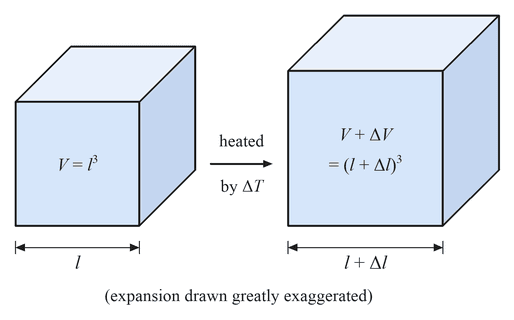
Step 2 — Find the new volume. The new side is , so the new volume is
Step 3 — Drop the very small terms. is very small compared with , so the terms in and can be neglected:
Step 4 — Put in . We substitute for :
Step 5 — Compare with the definition of . Dividing by gives
Therefore, the coefficient of cubical expansion is three times the coefficient of linear expansion: .
- 472 marks
Question 47
What is anomalous expansion of water?
- 482 marks
Question 48
Mention two consequences of anomalous expansion.
- 492 marks
Question 49
Define specific heat capacity and heat capacity.
- 502 marks
Question 50
Explain method of mixtures.
- 512 marks
Question 51
Define latent heat of fusion and latent heat of vaporisation.
- 522 marks
Question 52
Distinguish between evaporation and boiling.
- 533 marks
Question 53
What is temperature? How will you measure temperature? Obtain the relation connecting degree Celsius and degree Fahrenheit.
- 543 marks
Question 54
Derive the ideal gas equation. Explain absolute temperature scale. What is absolute zero?
- 553 marks
Question 55
Compare Celsius scale, Fahrenheit scale and Kelvin scale. How will you convert degree Celsius into Kelvin? Draw a graph to show the variation of temperature on the Celsius scale (°C) with temperature on the Fahrenheit scale (°F) of a body.
- 563 marks
Question 56
What is thermal expansion? Define the coefficient of linear expansion and the coefficient of superficial expansion. How are they related?
- 573 marks
Question 57
What is anomalous expansion of water? Obtain the relation connecting coefficient of apparent expansion and coefficient of real expansion of a liquid.
- 583 marks
Question 58
What is a calorimeter? How will you determine the specific heat of a solid using a calorimeter?
- 595 marks
Question 59
(a) Why is mercury used as a thermometric liquid?
(b) Explain the construction of a mercury thermometer.
(c) Mention the errors and their correction.
- 605 marks
Question 60
(a) Define coefficient of cubical expansion and the coefficient of linear expansion.
(b) Derive the relation connecting coefficient of linear expansion and coefficient of superficial expansion in the case of a rectangular sheet of a solid.
- 615 marks
Question 61
(a) What is the effect of pressure on the freezing point of ice?
(b) What is regelation?
(c) Heat is supplied at a uniform rate to one kg of ice at °C till its temperature becomes 100°C. Draw a graph to show the variation of temperature with heat supplied. Explain the shape of the graph.
What Class 11 Physics Ch 16 covers
The sections of the chapter, in the order the book takes them. Every question above comes from one of these.
- 01Heat and Temperature
- 02Measurement of Temperature
- 03Ideal Gas Equation and Absolute Scale
- 04Thermal Expansion of Solids
- 05Expansion of Liquids and Gases
- 06Specific Heat Capacity and Heat Capacity
More ways to study this chapter
The same chapter asked three other ways. Practise it, revise it, and see what the board has set on Ch 16 before.
Class 11 Physics Ch 16 questions students ask
How many questions are there in Class 11 Physics Ch 16?
61 questions. Every one is solved step by step on this page.
Are these Class 11 Physics solutions free?
Yes. Every question and its full working is free to read, with no account needed.
Can I download the Class 11 Physics Ch 16 solutions as a PDF?
There is no PDF to download. Every solution is on this page instead, which means it is searchable, always the current syllabus, and readable on a phone. Use your browser's print option if you want it on paper.