Solution:
Concept: When a solid is heated, every length in it grows by the same small fraction (for an isotropic solid), so its area and volume grow too. The three coefficients of expansion measure the fractional change per degree.
Step 1 — Part (a): define the coefficient of cubical expansion. The coefficient of cubical (volume) expansion γ is the increase in volume per unit original volume per degree rise in temperature. In symbols:
γ=VΔTΔV
So a volume V1 becomes V2=V1(1+γΔT). Its unit is K−1 (or ∘C−1).
Step 2 — Part (a): define the coefficient of linear expansion. The coefficient of linear expansion α is the increase in length per unit original length per degree rise in temperature. In symbols:
α=lΔTΔl
So a length l1 becomes l2=l1(1+αΔT). Its unit is also K−1.
Step 3 — Part (b): set up the sheet. Consider a rectangular sheet of length l and breadth b at temperature T; its area is A=lb.
The coefficient of superficial expansion is β=AΔTΔA.
When the temperature rises by ΔT, the length increases by Δl and the breadth by Δb, where
Δl=αlΔT
Δb=αbΔT
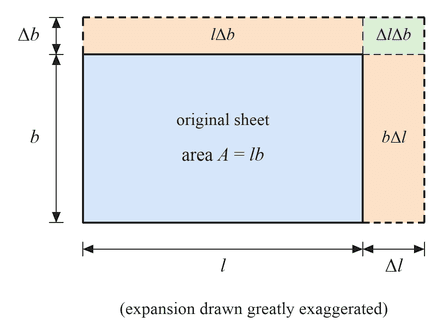
Step 4 — Part (b): find the new area. The final area is the product of the new length and the new breadth:
A+ΔA=(l+Δl)(b+Δb)
A+ΔA=lb+lΔb+bΔl+ΔlΔb
Step 5 — Part (b): find the increase in area. We subtract the original area lb. Since Δl and Δb are both very small, their product ΔlΔb (the tiny corner rectangle in the figure) is negligible:
ΔA=lΔb+bΔl
Step 6 — Part (b): put in Δl and Δb. We substitute the expressions from Step 3:
ΔA=l×αbΔT+b×αlΔT
ΔA=2αlbΔT
ΔA=2αAΔT
Step 7 — Part (b): compare with the definition of β. Dividing both sides by AΔT:
AΔTΔA=2α
β=2α
Therefore, (a) γ is the increase in volume per unit volume per degree rise in temperature and α the increase in length per unit length per degree rise; (b) for a rectangular sheet the coefficient of superficial expansion is twice the coefficient of linear expansion, β = 2α.
