
Question 595 marksMedium
(a) Why is mercury used as a thermometric liquid?
(b) Explain the construction of a mercury thermometer.
(c) Mention the errors and their correction.
Confirming your payment
Sign up now and get 250 free tokens.
Thermal Properties of Matter · Question 59 of 61
(a) Why is mercury used as a thermometric liquid?
(b) Explain the construction of a mercury thermometer.
(c) Mention the errors and their correction.
Solution:
Concept: A mercury thermometer uses the expansion of mercury in a glass bulb and capillary tube: as the temperature rises, the mercury expands more than the glass, and the thread rises in the tube.
Step 1 — Part (a): see why mercury is used. Mercury has these properties that suit a thermometer:
(Because mercury vapour is poisonous, mercury thermometers are now being replaced by alcohol and digital thermometers.)
Step 2 — Part (b): build the tube and the bulb. A thick-walled glass tube with a fine capillary bore of uniform cross-section is chosen; the thick wall protects the bore (and, when its front is shaped like a lens, makes the thin thread look wider). A thin-walled bulb (often cylindrical) is blown at one end, so that heat reaches the mercury quickly.
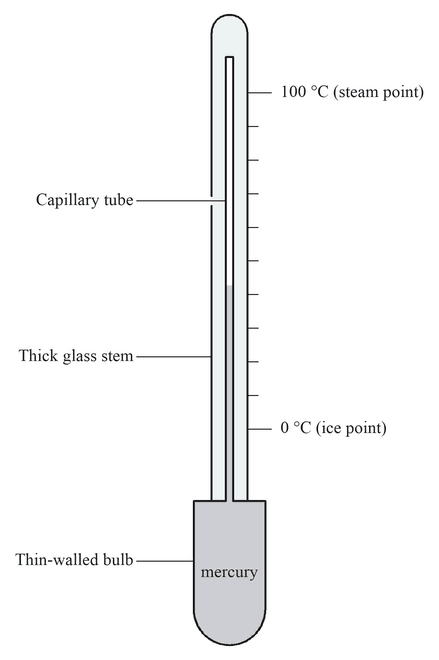
Step 3 — Part (b): fill and seal it. The bulb is warmed to drive out some air, and the open end is dipped in clean mercury, which is drawn in as the bulb cools; this is repeated, and the mercury is boiled to expel air and moisture, until the bulb and part of the bore are full. The thermometer is then heated a little above the highest temperature it is to read, and the top is sealed off. The space above the mercury is left as a vacuum (or filled with dry nitrogen in high-range thermometers, to raise the boiling point of mercury).
Step 4 — Part (b): calibrate it. The lower fixed point is marked by keeping the bulb in pure melting ice (). The upper fixed point is marked by keeping it in the steam above water boiling at normal atmospheric pressure (); the steam, not the boiling water, is used because impurities raise the boiling point of water but not the temperature of the steam. The distance between the two marks is divided into 100 equal parts.
Step 5 — Part (c): list the errors and their corrections. The main errors are:
Therefore, (a) mercury is used because it has a wide liquid range, expands uniformly, has low specific heat, is opaque, does not wet glass and does not evaporate easily; (b) the thermometer is a thin-walled bulb and a uniform capillary in a thick glass stem, filled with pure mercury, sealed, and calibrated at the ice and steam points; (c) its errors (shift of zero, non-uniform bore, emergent stem, lag, parallax, heat taken) are corrected by re-checking the ice point, calibration tables, the stem correction and careful reading.