
Question 583 marksMedium
What is a calorimeter? How will you determine the specific heat of a solid using a calorimeter?
Confirming your payment
Sign up now and get 250 free tokens.
Thermal Properties of Matter · Question 58 of 61
What is a calorimeter? How will you determine the specific heat of a solid using a calorimeter?
Solution:
Concept: By the principle of calorimetry (conservation of energy), when a hot body and a cold body are mixed and no heat escapes, the heat lost by the hot body equals the heat gained by the cold body.
Step 1 — Describe the calorimeter. A calorimeter is an apparatus for measuring heat. It is a thin cylindrical copper vessel with a stirrer of the same metal. It stands in an outer box, separated from it by insulating packing (felt or cotton wool) to cut down loss of heat by conduction and convection, and its outer surface is polished to reduce loss by radiation. An insulating lid has holes for a thermometer and the stirrer.
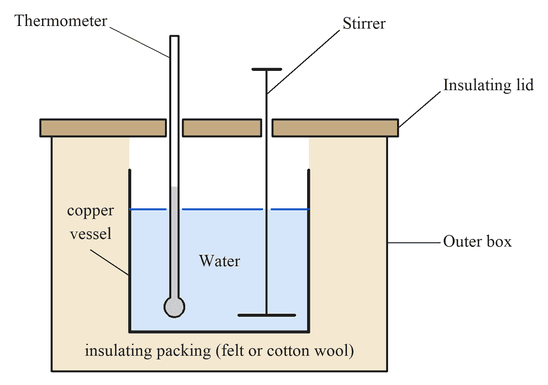
Step 2 — Take the readings. The experiment is done as follows:
Step 3 — Write the heat balance. The solid cools from to , while the water and the calorimeter warm from to . With , and the specific heat capacities of the solid, water and calorimeter,
Step 4 — Solve for . Taking the common factor and dividing gives
Since and are known, can be calculated.
Step 5 — Note the precautions. The solid must be transferred quickly so that it loses little heat on the way; the water must be stirred so that the mixture has one temperature; and a radiation (cooling) correction may be applied for heat lost to the surroundings.
Therefore, a calorimeter is a thin, polished copper vessel with a stirrer, insulated in an outer box, used to measure heat; the specific heat of a solid is found by the method of mixtures as .