
Question 573 marksMedium
What is anomalous expansion of water? Obtain the relation connecting coefficient of apparent expansion and coefficient of real expansion of a liquid.
Confirming your payment
Sign up now and get 250 free tokens.
Thermal Properties of Matter · Question 57 of 61
What is anomalous expansion of water? Obtain the relation connecting coefficient of apparent expansion and coefficient of real expansion of a liquid.
Solution:
Concept: A liquid is always held in a vessel, and the vessel expands too when heated. The real expansion of the liquid is its true increase in volume; the apparent expansion is the increase we see against the marks on the vessel.
Step 1 — Describe the anomalous expansion of water. Most liquids expand on heating at all temperatures. Water instead contracts when heated from to , and expands only above . So water at expands whether it is heated or cooled; its volume is least, and its density greatest, at . This unusual behaviour is called the anomalous expansion of water.

Step 2 — Define the two coefficients. We define the two coefficients for a liquid of volume heated through :
Let be the coefficient of cubical expansion of the material of the vessel.
Step 3 — Follow the level in the vessel. Fill a flask with a narrow neck with the liquid up to the mark A and heat it through . The vessel is heated first, so it expands and the level falls to B; then the liquid warms and expands, and the level rises to C.
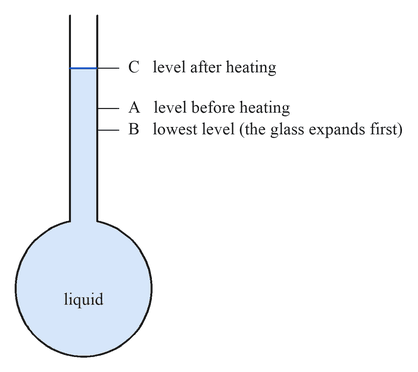
Step 4 — Write the three volumes. The fall from A to B is due to the expansion of the vessel, . The rise from B to C is the real expansion of the liquid, . The rise from A to C, seen against the marks, is the apparent expansion, . Since the rise from B to C is the fall from A to B plus the rise from A to C,
Step 5 — Cancel . Dividing both sides by gives
So the coefficient of real expansion is greater than the coefficient of apparent expansion.
Therefore, the anomalous expansion of water is its contraction on heating from 0 °C to 4 °C (least volume and greatest density at 4 °C), and the coefficients of a liquid are related by , where is the coefficient of cubical expansion of the vessel.