
Question 563 marksMedium
What is thermal expansion? Define the coefficient of linear expansion and the coefficient of superficial expansion. How are they related?
Confirming your payment
Sign up now and get 250 free tokens.
Thermal Properties of Matter · Question 56 of 61
What is thermal expansion? Define the coefficient of linear expansion and the coefficient of superficial expansion. How are they related?
Solution:
Concept: When a solid is heated, its particles vibrate with larger amplitude and their average separation increases, so the solid grows in length, area and volume.
Step 1 — Define thermal expansion. The increase in the size (length, area or volume) of a body when it is heated is called thermal expansion.
Step 2 — Define the coefficient of linear expansion. The coefficient of linear expansion is the increase in length per unit original length per degree rise in temperature:
Step 3 — Define the coefficient of superficial expansion. The coefficient of superficial (area) expansion is the increase in area per unit original area per degree rise in temperature:
Step 4 — Take a rectangular sheet. Consider a rectangular sheet of length and breadth , so its area is . When its temperature rises by , the length becomes and the breadth , where and .
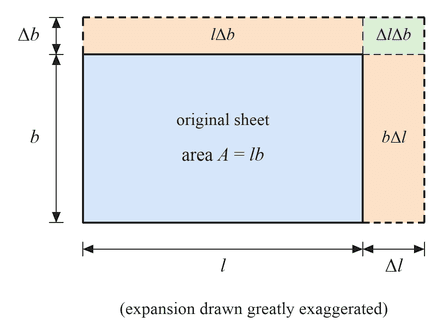
Step 5 — Find the increase in area. The new area is the product of the new sides:
The product (the tiny corner in the figure) is negligible, so
Step 6 — Put in and . We substitute and :
Step 7 — Compare with the definition of . Dividing by gives
In the same way a cube gives for the coefficient of cubical expansion, so .
Therefore, thermal expansion is the increase in size of a body on heating; α is the increase in length per unit length per degree and β the increase in area per unit area per degree, and they are related by β = 2α.