
Opening your dashboard
Class 11 Physics Chapter 16 Thermal Properties of Matter: Competency-Based Questions (CBQ)
40 questions on Chapter 16, each worked through on its own page with the AI tutor. Class 11 Physics, ICSE 2026-27.
40 questions
1–4 marks · Mixed difficulty
- 11 mark
Question 1
Competency: Analysis & Evaluation
On a cloudy winter morning a student sits in turn on two park benches, one made of steel and one made of wood. Both have stood outdoors all night in air at . The student tapes a small thermometer to each bench, and after a few minutes both thermometers read .
Assertion (A): The steel bench feels colder to the student's hand than the wooden bench.
Reason (R): The steel bench is at a lower temperature than the wooden bench.
- 21 mark
Question 2
Competency: Application
At a birthday party, a balloon filled with helium floats against the ceiling while a balloon filled with air lies on a table, in a room at . The gas in each balloon has reached the temperature of the room. In kinetic theory the average translational kinetic energy of a molecule of an ideal gas is , so that , where is the mass of one molecule and is the root mean square speed. Treat the air as nitrogen (molar mass ); the molar mass of helium is . Which statement about the helium atoms and the nitrogen molecules is correct?
- 33 marks
Question 3
Competency: Application
A laboratory technician measures the temperature of hot oil in a bath with a mercury-in-glass thermometer. The thermometer was calibrated with the whole mercury thread at the temperature being measured. Here, however, only the bulb and the stem up to the mark are in the oil, as shown. The thread reads , so the part of the thread from the mark to the mark is in the air above the bath, where its average temperature is only about . The coefficient of apparent expansion of mercury in glass is . (Hypothetical data.)

(a) Explain why the thermometer reads lower than the true temperature of the oil.
(b) The exposed thread is degree-divisions long. If it were at the temperature of the oil instead of at , it would be longer by the fraction , where is the coefficient of apparent expansion. Taking in this bracket as the reading, , find the correction and the true temperature of the oil.
(c) Suggest two ways in which the technician could avoid having to make this correction.
- 41 mark
Question 4
Competency: Analysis & Evaluation
A standards laboratory compares three constant-volume gas thermometers, filled with hydrogen, nitrogen and helium, with a mercury-in-glass thermometer.
Assertion (A): When the pressure of the gas in them is low, the three gas thermometers give almost the same reading for the temperature of a bath.
Reason (R): A gas thermometer can be used over a much wider range of temperatures than a mercury-in-glass thermometer.
- 51 mark
Question 5
Competency: Application
A constant-volume gas thermometer finds temperature from , where is the gas pressure and is its pressure at the triple point of water. In one such thermometer . The laboratory wants it to detect a change of in the temperature of a water bath near room temperature, about . (Hypothetical data.) The smallest change in pressure that its pressure gauge must be able to detect is about
- 63 marks
Question 6
Competency: Application
A diving shop fills a steel scuba cylinder of internal volume with air. Just after filling, the cylinder is warm, at , and the absolute pressure of the air in it is . The diver then takes it into sea water at . Treat the air as an ideal gas and ignore any change in the volume of the cylinder. (Hypothetical data.)
(a) Find the pressure in the cylinder once the air in it has cooled to .
(b) At a depth of the diver breathes air at an absolute pressure of and a temperature of . The diver must start to surface when the cylinder pressure has fallen to . What volume of air, measured at the diver's breathing pressure, can the diver use before then?
(c) The diver breathes of air per minute at that pressure. For how long can the diver stay at this depth?
- 71 mark
Question 7
Competency: Analysis & Evaluation
A teacher fills two identical flasks, one with oxygen and one with hydrogen, both at and atmospheric pressure. An oxygen molecule is about 16 times as heavy as a hydrogen molecule.
Assertion (A): The flask of oxygen contains about 16 times as many molecules as the flask of hydrogen.
Reason (R): For an ideal gas, , where is the number of molecules and the Boltzmann constant has the same value for every gas.
- 81 mark
Question 8
Competency: Application
A weather balloon is filled with of helium at ground level, where the pressure is and the temperature is . Its thin, stretchy skin keeps the helium at the same pressure and temperature as the air around it. At a height of the air pressure is and the temperature is . (Hypothetical data.) Treating the helium as an ideal gas and assuming that none escapes, the volume of the balloon at is about
- 93 marks
Question 9
Competency: Analysis & Evaluation
A dentist fills a cavity in a tooth with a metal filling. The filling is a short cylinder of diameter that fits the cavity exactly at body temperature, . For the filling material ; for the tooth around it take . Assume that the filling and the tooth around it are always at the same temperature. (Hypothetical data.)
(a) While the patient sips iced water, the tooth and the filling cool to . Find the change in the diameter of the filling and of the cavity, and say what happens at the edge of the filling.
(b) While the patient sips hot tea, they warm to . What happens now?
(c) A second filling material has . Explain why it is better on thermal grounds.
- 103 marks
Question 10
Competency: Application
An overhead power cable hangs between two towers of equal height that are apart. On a winter night, when the cable is at , its sag (the depth of its lowest point below the straight line joining its ends) is , as shown. For a cable whose sag is small compared with the span , the length of the cable is . The cable is made of aluminium, with . On a hot summer afternoon the cable reaches . Ignore any stretching of the cable by its tension. (Hypothetical data.)
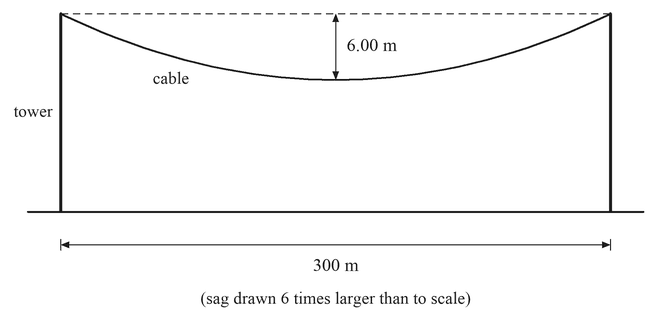
(a) Find the length of the cable on the winter night.
(b) Find how much longer the cable is on the summer afternoon.
(c) Find the sag on the summer afternoon, and explain why engineers check the clearance of power lines above roads for the hottest days.
- 111 mark
Question 11
Competency: Analysis & Evaluation
A laboratory uses beakers made of two kinds of glass. For borosilicate glass, ; for ordinary soda-lime glass, .
Assertion (A): A hot borosilicate beaker is more likely to crack than an equally hot soda-lime beaker when each is suddenly put into cold water.
Reason (R): Borosilicate glass has a much smaller coefficient of linear expansion than soda-lime glass.
- 123 marks
Question 12
Competency: Application
Sea level rises partly because sea water expands as it warms. In one ocean basin, measurements show that the top of water warmed by an average of between two surveys. For the sea water in this layer take the coefficient of volume expansion as . The sides of the basin are steep, so its area hardly changes with depth near the surface. (Hypothetical data.)
(a) Show that, if the area of the basin stays the same, a layer of depth that warms by raises the sea surface by .
(b) Find the rise in sea level caused by the warming of the top .
(c) Below the water is colder, and for it take . By how much would the layer from to have to warm, on average, to raise sea level by the same amount as in (b)?
- 131 mark
Question 13
Competency: Analysis & Evaluation
A student plunges the bulb of a mercury-in-glass thermometer from the air of the room into a beaker of hot water and watches the thread closely.
Assertion (A): The mercury thread first falls very slightly and then rises.
Reason (R): The coefficient of real expansion of mercury is much larger than the coefficient of volume expansion of glass.
- 141 mark
Question 14
Competency: Application
A mercury barometer has a brass scale that is correct at , as shown. In a room at the top of the mercury column is at the mark of the scale. Weather offices quote the pressure as the height that a column of mercury at would have. For mercury the coefficient of real expansion is , and for brass . (Hypothetical data.)
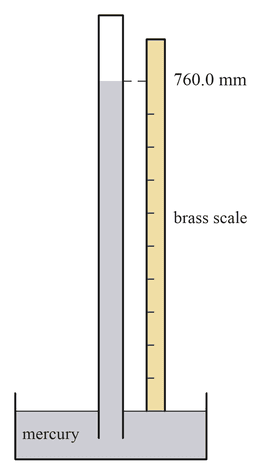
The height of a column of mercury at that matches this reading is
- 153 marks
Question 15
Competency: Application
A car of mass travelling at brakes to a stop. Its four steel brake discs each have a mass of , and the specific heat capacity of steel is . Assume that of the car's kinetic energy ends up as internal energy of the discs, shared equally among them, and that no heat escapes from the discs during the stop. Take . (Hypothetical data.)
(a) Find the heat capacity of the four discs together and the rise in their temperature in this stop.
(b) The same car then goes down a mountain road, descending at a steady speed using only its brakes. If of the loss of potential energy went into the discs and none of it escaped, what would their rise in temperature be?
(c) Use your answer to (b) to explain why drivers are advised to use a low gear, and not only the brakes, on long descents.
- 163 marks
Question 16
Competency: Analysis & Evaluation
A solar heating system must store of heat collected during a sunny day, and its store warms by while it does so. Two designs are compared:
- a tank of water (, density );
- a bed of granite pebbles (, density ), through which warm air is blown. The pebbles fill of the volume of the bed; the rest is air.
(Hypothetical data.)
(a) Find the mass and the volume of water needed.
(b) Find the mass of granite needed and the volume of the pebble bed.
(c) Which store is more compact, and by about how many times? Give one reason why the pebble bed might still be chosen.
- 171 mark
Question 17
Competency: Analysis & Evaluation
Two metal blocks are heated by identical heaters in an insulated enclosure. Block 1 has a mass of and block 2 a mass of . The graph shows how the rise in temperature of each block depends on the heat supplied to it. (Hypothetical data.)
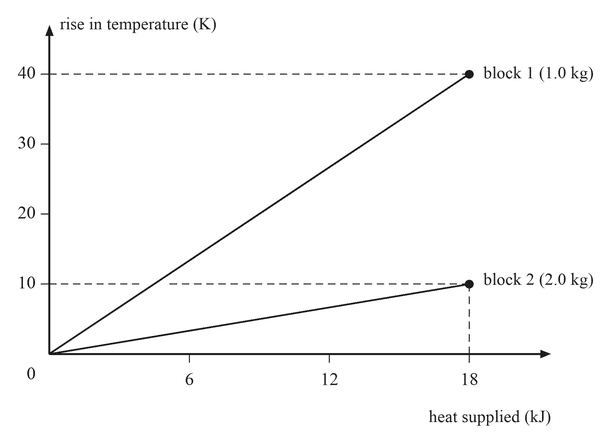
The ratio of the specific heat capacity of block 1 to that of block 2 is
- 183 marks
Question 18
Competency: Application
In a sauna, water is ladled onto hot stones to make steam. The stones have a total mass of and a specific heat capacity of , and they start at with the heater switched off. Each ladle holds of water at , which warms to and turns completely into steam at , taking all its heat from the stones. Assume that the stones share heat quickly, so that they are always at one temperature, and ignore any other loss of heat. Take the specific heat capacity of water as and its latent heat of vaporisation as . (Hypothetical data.)
(a) Find the heat needed to turn one ladle of water into steam at , and the fraction of it that is latent heat.
(b) Find the fall in the temperature of the stones for each ladle.
(c) How many ladles can be turned completely into steam before the stones cool to ?
- 191 mark
Question 19
Competency: Analysis & Evaluation
In a method-of-mixtures experiment in a room at , the water in a calorimeter is expected to warm by about . Instead of starting the water at room temperature, a student starts it at about , so that it ends at about .
Assertion (A): Starting the water about as far below room temperature as it will end above it reduces the error caused by heat exchange with the room.
Reason (R): While the water is colder than the room it gains heat from the room, and while it is hotter it loses heat to the room, so the two exchanges roughly cancel.
- 201 mark
Question 20
Competency: Analysis & Evaluation
A cook has two identical iron balls, each of mass , heated to , and a well-insulated pot holding of water at . In method 1 the cook drops both balls in together. In method 2 the cook drops in one ball, waits until it and the water reach a common temperature, and then drops in the second ball. Take the specific heat capacities of iron and water as and , ignore the pot and any loss of heat, and assume that no water turns to steam. (Hypothetical data.) How do the final temperatures of the water compare?
- 213 marks
Question 21
Competency: Application
On frosty spring nights, some fruit growers protect the blossoms on their trees by spraying them continuously with water. The water freezes on the blossoms, and as long as liquid water keeps freezing on them, the blossoms stay at about even when the air is colder. One grower sprays water at a rate equal to of rain per hour, and the water reaches the blossoms at . Take the density of water as , its specific heat capacity as and the latent heat of fusion of ice as . (Hypothetical data.)
(a) Show that of water spread over has a mass of .
(b) Find the heat given out per square metre in one hour as this water cools to and freezes. Find also the average power per square metre, and the fraction of the heat that comes from freezing.
(c) Growers are told to keep spraying until all the ice has melted the next morning. Explain why stopping the spray while the air is still below can harm the blossoms.
- 221 mark
Question 22
Competency: Analysis & Evaluation
The latent heat of fusion of ice is , and the latent heat of vaporisation of water at is .
Assertion (A): About seven times as much heat is needed to turn a kilogram of boiling water into steam as to melt a kilogram of ice at .
Reason (R): A kilogram of steam at has less internal energy than a kilogram of liquid water at .
- 231 mark
Question 23
Competency: Analysis & Evaluation
A cyclist rides on two afternoons with the same air temperature, , and sweats at about the same rate on both. On the first afternoon the air is dry. On the second the relative humidity is , and the cyclist's sweat drips off instead of drying on the skin. The cyclist feels much hotter on the humid afternoon. (Hypothetical data.) Which statement best explains this?
- 243 marks
Question 24
Competency: Analysis & Evaluation
Laboratories make "nitrogen slush", a mixture of solid and liquid nitrogen, by pumping the vapour away from liquid nitrogen kept in an insulated flask. The phase diagram of nitrogen (not to scale) is shown. Point A is liquid nitrogen boiling at atmospheric pressure, , at . The triple point Tr is at and . For liquid nitrogen take the specific heat capacity as and the latent heat of vaporisation as , and treat both as constant. (Hypothetical data.)
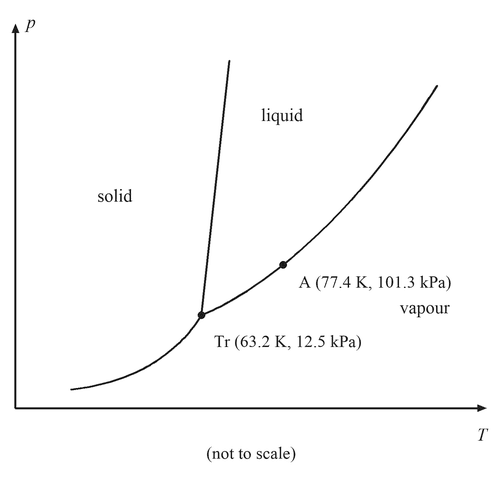
(a) As the pump lowers the pressure above the liquid, the liquid keeps boiling and cools. Describe how its state moves on the phase diagram, and what happens when the pressure reaches .
(b) The heat needed to boil away a mass of the liquid comes from the rest of the liquid, of mass , as it cools from to . Find the fraction that boils away.
(c) At the triple point, solid, liquid and vapour are all present while the pump keeps running. Explain why the temperature stays at until all the liquid has frozen.
- 251 mark
Question 25
Competency: Analysis & Evaluation
A cylinder of carbon dioxide stands in a hot storeroom at . On the phase diagram of carbon dioxide, the vaporisation curve ends at the critical point, at and . Above the critical temperature there is no boundary between liquid and vapour.
Assertion (A): At , carbon dioxide gas cannot be turned into a liquid however much it is compressed.
Reason (R): is above the critical temperature of carbon dioxide, and above its critical temperature a gas cannot be liquefied by pressure alone.
- 264 marks
Question 26
A calorimeter is used with an electric heater in two runs. (Hypothetical data.)
Run 1: The calorimeter holds of water. A heater runs for and the temperature rises by .
Run 2: The water is replaced by of a liquid at the same starting temperature. The same heater runs for the same time and the temperature rises by .
Take the specific heat capacity of water as and ignore heat losses.
(a) Find the heat capacity of the calorimeter (with its heater and thermometer).
(b) Find the specific heat capacity of the liquid.
(c) Why is the first run with water needed?
- 274 marks
Question 27
A student measures the latent heat of vaporisation of water with an electric kettle standing on a balance. Once the water is boiling steadily, the student records how fast its mass falls at two settings of the heater. (Hypothetical data.)
Heater power Rate of loss of mass At both settings the kettle is at , so it loses heat to the room at the same rate , and the rest of the heater power boils the water: , where is the rate of loss of mass.
(a) Find the latent heat of vaporisation .
(b) Find the rate of heat loss .
(c) A classmate uses only the run and assumes no heat loss. What value of does the classmate get, and is it too large or too small?
- 283 marks
Question 28
At what temperature on the Fahrenheit scale will the reading be double the reading on the Celsius scale?
- 293 marks
Question 29
The pressure of air in a constant volume air thermometer is 80 cm and 109.3 cm at 0 °C and 100 °C respectively. When the bulb is placed in some hot water, the pressure is 100 cm. Calculate the temperature of the hot water.
- 303 marks
Question 30
A constant volume hydrogen thermometer was used to measure the temperature of a hot bath. The excess pressure in the bulb over the atmospheric pressure is found to be equal to 114 cm of Hg. At 0 °C, the pressure in the bulb is equal to that of the atmosphere. Find the temperature of the hot bath.
- 313 marks
Question 31
A brass ball weighing 2 kg is taken from a furnace and dropped into a hole in a block of ice at 273 K. If 0.6 kg of ice is melted, calculate the temperature of the furnace. Specific heat capacity of brass . Specific latent heat of fusion of ice .
- 323 marks
Question 32
When a piece of metal weighing 48.3 kg at 10.7 °C is immersed in a current of steam at 100 °C, 0.762 kg of steam is condensed on it. Calculate the specific heat of the metal. Latent heat of vaporisation .
- 333 marks
Question 33
It is required to prepare a steel metre scale, such that the millimetre intervals are to be accurate within 0.0005 mm at a certain temperature. Determine the maximum temperature variation allowable during the rulings of millimetre marks. Given for steel .
- 343 marks
Question 34
The volume of a thin brass vessel and the volume of a solid cube are both equal to 1 litre. What will be the change in volume of the vessel and the cube upon being heated to 25 °C? Given for brass .
- 353 marks
Question 35
100 g of ice at 0 °C is mixed with 100 g of water at 100 °C. Calculate the final temperature of the mixture.
- 363 marks
Question 36
A 50 g lead bullet, specific heat is initially at 30 °C. It is fired vertically upward with a speed of and returning to the starting level strikes a cake of ice at 0 °C. How much ice has melted? Assume that all energy is spent in melting ice. Latent heat of ice cal/g.
- 373 marks
Question 37
A calorimeter contains 50 g of water at 30 °C. When 200 g of hot water at 80 °C is poured into the calorimeter, the temperature of water in the calorimeter increases by 10 °C. Calculate the water equivalent of the calorimeter.
- 383 marks
Question 38
A one litre flask contains some mercury. It is found that at different temperatures the volume of air inside the flask remains the same. What is the volume of mercury in the flask? Given that the coefficient of linear expansion of glass and coefficient of volume expansion of mercury .
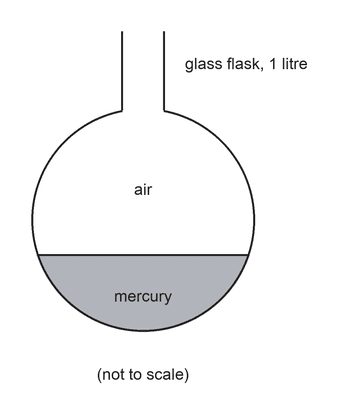
- 391 mark
Question 39
Competency: Application
A railway workshop fits a new steel tyre on a locomotive wheel by "shrink fitting". At the workshop temperature of , the bore (inside diameter) of the tyre is and the diameter of the wheel rim on which it must sit is . The tyre is heated in a ring of gas burners until its bore is larger than the rim, so that it can be slipped on easily; it then cools and grips the rim tightly. For steel take , and assume the wheel stays at . (Hypothetical data.)
The lowest temperature to which the tyre must be heated is about
- 404 marks
Question 40
Competency: Analysis & Evaluation
On a hot afternoon, a road tanker is filled with diesel at a coastal depot. A flow meter at the depot shows that of diesel at has passed into the tanker. Two days later the tanker unloads at a fuel station in a hill town in winter, where the diesel has cooled to , and the station's flow meter shows a smaller volume. No diesel leaks or evaporates on the way, and none is left in the pipes. The densities of this diesel, measured in a laboratory, are given below. (Hypothetical data.)
Temperature () 15 25 35 Density () 832.0 825.3 818.6 (a) Use the densities at and to find the average coefficient of volume expansion of the diesel over this range, based on its volume at .
(b) Find the volume of diesel shown by the station's meter at , and the difference between the two meter readings.
(c) The station owner says that the depot has cheated him of this difference. Is he right? Suggest a fair way of measuring diesel for a sale like this.