
Opening your dashboard
Class 11 Physics Chapter 16 Thermal Properties of Matter: Practice Questions
103 questions on Chapter 16, each worked through on its own page with the AI tutor. Class 11 Physics, ICSE 2026-27.
103 questions
1–4 marks · Mixed difficulty
- 11 mark
Question 1
Three metal blocks , and have different masses and are made of different metals. When is placed in contact with , no net heat flows between them. When is placed in contact with , again no net heat flows. Now is placed in contact with . Which statement is correct?
- 22 marks
Question 2
(Hypothetical data.) A packet of biscuits lists its energy content as (the "Calories" on food labels are kilocalories). Take and .
(i) Express this energy in joules.
(ii) Find the height through which a student would have to climb for the work done against gravity to equal this energy.
- 31 mark
Question 3
According to the kinetic theory, the root mean square (r.m.s.) speed of the molecules of a gas is proportional to the square root of its absolute temperature. A sample of nitrogen is heated from to . Its r.m.s. molecular speed becomes about
- 43 marks
Question 4
(Hypothetical data.) A red-hot steel pin of mass at is dropped into a bucket holding of water at . Take the specific heat capacity of steel as and that of water as , and ignore heat lost to the bucket and the air.
(i) The water has far more internal energy than the pin. Explain why heat nevertheless flows from the pin to the water.
(ii) Estimate the heat given out by the pin and the rise in the temperature of the water.
- 51 mark
Question 5
A sealed glass bottle of juice at is taken out of a refrigerator and left in a kitchen at . The juice is the system and the kitchen is its surroundings. Using the convention that heat entering a system is positive, which statement is correct for the first few minutes?
- 63 marks
Question 6
A platinum resistance thermometer has a resistance of in melting ice and in steam at standard pressure. A temperature scale, the platinum scale, is defined by assuming that the resistance changes uniformly between these two fixed points. (Hypothetical data.)
(i) In a water bath the resistance is . Find the temperature of the bath on the platinum scale.
(ii) What resistance does the thermometer have at on the platinum scale?
- 73 marks
Question 7
(Hypothetical data.) A mercury-in-glass thermometer has a bulb of volume and a capillary bore of diameter . Take the coefficient of apparent expansion of mercury in glass as , and neglect the mercury already in the bore compared with that in the bulb.
(i) How far does the end of the mercury thread move along the bore for a rise in temperature of ?
(ii) What bore diameter would make the thread move per kelvin with the same bulb?
- 81 mark
Question 8
Since 20 May 2019, the S.I. unit of temperature, the kelvin, has been defined by fixing the exact numerical value of
- 93 marks
Question 9
(Hypothetical data.) A chromel–alumel (type K) thermocouple is used to measure the temperature inside an oven. Junction is in the oven and junction is kept in melting ice, as shown.
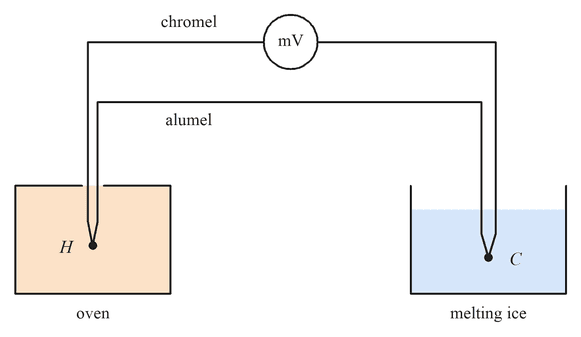
The millivoltmeter reads . Part of the standard table for this thermocouple, with the reference junction at , is given below.
Temperature of the hot junction (°C) 250 300 350 e.m.f. (mV) 10.153 12.209 14.293 (i) Estimate the oven temperature by linear interpolation in the table.
(ii) Why must junction be kept in melting ice?
(iii) The e.m.f. rises by from to but by from to . What does this tell you about reading a thermocouple?
- 101 mark
Question 10
(Hypothetical data.) A thermometer reads in the air of a room. The part of it that is dipped into a liquid has a heat capacity of . It is dipped into of water at in a thin plastic cup. The specific heat capacity of water is . Ignoring heat taken by the cup and the air, the steady reading of the thermometer is about
- 113 marks
Question 11
(Hypothetical data.) On a cool morning at a car tyre is pumped to a gauge pressure of . The atmospheric pressure is . After a long drive the air in the tyre is at and the volume of the tyre has increased by . Treating the air as an ideal gas, find the new gauge pressure in the tyre.
- 121 mark
Question 12
How many molecules are there in of air at and a pressure of ? Treat the air as an ideal gas and take the Boltzmann constant .
- 133 marks
Question 13
(Hypothetical data.) The envelope of a hot-air balloon holds of air. The outside air is at and the air inside is heated to . The envelope is open at the bottom, so the pressure inside and outside is . Take the molar mass of air as and .
(i) Find the density of the air outside and inside the envelope.
(ii) Find the greatest total mass of the envelope, basket, burner, fuel and passengers that the balloon can just hold up.
- 141 mark
Question 14
The same sample of an ideal gas is heated twice, once at a constant pressure and once at a constant pressure . Each time its volume is plotted against its absolute temperature , as shown.
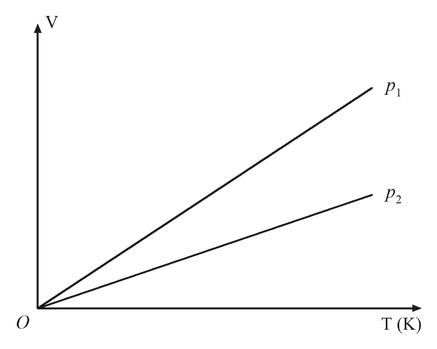
Which statement is correct?
- 153 marks
Question 15
(Hypothetical data.) In a constant-volume gas thermometer the pressure of the gas is at and at . Assume the pressure changes linearly with temperature.
(i) Find the temperature at which the pressure would become zero.
(ii) Find the pressure of the gas at .
(iii) What does your answer to (i) tell you about the absolute scale of temperature?
- 163 marks
Question 16
(Hypothetical data.) Steel rails, each long, are laid on a day when the rail temperature is . In summer sunshine the rails can reach . For steel take .
(i) What is the smallest gap that must be left between neighbouring rails?
(ii) If a gap of only were left, at what rail temperature would neighbouring rails just touch?
- 171 mark
Question 17
(Hypothetical data.) A pendulum clock with a simple brass pendulum keeps correct time at . For brass . On a day when the room stays at , in one day () the clock
- 183 marks
Question 18
(Hypothetical data.) A steel metre rule is correct at . At it shows an aluminium rod to be long. The rod and the rule are then both heated to . Take and .
(i) Find the true length of the rod at .
(ii) Find the length that the steel rule now shows for the rod.
(iii) What would an aluminium rule, correct at , show for the rod at ?
- 191 mark
Question 19
(Hypothetical data.) A steel C-ring has a narrow gap of width , as shown.
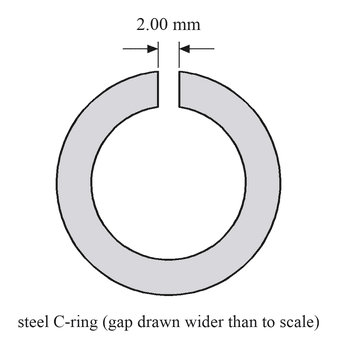
The ring is heated uniformly through . For steel . The width of the gap becomes
- 203 marks
Question 20
Steel rods are used to reinforce concrete. For concrete take . For steel take and Young's modulus ; for aluminium take and . A concrete beam warms by during a summer day. Assume that the concrete is so massive that it forces an embedded rod to change length exactly as the concrete does.
(i) Find the thermal stress in an embedded steel rod.
(ii) Find the thermal stress in an embedded aluminium rod.
(iii) Use your answers to explain why steel, and not aluminium, is used to reinforce concrete.
- 213 marks
Question 21
(Hypothetical data.) A steel petrol tank of capacity litres is filled to the brim at . The car is then parked in the sun until the tank and the petrol are at . For petrol ; for steel .
(i) How much petrol overflows?
(ii) Find the coefficient of apparent expansion of petrol in the steel tank.
- 221 mark
Question 22
For an ideal gas held at constant pressure, the coefficient of volume expansion depends on the temperature. Its value for a sample of air, treated as an ideal gas, at is about
- 233 marks
Question 23
(Hypothetical data.) A decorative "Galileo thermometer" is a sealed glass cylinder of clear liquid containing several sealed glass floats, each carrying a temperature tag. The figure shows one of the floats.
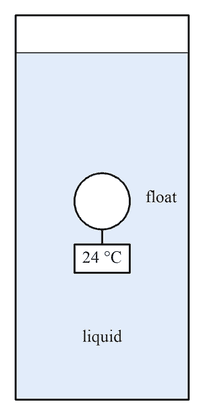
The liquid has density at and coefficient of volume expansion . Each float is made so that its average density equals the density of the liquid at the temperature on its tag. The floats expand so little that their densities may be taken as constant.
(i) Find the average density of the float tagged .
(ii) State, with a reason, whether this float rises to the top or sinks to the bottom when the room is at , and when it is at .
- 241 mark
Question 24
In an experiment to find the coefficient of real (absolute) expansion of mercury, a U-tube open at both ends contains mercury. One arm is surrounded by melting ice and the other by boiling water, as shown.
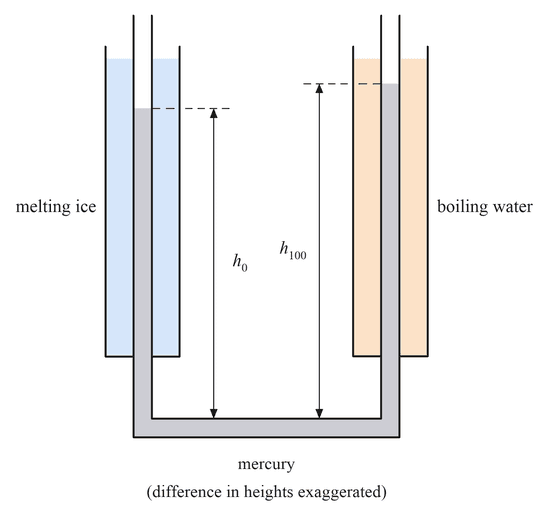
The heights of the mercury columns above the horizontal connecting tube are in the cold arm and in the hot arm. (Hypothetical data.) The coefficient of real expansion of mercury found from these readings is
- 253 marks
Question 25
(Hypothetical data.) A plastic syringe with its nozzle sealed holds of air at . Its plunger moves freely, so the air stays at atmospheric pressure. The syringe is held in a water bath, as shown, and the bath is slowly heated to . Neglect the expansion of the syringe itself.
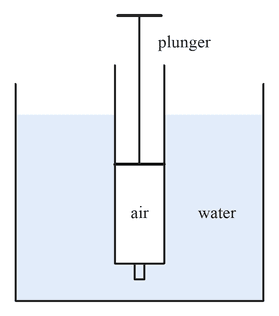
(i) Find the new volume of the air.
(ii) Find the average coefficient of volume expansion of the air between and , based on its volume at , and compare it with at .
(iii) Water has density at and at . By how much would of water expand over the same range? Compare this with the expansion of the air.
- 261 mark
Question 26
An old data table gives the specific heat capacity of aluminium as . Taking , its value in S.I. units is about
- 273 marks
Question 27
An electric kettle made of stainless steel has a mass of . It holds of water, and the kettle and water start at . Its heating element is rated , and of the electrical energy reaches the kettle and the water. Take the specific heat capacity of stainless steel as and of water as . (Hypothetical data.)
(a) Find the heat capacity of the kettle with its water.
(b) Find the heat needed to bring the kettle and water to .
(c) How long does the kettle take to reach ?
- 281 mark
Question 28
Two rigid sealed containers hold equal masses of helium (molar mass ) and argon (molar mass ). Both gases are monatomic, so each has a molar specific heat capacity at constant volume of . The two gases receive equal quantities of heat. The rise in temperature of the argon is how many times the rise in temperature of the helium?
- 293 marks
Question 29
To measure the specific heat capacity of aluminium, a student places a electric heater in a hole in a aluminium block wrapped in insulation. The student switches it on and records the temperature every minutes. The readings are given below. (Hypothetical data.)
Time (min) 0 2 4 6 8 10 Temperature (°C) 25.0 31.6 38.2 44.8 51.2 57.4 (a) Use the readings for the first minutes to find the specific heat capacity of aluminium.
(b) Why does the temperature rise more slowly in the last minutes?
(c) A classmate uses the whole minutes instead. What value does the classmate get, and why is it less reliable?
- 302 marks
Question 30
A cast-iron pan of mass and a pot holding of water are on two identical burners. The specific heat capacity of cast iron is and that of water is . Ignore the pot itself.
(a) Which has the greater heat capacity, the pan or the water? Show your working.
(b) Water has a specific heat capacity more than nine times that of iron. Explain how your answer to (a) can still be true.
- 311 mark
Question 31
Over the range to , the specific heat capacity of a certain alloy varies with temperature (in ) as . (Hypothetical data.) The heat needed to raise the temperature of of the alloy from to is
- 323 marks
Question 32
The specific heat capacities of copper and aluminium are and , and their molar masses are and . For many solid elements at room temperature the molar heat capacity is close to .
(a) Find the molar heat capacity of each metal.
(b) Compare your answers with .
(c) Explain why a kilogram of aluminium needs more than twice as much heat as a kilogram of copper for the same rise in temperature.
- 331 mark
Question 33
In an insulated vessel of negligible heat capacity, of water at , of water at and of water at are mixed and stirred. The final temperature of the mixture is
- 343 marks
Question 34
A student finds the specific heat capacity of a cooking oil by the method of mixtures. A copper block is heated to and dropped into of the oil at , held in an aluminium calorimeter of mass . After stirring, the highest temperature reached is . The specific heat capacities of copper and aluminium are and . (Hypothetical data.)
(a) Find the specific heat capacity of the oil, assuming no heat is lost.
(b) In fact some heat escapes to the room during the experiment. Is the true specific heat capacity of the oil larger or smaller than your answer? Explain.
- 351 mark
Question 35
A vacuum flask has a heat capacity of and is at . Then of water at is poured into it and the stopper is put on. Take the specific heat capacity of water as and assume no heat escapes from the flask. The common temperature reached is about
- 363 marks
Question 36
A bathtub is to be filled with of water at from a hot tap at and a cold tap at . Take of water as and its specific heat capacity as . (Hypothetical data.)
(a) Ignoring the tub, how many litres should come from each tap?
(b) The tub itself has a heat capacity of and starts at . It ends at with the water. How many litres of hot water are needed now, for the same total?
- 371 mark
Question 37
To find the specific heat capacity of a metal, a student heats a metal block in boiling water at and drops it into water in a calorimeter. The student carries the block slowly, so it cools to about before it enters the water, but the working still takes its starting temperature as . The student's value of the specific heat capacity will be
- 382 marks
Question 38
A blacksmith quenches a iron tool at in a tub of water at . What is the least mass of water that must be used so that the water, and the tool with it, ends no hotter than ? Take the specific heat capacities of iron and water as and , and assume that no water boils away and no heat is lost. (Hypothetical data.)
- 391 mark
Question 39
of ice at is turned into steam at at normal atmospheric pressure. Take the latent heat of fusion of ice as , the specific heat capacity of water as and the latent heat of vaporisation of water as . About what percentage of the total heat is used to boil the water at ?
- 404 marks
Question 40
A sample of a solid wax is heated by a heater, and all the heat goes into the wax. The graph shows how its temperature changes with time . (Hypothetical data.)
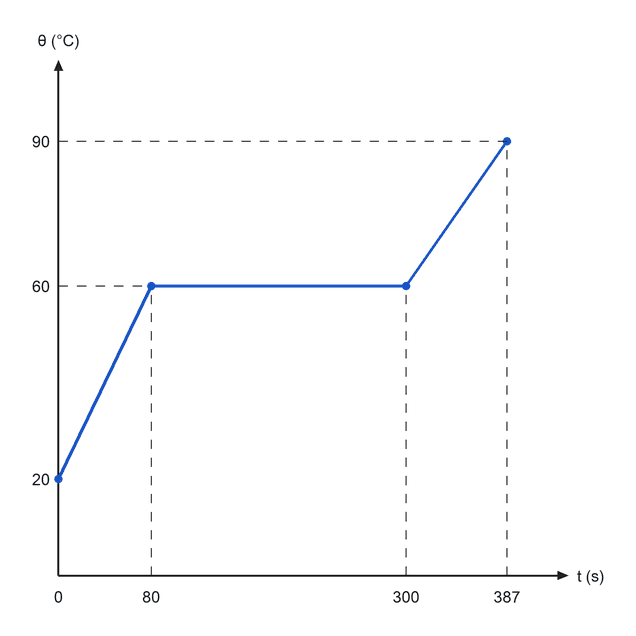
(a) What is the melting point of the wax?
(b) Find the specific heat capacity of the wax as a solid and as a liquid.
(c) Find the specific latent heat of fusion of the wax.
- 411 mark
Question 41
An unglazed clay pot holds water in a shady room at . Over a few hours of water seeps through the walls and evaporates, and of water remains inside. At the latent heat of vaporisation of water is (at it is ); the specific heat capacity of water is and the latent heat of fusion of ice is . If all the heat for the evaporation came from the remaining water, its temperature would fall by about
- 423 marks
Question 42
A glass holds of a fruit drink at . Ice cubes straight from a freezer at are added. What mass of ice is needed to cool the drink to , with all the ice melted? Take the specific heat capacity of the drink as , of ice as and of water as , and the latent heat of fusion of ice as . Ignore the glass and any heat from the room. (Hypothetical data.)
- 433 marks
Question 43
An ice tray holding of water at is put in a freezer that removes heat from it at a steady . Take the specific heat capacities of water and ice as and , and the latent heat of fusion as . Ignore the tray. (Hypothetical data.)
(a) How long does it take to turn the water into ice at ?
(b) Which stage takes the longest, and why?
- 441 mark
Question 44
A pure crystalline solid is heated steadily at its melting point and its temperature stays constant until it has all melted. While it is melting, the heat it takes in is mainly used in
- 451 mark
Question 45
The phase diagram of carbon dioxide (not to scale) is shown. Its triple point is at and . A block of dry ice (solid carbon dioxide) is left in an open dish at a steady pressure of and slowly warms up.
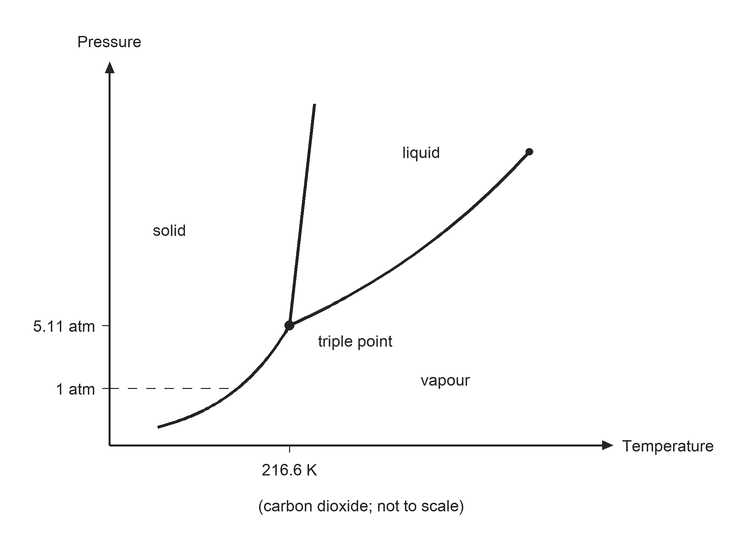
What happens to the dry ice?
- 463 marks
Question 46
In freeze-drying, food is first frozen to () at atmospheric pressure (point F on the phase diagram of water below, not to scale). The chamber is then pumped down to while the food is kept at and gently heated. At the vapour pressure of ice is about , and the triple point of water is at and .
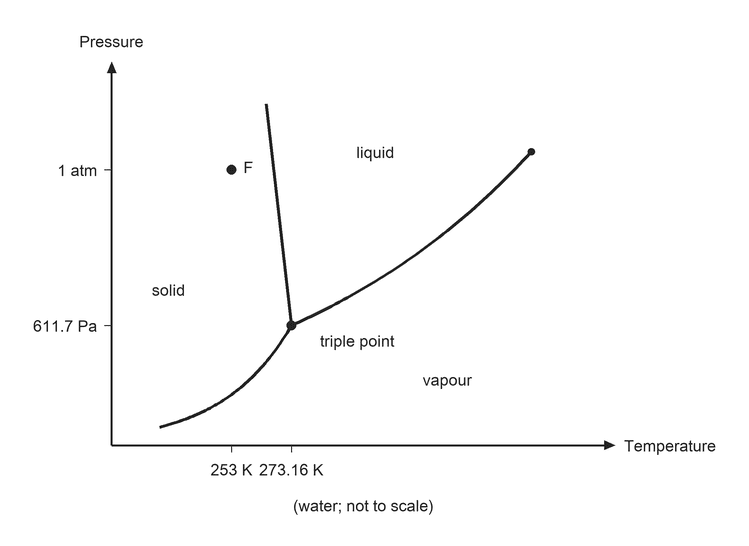
(a) Use the phase diagram to explain what happens to the ice in the food as the pressure is lowered.
(b) Why must the chamber pressure be kept below , and why must heat be supplied to the food?
- 471 mark
Question 47
The phase diagram (not to scale) is for a substance that expands on melting. A sample is at D, as a vapour at a temperature below its triple-point temperature. It is then compressed slowly while its temperature is kept at .

Which describes the changes of phase that occur?
- 483 marks
Question 48
A liquid boils when its saturated vapour pressure equals the pressure on its surface, so pairs of boiling point and pressure are points on the vaporisation curve of its phase diagram. The saturated vapour pressure of water at some temperatures is:
Temperature (°C) 80 90 100 110 120 130 Vapour pressure (kPa) 47.4 70.2 101.4 143.4 198.7 270.3 Use straight-line interpolation between neighbouring entries.
(a) In a hill town the air pressure is about . At what temperature does water boil there?
(b) At sea level (air pressure ) a pressure cooker keeps the steam inside at above the outside pressure. At what temperature does water boil in the cooker?
(c) Use your answers to explain why rice takes much longer to cook in an open pot in the hill town than in a pressure cooker.
- 492 marks
Question 49
The triple point of water is a standard fixed point in the modern thermometry, why? What is wrong in taking the melting point of ice and boiling point of water as standard fixed point?
- 502 marks
Question 50
What is meant by the dynamical theory of heat?
- 511 mark
Question 51
On the absolute scale triple point of water is one fixed temperature, what is the other?
- 521 mark
Question 52
What is Joule's constant?
- 532 marks
Question 53
The zero Kelvin is called absolute zero, why?
- 541 mark
Question 54
There is a slight temperature difference between the waterfall at the top and bottom, why?
- 551 mark
Question 55
What is the temperature of the triple point of water on an absolute scale whose unit interval size is equal to that of Fahrenheit scale?
- 561 mark
Question 56
Out of two thermometers, one with spherical bulb and another with cylindrical bulb, which will respond quickly to temperature changes?
- 572 marks
Question 57
Name various fixed points used in thermometry.
- 582 marks
Question 58
What are the requisites of a thermometer?
- 592 marks
Question 59
Compare the relative merits of mercury and alcohol as a thermometric liquid.
- 602 marks
Question 60
When hot water is poured in a thick glass it cracks. Why?
- 612 marks
Question 61
Why do sometimes water pipes burst in severe winter?
- 622 marks
Question 62
Why is Invar used in making clock pendulum?
- 632 marks
Question 63
A brass disc fits in a hole in a steel plate. Should you heat or cool the system to loosen the disc from the hole?
for steel . for brass .
- 642 marks
Question 64
Why should we apply radiation correction in calorimetric experiments?
- 652 marks
Question 65
Show that .
- 663 marks
Question 66
Room temperature is 30 °C. Express this in degree Fahrenheit and Kelvin.
- 673 marks
Question 67
The temperature of human body is 98.4 °F. Calculate the temperature in °C and in Kelvin.
- 683 marks
Question 68
The temperature of the surface of the Sun is about 6000 K. Express this on the Fahrenheit scale.
- 693 marks
Question 69
Liquid oxygen freezes at −218.4 °C and boils at −183 °C. Express these temperatures in Fahrenheit scale.
- 703 marks
Question 70
The boiling point of liquid hydrogen is 20.2 K. Express this in degree Rankine.
- 713 marks
Question 71
On Celsius scale two temperatures differ by 30°. What is the difference on Fahrenheit scale?
- 723 marks
Question 72
The reading of a Fahrenheit thermometer is 132 °F. The same temperature read by a faulty Celsius thermometer is 54 °C. Find the correction needed in the Celsius thermometer.
- 733 marks
Question 73
The boiling point of liquid nitrogen is −195.81 °C at atmospheric pressure. Express this temperature in (a) °F and (b) K.
- 743 marks
Question 74
A body is heated from −22 °F to 140 °F. What is the change in temperature on (a) the Celsius scale and (b) the Kelvin scale?
- 751 mark
Question 75
The temperature on Celsius scale is . What is the corresponding temperature on the Fahrenheit scale?
- 761 mark
Question 76
Two rods, one of aluminum and the other made of steel, having initial length and are connected together to form a single rod of length . The coefficients of linear expansion for aluminum and steel are and respectively. If the length of each rod increases by the same amount when their temperature are raised by , then find the ratio .
- 771 mark
Question 77
When a bimetallic strip is heated, it
- 781 mark
Question 78
A beaker is completely filled with water at . It will overflow if
- 791 mark
Question 79
Water is used to cool radiators of engines, because
- 801 mark
Question 80
Two rigid boxes containing different ideal gases are placed on a table. Box contains one mole of nitrogen at temperature , while Box contains one mole of helium at temperature . The boxes are then put into thermal contact with each other and heat flows between them until the gases reach a common final temperature of the gases, , in terms of is
- 811 mark
Question 81
A piece of ice falls from a height so that it melts completely. Only one quarter of the heat produced is absorbed by the ice and all energy of ice gets converted into heat during its fall. The value of is
(latent heat of ice is J/kg and N/kg)
- 821 mark
Question 82
Steam at is passed into 20 g of water at . When water acquires a temperature of , the mass of water present will be [take specific heat of water and latent heat of steam ]
- 831 mark
Question 83
The pressure that has to be applied to the ends of a steel wire of length 10 cm to keep its length constant when its temperature is raised by is
(for steel, Young's modulus is and coefficient of thermal expansion is )
- 841 mark
Question 84
An unknown metal of mass 192 g heated to a temperature of was immersed into a brass calorimeter of mass 128 g containing 240 g of water at a temperature of . Calculate the specific heat of the unknown metal if water temperature stabilises at (specific heat of brass is )
- 851 mark
Question 85
Ice at is added to 50 g of water at . When the temperature of the mixture reaches , it is found that 20 g of ice is still unmelted. The amount of ice added to the water was close to (specific heat of ice and heat of fusion of water at )
- 861 mark
Question 86
Two rods and of identical dimensions are at temperature . If is heated upto and upto , then the new lengths are the same. If the ratio of the coefficients of linear expansion of and is 4 : 3, then the value of is
- 871 mark
Question 87
A metal ball of mass 0.1 kg is heated upto and dropped into a vessel of heat capacity and containing 0.5 kg water. The initial temperature of water and vessel is . What is the approximate percentage increment in the temperature of the water? [Specific heat capacities of water and metal are respectively and ]
- 881 mark
Question 88
A copper rod of 88 cm and an aluminum rod of unknown length have their increase in length independent of increase in temperature. The length of aluminum rod is ( and )
- 891 mark
Question 89
When gram of ice at (specific heat ) is added to gram of water at , finally no ice is left and the water is at . The value of latent heat of ice, in is
- 901 mark
Question 90
At , a brass wire of 1 mm radius is hung from the ceiling. A small mass, is hung from the free end of the wire. When the wire is cooled down from to , it regains its original length of 0.2 m. The value of is close to (coefficient of linear expansion and Young's modulus of brass are and , respectively; )
- 911 mark
Question 91
Two different wires having lengths and and respective temperature coefficient of linear expansion and , are joined end-to-end. Then the effective temperature coefficient of linear expansion is
- 921 mark
Question 92
The specific heat of water and the latent heat of ice . 100 grams of ice at is placed in 200 g of water at . The amount of ice that will melt as the temperature of water reaches is close to (in grams)
- 931 mark
Question 93
When the temperature of metal wire is increased from to , its length increases by 0.02%. The percentage change in its mass density will be close to
- 941 mark
Question 94
A calorimeter of water equivalent 20 g contains 180 g of water at . ‘’ grams of steam at is mixed in it till the temperature of the mixture is . The value of ‘’ is close to (latent heat of water and specific heat of water )
- 951 mark
Question 95
Each side of a box made of metal sheet in cubic shape is ‘’ at room temperature ‘’, the coefficient of linear expansion of the metal sheet is ‘’. The metal sheet is heated uniformly by a small temperature , so that its new temperature is . Calculate the increase in the volume of the metal box.
- 961 mark
Question 96
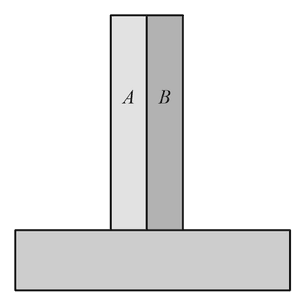
A bimetallic strip consists of metals and . It is mounted rigidly as shown in the given figure. The metal has higher coefficient of expansion compared to that of metal . When the bimetallic strip is placed in a cold bath, it will
- 971 mark
Question 97
Due to cold weather, a 1 m water pipe of cross-sectional area is filled with ice at . Resistance heating is used to melt the ice. Current of 0.5 A is passed through resistance. Assuming that all the heat produced is used for melting, what is the minimum time required (Given latent heat of fusion for water/ice , specific heat of ice and density of ice )
- 981 mark
Question 98
A solid metallic cube having total surface area is uniformly heated. If its temperature is increased by , calculate the increase in volume of the cube. [Given ]
- 991 mark
Question 99
A copper block of mass 5.0 kg is heated to a temperature of and is placed on a large ice block. What is the maximum amount of ice that can melt? [Specific heat of copper is and latent heat of fusion of water is ]
- 1001 mark
Question 100
Read the assertion and reason carefully to mark the correct option out of the options given below:
Assertion: The melting point of ice decreases with increase of pressure.
Reason: Ice contracts on melting.
- 1011 mark
Question 101
A geyser heats water flowing at a rate of 2.0 kg per minute from to . If geyser operates on a gas burner, the rate of combustion of fuel will be ______ . [Heat of combustion , specific heat of water ]
- 1021 mark
Question 102
A hole is drilled in a metal sheet. At , the diameter of hole is 5 cm. When the sheet is heated to , the change in diameter of the hole is cm. The value of is ______. Given coefficient of linear expansion of the metal .
- 1031 mark
Question 103
A faulty thermometer reads in melting ice and in steam. The correct temperature on absolute scale will be ______ K when the faulty thermometer reads .