
Question 543 marksMedium
Derive the ideal gas equation. Explain absolute temperature scale. What is absolute zero?
Confirming your payment
Sign up now and get 250 free tokens.
Thermal Properties of Matter · Question 54 of 61
Derive the ideal gas equation. Explain absolute temperature scale. What is absolute zero?
Solution:
Concept: The ideal gas equation combines Boyle's law ( = constant at constant temperature) and Charles' law ( = constant at constant pressure), where is the absolute temperature.
Step 1 — Choose the two states. Take one mole of an ideal gas that changes from a state to a state . We let the change happen in two stages, so that one law can be used in each.
Step 2 — Use Charles' law for the first stage. First the gas is heated at the constant pressure , so its temperature changes from to and its volume from to . By Charles' law,
Step 3 — Use Boyle's law for the second stage. Next the gas is compressed or expanded at the constant temperature , so its pressure changes from to and its volume from to . By Boyle's law,
Step 4 — Equate the two values of . Both expressions give the same intermediate volume:
So has the same value in every state of the gas.
Step 5 — Find the constant. For one mole at S.T.P., , and . The constant is the universal gas constant :
So for one mole , and for moles the ideal gas equation is
Step 6 — Explain the absolute temperature scale. If the volume of a gas is kept constant, its pressure changes linearly with the Celsius temperature . Graphs of against for different gases (at low density) are straight lines; when they are extended backwards, they all meet the temperature axis at the same point, , where the pressure would be zero.
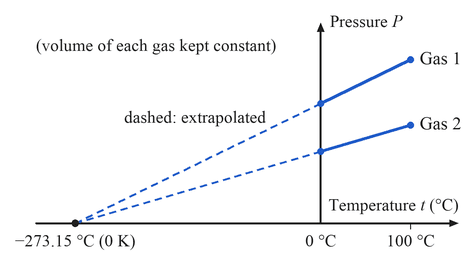
Taking this point as zero and keeping the degree the same size as the Celsius degree gives the absolute (Kelvin) scale:
This scale does not depend on which gas is used, and it has no negative temperatures; with it, at constant volume.
Step 7 — Define absolute zero. Absolute zero is the temperature, or , at which the pressure of an ideal gas kept at constant volume would become zero. It is the lowest temperature possible: there the molecules have the least possible energy, and no lower temperature can exist. (Real gases liquefy before this, so it is found by extending the graph; and even at a small least motion remains.)
Note: since 2019 the value of R is fixed exactly as 8.314462618 J mol⁻¹ K⁻¹; the S.T.P. data above give 8.31.
Therefore, combining Boyle's and Charles' laws shows that PV/T is constant, which leads to the ideal gas equation with ; the absolute scale takes the point of zero gas pressure, −273.15 °C, as its zero (T = t + 273.15), and absolute zero (0 K) is the lowest possible temperature.