
Opening your dashboard
Class 10 Maths Chapter 18: Tangents and Intersecting Chords Solutions
76 textbook questions with step-by-step answers, free to read, for ICSE 2026-27.
Get talked through Ch 18, not just shown the answer
Reading a finished solution is not the same as being able to do it. The AI tutor takes one question at a time and works it with you, in your own words, until you can.
- Ask it out loud, in your own words
- It gives you the next step, not the answer
- Stuck on part (ii)? Start there
76 questions with solutions
1–3 marks · Mixed difficulty
The first 65 solutions are on this page. This chapter is a long one, so the rest open on their own page to keep this one quick to load.
- 11 mark
Question 1
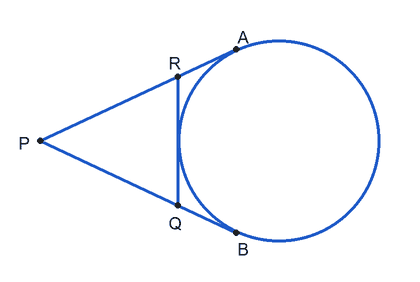
In the given figure, PA, PB and QR are tangents to a circle. If perimeter of the ΔPQR = 18 cm, the length of tangent PA is :
 Solve with AI
Answer
(A) 18 cm
(B) 27 cm
- Correct
(C) 9 cm
(D) none of these
Answer: (C) 9 cm
Concept: From a point outside a circle exactly two tangents can be drawn, and these two tangents are equal in length. The line joining that point to the centre also bisects the angle between the two tangents.
Step 1 — Name the points of contact.
Let QR touch the circle at S. The circle is touched by PA at A, by PB at B and by QR at S, so R and Q are exterior points with two tangents each.
Step 2 — Use equal tangents from R and Q.
From R the two tangents are RA and RS, so RA = RS. From Q the two tangents are QB and QS, so QB = QS.
Step 3 — Rewrite the perimeter.
The perimeter of ΔPQR is PR + RS + SQ + QP. We replace RS by RA and SQ by QB, because they are equal.
The last line uses PA = PB, the two tangents from P.
Step 4 — Find PA.
The perimeter is 18 cm, so twice PA is 18 cm. Dividing by 2 gives PA.
So the tangent PA is 9 cm long.
Watch out: The perimeter is not PA + PB + QR with QR counted separately; QR is split at S and its two parts join PA and PB.
Why the other options are wrong:
- (A) 18 cm: 18 cm is the whole perimeter, which equals PA + PB, that is 2 × PA, not PA.
- (B) 27 cm: 27 cm would make the perimeter 54 cm, three times the given 18 cm.
- (D) none of these: a definite answer exists: PA is 9 cm, which is option (C).
Therefore, the length of tangent PA is 9 cm, option (C).
- 21 mark
Question 2
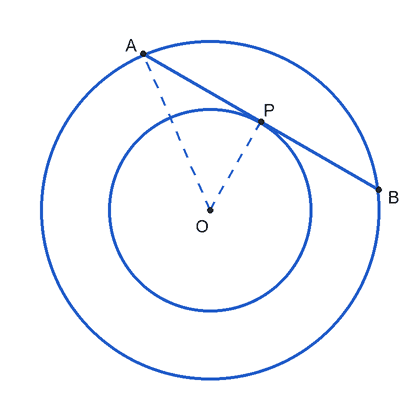
In the given figure, APB is tangent to the inner circle and also a chord of outer circle. Both the circles are concentric. If OA = 10 cm and OP = 6 cm, the length of AB is :
 Solve with AI
Answer
- Correct
(A) 16 cm
(B) 10 cm
(C) 14 cm
(D) 20 cm
Answer: (A) 16 cm
Concept: The tangent at any point of a circle is perpendicular to the radius drawn to the point of contact. So the radius and the tangent always meet at 90°. Also, the perpendicular from the centre to a chord bisects the chord.
Step 1 — See the right angle at P.
AB touches the inner circle at P, so the inner radius OP is perpendicular to AB. So ΔOPA is right-angled at P, with hypotenuse OA = 10 cm.
Step 2 — Find AP by Pythagoras' theorem.
In right ΔOPA, OA² = OP² + AP², so AP² = OA² − OP².
So AP = 8 cm.
Step 3 — Double it.
AB is a chord of the outer circle and OP is perpendicular to it, so P is the mid-point of AB.
Watch out: AP is only half of the chord; the answer asks for the whole chord AB = 2 × AP.
Why the other options are wrong:
- (B) 10 cm: 10 cm is OA, the radius of the outer circle, not the chord AB.
- (C) 14 cm: 14 cm would make AP = 7 cm, but then is 85, not (100).
- (D) 20 cm: 20 cm is the diameter of the outer circle; a chord that does not pass through O is shorter than the diameter.
Therefore, the length of AB is 16 cm, option (A).
- 31 mark
Question 3
A, B and C are three circles which touch each other as shown. Using the information, given in the diagram, we find the length AB as :
 Solve with AI
Answer
(A) 6 cm
- Correct
(B) 17 cm
(C) (289 – 9 – 2) cm
(D) 11 cm
Answer: (B) 17 cm
Concept: When two circles touch each other, the point of contact lies on the line joining their centres. If they touch externally, the distance between the centres = sum of the radii; if they touch internally, it is the difference of the radii. Pythagoras' theorem then gives the third side of a right-angled triangle.
Step 1 — Find AC and CB.
Circles A and C touch externally, so AC is the sum of their radii. Circles C and B also touch externally, so CB is the sum of their radii.
Step 2 — Use the right angle at C.
The figure marks ∠ACB = 90°, so AB is the hypotenuse of right ΔACB. By Pythagoras' theorem, AB² = AC² + CB².
Step 3 — Take the square root.
AB is a length, so we take the positive square root of 289.
Watch out: AB is a distance between centres, so it uses the sums of radii (15 and 8), not the radii 9, 6 and 2 themselves.
Why the other options are wrong:
- (A) 6 cm: 6 cm is only the radius of circle C.
- (C) (289 – 9 – 2) cm: (289 − 9 − 2) cm is 278 cm. It subtracts radii from AB², which is not a length formula at all.
- (D) 11 cm: 11 cm is 9 + 2, the sum of the radii of A and B, but circles A and B do not touch each other.
Therefore, AB = 17 cm, option (B).
- 41 mark
Question 4
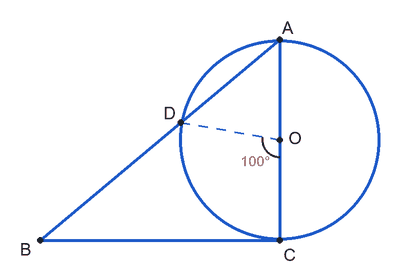
BC is a tangent to the circle with centre O. OD is radius of the circle. If ∠DOC = 100°, ∠B is equal to :
 Solve with AI
Answer
(A) 50°
(B) 60°
- Correct
(C) 40°
(D) 70°
Answer: (C) 40°
Concept: The angle which an arc subtends at the centre is double the angle which it subtends at any point on the remaining part of the circle. The tangent at any point of a circle is perpendicular to the radius drawn to the point of contact. So the radius and the tangent always meet at 90°.
Step 1 — Find ∠DAC.
Arc DC subtends ∠DOC = 100° at the centre and ∠DAC at the point A on the circle. The angle at the centre is double, so ∠DAC is half of 100°.
Step 2 — Find ∠ACB.
AC passes through the centre O, so OC is a radius, and BC is the tangent at C. A tangent is perpendicular to the radius at the point of contact, so ∠ACB = 90°.
Step 3 — Use the angle sum in ΔABC.
B, D and A lie on one straight line, so ∠BAC is the same angle as ∠DAC = 50°. The angles of ΔABC add up to 180°.
Watch out: ∠DOC = 100° is at the centre; the angle at A on the circle is only half of it (50°).
Why the other options are wrong:
- (A) 50°: 50° is ∠DAC (∠BAC), not ∠B.
- (B) 60°: 60° would need ∠BAC to be 30°, but ∠BAC is half of 100°, which is 50°.
- (D) 70°: 70° would need ∠BAC = 20°; it also ignores the right angle at C.
Therefore, ∠B = 40°, option (C).
- 51 mark
Question 5
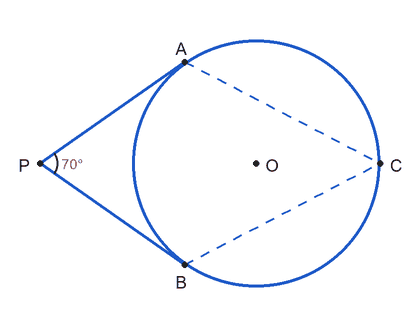
PA and PB are tangents to a circle with centre O. If angle BPA = 70°, the angle ACB is :
 Solve with AI
Answer
(A) 70°
(B) 105°
(C) 140°
- Correct
(D) 55°
Answer: (D) 55°
Concept: The tangent at any point of a circle is perpendicular to the radius drawn to the point of contact. So the radius and the tangent always meet at 90°. The angle which an arc subtends at the centre is double the angle which it subtends at any point on the remaining part of the circle.
Step 1 — Mark the right angles.
OA and OB are radii drawn to the points of contact of the tangents PA and PB. So ∠OAP = 90° and ∠OBP = 90°.
Step 2 — Find ∠AOB.
The four angles of quadrilateral OAPB add up to 360°.
Step 3 — Find ∠ACB.
Arc AB (the minor arc, facing P) subtends ∠AOB at the centre and ∠ACB at C on the major arc. So ∠ACB is half of ∠AOB.
Watch out: ∠ACB is half of ∠AOB (110°), not of ∠APB (70°).
Why the other options are wrong:
- (A) 70°: 70° is ∠BPA; ∠ACB is not equal to it.
- (B) 105°: 105° does not come from the figure; the angle at C on the major arc is half of 110°.
- (C) 140°: 140° is double 70°; ∠AOB is 180° − 70° = 110°, and ∠ACB is half of that.
Therefore, ∠ACB = 55°, option (D).
- 63 marks
Question 6
The radius of a circle is 8 cm. Calculate the length of a tangent drawn to this circle from a point at a distance of 10 cm from its centre.
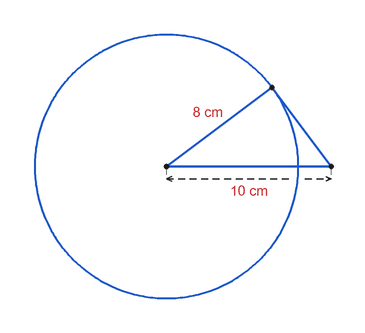 Solve with AI
Written solution
Solution:
Concept: The tangent at any point of a circle is perpendicular to the radius drawn to the point of contact. So the radius and the tangent always meet at 90°. So the radius, the tangent and the line to the centre form a right-angled triangle.
Step 1 — Draw the right-angled triangle.
Let O be the centre and let the tangent from P touch the circle at T. Then OT = 8 cm (radius), OP = 10 cm, and OT ⊥ PT because the radius meets the tangent at 90°. So ΔOTP is right-angled at T, with hypotenuse OP.
Step 2 — Use Pythagoras' theorem.
In right ΔOTP, OP² = OT² + PT², so PT² = OP² − OT².
Step 3 — Take the square root.
A length is positive, so we take the positive root.
Watch out: The hypotenuse is OP (10 cm), the side opposite the right angle at T; so subtract, PT² = 10² − 8².
Therefore, the length of the tangent is 6 cm.
- 73 marks
Question 7
In the given figure, O is the centre of the circle and AB is a tangent at B. If AB = 15 cm and AC = 7·5 cm, calculate the radius of the circle.
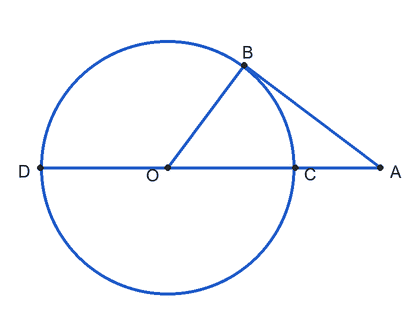 Solve with AI
Written solution
Solution:
Concept: The tangent at any point of a circle is perpendicular to the radius drawn to the point of contact. So the radius and the tangent always meet at 90°. Pythagoras' theorem then links the radius, the tangent and the line to the centre.
Step 1 — Name the lengths.
Let the radius be cm. Then OB = and OC = . A, C, O and D lie on one line, so OA is the sum OC + CA, which we write as .
Step 2 — Use the right angle at B.
AB is the tangent at B and OB is the radius, so ∠OBA = 90°. In right ΔOBA, OA² = OB² + AB².
Step 3 — Expand and solve.
We expand the square on the left and cancel from both sides.
Check: With , OA is 18.75 cm. Then is 351.5625, and is 126.5625 + 225, also 351.5625. Both sides agree.
Watch out: OA is not 7.5 cm; it is the whole length OC + CA = .
Therefore, the radius of the circle is 11.25 cm.
- 83 marks
Question 8
Two circles of radii 5 cm and 3 cm are concentric. Calculate the length of a chord of the outer circle which touches the inner.
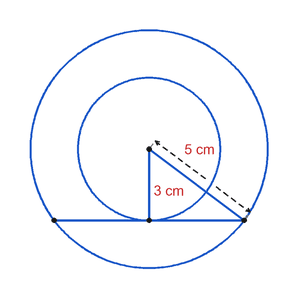 Solve with AI
Written solution
Solution:
Concept: The tangent at any point of a circle is perpendicular to the radius drawn to the point of contact. So the radius and the tangent always meet at 90°. Also, the perpendicular from the centre to a chord bisects the chord.
Step 1 — Draw the figure.
Let O be the common centre and let the chord AB of the outer circle touch the inner circle at P. Then OA = 5 cm (outer radius) and OP = 3 cm (inner radius).
Step 2 — Use the right angle at P.
AB is a tangent to the inner circle at P, so OP ⊥ AB. In right ΔOPA, AP² = OA² − OP².
So AP = 4 cm.
Step 3 — Find the whole chord.
OP is perpendicular to the chord AB of the outer circle, so it bisects AB, and AB = 2 × AP.
Watch out: AP is half the chord; remember to double it.
Therefore, the length of the chord is 8 cm.
- 93 marks
Question 9
Three circles touch each other externally. A triangle is formed when the centres of these circles are joined together. Find the radii of the circles, if the sides of the triangle formed are 6 cm, 8 cm and 9 cm.
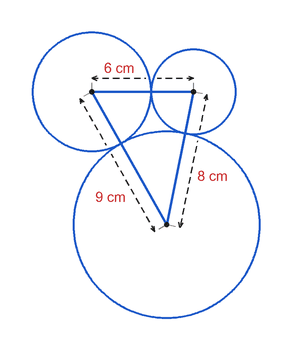 Solve with AI
Written solution
Solution:
Concept: When two circles touch each other, the point of contact lies on the line joining their centres. If they touch externally, the distance between the centres = sum of the radii; if they touch internally, it is the difference of the radii.
Step 1 — Write one equation for each side.
Let the radii be , and cm, named so that the sides of the triangle of centres are , and . Each side joins two centres of circles that touch externally, so each side is a sum of two radii.
Step 2 — Add the three equations.
Adding gives each radius twice, so we can find the sum of the radii.
Step 3 — Subtract each equation from the sum.
Taking away one pair leaves the third radius.
Check:
Watch out: Each side of the triangle is a SUM of two radii, not a single radius.
Therefore, the radii of the circles are 2.5 cm, 3.5 cm and 5.5 cm.
- 103 marks
Question 10
If the sides of a quadrilateral ABCD touch a circle, prove that :
AB + CD = BC + AD.
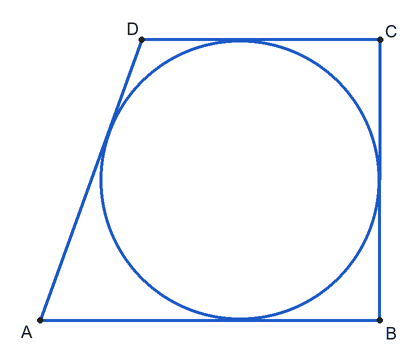 Solve with AI
Written solution
Solution:
Concept: From a point outside a circle exactly two tangents can be drawn, and these two tangents are equal in length. The line joining that point to the centre also bisects the angle between the two tangents.
Step 1 — Name the points of contact.
Let the sides AB, BC, CD and DA touch the circle at P, Q, R and S respectively.
Step 2 — Write the equal tangents.
Each vertex is an exterior point with two tangents to the circle, and these are equal.
Step 3 — Add the four equations.
Adding the left sides and the right sides keeps the equality.
Step 4 — Group into sides.
On the left, AP + BP is the side AB and CR + DR is the side CD. On the right, BQ + CQ is BC and AS + DS is AD.
Watch out: Pair each tangent with the one from the SAME vertex (AP with AS, not AP with BP).
Therefore, AB + CD = BC + AD. Hence proved.
- 113 marks
Question 11
If the sides of a parallelogram touch a circle (refer figure of Q. 6), prove that the parallelogram is a rhombus.
 Solve with AI
Written solution
Solution:
Concept: If the sides of a quadrilateral ABCD touch a circle, then AB + CD = BC + AD (Q. 6, which comes from equal tangents). In a parallelogram, opposite sides are equal. A parallelogram with two adjacent sides equal is a rhombus.
Step 1 — Use the result of Q. 6.
Let ABCD be the parallelogram whose four sides touch the circle. By Q. 6:
Step 2 — Use the opposite sides of a parallelogram.
In a parallelogram CD = AB and AD = BC, so we replace CD by AB and AD by BC.
Step 3 — Conclude.
So two adjacent sides of the parallelogram are equal. Then all four sides are equal, since opposite sides are already equal, and the parallelogram is a rhombus.
Watch out: It is not enough to say the opposite sides are equal; you must show two ADJACENT sides are equal.
Therefore, the parallelogram is a rhombus. Hence proved.
- 123 marks
Question 12
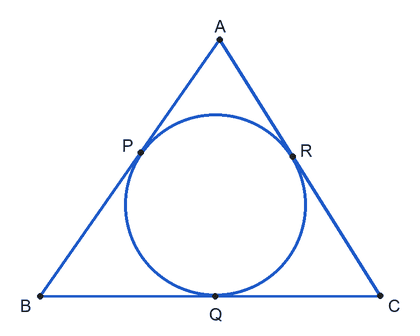
From the given figure, prove that :
AP + BQ + CR = BP + CQ + AR.
Also, show that :
AP + BQ + CR = × Perimeter of Δ ABC.
 Solve with AI
Written solution
Solution:
Concept: From a point outside a circle exactly two tangents can be drawn, and these two tangents are equal in length. The line joining that point to the centre also bisects the angle between the two tangents. Here the circle touches AB at P, BC at Q and CA at R.
Step 1 — Write the equal tangents.
From each vertex the two tangents to the circle are equal.
Step 2 — Prove the first result.
Adding the three equations, side by side:
Rearranging the right side gives AP + BQ + CR = BP + CQ + AR, which is the first result.
Step 3 — Split the perimeter into tangent pieces.
Each side of the triangle is made of two tangent lengths.
Step 4 — Use the first result.
By Step 2 the two brackets are equal, so the perimeter is twice the first bracket.
Watch out: The two tangents from B are BP and BQ (both start at B); do not pair BQ with CQ.
Therefore, AP + BQ + CR = BP + CQ + AR, and AP + BQ + CR = ½ × perimeter of ΔABC. Hence proved.
- 133 marks
Question 13
In the figure of Q. 8; if AB = AC then prove that : BQ = CQ.
Solve with AIWritten solution
Solution:
Concept: From a point outside a circle exactly two tangents can be drawn, and these two tangents are equal in length. The line joining that point to the centre also bisects the angle between the two tangents.
Step 1 — Write the equal tangents.
As in Q. 8, the circle touches AB at P, BC at Q and CA at R, so from each vertex the two tangents are equal.
Step 2 — Use AB = AC.
We write each side as the sum of its two tangent pieces.
Step 3 — Cancel the equal tangents from A.
AP = AR, so subtracting them from both sides leaves BP = CR.
Step 4 — Change to the tangents on BC.
BP is equal to BQ, and CR is equal to CQ. So the equal lengths BP and CR are the same as BQ and CQ, which gives BQ = CQ.
Watch out: The fact AB = AC alone is not enough to make BQ and CQ equal; you need the equal tangents from A, B and C as well.
Therefore, BQ = CQ. Hence proved.
- 143 marks
Question 14
Radii of two circles are 6·3 cm and 3·6 cm. State the distance between their centres if :
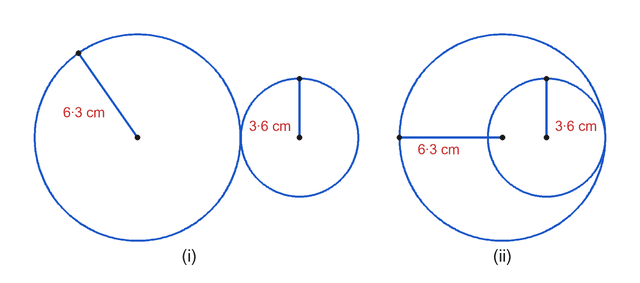
(i) they touch each other externally,
(ii) they touch each other internally.
Solve with AIWritten solution
Solution:
Concept: When two circles touch each other, the point of contact lies on the line joining their centres. If they touch externally, the distance between the centres = sum of the radii; if they touch internally, it is the difference of the radii.
Step 1 — Part (i): touching externally.
The circles lie outside each other and meet at one point, so the distance between the centres is the sum of the radii.
Step 2 — Part (ii): touching internally.
The smaller circle lies inside the bigger one and touches it, so the distance between the centres is the difference of the radii.
Watch out: Internally means the DIFFERENCE of the radii, not the sum.
Therefore, (i) the distance between the centres is 9.9 cm; (ii) it is 2.7 cm.
- 153 marks
Question 15
From a point P outside a circle, with centre O, tangents PA and PB are drawn.
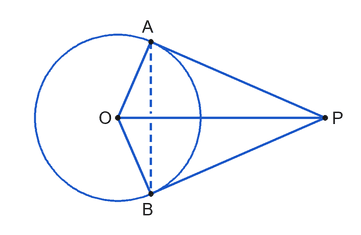
Prove that :
(i) ∠AOP = ∠BOP,
(ii) OP is the ⊥ bisector of chord AB.
Solve with AIWritten solution
Solution:
Concept: The tangent at any point of a circle is perpendicular to the radius drawn to the point of contact. So the radius and the tangent always meet at 90°. Two right triangles with equal hypotenuses and one pair of equal sides are congruent (RHS).
Step 1 — Part (i): compare ΔOAP and ΔOBP.
We show that the two triangles are congruent.
- OA = OB (radii of the same circle)
- ∠OAP = 90° and ∠OBP = 90° (radius ⊥ tangent)
- OP = OP (common hypotenuse)
So ΔOAP ≅ ΔOBP by RHS, and their corresponding angles are equal: ∠AOP = ∠BOP.
Step 2 — Part (ii): compare ΔAOM and ΔBOM.
Let OP cut the chord AB at M. Now we compare the two triangles on either side of OM.
- OA = OB (radii)
- ∠AOM = ∠BOM (part (i), since M lies on OP)
- OM = OM (common)
So ΔAOM ≅ ΔBOM by SAS. Hence AM = BM and ∠AMO = ∠BMO.
Step 3 — Show the angle at M is 90°.
∠AMO and ∠BMO together make the straight angle AMB, so they add up to 180°. Being equal, each is 90°.
So OP is perpendicular to AB, and it passes through the mid-point M of AB.
Watch out: For part (ii) you must prove BOTH facts: AM = BM (bisects) and ∠AMO = 90° (perpendicular).
Therefore, (i) ∠AOP = ∠BOP; (ii) OP is the perpendicular bisector of chord AB. Hence proved.
- 163 marks
Question 16
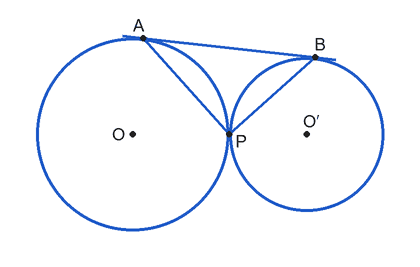
In the given figure, two circles touch each other externally at point P. AB is the direct common tangent of these circles. Prove that :
(i) tangent at point P bisects AB,
(ii) angle APB = 90°.
 Solve with AI
Written solution
Solution:
Concept: From a point outside a circle exactly two tangents can be drawn, and these two tangents are equal in length. The line joining that point to the centre also bisects the angle between the two tangents. Base angles opposite equal sides of a triangle are equal.
Step 1 — Draw the tangent at P.
Let the common tangent at P meet AB at M. (Both circles have the same tangent at P, because P lies on the line of centres OO′ and the tangent is perpendicular to it.)
Step 2 — Part (i): equal tangents from M.
From M, MA and MP are two tangents to the first circle, so MA = MP. MB and MP are two tangents to the second circle, so MB = MP.
Hence MA = MB, so M is the mid-point of AB.
Step 3 — Part (ii): find the equal angles.
In ΔAMP, MA = MP, so the base angles are equal: ∠MAP = ∠MPA. In ΔBMP, MB = MP, so ∠MBP = ∠MPB.
Step 4 — Use the angle sum in ΔAPB.
The angles of ΔAPB add up to 180°. We replace ∠PAB by ∠MPA and ∠PBA by ∠MPB, and note that ∠MPA + ∠MPB is the whole ∠APB.
Watch out: The tangent at P is a different line from AB; it cuts AB at M, and MP is a tangent to BOTH circles.
Therefore, (i) the tangent at P bisects AB; (ii) ∠APB = 90°. Hence proved.
- 173 marks
Question 17
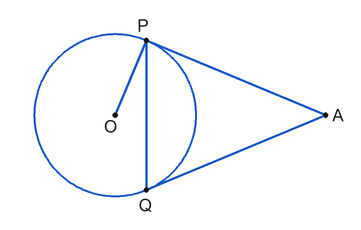
Tangents AP and AQ are drawn to a circle, with centre O, from an exterior point A.
Prove that :
∠PAQ = 2∠OPQ
Solve with AIWritten solution
Solution:
Concept: From a point outside a circle exactly two tangents can be drawn, and these two tangents are equal in length. The line joining that point to the centre also bisects the angle between the two tangents. The tangent at any point of a circle is perpendicular to the radius drawn to the point of contact. So the radius and the tangent always meet at 90°.
Step 1 — Find ∠APQ in terms of ∠PAQ.
AP = AQ (tangents from A), so ΔAPQ is isosceles and its base angles are equal. Let ∠PAQ = . The base angles share the rest of 180°.
Step 2 — Use the right angle at P.
OP is a radius and AP is the tangent at P, so ∠OPA = 90°. ∠OPQ is the part of ∠OPA left after ∠APQ.
Step 3 — Conclude.
So ∠OPQ is half of ∠PAQ, which means ∠PAQ is twice ∠OPQ.
Watch out: ∠OPA (not ∠OPQ) is the right angle; ∠OPQ is only part of it.
Therefore, ∠PAQ = 2∠OPQ. Hence proved.
- 183 marks
Question 18
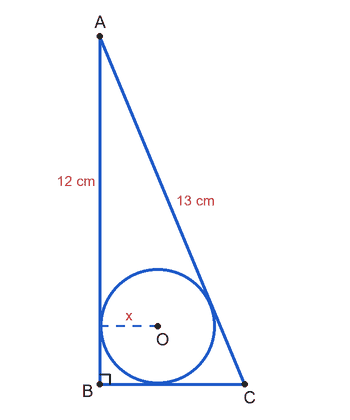
ABC is a right angled triangle with AB = 12 cm and AC = 13 cm. A circle, with centre O, has been inscribed inside the triangle. Calculate the value of x, the radius of the inscribed circle.
 Solve with AI
Written solution
Solution:
Concept: From a point outside a circle exactly two tangents can be drawn, and these two tangents are equal in length. The line joining that point to the centre also bisects the angle between the two tangents. The tangent at any point of a circle is perpendicular to the radius drawn to the point of contact. So the radius and the tangent always meet at 90°.
Step 1 — Find BC.
∠B = 90° (the right angle of the triangle), so AC = 13 cm is the hypotenuse. By Pythagoras' theorem:
So BC = 5 cm.
Step 2 — Find the tangents from B.
Let the circle touch AB at P, BC at Q and AC at R. OP ⊥ AB and OQ ⊥ BC (radius ⊥ tangent), and ∠B = 90°, so OPBQ is a square of side . Hence BP = and BQ = .
Step 3 — Find the tangents from A and C.
The tangents from A are equal, so AR = AP. Since BP is , AP is 12 − . The tangents from C are equal, so CR = CQ. Since BQ is , CQ is 5 − . AR and CR together make AC.
Watch out: The dashed radius is drawn to the side AB; the line OB is NOT the radius (it is the diagonal of the square, ).
Therefore, the radius of the inscribed circle is cm.
- 193 marks
Question 19
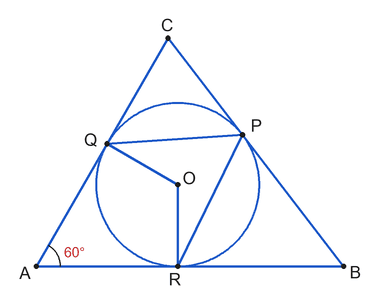
In a triangle ABC, the incircle (centre O) touches BC, CA and AB at points P, Q and R respectively. Calculate :
(i) ∠QOR
(ii) ∠QPR;
given that ∠A = 60°.
 Solve with AI
Written solution
Solution:
Concept: The tangent at any point of a circle is perpendicular to the radius drawn to the point of contact. So the radius and the tangent always meet at 90°. The angle which an arc subtends at the centre is double the angle which it subtends at any point on the remaining part of the circle.
Step 1 — Part (i): use quadrilateral AROQ.
OR ⊥ AB and OQ ⊥ AC, because each radius meets its tangent at 90°. So ∠ARO = 90° and ∠AQO = 90°. The angles of quadrilateral AROQ add up to 360°.
Step 2 — Part (ii): use the angle at the centre.
P, Q and R all lie on the incircle. Arc QR subtends ∠QOR at the centre and ∠QPR at P on the remaining arc, so ∠QPR is half of ∠QOR.
Watch out: ∠QPR is at the point P on the CIRCLE, so it is half the central angle, not equal to it.
Therefore, (i) ∠QOR = 120°; (ii) ∠QPR = 60°.
- 203 marks
Question 20
In the given figure, PT touches the circle with centre O at point R. Diameter SQ is produced to meet the tangent TR at P.
Given ∠SPR = x° and ∠QRP = y°; prove that :
(i) ∠ORS = y°
(ii) write an expression connecting x and y.
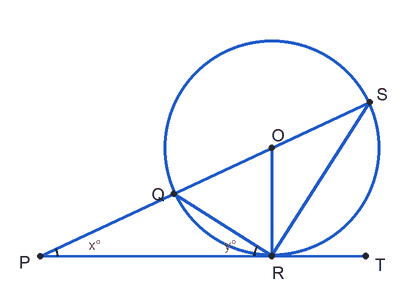 Solve with AI
Written solution
Solution:
Concept: Alternate segment theorem: The angle between a tangent and a chord drawn from the point of contact is equal to the angle which that chord subtends in the alternate segment (the part of the circle on the other side of the chord). The angle in a semicircle is a right angle: a diameter subtends 90° at every other point of the circle.
Step 1 — Part (i): use the alternate segment.
RP is the tangent at R and RQ is a chord through R. The angle between them, ∠QRP = y°, equals the angle that RQ subtends in the alternate segment, at S.
Step 2 — Use the isosceles triangle ORS.
OR = OS (radii), so the base angles of ΔORS are equal. ∠OSR is the same angle as ∠QSR, because O lies on SQ.
Step 3 — Part (ii): find ∠PRS.
SQ is a diameter, so ∠QRS = 90° (angle in a semicircle). ∠PRS is made of ∠PRQ and ∠QRS.
Step 4 — Use the angle sum in ΔPRS.
In ΔPRS, ∠P = x°, ∠PRS = y° + 90° and ∠PSR = y° (Step 1). They add up to 180°.
Watch out: The alternate-segment angle for ∠QRP is at S, on the other side of chord RQ from P.
Therefore, (i) ∠ORS = y°; (ii) x + 2y = 90.
- 213 marks
Question 21
PT is a tangent to the circle at T. If ∠ABC = 70° and ∠ACB = 50°; calculate :
(i) ∠CBT
(ii) ∠BAT
(iii) ∠APT
 Solve with AI
Written solution
Solution:
Concept: The angle in a semicircle is a right angle: a diameter subtends 90° at every other point of the circle. Angles in the same segment of a circle are equal: a chord subtends equal angles at all points on the same arc. Alternate segment theorem: The angle between a tangent and a chord drawn from the point of contact is equal to the angle which that chord subtends in the alternate segment (the part of the circle on the other side of the chord).
Step 1 — Find ∠BAC.
The angles of ΔABC add up to 180°.
Step 2 — Part (i): find ∠CBT.
The figure shows the centre O on CT, so CT is a diameter. ∠CBT stands on this diameter, so it is an angle in a semicircle.
Step 3 — Find ∠BTC and ∠BCT.
∠BTC and ∠BAC stand on the same arc BC, so they are equal: ∠BTC = 60°. Then the angles of ΔCBT give ∠BCT.
Step 4 — Part (ii): find ∠BAT.
∠BAT and ∠BCT stand on the same arc BT, so they are equal.
Step 5 — Find ∠ATP.
∠ACT is the part of ∠ACB left after ∠BCT. By the alternate segment theorem, the angle between the tangent TP and the chord TA equals ∠ACT, the angle in the alternate segment.
Step 6 — Part (iii): find ∠APT.
P, A and B lie on one line, so ∠PAT and ∠BAT add up to 180°. Then the angles of ΔAPT add up to 180°.
Watch out: ∠BAT is on the same arc as ∠BCT (arc BT), not as ∠BTC.
Therefore, (i) ∠CBT = 90°; (ii) ∠BAT = 30°; (iii) ∠APT = 10°.
- 223 marks
Question 22
In the given figure, O is the centre of the circumcircle ABC. Tangents at A and C intersect at P. Given angle AOB = 140° and angle APC = 80°; find the angle BAC.
 Solve with AI
Written solution
Solution:
Concept: The tangent at any point of a circle is perpendicular to the radius drawn to the point of contact. So the radius and the tangent always meet at 90°. The angle which an arc subtends at the centre is double the angle which it subtends at any point on the remaining part of the circle.
Step 1 — Join OC and find ∠AOC.
OA and OC are radii to the points of contact of the tangents PA and PC, so ∠OAP = 90° and ∠OCP = 90°. The angles of quadrilateral OAPC add up to 360°.
Step 2 — Find ∠ACB.
Arc AB subtends ∠AOB = 140° at the centre and ∠ACB at C, so ∠ACB is half of it.
Step 3 — Find ∠ABC.
Arc AC subtends ∠AOC = 100° at the centre and ∠ABC at B, so ∠ABC is half of it.
Step 4 — Find ∠BAC.
The angles of ΔABC add up to 180°.
Watch out: Use ∠AOC for ∠ABC and ∠AOB for ∠ACB: each central angle pairs with the vertex NOT on its arc.
Therefore, ∠BAC = 60°.
- 233 marks
Question 23
In the given figure, PQ is a tangent to the circle at A. AB and AD are bisectors of ∠CAQ and ∠PAC. If ∠BAQ = 30°, prove that : BD is diameter of the circle.
 Solve with AI
Written solution
Solution:
Concept: A chord that subtends a right angle at a point of the circle is a diameter (the converse of 'the angle in a semicircle is 90°'). Angles on a straight line add up to 180°.
Step 1 — Use the bisector AB.
AB bisects ∠CAQ, so ∠CAB is equal to ∠BAQ, which is 30°. So ∠CAQ is twice 30°.
Step 2 — Find ∠PAC.
PAQ is a straight line, so ∠PAC and ∠CAQ add up to 180°.
Step 3 — Use the bisector AD.
AD bisects ∠PAC, so ∠DAC is half of it.
Step 4 — Find ∠DAB.
∠DAB is made of ∠DAC and ∠CAB.
Step 5 — Conclude.
The chord BD subtends a right angle at A, a point on the circle. Only a diameter subtends 90° at the circle, so BD is a diameter.
Watch out: The bisectors of two angles on a straight line always meet at 90° (here 60° + 30°); the 30° only confirms the numbers.
Therefore, BD is a diameter of the circle. Hence proved.
- 241 mark
Question 24
Chords AB and CD of a circle intersect each other at point O such that OA : OC = 4 : 7. Then OB : OD is equal to :
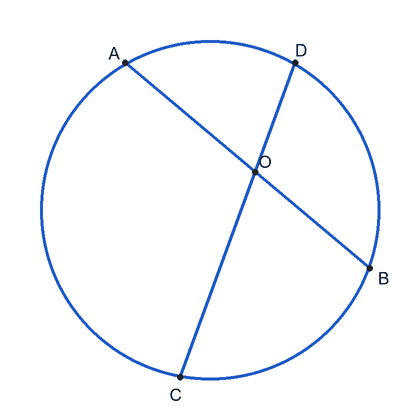 Solve with AI
Answer
(A) 4 : 7
(B) 5 : 4
- Correct
(C) 7 : 4
(D) 4 : 5
Answer: (C) 7 : 4
Concept: Intersecting chords: If two chords AB and CD of a circle cut each other at a point P inside the circle, then PA × PB = PC × PD.
Step 1 — Write the chord rule.
Chords AB and CD cut each other at O inside the circle, so the products of the two parts of each chord are equal.
Step 2 — Put in the given ratio.
OA : OC = 4 : 7, so we may take OA = and OC = for some positive number .
Step 3 — Write the ratio.
So OB : OD = 7 : 4. The ratio turns round: the shorter part OA goes with the longer part OB.
Watch out: The parts of ONE chord are multiplied (OA × OB), so OB : OD is the reverse of OA : OC, not the same.
Why the other options are wrong:
- (A) 4 : 7: 4 : 7 is OA : OC itself; the product rule reverses it.
- (B) 5 : 4: 5 : 4 has no basis in the data; only the numbers 4 and 7 appear.
- (D) 4 : 5: 4 : 5 has no basis in the data either; the product rule gives 7 : 4.
Therefore, OB : OD = 7 : 4, option (C).
- 251 mark
Question 25
If ∠PAC : ∠PCA = 5 : 4; ∠P is :
 Solve with AI
Answer
(A) 40°
(B) 60°
(C) 105°
- Correct
(D) 45°
Answer: (D) 45°
Concept: In a cyclic quadrilateral the opposite angles add up to 180°, and an exterior angle equals the interior opposite angle.
Step 1 — Find ∠PCA.
A, B, D and C lie on the circle, so ABDC is a cyclic quadrilateral. P, C and D lie on one line, so ∠PCA is the exterior angle of ABDC at C. It equals the interior opposite angle, ∠ABD, which is marked 60°.
Step 2 — Find ∠PAC from the ratio.
∠PAC : ∠PCA = 5 : 4, so ∠PAC is of ∠PCA.
Step 3 — Find ∠P.
The angles of ΔPAC add up to 180°.
Watch out: The exterior angle of a cyclic quadrilateral equals the INTERIOR OPPOSITE angle (∠ABD), not the angle next to it.
Why the other options are wrong:
- (A) 40°: 40° would need ∠PAC to be 80°, but ∠PAC is , which is 75°.
- (B) 60°: 60° is ∠PCA (and ∠ABD), not ∠P.
- (C) 105°: 105° is ∠BAC, the angle next to ∠PAC on the straight line PAB, not ∠P.
Therefore, ∠P = 45°, option (D).
- 261 mark
Question 26
AC is a tangent to the given circle which touches the circle at point B. If ∠EBC = 45°; angle EDB is equal to :
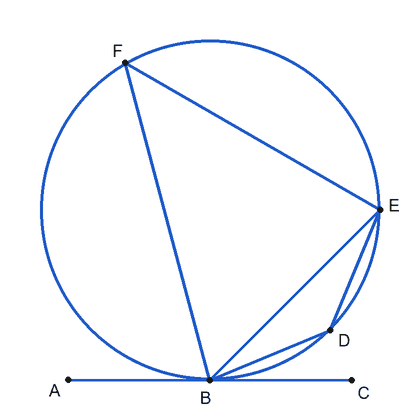 Solve with AI
Answer
(A) 45°
(B) 90°
(C) 125°
- Correct
(D) 135°
Answer: (D) 135°
Concept: Alternate segment theorem: The angle between a tangent and a chord drawn from the point of contact is equal to the angle which that chord subtends in the alternate segment (the part of the circle on the other side of the chord). In a cyclic quadrilateral the opposite angles add up to 180°, and an exterior angle equals the interior opposite angle.
Step 1 — Use the alternate segment.
BC is the tangent at B and BE is a chord through B. The angle between them, ∠EBC = 45°, equals the angle that BE subtends in the alternate segment, at F (F is on the other side of BE from C).
Step 2 — Use the cyclic quadrilateral FBDE.
F, B, D and E lie on the circle, and F and D are opposite vertices of quadrilateral FBDE. Opposite angles add up to 180°.
Watch out: D is on the SAME side of BE as C, so ∠EDB is not equal to 45°; it is the angle opposite F in the cyclic quadrilateral.
Why the other options are wrong:
- (A) 45°: 45° is ∠EBC and ∠EFB; ∠EDB is supplementary to ∠EFB.
- (B) 90°: 90° would need ∠EFB to be 90°, that is BE a diameter, which nothing in the data says.
- (C) 125°: 125° would need ∠EFB to be 55°, but ∠EFB is 45°.
Therefore, ∠EDB = 135°, option (D).
- 271 mark
Question 27
In the given circle, PA is tangent and PBC is secant, PA = 8 cm and PB = 4 cm. The length of BC is :
 Solve with AI
Answer
(A) 8 cm
- Correct
(B) 12 cm
(C) 16 cm
(D) 2 cm
Answer: (B) 12 cm
Concept: Tangent and secant: If from an exterior point P a secant meets the circle at A and B and a tangent touches it at T, then PT² = PA × PB.
Step 1 — Write the tangent–secant rule.
PA is the tangent and PBC is the secant from P, so the square of the tangent equals the whole secant times its outside part.
Step 2 — Find PC.
We put PA = 8 and PB = 4 and solve for PC.
Step 3 — Find BC.
BC is the part of PC beyond B.
Watch out: PC is the WHOLE secant (16 cm); the question asks for the chord BC = PC − PB.
Why the other options are wrong:
- (A) 8 cm: 8 cm is the tangent PA, not the chord BC.
- (C) 16 cm: 16 cm is the whole secant PC; BC is PC − PB.
- (D) 2 cm: 2 is the ratio PA ÷ PB, not a length on the secant.
Therefore, BC = 12 cm, option (B).
- 281 mark
Question 28
In the given figure, O is the centre of the circle, PA is tangent and PBC is secant. If ∠ABC = 60°; ∠P is :
 Solve with AI
Answer
- Correct
(A) 30°
(B) 60°
(C) 120°
(D) 90°
Answer: (A) 30°
Concept: Alternate segment theorem: The angle between a tangent and a chord drawn from the point of contact is equal to the angle which that chord subtends in the alternate segment (the part of the circle on the other side of the chord). The angle in a semicircle is a right angle: a diameter subtends 90° at every other point of the circle.
Step 1 — Find ∠ACB.
BC passes through the centre O, so BC is a diameter and ∠BAC = 90° (angle in a semicircle). The angles of ΔABC add up to 180°.
Step 2 — Use the alternate segment.
PA is the tangent at A and AB is a chord. The angle between them, ∠PAB, equals the angle in the alternate segment, ∠ACB.
Step 3 — Find ∠ABP.
P, B and C lie on one line, so ∠ABP and ∠ABC add up to 180°.
Step 4 — Find ∠P.
The angles of ΔPAB add up to 180°.
Watch out: ∠ABP (120°) is the angle INSIDE ΔPAB at B, not the given ∠ABC (60°).
Why the other options are wrong:
- (B) 60°: 60° is ∠ABC, not ∠P.
- (C) 120°: 120° is ∠ABP, the angle of ΔPAB at B.
- (D) 90°: 90° is ∠BAC, the angle in the semicircle.
Therefore, ∠P = 30°, option (A).
- 293 marks
Question 29
In the given figure, diameter AB and chord CD of a circle meet at P. PT is a tangent to the circle at T. CD = 7·8 cm, PD = 5 cm, PB = 4 cm. Find :
(i) AB. (ii) the length of tangent PT.
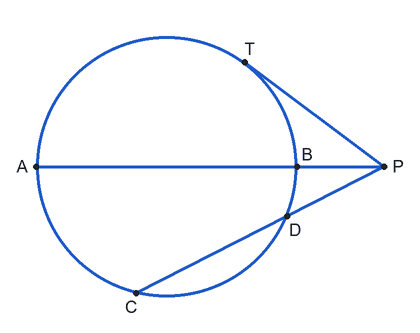 Solve with AI
Written solution
Solution:
Concept: Chords meeting outside: If two chords AB and CD, when produced, meet at a point P outside the circle, then PA × PB = PC × PD (for each line, the whole length from P times the outside part). Tangent and secant: If from an exterior point P a secant meets the circle at A and B and a tangent touches it at T, then PT² = PA × PB.
Step 1 — Find PC.
PC is made of PD and DC.
Step 2 — Part (i): find PA.
Lines PBA and PDC are two chords produced to meet at P, so PA × PB = PC × PD.
Step 3 — Find AB.
AB is the part of PA beyond B.
Step 4 — Part (ii): find PT.
PT is the tangent from P and PBA is a secant, so PT² = PA × PB.
Watch out: Use the WHOLE lengths from P (PA = 16, PC = 12.8), not the chords AB and DC.
Therefore, (i) AB = 12 cm; (ii) the tangent PT = 8 cm.
- 303 marks
Question 30
In the following figure, PQ is the tangent to the circle at A, DB is the diameter and O is the centre of the circle. If ∠ADB = 30° and ∠CBD = 60°, calculate :
(i) ∠QAB,
(ii) ∠PAD,
(iii) ∠CDB.
 Solve with AI
Written solution
Solution:
Concept: Alternate segment theorem: The angle between a tangent and a chord drawn from the point of contact is equal to the angle which that chord subtends in the alternate segment (the part of the circle on the other side of the chord). The angle in a semicircle is a right angle: a diameter subtends 90° at every other point of the circle.
Step 1 — Part (i): use the alternate segment.
AQ is the tangent at A and AB is a chord. The angle between them, ∠QAB, equals the angle AB subtends in the alternate segment, ∠ADB.
Step 2 — Part (ii): use the semicircle.
DB is a diameter, so ∠DAB = 90°. P, A and Q lie on one straight line, so the three angles at A on one side of it add up to 180°.
Step 3 — Part (iii): use the semicircle again.
DB is a diameter, so ∠DCB = 90°. The angles of ΔBCD add up to 180°.
Check: ∠PAD should also equal ∠ABD (alternate segment for chord AD). In ΔABD, ∠ABD is 180° − 90° − 30°, which is 60°, the same as part (ii).
Watch out: ∠QAB pairs with ∠ADB (the angle at D, on the other side of chord AB from Q).
Therefore, (i) ∠QAB = 30°; (ii) ∠PAD = 60°; (iii) ∠CDB = 30°.
- 313 marks
Question 31
If PQ is a tangent to the circle at R; calculate :
(i) ∠PRS,
(ii) ∠ROT.
Given O is the centre of the circle and angle TRQ = 30°.
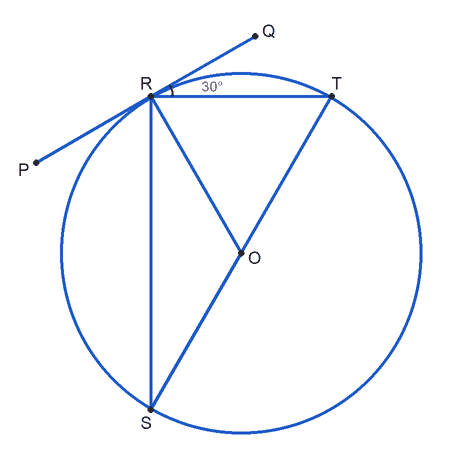 Solve with AI
Written solution
Solution:
Concept: Alternate segment theorem: The angle between a tangent and a chord drawn from the point of contact is equal to the angle which that chord subtends in the alternate segment (the part of the circle on the other side of the chord). The angle in a semicircle is a right angle: a diameter subtends 90° at every other point of the circle. The angle which an arc subtends at the centre is double the angle which it subtends at any point on the remaining part of the circle.
Step 1 — Find ∠SRT.
ST passes through the centre O, so ST is a diameter and ∠SRT = 90° (angle in a semicircle).
Step 2 — Part (i): find ∠PRS.
P, R and Q lie on the tangent, a straight line, so ∠PRS, ∠SRT and ∠TRQ add up to 180°.
Step 3 — Find ∠RST.
RQ is the tangent at R and RT is a chord. The angle between them, ∠TRQ = 30°, equals the angle RT subtends in the alternate segment, at S.
Step 4 — Part (ii): find ∠ROT.
Arc RT subtends ∠ROT at the centre and ∠RST at S, so ∠ROT is twice ∠RST.
Watch out: ∠ROT is at the centre, so it is DOUBLE the angle at the circle (30°), not equal to it.
Therefore, (i) ∠PRS = 60°; (ii) ∠ROT = 60°.
- 323 marks
Question 32
Two circles with centres O and O′ are drawn to intersect each other at points A and B. Centre O of one circle lies on the circumference of the other circle and CD is drawn tangent to the circle with centre O′ at A. Prove that OA bisects angle BAC.
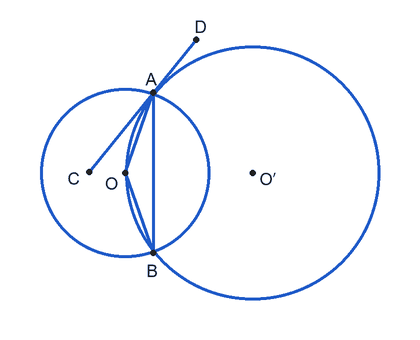 Solve with AI
Written solution
Solution:
Concept: Alternate segment theorem: The angle between a tangent and a chord drawn from the point of contact is equal to the angle which that chord subtends in the alternate segment (the part of the circle on the other side of the chord). Base angles opposite equal sides of a triangle are equal.
Step 1 — Use the alternate segment in the circle with centre O′.
CD is the tangent to this circle at A, and O lies on this circle, so AO is a chord of it. The angle between the tangent AC and the chord AO equals the angle AO subtends at B, which lies on this circle on the other side of AO from C.
Step 2 — Use the isosceles triangle OAB.
In the circle with centre O, OA and OB are radii, so OA = OB. The base angles of ΔOAB are equal.
Step 3 — Combine the two results.
∠ABO and ∠OBA are the same angle, so Steps 1 and 2 give two equal angles at A.
So OA divides ∠BAC into the two equal angles ∠CAO and ∠OAB.
Watch out: AO is a chord of the circle with centre O′ (O lies on that circle), but a RADIUS of the circle with centre O; each step uses a different circle.
Therefore, OA bisects ∠BAC. Hence proved.
- 333 marks
Question 33
In the figure, ABCD is a cyclic quadrilateral with BC = CD. TC is tangent to the circle at point C and DC is produced to point G. If ∠BCG = 108° and O is the centre of the circle, find :
(i) angle BCT
(ii) angle DOC
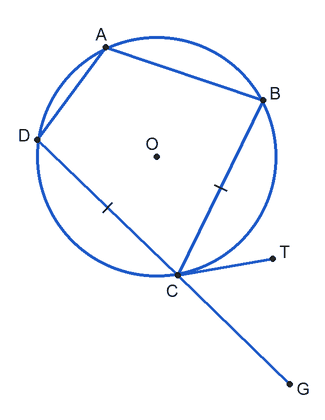 Solve with AI
Written solution
Solution:
Concept: Alternate segment theorem: The angle between a tangent and a chord drawn from the point of contact is equal to the angle which that chord subtends in the alternate segment (the part of the circle on the other side of the chord). The angle which an arc subtends at the centre is double the angle which it subtends at any point on the remaining part of the circle.
Step 1 — Find ∠BCD.
D, C and G lie on one line, so ∠BCD and ∠BCG add up to 180°.
Step 2 — Find ∠CBD and ∠CDB.
BC = CD, so ΔBCD is isosceles and its base angles ∠CBD and ∠CDB are equal. They share the rest of 180°.
Step 3 — Part (i): use the alternate segment.
CT is the tangent at C and CB is a chord. The angle between them, ∠BCT, equals the angle CB subtends in the alternate segment, at D.
Step 4 — Part (ii): use the angle at the centre.
Arc DC subtends ∠DOC at the centre and ∠DBC at B, so ∠DOC is twice ∠DBC.
Watch out: ∠BCG = 108° is outside the triangle BCD; the angle inside it at C is 180° − 108° = 72°.
Therefore, (i) ∠BCT = 54°; (ii) ∠DOC = 108°.
- 343 marks
Question 34
In the figure; PA is a tangent to the circle, PBC is secant and AD bisects angle BAC. Show that triangle PAD is an isosceles triangle. Also, show that :
∠CAD = [∠PBA – ∠PAB]
 Solve with AI
Written solution
Solution:
Concept: Alternate segment theorem: The angle between a tangent and a chord drawn from the point of contact is equal to the angle which that chord subtends in the alternate segment (the part of the circle on the other side of the chord). An exterior angle of a triangle equals the sum of the two interior opposite angles; sides opposite equal angles are equal.
Step 1 — Use the alternate segment and the bisector.
PA is the tangent at A and AB is a chord, so ∠PAB equals the angle in the alternate segment, ∠ACB. AD bisects ∠BAC, so ∠BAD = ∠DAC.
Step 2 — Write ∠PAD.
∠PAD is made of ∠PAB and ∠BAD. We replace them by the equal angles from Step 1.
Step 3 — Write ∠PDA.
∠PDA is an exterior angle of ΔADC at D, so it equals the sum of the interior opposite angles at C and A.
Step 4 — Conclude that ΔPAD is isosceles.
Steps 2 and 3 give ∠PAD = ∠PDA. Sides opposite equal angles are equal, so PD = PA, and ΔPAD is isosceles.
Step 5 — Write ∠PBA as an exterior angle.
∠PBA is an exterior angle of ΔABC at B (P, B and C lie on one line). So it equals ∠BAC + ∠ACB, and ∠ACB = ∠PAB from Step 1.
Step 6 — Find ∠CAD.
Subtracting ∠PAB gives ∠BAC, and ∠CAD is half of ∠BAC because AD is the bisector.
Watch out: ∠PDA is the EXTERIOR angle of ΔADC at D, so it is the sum of ∠ACD and ∠DAC.
Therefore, ΔPAD is isosceles (PA = PD), and ∠CAD = ½[∠PBA − ∠PAB]. Hence proved.
- 353 marks
Question 35
Two circles intersect each other at points A and B. Their common tangent touches the circles at points P and Q as shown in the figure. Show that the angles PAQ and PBQ are supplementary.
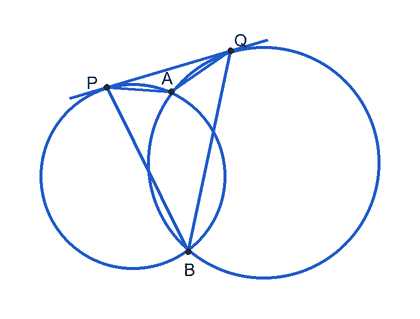 Solve with AI
Written solution
Solution:
Concept: Alternate segment theorem: The angle between a tangent and a chord drawn from the point of contact is equal to the angle which that chord subtends in the alternate segment (the part of the circle on the other side of the chord).
Step 1 — Join AB and use the first circle.
PQ touches the first circle at P, and PA is a chord of it. The angle between the tangent and the chord, ∠QPA, equals the angle PA subtends in the alternate segment, at B.
Step 2 — Use the second circle.
PQ touches the second circle at Q, and QA is a chord of it. In the same way, ∠PQA equals the angle QA subtends at B.
Step 3 — Add the two results.
∠PBQ is made of ∠PBA and ∠ABQ.
Step 4 — Use the angle sum in ΔAPQ.
The angles of ΔAPQ add up to 180°. We replace ∠QPA + ∠PQA by ∠PBQ from Step 3.
Watch out: Each tangent–chord angle uses its OWN circle: ∠QPA in the circle through P, ∠PQA in the circle through Q.
Therefore, ∠PAQ + ∠PBQ = 180°, so the angles PAQ and PBQ are supplementary. Hence proved.
- 363 marks
Question 36
In the figure, chords AE and BC intersect each other at point D.
(i) If ∠CDE = 90°, AB = 5 cm, BD = 4 cm and CD = 9 cm; find DE.
(ii) If AD = BD, show that : AE = BC.
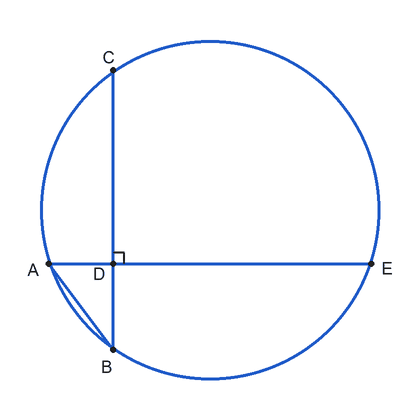 Solve with AI
Written solution
Solution:
Concept: Intersecting chords: If two chords AB and CD of a circle cut each other at a point P inside the circle, then PA × PB = PC × PD. Vertically opposite angles are equal.
Step 1 — Part (i): find AD.
∠ADB and ∠CDE are vertically opposite, so ∠ADB = 90°. In right ΔADB, AB = 5 cm is the hypotenuse.
So AD = 3 cm.
Step 2 — Use the intersecting chords.
Chords AE and BC cut at D, so AD × DE = BD × DC.
Step 3 — Part (ii): use AD = BD.
The chord rule still holds: AD × DE = BD × DC. AD and BD are equal and not zero, so dividing both sides by them gives DE = DC.
Step 4 — Add the parts.
AE is made of AD and DE, and BC is made of BD and DC.
Watch out: Multiply the two parts of the SAME chord (AD × DE), not parts of different chords.
Therefore, (i) DE = 12 cm; (ii) AE = BC. Hence proved.
- 373 marks
Question 37
In the adjoining figure, O is the centre of the circle and AB is a tangent to it at point B. ∠BDC = 65°. Find ∠BAO.
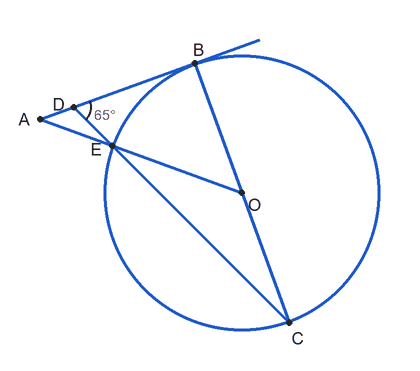 Solve with AI
Written solution
Solution:
Concept: The tangent at any point of a circle is perpendicular to the radius drawn to the point of contact. So the radius and the tangent always meet at 90°. The angle which an arc subtends at the centre is double the angle which it subtends at any point on the remaining part of the circle.
Step 1 — Find ∠DBC.
B, O and C lie on one line, so BC is a diameter and OB is a radius. AB is the tangent at B, so ∠ABC = 90°. D lies on AB, so ∠DBC = 90°.
Step 2 — Find ∠BCD.
The angles of ΔDBC add up to 180°.
E lies on CD, so ∠BCE = 25° too.
Step 3 — Find ∠BOE.
Arc BE subtends ∠BOE at the centre and ∠BCE at C, so ∠BOE is twice ∠BCE.
Step 4 — Find ∠BAO.
A, E and O lie on one line, so ∠BOA is the same angle as ∠BOE, which is 50°. In ΔABO, ∠ABO = 90° (radius ⊥ tangent).
Watch out: ∠BOE (at the centre) is double ∠BCE; do not use 25° directly in ΔABO.
Therefore, ∠BAO = 40°.
- 381 mark
Question 38
AP is a tangent to the given circle. If AB = 8 cm and BC = 10 cm, then AP is :
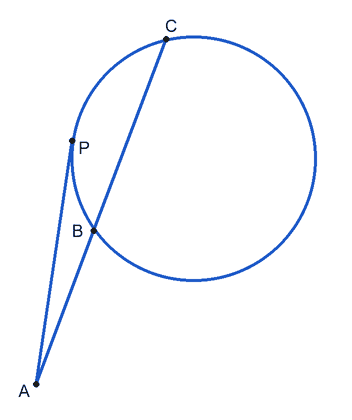 Solve with AI
Answer
(A) 8 cm
(B) 16 cm
- Correct
(C) 12 cm
(D) 24 cm
Answer: (C) 12 cm
Concept: Tangent and secant: If from an exterior point P a secant meets the circle at A and B and a tangent touches it at T, then PT² = PA × PB.
Step 1 — Find the whole secant AC.
B lies between A and C on the secant, so AC is AB + BC.
Step 2 — Use the tangent–secant rule.
AP is the tangent from A and ABC is the secant, so AP² = AB × AC.
Watch out: Use the whole secant AC = 18 cm, not the chord BC = 10 cm.
Why the other options are wrong:
- (A) 8 cm: 8 cm is AB, the outside part of the secant.
- (B) 16 cm: 16 cm would give AP² = 256, but AB × AC = 144.
- (D) 24 cm: 24 cm would give AP² = 576, four times 144.
Therefore, AP = 12 cm, option (C).
- 391 mark
Question 39
In the given figure, O is centre of the circle and PQ is a tangent. If angle OAB = x; the measure of angle ABP, in terms of x, is :
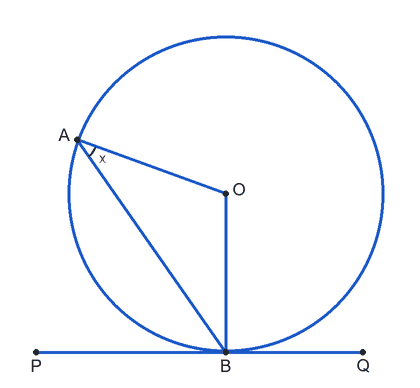 Solve with AI
Answer
(A) x
(B) 180° – 2x
(C) 90° + x
- Correct
(D) 90° – x
Answer: (D) 90° – x
Concept: The tangent at any point of a circle is perpendicular to the radius drawn to the point of contact. So the radius and the tangent always meet at 90°. The radii OA and OB are equal, so ΔOAB is isosceles.
Step 1 — Find ∠OBA.
OA = OB (radii), so the base angles of ΔOAB are equal.
Step 2 — Use the right angle at B.
PQ is the tangent at B and OB is the radius, so ∠OBP = 90°. The chord BA lies between BO and BP, so ∠ABP is what is left of 90° after ∠OBA.
Watch out: The right angle is between the RADIUS OB and the tangent, not between the chord AB and the tangent.
Why the other options are wrong:
- (A) x: is ∠OAB; ∠ABP equals only in the special case .
- (B) 180° – 2x: is ∠AOB, the angle at the centre.
- (C) 90° + x: is ∠ABQ, the angle on the other side of BA (it and ∠ABP add up to 180°).
Therefore, ∠ABP = 90° − , option (D).
- 401 mark
Question 40
In the given figure, AB is tangent to the circle with centre O. If OCB is a straight line segment, the angle BAC is :
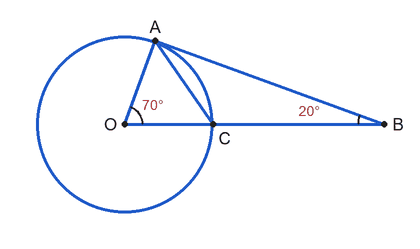 Solve with AI
Answer
(A) 40°
(B) 55°
- Correct
(C) 35°
(D) 20°
Answer: (C) 35°
Concept: The tangent at any point of a circle is perpendicular to the radius drawn to the point of contact. So the radius and the tangent always meet at 90°. The radii OA and OC are equal, so ΔOAC is isosceles.
Step 1 — Find ∠OAC.
OA = OC (radii), so the base angles ∠OAC and ∠OCA are equal. The angle at O is 70°, so the two base angles share the rest of 180°.
Step 2 — Use the right angle at A.
AB is the tangent at A and OA is the radius, so ∠OAB = 90°. ∠BAC is the part of it left after ∠OAC.
Check: ∠OCA is 55°, so ∠ACB is 180° − 55°, which is 125°. Then in ΔABC, ∠BAC is 180° − 125° − 20°, which is 35° again.
Watch out: ∠OAC is 55°, not 70°; 70° is the angle at the centre O.
Why the other options are wrong:
- (A) 40°: 40° would need ∠OAC to be 50°, but ∠OAC is 55°.
- (B) 55°: 55° is ∠OAC, not ∠BAC.
- (D) 20°: 20° is ∠ABC, the angle at B.
Therefore, ∠BAC = 35°, option (C).
- 411 mark
Question 41
In the given figure O is centre, PQ is tangent at point A, BD is diameter and ∠AOD = 84° then angle QAD is :
 Solve with AI
Answer
(A) 32°
(B) 84°
(C) 48°
- Correct
(D) 42°
Answer: (D) 42°
Concept: The angle which an arc subtends at the centre is double the angle which it subtends at any point on the remaining part of the circle. Alternate segment theorem: The angle between a tangent and a chord drawn from the point of contact is equal to the angle which that chord subtends in the alternate segment (the part of the circle on the other side of the chord).
Step 1 — Find ∠ABD.
Arc AD subtends ∠AOD = 84° at the centre and ∠ABD at B on the circle, so ∠ABD is half of 84°.
Step 2 — Use the alternate segment.
AQ is the tangent at A and AD is a chord. The angle between them, ∠QAD, equals the angle AD subtends in the alternate segment, at B.
Check: OA = OD, so ∠OAD is ½(180° − 84°), which is 48°. ∠OAQ is 90°, so ∠QAD is 90° − 48°, which is 42° again.
Watch out: 84° is the angle at the centre; the angle at the circle (and so ∠QAD) is half of it.
Why the other options are wrong:
- (A) 32°: 32° does not come from the figure; ∠QAD is half of 84°.
- (B) 84°: 84° is ∠AOD at the centre, double ∠QAD.
- (C) 48°: 48° is ∠OAD, the base angle of isosceles ΔOAD.
Therefore, ∠QAD = 42°, option (D).
- 421 mark
Question 42
Two mutually perpendicular tangents are drawn to a circle with radius R√2 units. The shortest distance between the two points of contact is :
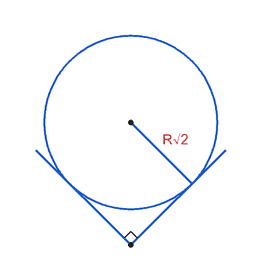 Solve with AI
Answer
(A) R units
(B) ½R units
(C) R√2 units
- Correct
(D) 2R units
Answer: (D) 2R units
Concept: The tangent at any point of a circle is perpendicular to the radius drawn to the point of contact. So the radius and the tangent always meet at 90°. From a point outside a circle exactly two tangents can be drawn, and these two tangents are equal in length. The line joining that point to the centre also bisects the angle between the two tangents.
Step 1 — Draw the figure.
Let the two tangents meet at P at 90° and touch the circle (centre O) at A and B. Then OA ⊥ PA and OB ⊥ PB, and ∠APB = 90°.
Step 2 — See the square.
Quadrilateral OAPB has right angles at A, P and B, so its fourth angle at O is also 90°. Its adjacent sides OA and OB are equal radii, so OAPB is a square of side .
Step 3 — Find AB.
The shortest distance between A and B is the straight segment AB, a diagonal of the square. A diagonal is times the side.
Watch out: The points of contact are two corners of the square, so the distance is its DIAGONAL, not its side.
Why the other options are wrong:
- (A) R units: is less than the radius ; the chord AB is longer than the radius.
- (B) ½R units: is even shorter than option (A), so it cannot be AB either.
- (C) R√2 units: is the side of the square (the radius, and each tangent length), not the diagonal AB.
Therefore, the distance between the points of contact is units, option (D).
- 431 mark
Question 43
Three circles with centres A, B and C and radii 5 cm, 2 cm and 6 cm respectively and touch each other externally.
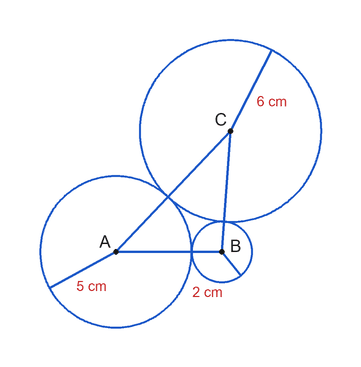
Assertion (A) : To find the perimeter of the triangle ABC, add the radii of given three circles.
Reason (R) : The required perimeter is the product of the sum of the radii and 2.
Solve with AIAnswer
(A) A is true, R is false.
- Correct
(B) A is false, R is true.
(C) Both A and R are true and R is the correct reason for A.
(D) Both A and R are true and R is the incorrect reason for A.
Answer: (B) A is false, R is true.
Concept: When two circles touch each other, the point of contact lies on the line joining their centres. If they touch externally, the distance between the centres = sum of the radii; if they touch internally, it is the difference of the radii.
Step 1 — Find the sides of ΔABC.
Each pair of circles touches externally, so each side is the sum of two radii.
Step 2 — Find the perimeter.
We add the three sides.
The sum of the radii is half of this perimeter:
Step 3 — Judge A and R.
Assertion A says the perimeter is the sum of the radii, 13 cm, so A is false. Reason R says it is twice the sum of the radii, 26 cm, so R is true: each radius is counted in two sides.
Watch out: Each radius appears in TWO sides of the triangle, so the radii are counted twice.
Why the other options are wrong:
- (A) A is true, R is false: A is false (13 cm ≠ 26 cm) and R is true, the opposite of this option.
- (C) Both A and R are true and R is the correct reason for A: A is false, so 'both true' cannot be right.
- (D) Both A and R are true and R is the incorrect reason for A: A is false, so 'both true' cannot be right.
Therefore, A is false and R is true, option (B).
- 441 mark
Question 44
AB is diameter of the circle, PA is tangent and ∠AOC = 60°.
Assertion (A) : x + 30° = 90°.
Reason (R) : PA is tangent ⇒ ∠BAP = 90°
∴ x + 30° = 90°
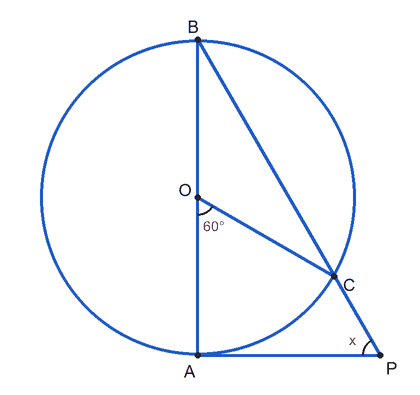 Solve with AI
Answer
(A) A is true, R is false.
(B) A is false, R is true.
- Correct
(C) Both A and R are true and R is the correct reason for A.
(D) Both A and R are true and R is the incorrect reason for A.
Answer: (C) Both A and R are true and R is the correct reason for A.
Concept: The angle which an arc subtends at the centre is double the angle which it subtends at any point on the remaining part of the circle. The tangent at any point of a circle is perpendicular to the radius drawn to the point of contact. So the radius and the tangent always meet at 90°.
Step 1 — Find ∠ABC.
Arc AC subtends ∠AOC = 60° at the centre and ∠ABC at B, so ∠ABC is half of 60°.
C lies on BP, so ∠ABP = 30°.
Step 2 — Use the tangent.
PA is the tangent at A and AB is a diameter, so ∠BAP = 90°.
Step 3 — Use the angle sum in ΔABP.
The angle of ΔABP at P is .
So A is true (and ).
Step 4 — Judge R.
R states that ∠BAP is 90° because PA is a tangent. Using this with ∠ABP of 30° gives . This is exactly the working of Step 3, so R is true and it explains A.
Watch out: The 30° is ∠ABC (half of the central angle 60°), and it is also ∠ABP because C lies on BP.
Why the other options are wrong:
- (A) A is true, R is false: R is true: a tangent is perpendicular to the radius (here the diameter AB) at A.
- (B) A is false, R is true: A is true: follows from the angle sum of ΔABP.
- (D) Both A and R are true and R is the incorrect reason for A: R gives the very reason for A (the right angle at A in ΔABP), so it is the correct reason.
Therefore, both A and R are true and R is the correct reason for A, option (C).
- 451 mark
Question 45
Chords AD and BC when produced meet at exterior point P.
Assertion (A) : PD × AD = PC × BC
Reason (R) : In triangles PAB and PCD, ∠PAB = ∠PCD ⇒ ΔPAB ~ ΔPCD
⇒
 Solve with AI
Answer
(A) A is true, R is false.
- Correct
(B) A is false, R is true.
(C) Both A and R are true and R is the correct reason for A.
(D) Both A and R are true and R is the incorrect reason for A.
Answer: (B) A is false, R is true.
Concept: In a cyclic quadrilateral the opposite angles add up to 180°, and an exterior angle equals the interior opposite angle. Chords meeting outside: If two chords AB and CD, when produced, meet at a point P outside the circle, then PA × PB = PC × PD (for each line, the whole length from P times the outside part).
Step 1 — Check the angle in R.
ABCD is a cyclic quadrilateral. P, C and B lie on one line, so ∠PCD is the exterior angle at C, and it equals the interior opposite angle ∠DAB, which is ∠PAB.
Step 2 — Check the similarity in R.
In ΔPAB and ΔPCD, ∠PAB = ∠PCD (Step 1) and ∠P is common. So ΔPAB ~ ΔPCD (AA), with P ↔ P, A ↔ C and B ↔ D. Corresponding sides are in proportion.
So R is true.
Step 3 — Judge A.
Cross-multiplying R gives the true rule: the whole length from P times the outside part is the same for both lines.
A instead multiplies PD by the chord AD and PC by the chord BC. That is not the rule, and it fails in general. For example, take PD = 2, DA = 4, so that PA = 6, and PC = 3, CB = 1, so that PB = 4.
These lengths obey the true rule, because both products are 12. But PD × AD is 8 while PC × BC is 3. So A is false.
Watch out: The product rule uses the WHOLE length PA (or PB), not the chord AD (or BC).
Why the other options are wrong:
- (A) A is true, R is false: A is false and R is true, the opposite of this option.
- (C) Both A and R are true and R is the correct reason for A: A is false, so 'both true' cannot be right.
- (D) Both A and R are true and R is the incorrect reason for A: A is false, so 'both true' cannot be right.
Therefore, A is false and R is true, option (B).
- 461 mark
Question 46
Two circles touch each other externally at point P. OA and OB are tangents to the two circles (as shown) and OA = 10.
Statement (1) : OB = 10 cm.
Statement (2) : On joining O and P, tangent OP = tangent OA and tangent OP = tangent OB.
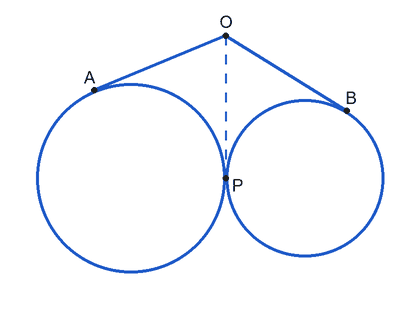 Solve with AI
Answer
- Correct
(A) Both the statements are true.
(B) Both the statements are false.
(C) Statement 1 is true, and statement 2 is false.
(D) Statement 1 is false, and statement 2 is true.
Answer: (A) Both the statements are true.
Concept: From a point outside a circle exactly two tangents can be drawn, and these two tangents are equal in length. The line joining that point to the centre also bisects the angle between the two tangents.
Step 1 — See that OP is a tangent to both circles.
The circles touch at P and have a common tangent there. As shown, O lies on this common tangent, so OP touches the first circle at P and also touches the second circle at P.
Step 2 — Judge statement 2.
From O, OA and OP are two tangents to the first circle, so OP = OA. Also OB and OP are two tangents to the second circle, so OP = OB. Statement 2 is true.
Step 3 — Judge statement 1.
Statement 2 gives OB = OP and OP = OA, so OB = OA, which is 10 cm. Statement 1 is true.
Watch out: OA and OB are tangents to DIFFERENT circles; they are equal only because both equal the common tangent OP.
Why the other options are wrong:
- (B) Both the statements are false: both statements are true (Steps 2 and 3).
- (C) Statement 1 is true, and statement 2 is false: statement 2 is true as well: OP equals both OA and OB.
- (D) Statement 1 is false, and statement 2 is true: statement 1 is true as well: OB = OA, which is 10 cm.
Therefore, both the statements are true, option (A).
- 471 mark
Question 47
O is centre of the circle, PB and PC are tangents and ∠BPC = 50°.
Statement (1) : ∠BAC = ∠P = 50°
Statement (2) : ∠BOC + 50° = 180°
⇒ ∠BOC = 130°
∴ ∠BAC = 65°
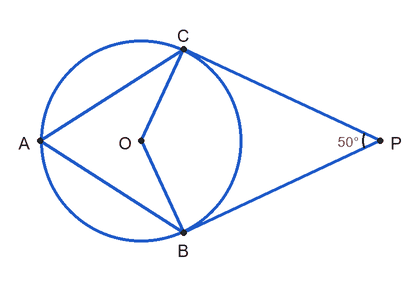 Solve with AI
Answer
(A) Both the statements are true.
(B) Both the statements are false.
(C) Statement 1 is true, and statement 2 is false.
- Correct
(D) Statement 1 is false, and statement 2 is true.
Answer: (D) Statement 1 is false, and statement 2 is true.
Concept: The tangent at any point of a circle is perpendicular to the radius drawn to the point of contact. So the radius and the tangent always meet at 90°. The angle which an arc subtends at the centre is double the angle which it subtends at any point on the remaining part of the circle.
Step 1 — Find ∠BOC.
OB and OC are radii to the points of contact of the tangents PB and PC, so ∠OBP = 90° and ∠OCP = 90°. The angles of quadrilateral OBPC add up to 360°.
This is the same as ∠BOC + 50° = 180°, as statement 2 says.
Step 2 — Find ∠BAC.
Arc BC subtends ∠BOC at the centre and ∠BAC at A on the major arc, so ∠BAC is half of 130°.
Step 3 — Judge the statements.
Statement 1 says ∠BAC = 50°, but it is 65°, so statement 1 is false. Statement 2 reaches ∠BAC = 65° by the working above, so statement 2 is true.
Watch out: ∠BAC is not equal to ∠P; it is half of ∠BOC, and ∠BOC is the supplement of ∠P.
Why the other options are wrong:
- (A) Both the statements are true: statement 1 is false: ∠BAC is 65°, not 50°.
- (B) Both the statements are false: statement 2 is true: ∠BOC = 130° and ∠BAC = 65°.
- (C) Statement 1 is true, and statement 2 is false: this is the reverse: statement 1 is the false one and statement 2 the true one.
Therefore, statement 1 is false and statement 2 is true, option (D).
- 483 marks
Question 48
Prove that, of any two chords of a circle, the greater chord is nearer to the centre.
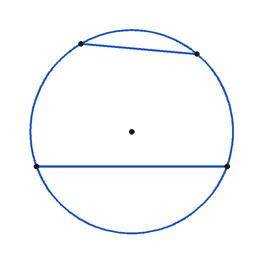 Solve with AI
Written solution
Solution:
Concept: The perpendicular from the centre to a chord bisects the chord. The distance of a chord from the centre is the length of this perpendicular.
Step 1 — Write what is given and what to prove.
Let AB and CD be chords of a circle with centre O and radius , with AB > CD. Draw OM ⊥ AB and ON ⊥ CD. We must prove OM < ON, that is, AB is nearer to the centre.
Step 2 — Halve the chords.
A perpendicular from the centre bisects a chord, so AM is half of AB and CN is half of CD.
Step 3 — Use Pythagoras' theorem twice.
OA and OC are both equal to (radii). Triangles OMA and ONC are right-angled at M and N.
Step 4 — Compare.
AB > CD, so . Taking a bigger amount away from leaves less, so OM² < ON². Both lengths are positive, so OM < ON.
Watch out: A LONGER chord leaves a SMALLER distance: the bigger the part subtracted from , the smaller the result.
Therefore, OM < ON, so the greater chord AB is nearer to the centre. Hence proved.
- 493 marks
Question 49
ABCD is a cyclic quadrilateral in which BC is parallel to AD, angle ADC = 110° and angle BAC = 50°. Find angle DAC and angle DCA.
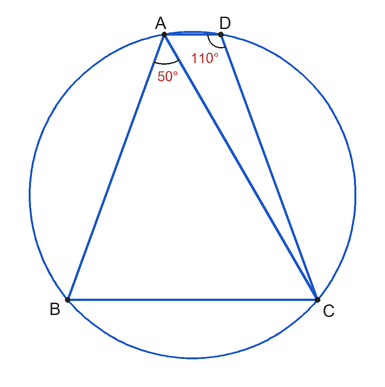 Solve with AI
Written solution
Solution:
Concept: In a cyclic quadrilateral the opposite angles add up to 180°, and an exterior angle equals the interior opposite angle. When two lines are parallel, co-interior angles on a transversal add up to 180°.
Step 1 — Find ∠ABC.
B and D are opposite vertices of the cyclic quadrilateral ABCD, so ∠ABC + ∠ADC = 180°.
Step 2 — Find ∠DAB.
BC ∥ AD and AB is a transversal, so the co-interior angles ∠DAB and ∠ABC add up to 180°.
Step 3 — Find ∠DAC.
∠DAC is the part of ∠DAB left after ∠BAC.
Step 4 — Find ∠DCA.
The angles of ΔADC add up to 180°.
Check: BC ∥ AD, so ∠ACB should equal ∠DAC (alternate angles). In ΔABC, ∠ACB is 180° − 70° − 50°, which is 60°. It agrees.
Watch out: ∠DAB comes from the PARALLEL sides (co-interior angles); the cyclic rule pairs ∠ADC with ∠ABC.
Therefore, ∠DAC = 60° and ∠DCA = 10°.
- 503 marks
Question 50
In the given figure, C and D are points on the semi-circle described on AB as diameter. Given angle BAD = 70° and angle DBC = 30°, calculate angle BDC.
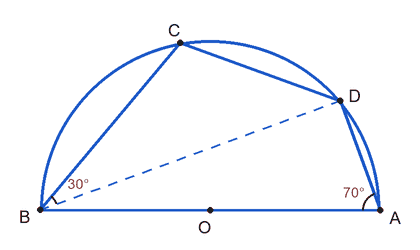 Solve with AI
Written solution
Solution:
Concept: In a cyclic quadrilateral the opposite angles add up to 180°, and an exterior angle equals the interior opposite angle.
Step 1 — Find ∠BCD.
A, B, C and D all lie on the circle, so ABCD is a cyclic quadrilateral, and A and C are opposite vertices. So ∠BCD + ∠BAD = 180°.
Step 2 — Find ∠BDC.
The angles of ΔBCD add up to 180°.
Watch out: ∠BAD and ∠BCD are opposite angles of the cyclic quadrilateral, so they are supplementary, not equal.
Therefore, ∠BDC = 40°.
- 513 marks
Question 51
In cyclic quadrilateral ABCD, ∠A = 3 ∠C and ∠D = 5 ∠B. Find the measure of each angle of the quadrilateral.
 Solve with AI
Written solution
Solution:
Concept: In a cyclic quadrilateral the opposite angles add up to 180°, and an exterior angle equals the interior opposite angle.
Step 1 — Find ∠C and ∠A.
∠A and ∠C are opposite angles, so they add up to 180°. We put ∠A = 3∠C.
Step 2 — Find ∠B and ∠D.
∠B and ∠D are opposite angles, so they add up to 180°. We put ∠D = 5∠B.
Check: The four angles 135° + 30° + 45° + 150° add up to 360°, as they must in a quadrilateral.
Watch out: Pair the OPPOSITE angles (A with C, B with D); adjacent angles of a cyclic quadrilateral need not be supplementary.
Therefore, ∠A = 135°, ∠B = 30°, ∠C = 45° and ∠D = 150°.
- 523 marks
Question 52
Show that the circle drawn on any one of the equal sides of an isosceles triangle as diameter bisects the base.
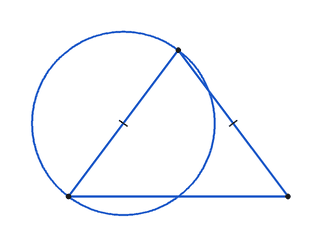 Solve with AI
Written solution
Solution:
Concept: The angle in a semicircle is a right angle: a diameter subtends 90° at every other point of the circle. Two right triangles with equal hypotenuses and one more pair of equal sides are congruent (RHS).
Step 1 — Draw the figure.
Let ΔABC have AB = AC, and let the circle on AB as diameter cut the base BC at D. We must prove BD = DC.
Step 2 — Find ∠ADB.
AB is a diameter and D is on the circle, so ∠ADB = 90° (angle in a semicircle). So AD ⊥ BC, and also ∠ADC = 90°.
Step 3 — Compare ΔADB and ΔADC.
We show the two triangles are congruent.
- ∠ADB = 90° and ∠ADC = 90°
- AB = AC (hypotenuses; given)
- AD = AD (common)
So ΔADB ≅ ΔADC by RHS, and the corresponding sides BD and DC are equal.
Watch out: The right angle is at D on the circle (angle in a semicircle), which is what makes AD perpendicular to BC.
Therefore, BD = DC, so the circle bisects the base BC. Hence proved.
- 533 marks
Question 53
Bisectors of vertex angles A, B and C of a triangle ABC intersect its circumcircle at the points D, E and F respectively.
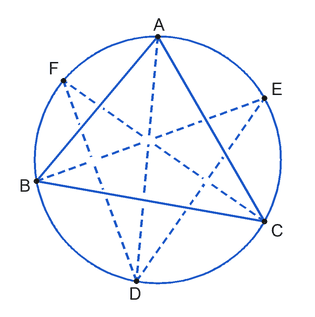
Prove that angle EDF = 90° – ∠A.
Solve with AIWritten solution
Solution:
Concept: Angles in the same segment of a circle are equal: a chord subtends equal angles at all points on the same arc.
Step 1 — Join DE and DF.
D, E and F are on the circumcircle. We split ∠EDF by the line DA into ∠EDA and ∠ADF.
Step 2 — Find ∠EDA.
∠EDA and ∠EBA stand on the same arc AE, so they are equal. BE bisects ∠B, so ∠EBA is half of ∠B.
Step 3 — Find ∠ADF.
∠ADF and ∠ACF stand on the same arc AF, so they are equal. CF bisects ∠C, so ∠ACF is half of ∠C.
Step 4 — Add and use the angle sum of ΔABC.
∠B + ∠C is 180° − ∠A.
Watch out: ∠EDA pairs with ∠EBA (both on arc AE), not with ∠ECA.
Therefore, ∠EDF = 90° − ½∠A. Hence proved.
- 543 marks
Question 54
In the figure, AB is the chord of a circle with centre O and DOC is a line segment such that BC = DO. If ∠C = 20°, find angle AOD.
 Solve with AI
Written solution
Solution:
Concept: Base angles opposite equal sides of a triangle are equal. An exterior angle of a triangle equals the sum of the two interior opposite angles.
Step 1 — Find ∠BOC.
BC = DO is given. Also DO and OB are both radii, so they are equal. Hence BC = OB, and ΔOBC is isosceles with equal base angles.
Step 2 — Find ∠OBA.
A, B and C lie on one line, so ∠OBA is the exterior angle of ΔOBC at B. It equals the sum of the two interior opposite angles.
Step 3 — Find ∠OAB.
OA = OB (radii), so ΔOAB is isosceles and its base angles are equal: ∠OAB equals ∠OBA, which is 40°.
Step 4 — Find ∠AOD.
D, O and C lie on one line, so ∠AOD is the exterior angle of ΔAOC at O. It equals ∠OAC + ∠OCA.
Watch out: BC is equal to the RADIUS (DO), which is what makes ΔOBC isosceles with ∠BOC = ∠C.
Therefore, ∠AOD = 60°.
- 553 marks
Question 55
P is the mid-point of an arc APB of a circle. Prove that the tangent drawn at P will be parallel to the chord AB.
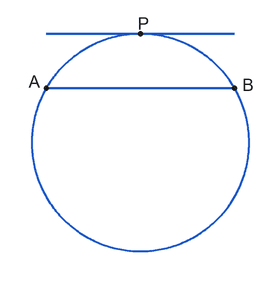 Solve with AI
Written solution
Solution:
Concept: The tangent at any point of a circle is perpendicular to the radius drawn to the point of contact. So the radius and the tangent always meet at 90°. Equal arcs subtend equal angles at the centre. Two lines perpendicular to the same line are parallel.
Step 1 — Draw the figure.
Let O be the centre, and let OP cut the chord AB at M. P is the mid-point of arc APB, so arc AP = arc PB, and these equal arcs subtend equal angles at the centre: ∠AOP = ∠BOP.
Step 2 — Compare ΔAOM and ΔBOM.
We show the two triangles are congruent.
- OA = OB (radii)
- ∠AOM = ∠BOM (Step 1)
- OM = OM (common)
So ΔAOM ≅ ΔBOM by SAS, and ∠OMA = ∠OMB.
Step 3 — Show OP ⊥ AB.
∠OMA and ∠OMB lie on the straight line AB, so they add up to 180°. Being equal, each is 90°. So OP ⊥ AB.
Step 4 — Use the tangent at P.
The tangent at P is perpendicular to the radius OP. AB is also perpendicular to OP (Step 3). Two lines perpendicular to the same line are parallel.
Watch out: The key fact is that OP is perpendicular to BOTH the tangent and the chord.
Therefore, the tangent at P is parallel to the chord AB. Hence proved.
- 563 marks
Question 56
In the given figure, ABCD is a cyclic quadrilateral, PQ is tangent to the circle at point C and BD is its diameter. If ∠DCQ = 40° and ∠ABD = 60°, find :
(i) ∠DBC
(ii) ∠BCP
(iii) ∠ADB
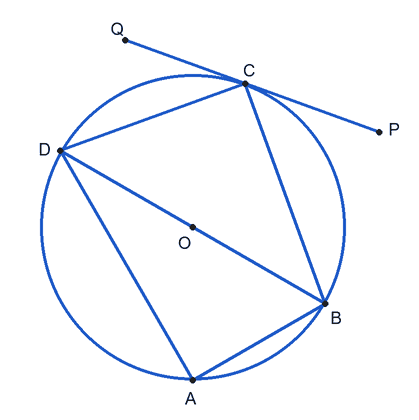 Solve with AI
Written solution
Solution:
Concept: Alternate segment theorem: The angle between a tangent and a chord drawn from the point of contact is equal to the angle which that chord subtends in the alternate segment (the part of the circle on the other side of the chord). The angle in a semicircle is a right angle: a diameter subtends 90° at every other point of the circle.
Step 1 — Part (i): use the alternate segment.
CQ is the tangent at C and CD is a chord. The angle between them, ∠DCQ = 40°, equals the angle CD subtends in the alternate segment, at B.
Step 2 — Part (ii): use the semicircle.
BD is a diameter, so ∠BCD = 90°. P, C and Q lie on one straight line, so the three angles at C on that side add up to 180°.
Step 3 — Part (iii): use the semicircle again.
BD is a diameter, so ∠BAD = 90°. The angles of ΔABD add up to 180°.
Check: ∠BCP should also equal ∠BDC (alternate segment for chord CB). In ΔBCD, ∠BDC is 180° − 90° − 40°, which is 50°. It agrees with part (ii).
Watch out: ∠DCQ pairs with ∠DBC, the angle at B on the other side of chord CD from Q.
Therefore, (i) ∠DBC = 40°; (ii) ∠BCP = 50°; (iii) ∠ADB = 30°.
- 573 marks
Question 57
The given figure shows a circle with centre O and BCD is tangent to it at C. Show that : ∠ACD + ∠BAC = 90°.
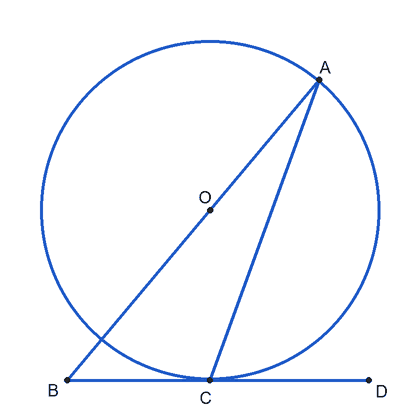 Solve with AI
Written solution
Solution:
Concept: Alternate segment theorem: The angle between a tangent and a chord drawn from the point of contact is equal to the angle which that chord subtends in the alternate segment (the part of the circle on the other side of the chord). The angle in a semicircle is a right angle: a diameter subtends 90° at every other point of the circle.
Step 1 — Construct a diameter.
Let AO produced meet the circle again at E (E lies on AB, between O and B), and join CE. Then AE is a diameter.
Step 2 — Use the semicircle.
AE is a diameter, so ∠ACE = 90°. The other two angles of ΔACE add up to 90°.
Step 3 — Use the alternate segment.
CD is the tangent at C and CA is a chord. The angle between them, ∠ACD, equals the angle CA subtends at E, which lies on the other side of CA from D.
Step 4 — Replace the angles.
E lies on AB, so ∠EAC is the same angle as ∠BAC. Putting this and Step 3 into Step 2:
Watch out: The construction is needed: without the diameter AE there is no right angle to work with.
Therefore, ∠ACD + ∠BAC = 90°. Hence proved.
- 583 marks
Question 58
ABC is a right triangle with angle B = 90°. A circle with BC as diameter meets hypotenuse AC at point D.
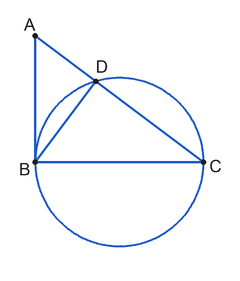
Prove that :
(i) AC × AD = AB²
(ii) BD² = AD × DC.
Solve with AIWritten solution
Solution:
Concept: Tangent and secant: If from an exterior point P a secant meets the circle at A and B and a tangent touches it at T, then PT² = PA × PB. The angle in a semicircle is a right angle: a diameter subtends 90° at every other point of the circle. The tangent at any point of a circle is perpendicular to the radius drawn to the point of contact. So the radius and the tangent always meet at 90°.
Step 1 — Show that AB is a tangent.
∠ABC = 90°, so AB ⊥ BC at B. BC is a diameter, so AB is perpendicular to the radius at its end B. A line perpendicular to a radius at its end on the circle is the tangent there.
Step 2 — Part (i): use the tangent and secant from A.
From A, AB is the tangent and ADC is a secant (D and C on the circle).
Step 3 — Part (ii): find the right angle at D.
BC is a diameter and D is on the circle, so ∠BDC = 90°. So BD ⊥ AC, and ∠ADB = 90° as well.
Step 4 — Show ΔADB ~ ΔBDC.
In right ΔBDC the two acute angles add up to 90°. Also ∠ABC = 90° is split by BD into ∠ABD and ∠DBC.
So ∠ABD = ∠BCD. Both triangles also have a right angle at D, so ΔADB and ΔBDC are similar (AA), with A ↔ B, D ↔ D and B ↔ C.
Step 5 — Write the proportion.
Corresponding sides of similar triangles are in proportion.
Watch out: Match the angles carefully: ∠ABD (in ΔADB) equals ∠BCD (in ΔBDC), so AD ↔ BD and BD ↔ DC.
Therefore, (i) AC × AD = AB²; (ii) BD² = AD × DC. Hence proved.
- 593 marks
Question 59
In the given figure, AC = AE.
Show that :
(i) CP = EP
(ii) BP = DP.
 Solve with AI
Written solution
Solution:
Concept: Chords meeting outside: If two chords AB and CD, when produced, meet at a point P outside the circle, then PA × PB = PC × PD (for each line, the whole length from P times the outside part). Angles in the same segment of a circle are equal: a chord subtends equal angles at all points on the same arc.
Step 1 — Show AB = AD.
Lines ABC and ADE meet at A outside the circle, so AB × AC = AD × AE. Since AC and AE are equal (given), dividing both sides by this length gives AB = AD.
Step 2 — Show BC = DE.
BC is what is left of AC after AB, and DE is what is left of AE after AD.
Step 3 — Compare ΔBPC and ΔDPE.
P is where BE and CD cross. We find two pairs of equal angles and one pair of equal sides.
- ∠BCP = ∠DEP (∠BCD and ∠BED stand on the same arc BD)
- ∠CBP = ∠EDP (∠CBE and ∠CDE stand on the same arc CE)
- BC = DE (Step 2)
So ΔBPC ≅ ΔDPE (ASA).
Step 4 — Read off the equal sides.
Corresponding sides of congruent triangles are equal: CP (opposite ∠CBP) = EP (opposite ∠EDP), and BP (opposite ∠BCP) = DP (opposite ∠DEP).
Watch out: Match each side with the side opposite the EQUAL angle: CP ↔ EP and BP ↔ DP.
Therefore, (i) CP = EP; (ii) BP = DP. Hence proved.
- 603 marks
Question 60
ABCDE is a cyclic pentagon with centre of its circumcircle at point O such that AB = BC = CD and angle ABC = 120°.
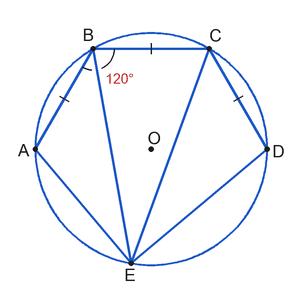
Calculate : (i) ∠BEC (ii) ∠BED
Solve with AIWritten solution
Solution:
Concept: In a cyclic quadrilateral the opposite angles add up to 180°, and an exterior angle equals the interior opposite angle. Equal chords of a circle subtend equal angles at any point on the remaining part of the circle.
Step 1 — Find ∠AEC.
A, B, C and E lie on the circle, so ABCE is a cyclic quadrilateral, with B and E opposite.
Step 2 — Part (i): split ∠AEC.
AB = BC, so these equal chords subtend equal angles at E: ∠AEB = ∠BEC. Together they make ∠AEC.
Step 3 — Part (ii): add ∠CED.
CD = BC, so for the same reason ∠CED equals ∠BEC, which is 30°.
Watch out: ∠AEC is opposite ∠ABC in the cyclic quadrilateral ABCE, so it is 180° − 120°, not 120°.
Therefore, (i) ∠BEC = 30°; (ii) ∠BED = 60°.
- 613 marks
Question 61
In the given figure, O is the centre of the circle. Tangents at A and B meet at C. If ∠ACO = 30°, find :
(i) ∠BCO
(ii) ∠AOB
(iii) ∠APB
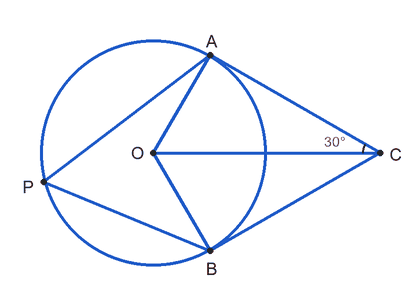 Solve with AI
Written solution
Solution:
Concept: From a point outside a circle exactly two tangents can be drawn, and these two tangents are equal in length. The line joining that point to the centre also bisects the angle between the two tangents. The tangent at any point of a circle is perpendicular to the radius drawn to the point of contact. So the radius and the tangent always meet at 90°. The angle which an arc subtends at the centre is double the angle which it subtends at any point on the remaining part of the circle.
Step 1 — Part (i): find ∠BCO.
CA and CB are the tangents from C, so the line CO to the centre bisects ∠ACB. Hence ∠BCO = ∠ACO.
Step 2 — Part (ii): find ∠AOB.
∠ACB is twice 30°, that is 60°. OA ⊥ CA and OB ⊥ CB (radius ⊥ tangent), so ∠OAC = 90° and ∠OBC = 90°. The angles of quadrilateral OACB add up to 360°.
Step 3 — Part (iii): find ∠APB.
Arc AB subtends ∠AOB at the centre and ∠APB at P on the major arc, so ∠APB is half of ∠AOB.
Watch out: ∠ACB is 2 × 30° = 60°; do not put 30° into the quadrilateral.
Therefore, (i) ∠BCO = 30°; (ii) ∠AOB = 120°; (iii) ∠APB = 60°.
- 623 marks
Question 62
The given figure shows a semi-circle with centre O and diameter PQ. If PA = AB and ∠BCQ = 140°; find measures of angles PAB and AQB. Also, show that AO is parallel to BQ.
 Solve with AI
Written solution
Solution:
Concept: In a cyclic quadrilateral the opposite angles add up to 180°, and an exterior angle equals the interior opposite angle. The angle in a semicircle is a right angle: a diameter subtends 90° at every other point of the circle. Angles in the same segment of a circle are equal: a chord subtends equal angles at all points on the same arc. The angle which an arc subtends at the centre is double the angle which it subtends at any point on the remaining part of the circle.
Step 1 — Find ∠BPQ.
P, B, C and Q lie on the circle, so PBCQ is a cyclic quadrilateral, with P and C opposite.
Step 2 — Find ∠PQB.
PQ is a diameter, so ∠PBQ = 90°. The angles of ΔPBQ add up to 180°.
Step 3 — Find ∠PAB.
PABQ is also a cyclic quadrilateral, with A and Q opposite.
Step 4 — Find ∠AQB.
PA = AB, so ΔPAB is isosceles and ∠APB = ∠ABP. They share the rest of 180°. ∠AQB and ∠APB stand on the same arc AB, so they are equal.
Step 5 — Find ∠AOP.
∠AQP is the part of ∠PQB left after ∠AQB. Arc AP subtends ∠AOP at the centre and ∠AQP at Q.
Step 6 — Show AO ∥ BQ.
∠AOP = 50° and ∠BQP = 50°. These are corresponding angles made by the lines OA and QB with the line PQ, and they are equal, so AO ∥ BQ.
Watch out: ∠PAB is opposite ∠PQB in the cyclic quadrilateral PABQ, so it is 180° − 50°.
Therefore, ∠PAB = 130° and ∠AQB = 25°; since ∠AOP and ∠BQP are both 50°, AO is parallel to BQ.
- 633 marks
Question 63
The given figure shows a circle with centre O such that chord RS is parallel to chord QT, angle PRT = 20° and angle POQ = 100°. Calculate :
(i) angle QTR
(ii) angle QRP
(iii) angle QRS
(iv) angle STR
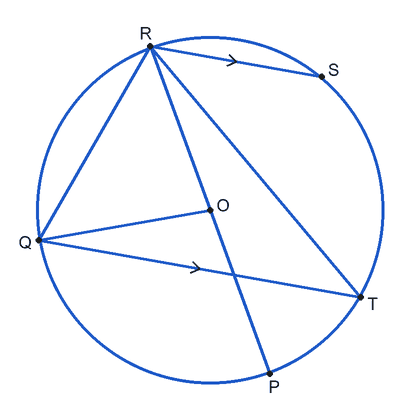 Solve with AI
Written solution
Solution:
Concept: The angle which an arc subtends at the centre is double the angle which it subtends at any point on the remaining part of the circle. In a cyclic quadrilateral the opposite angles add up to 180°, and an exterior angle equals the interior opposite angle. When two lines are parallel, alternate angles are equal and co-interior angles add up to 180°.
Step 1 — Find ∠QOR.
RP passes through O, so it is a diameter, and ∠QOR and ∠POQ make a straight angle.
Step 2 — Part (i): find ∠QTR.
Arc QR subtends ∠QOR at the centre and ∠QTR at T, so ∠QTR is half of 80°.
Step 3 — Part (ii): find ∠QRP.
Arc QP subtends ∠QOP = 100° at the centre and ∠QRP at R, so ∠QRP is half of 100°.
Step 4 — Part (iii): find ∠QRS.
First ∠QRT is ∠QRP + ∠PRT. Then the angles of ΔQRT give ∠RQT. Finally RS ∥ QT, so the co-interior angles ∠QRS and ∠RQT add up to 180°.
Step 5 — Part (iv): find ∠STR.
RS ∥ QT, so the alternate angles ∠SRT and ∠RTQ are equal, and ∠SRT is 40°. RSTQ is a cyclic quadrilateral with S and Q opposite, so ∠RST is 180° − ∠RQT. Then the angles of ΔRST add up to 180°.
Watch out: ∠QTR uses ∠QOR (80°), not the given ∠POQ (100°).
Therefore, (i) ∠QTR = 40°; (ii) ∠QRP = 50°; (iii) ∠QRS = 110°; (iv) ∠STR = 30°.
- 643 marks
Question 64
TA and TB are tangents to a circle with centre O from an external point T. OT intersects the circle at point P. Prove that AP bisects the angle TAB.
 Solve with AI
Written solution
Solution:
Concept: From a point outside a circle exactly two tangents can be drawn, and these two tangents are equal in length. The line joining that point to the centre also bisects the angle between the two tangents. The tangent at any point of a circle is perpendicular to the radius drawn to the point of contact. So the radius and the tangent always meet at 90°. The line from the exterior point to the centre is the perpendicular bisector of the chord joining the two points of contact.
Step 1 — Show OT ⊥ AB.
TA = TB (tangents from T), and OT bisects ∠ATB. So OT is the perpendicular bisector of AB (as in Ex 18(A) Q11). Let OT meet AB at M; then ∠AMP = 90°.
Step 2 — Use the isosceles triangle OAP.
OA = OP (radii), so the base angles are equal: ∠OAP = ∠OPA.
Step 3 — Write ∠TAP.
OA ⊥ TA (radius ⊥ tangent), so ∠OAT = 90°, and ∠TAP is what is left after ∠OAP.
Step 4 — Write ∠PAM.
In right ΔAMP, the two acute angles add up to 90°. M lies on PO, so ∠APM is the same angle as ∠OPA.
Step 5 — Compare.
By Step 2, ∠OAP = ∠OPA, so the right sides of Steps 3 and 4 are equal. Hence ∠TAP = ∠PAM, and ∠PAM is ∠PAB because M lies on AB.
Watch out: ∠OPA (at P) is used in the right triangle AMP, while ∠OAP (at A) is used with the right angle OAT.
Therefore, ∠TAP = ∠PAB, so AP bisects ∠TAB. Hence proved.
- 653 marks
Question 65
Chords AB and CD of a circle when extended meet at point X. Given AB = 4 cm, BX = 6 cm and XD = 5 cm, calculate the length of CD.
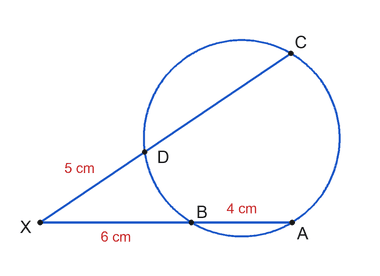 Solve with AI
Written solution
Solution:
Concept: Chords meeting outside: If two chords AB and CD, when produced, meet at a point P outside the circle, then PA × PB = PC × PD (for each line, the whole length from P times the outside part).
Step 1 — Find XA.
B lies between A and X, so XA is XB + BA.
Step 2 — Use the rule for chords meeting outside.
Chords AB and CD meet at X outside the circle, so XB × XA = XD × XC.
Step 3 — Find CD.
CD is the part of XC beyond D.
Watch out: For chords meeting outside, multiply the WHOLE length from P by the outside part (PA × PB), not the two chord pieces.
Therefore, CD = 7 cm.
- 663 marks
Question 66
In the following figure, a circle is inscribed in the quadrilateral ABCD.
If BC = 38 cm, QB = 27 cm, DC = 25 cm and that AD is perpendicular to DC, find the radius of the circle.

- 673 marks
Question 67
In the given figure, XY is the diameter of the circle and PQ is a tangent to the circle at Y. If ∠AXB = 50° and ∠ABX = 70°, find ∠BAY and ∠APY.
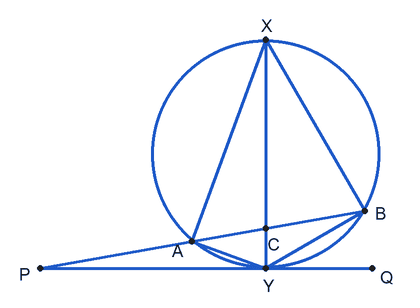
- 683 marks
Question 68
In the given figure, QAP is the tangent at point A and PBD is a straight line.
If ∠ACB = 36° and ∠APB = 42°, find :
(i) ∠BAP
(ii) ∠ABD
(iii) ∠QAD
(iv) ∠BCD
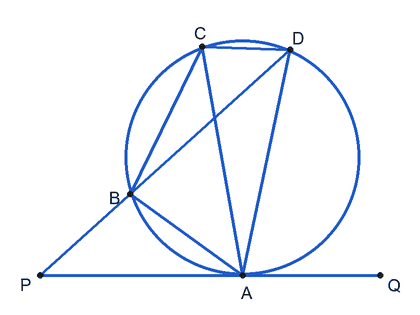
- 693 marks
Question 69
In the given figure, AB is the diameter. The tangent at C meets AB produced at Q.
If ∠CAB = 34°, find :
(i) ∠CBA
(ii) ∠CQB
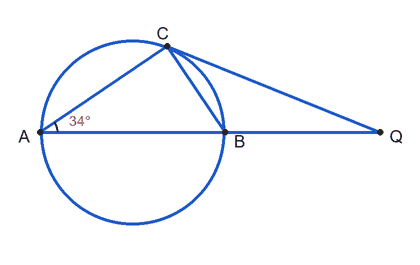
- 703 marks
Question 70
In the given figure, O is the centre of the circle. The tangents at B and D intersect each other at point P.
If AB is parallel to CD and ∠ABC = 55°, find : (i) ∠BOD (ii) ∠BPD

- 713 marks
Question 71
In the following figure, PQ = QR, ∠RQP = 68°, PC and CQ are tangents to the circle with centre O.
Calculate the values of :
(i) ∠QOP
(ii) ∠QCP
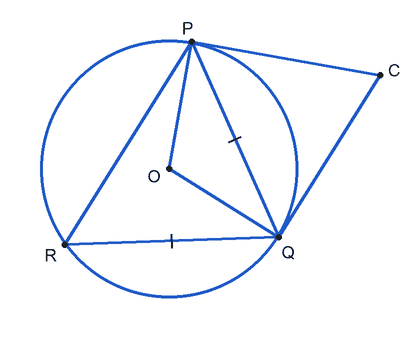
- 723 marks
Question 72
In the figure, given below, AC is a transverse common tangent to two circles with centres P and Q and of radii 6 cm and 3 cm respectively.
Given that AB = 8 cm, calculate PQ.
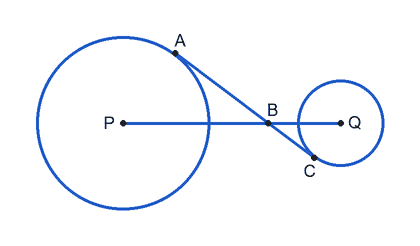
- 733 marks
Question 73
In the figure, given alongside, O is the centre of the circumcircle of triangle XYZ. Tangents at X and Y intersect at point T. Given ∠XTY = 80° and ∠XOZ = 140°, calculate the value of ∠ZXY.

- 743 marks
Question 74
In the given figure, AE and BC intersect each other at point D.
If ∠CDE = 90°, AB = 5 cm, BD = 4 cm and CD = 9 cm, find AE.
- 753 marks
Question 75
In the given circle with centre O, angle ABC = 100°, ∠ACD = 40° and CT is a tangent to the circle at C. Find ∠ADC and ∠DCT.

- 763 marks
Question 76
In the figure given below, O is the centre of the circle and SP is a tangent. If ∠SRT = 65°, find the values of x, y and z.
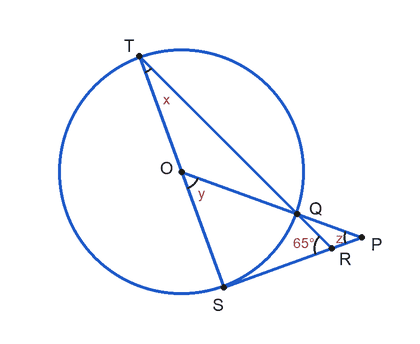
What Class 10 Maths Ch 18 covers
The sections of the chapter, in the order the book takes them. Every question above comes from one of these.
- 01Tangent and Radius of a Circle
- 02Tangents From an Exterior Point
- 03Circles Touching Each Other
- 04Direct and Transverse Common Tangents
- 05Chords Intersecting Internally or Externally
- 06Angle in the Alternate Segment
More ways to study this chapter
The same chapter asked three other ways. Practise it, revise it, and see what the board has set on Ch 18 before.
- Competency-Based Questions (CBQ)Case study questions: a situation, and the part of the chapter that answers it.40questionsOpen
- Previous Year QuestionsQuestions that have actually appeared in board papers, each tagged with its year.20questionsOpen
- Practice QuestionsExtra questions per chapter, for when one attempt at a method is not enough.40questionsOpen
Ch 18 in past ICSE papers
The same chapter as the board has actually asked it. These are worded differently from the textbook exercise, which is the point of reading them.
- 13 marks
Board paper question 1
In the given figure PQ is a tangent to the circle at A. AB and AD are bisectors of and . IF , prove that:
(i) BD is a diameter of the circle.
(ii) ABC is an isosceles triangle.
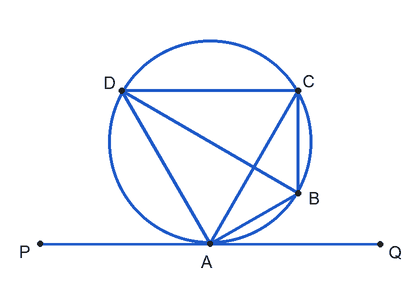 Solve with AI
Written solution
Solution:
Concept: These facts are used here.
- Alternate segment theorem: the angle between a tangent and a chord through the point of contact equals the angle that the chord subtends in the alternate segment (the part of the circle on the other side of the chord).
- Angle bisector: a bisector splits an angle into two equal halves.
- Converse of the semicircle angle: a chord that subtends at a point on the circle is a diameter.
- Isosceles test: a triangle with two equal angles has the sides opposite them equal.
Step 1 — Use the bisector AB.
AB bisects , so equals , and is twice it.
Step 2 — Find ∠PAC.
P, A and Q lie on the tangent, so and form a linear pair.
Step 3 — Use the bisector AD.
AD bisects , so is half of it.
Step 4 — Prove BD is a diameter (part i).
The angle BAD at A is made of and .
The chord BD subtends a right angle at the point A on the circle, so BD is a diameter.
Step 5 — Find ∠ACB.
The tangent AQ and the chord AB make . By the alternate segment theorem this equals the angle that AB subtends at C, which lies in the other segment.
Step 6 — Prove ABC is isosceles (part ii).
In , (Step 1) and (Step 5). The sides opposite these equal angles are BC (opposite A) and BA (opposite C), so .
Watch out: is the whole angle that AB bisects; is only half of it.
Therefore, BD is a diameter (it subtends at A), and is isosceles with .
- 23 marks
Board paper question 2
In the given figure AC is a tangent to the circle with centre O.
If , find and . Give reasons for your answers.
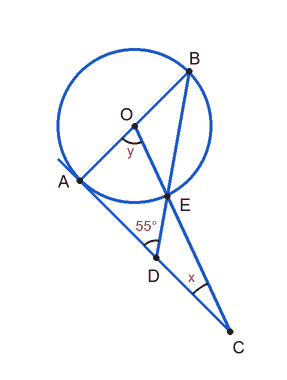 Solve with AI
Written solution
Solution:
Concept: These facts are used here.
- Tangent and radius: a tangent is perpendicular to the radius drawn to its point of contact.
- Angle sum: the angles of a triangle add up to , and those of a quadrilateral add up to .
- Angle at the centre: the angle that an arc subtends at the centre is double the angle it subtends at any point on the remaining part of the circle.
Step 1 — Find ∠ABD.
AC is a tangent at A and AB is a diameter, so . In the angle sum gives the angle at B.
Step 2 — Find y.
E lies on BD, so is the same angle as . The arc AE subtends at the centre and at B, so y is double.
Step 3 — Find x.
In , (radius OA is perpendicular to the tangent), and is the angle y. The angle sum gives .
Watch out: The angle y is at the CENTRE on the arc AE, so it is double , not equal to it.
Therefore, and .
- 33 marks
Board paper question 3
In the given figure cm, cm and cm.
Chords and intersect at .
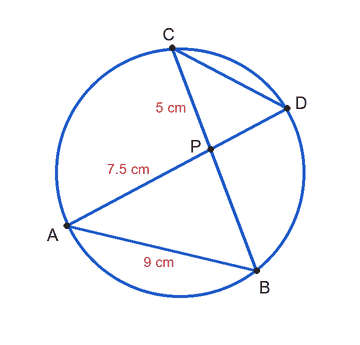
(i) Prove that .
(ii) Find the length of .
(iii) Find area of : area of .
Solve with AIWritten solution
Solution:
Concept: These facts are used here.
- Angles in the same segment: angles subtended by the same chord at points on the same side of it are equal.
- Vertically opposite angles are equal.
- Similar triangles (AA): two triangles with two pairs of equal angles are similar, and their corresponding sides are in proportion.
- Areas of similar triangles are in the ratio of the squares of corresponding sides.
Step 1 — Prove the triangles similar (part i).
In and the angles at P are vertically opposite, so . Also and are both subtended by the chord BD from the same side, so they are equal, that is, .
Two pairs of angles are equal, so (AA), with P matching P, A matching C and B matching D.
Step 2 — Write the ratio of sides.
Corresponding sides of similar triangles are in proportion.
Step 3 — Find CD (part ii).
Put in the given lengths and solve for CD.
Step 4 — Find the ratio of areas (part iii).
The ratio of the areas of similar triangles is the square of the ratio of corresponding sides.
Watch out: Match the vertices in the right order: A goes with C (the equal angles), so AB pairs with CD and PA pairs with PC.
Therefore, , cm, and the areas are in the ratio .
- 44 marks
Board paper question 4
In the given figure and are two tangents to the circle with centre , touching at and respectively. If and , find :
(i) and
(ii)
(iii)
 Solve with AI
Written solution
Solution:
Concept: These facts are used here.
- Tangent and radius: a tangent is perpendicular to the radius drawn to its point of contact.
- Equal radii: two radii and a chord form an isosceles triangle, so the angles opposite the radii are equal.
- Angle at the centre: the angle that an arc subtends at the centre is double the angle it subtends at any point on the remaining part of the circle.
- Angle sum: the angles of a triangle add up to , and those of a quadrilateral add up to .
Step 1 — Find ∠OBA (part i).
OA is perpendicular to the tangent TP, so . Taking away leaves .
OA and OB are radii, so .
Step 2 — Find ∠OBC (part i).
In the same way OC is perpendicular to the tangent TQ, so .
OB and OC are radii, so .
Step 3 — Find ∠AOC (part ii).
The angle ABC at B is the sum of the two parts, and the arc AC subtends double this at the centre.
Step 4 — Find ∠ATC (part iii).
In the quadrilateral OATC the angles at A and C are right angles (radius and tangent), and the four angles add up to .
Watch out: The angle between a radius and a tangent is , so subtract the given tangent angle from , not from .
Therefore, , , and .
- 53 marks
Board paper question 5
In the given figure O is the centre of the circle. PQ and PR are tangents and Calculate:
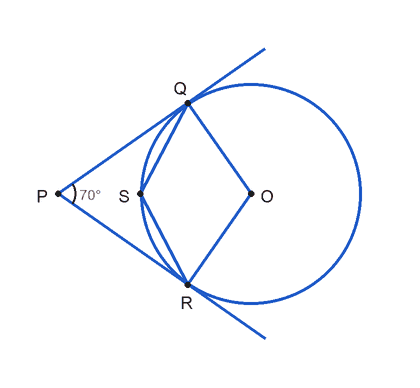
(a)
(b)
Solve with AIWritten solution
Solution:
Concept: These facts are used here.
- Tangent and radius: a tangent is perpendicular to the radius drawn to its point of contact.
- Angle sum: the angles of a triangle add up to , and those of a quadrilateral add up to .
- Angle at the centre: the angle that an arc subtends at the centre is double the angle it subtends at any point on the remaining part of the circle.
Step 1 — Find ∠QOR (part a).
OQ and OR are radii to the points of contact, so and are both . The four angles of the quadrilateral OQPR add up to .
Step 2 — Find the reflex angle QOR.
S lies on the minor arc QR, so stands on the MAJOR arc QR. That arc subtends the reflex angle QOR at the centre.
Step 3 — Find ∠QSR (part b).
The angle at S is half the angle that its arc subtends at the centre.
Watch out: S is on the minor arc, so halve the REFLEX angle (); halving gives , the angle at a point on the major arc.
Therefore, and .
- 62 marks
Board paper question 6
Two chords AB and CD of a circle intersect externally at E. If EC = 2 cm, EA = 3 cm and AB = 5 cm, find the length of CD.
 Solve with AI
Written solution
Solution:
Concept: Intersecting chords: if two chords AB and CD meet at E (inside or outside the circle), then .
Step 1 — Find EB.
A lies between E and B, so EB is EA plus AB.
Step 2 — Use the intersecting-chords rule.
The chords AB and CD produced meet at E outside the circle.
Step 3 — Find CD.
C lies between E and D, so CD is what is left of ED after EC.
Watch out: Use the WHOLE lengths from E (EB and ED), not the chord lengths AB and CD, in the product rule.
Therefore, cm.
All 20 board paper questions for this chapter, solved the same way.
Class 10 Maths Ch 18 questions students ask
How many questions are there in Class 10 Maths Ch 18?
76 questions. Every one is solved step by step on this page.
Are these Class 10 Maths solutions free?
Yes. Every question and its full working is free to read, with no account needed.
Can I download the Class 10 Maths Ch 18 solutions as a PDF?
There is no PDF to download. Every solution is on this page instead, which means it is searchable, always the current syllabus, and readable on a phone. Use your browser's print option if you want it on paper.