
Question 363 marksEasy
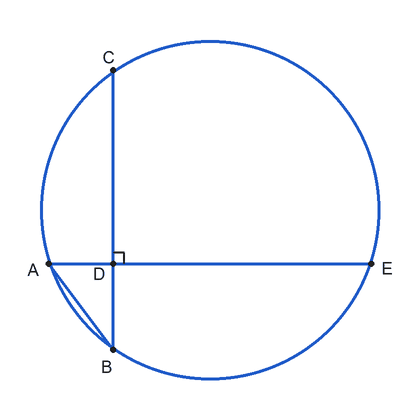
In the figure, chords AE and BC intersect each other at point D.
(i) If ∠CDE = 90°, AB = 5 cm, BD = 4 cm and CD = 9 cm; find DE.
(ii) If AD = BD, show that : AE = BC.
Confirming your payment
Sign up now and get 250 free tokens.
Tangents and Intersecting Chords · Question 36 of 76
In the figure, chords AE and BC intersect each other at point D.
(i) If ∠CDE = 90°, AB = 5 cm, BD = 4 cm and CD = 9 cm; find DE.
(ii) If AD = BD, show that : AE = BC.
Solution:
Concept: Intersecting chords: If two chords AB and CD of a circle cut each other at a point P inside the circle, then PA × PB = PC × PD. Vertically opposite angles are equal.
Step 1 — Part (i): find AD.
∠ADB and ∠CDE are vertically opposite, so ∠ADB = 90°. In right ΔADB, AB = 5 cm is the hypotenuse.
So AD = 3 cm.
Step 2 — Use the intersecting chords.
Chords AE and BC cut at D, so AD × DE = BD × DC.
Step 3 — Part (ii): use AD = BD.
The chord rule still holds: AD × DE = BD × DC. AD and BD are equal and not zero, so dividing both sides by them gives DE = DC.
Step 4 — Add the parts.
AE is made of AD and DE, and BC is made of BD and DC.
Watch out: Multiply the two parts of the SAME chord (AD × DE), not parts of different chords.
Therefore, (i) DE = 12 cm; (ii) AE = BC. Hence proved.