
Question 13 marksAsked 2017Medium
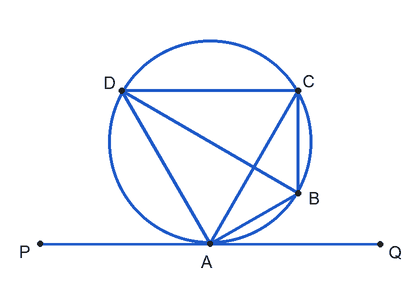
In the given figure PQ is a tangent to the circle at A. AB and AD are bisectors of and . IF , prove that:
(i) BD is a diameter of the circle.
(ii) ABC is an isosceles triangle.
Confirming your payment
Sign up now and get 250 free tokens.
Previous Year Questions · Question 1 of 20
In the given figure PQ is a tangent to the circle at A. AB and AD are bisectors of and . IF , prove that:
(i) BD is a diameter of the circle.
(ii) ABC is an isosceles triangle.
Solution:
Concept: These facts are used here.
Step 1 — Use the bisector AB.
AB bisects , so equals , and is twice it.
Step 2 — Find ∠PAC.
P, A and Q lie on the tangent, so and form a linear pair.
Step 3 — Use the bisector AD.
AD bisects , so is half of it.
Step 4 — Prove BD is a diameter (part i).
The angle BAD at A is made of and .
The chord BD subtends a right angle at the point A on the circle, so BD is a diameter.
Step 5 — Find ∠ACB.
The tangent AQ and the chord AB make . By the alternate segment theorem this equals the angle that AB subtends at C, which lies in the other segment.
Step 6 — Prove ABC is isosceles (part ii).
In , (Step 1) and (Step 5). The sides opposite these equal angles are BC (opposite A) and BA (opposite C), so .
Watch out: is the whole angle that AB bisects; is only half of it.
Therefore, BD is a diameter (it subtends at A), and is isosceles with .