
Opening your dashboard
Class 10 Maths Chapter 18 Tangents and Intersecting Chords: Previous Year Questions
20 questions on Chapter 18, each solved step by step. Class 10 Maths, ICSE 2026-27.
20 questions with solutions
1–4 marks · Mixed difficulty
The first 17 solutions are on this page. This chapter is a long one, so the rest open on their own page to keep this one quick to load.
- 13 marks
Question 1
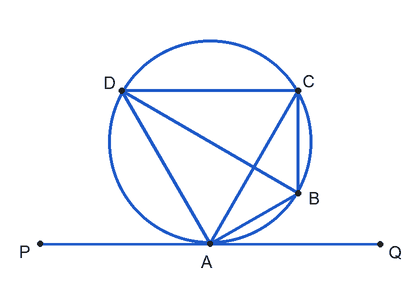
In the given figure PQ is a tangent to the circle at A. AB and AD are bisectors of and . IF , prove that:
(i) BD is a diameter of the circle.
(ii) ABC is an isosceles triangle.
 Solve with AI
Written solution
Solution:
Concept: These facts are used here.
- Alternate segment theorem: the angle between a tangent and a chord through the point of contact equals the angle that the chord subtends in the alternate segment (the part of the circle on the other side of the chord).
- Angle bisector: a bisector splits an angle into two equal halves.
- Converse of the semicircle angle: a chord that subtends at a point on the circle is a diameter.
- Isosceles test: a triangle with two equal angles has the sides opposite them equal.
Step 1 — Use the bisector AB.
AB bisects , so equals , and is twice it.
Step 2 — Find ∠PAC.
P, A and Q lie on the tangent, so and form a linear pair.
Step 3 — Use the bisector AD.
AD bisects , so is half of it.
Step 4 — Prove BD is a diameter (part i).
The angle BAD at A is made of and .
The chord BD subtends a right angle at the point A on the circle, so BD is a diameter.
Step 5 — Find ∠ACB.
The tangent AQ and the chord AB make . By the alternate segment theorem this equals the angle that AB subtends at C, which lies in the other segment.
Step 6 — Prove ABC is isosceles (part ii).
In , (Step 1) and (Step 5). The sides opposite these equal angles are BC (opposite A) and BA (opposite C), so .
Watch out: is the whole angle that AB bisects; is only half of it.
Therefore, BD is a diameter (it subtends at A), and is isosceles with .
- 23 marks
Question 2
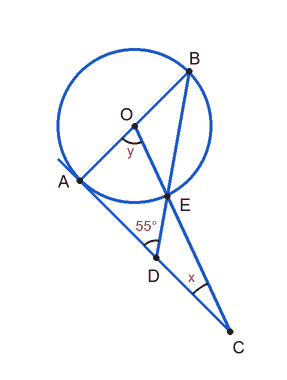
In the given figure AC is a tangent to the circle with centre O.
If , find and . Give reasons for your answers.
 Solve with AI
Written solution
Solution:
Concept: These facts are used here.
- Tangent and radius: a tangent is perpendicular to the radius drawn to its point of contact.
- Angle sum: the angles of a triangle add up to , and those of a quadrilateral add up to .
- Angle at the centre: the angle that an arc subtends at the centre is double the angle it subtends at any point on the remaining part of the circle.
Step 1 — Find ∠ABD.
AC is a tangent at A and AB is a diameter, so . In the angle sum gives the angle at B.
Step 2 — Find y.
E lies on BD, so is the same angle as . The arc AE subtends at the centre and at B, so y is double.
Step 3 — Find x.
In , (radius OA is perpendicular to the tangent), and is the angle y. The angle sum gives .
Watch out: The angle y is at the CENTRE on the arc AE, so it is double , not equal to it.
Therefore, and .
- 33 marks
Question 3
In the given figure cm, cm and cm.
Chords and intersect at .
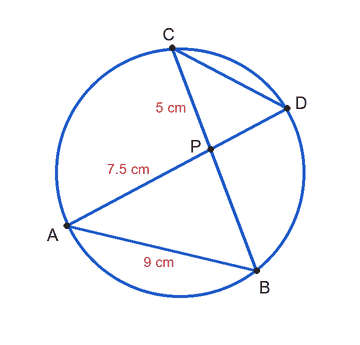
(i) Prove that .
(ii) Find the length of .
(iii) Find area of : area of .
Solve with AIWritten solution
Solution:
Concept: These facts are used here.
- Angles in the same segment: angles subtended by the same chord at points on the same side of it are equal.
- Vertically opposite angles are equal.
- Similar triangles (AA): two triangles with two pairs of equal angles are similar, and their corresponding sides are in proportion.
- Areas of similar triangles are in the ratio of the squares of corresponding sides.
Step 1 — Prove the triangles similar (part i).
In and the angles at P are vertically opposite, so . Also and are both subtended by the chord BD from the same side, so they are equal, that is, .
Two pairs of angles are equal, so (AA), with P matching P, A matching C and B matching D.
Step 2 — Write the ratio of sides.
Corresponding sides of similar triangles are in proportion.
Step 3 — Find CD (part ii).
Put in the given lengths and solve for CD.
Step 4 — Find the ratio of areas (part iii).
The ratio of the areas of similar triangles is the square of the ratio of corresponding sides.
Watch out: Match the vertices in the right order: A goes with C (the equal angles), so AB pairs with CD and PA pairs with PC.
Therefore, , cm, and the areas are in the ratio .
- 44 marks
Question 4
In the given figure and are two tangents to the circle with centre , touching at and respectively. If and , find :
(i) and
(ii)
(iii)
 Solve with AI
Written solution
Solution:
Concept: These facts are used here.
- Tangent and radius: a tangent is perpendicular to the radius drawn to its point of contact.
- Equal radii: two radii and a chord form an isosceles triangle, so the angles opposite the radii are equal.
- Angle at the centre: the angle that an arc subtends at the centre is double the angle it subtends at any point on the remaining part of the circle.
- Angle sum: the angles of a triangle add up to , and those of a quadrilateral add up to .
Step 1 — Find ∠OBA (part i).
OA is perpendicular to the tangent TP, so . Taking away leaves .
OA and OB are radii, so .
Step 2 — Find ∠OBC (part i).
In the same way OC is perpendicular to the tangent TQ, so .
OB and OC are radii, so .
Step 3 — Find ∠AOC (part ii).
The angle ABC at B is the sum of the two parts, and the arc AC subtends double this at the centre.
Step 4 — Find ∠ATC (part iii).
In the quadrilateral OATC the angles at A and C are right angles (radius and tangent), and the four angles add up to .
Watch out: The angle between a radius and a tangent is , so subtract the given tangent angle from , not from .
Therefore, , , and .
- 53 marks
Question 5
In the given figure O is the centre of the circle. PQ and PR are tangents and Calculate:
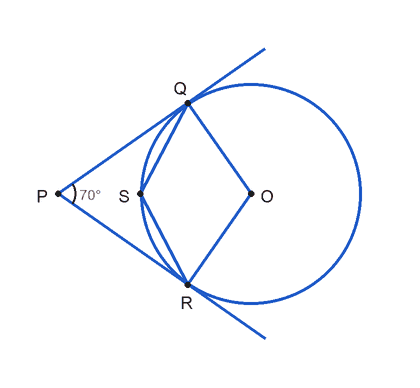
(a)
(b)
Solve with AIWritten solution
Solution:
Concept: These facts are used here.
- Tangent and radius: a tangent is perpendicular to the radius drawn to its point of contact.
- Angle sum: the angles of a triangle add up to , and those of a quadrilateral add up to .
- Angle at the centre: the angle that an arc subtends at the centre is double the angle it subtends at any point on the remaining part of the circle.
Step 1 — Find ∠QOR (part a).
OQ and OR are radii to the points of contact, so and are both . The four angles of the quadrilateral OQPR add up to .
Step 2 — Find the reflex angle QOR.
S lies on the minor arc QR, so stands on the MAJOR arc QR. That arc subtends the reflex angle QOR at the centre.
Step 3 — Find ∠QSR (part b).
The angle at S is half the angle that its arc subtends at the centre.
Watch out: S is on the minor arc, so halve the REFLEX angle (); halving gives , the angle at a point on the major arc.
Therefore, and .
- 62 marks
Question 6
Two chords AB and CD of a circle intersect externally at E. If EC = 2 cm, EA = 3 cm and AB = 5 cm, find the length of CD.
 Solve with AI
Written solution
Solution:
Concept: Intersecting chords: if two chords AB and CD meet at E (inside or outside the circle), then .
Step 1 — Find EB.
A lies between E and B, so EB is EA plus AB.
Step 2 — Use the intersecting-chords rule.
The chords AB and CD produced meet at E outside the circle.
Step 3 — Find CD.
C lies between E and D, so CD is what is left of ED after EC.
Watch out: Use the WHOLE lengths from E (EB and ED), not the chord lengths AB and CD, in the product rule.
Therefore, cm.
- 71 mark
Question 7
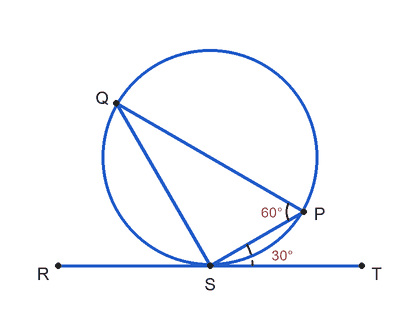
In the given diagram, RT is a tangent touching the circle at S. If and then is equal to :
 Solve with AI
Answer
(A)
(B)
(C)
- Correct
(D)
Answer: (D)
Concept: These facts are used here.
- Alternate segment theorem: the angle between a tangent and a chord through the point of contact equals the angle that the chord subtends in the alternate segment (the part of the circle on the other side of the chord).
- Angle sum: the angles of a triangle add up to , and those of a quadrilateral add up to .
Step 1 — Use the alternate segment theorem.
The tangent ST and the chord SP make . This equals the angle that SP subtends at Q, which lies in the other segment.
Step 2 — Use the angle sum of triangle PQS.
Two angles of are now known.
Watch out: The tangent-chord angle at S equals the angle at Q (the far vertex), not the angle at P.
Why the other options are wrong:
- (A) : does not follow from any rule; the angles of the triangle would then add up to .
- (B) : is , the angle at Q, not the angle at S.
- (C) : is , the angle at P.
Therefore, , option (D).
- 84 marks
Question 8
In the given figure O, is the centre of the circle. CE is a tangent to the circle at A. If , then find :
(a)
(b)
(c)
(d)
 Solve with AI
Written solution
Solution:
Concept: These facts are used here.
- Angle in a semicircle: the angle that a diameter subtends at any point on the circle is .
- Angle sum: the angles of a triangle add up to , and those of a quadrilateral add up to .
- Alternate segment theorem: the angle between a tangent and a chord through the point of contact equals the angle that the chord subtends in the alternate segment (the part of the circle on the other side of the chord).
- Equal radii: two radii and a chord form an isosceles triangle, so the angles opposite the radii are equal.
Step 1 — Find ∠BDA (part a).
AB passes through the centre O, so AB is a diameter, and D is on the circle.
Step 2 — Find ∠BAD (part b).
The angle sum of gives the angle at A.
Step 3 — Find ∠CAD (part c).
CA is part of the tangent at A and AD is a chord, so equals the angle that AD subtends at B in the alternate segment.
Step 4 — Find ∠ODB (part d).
OD and OB are radii, so is isosceles. O lies on AB, so is the same angle as .
Watch out: For part (c), check which segment is the alternate one: B lies on the other side of AD from C, so equals the angle at B.
Therefore, , , and .
- 94 marks
Question 9
In the given figure, O is the centre of the circle. PQ is a tangent to the circle at T. Chord AB produced meets the tangent at P. cm, cm, , . Find :
(a) length of PT
(b)
(c)
(d)
 Solve with AI
Written solution
Solution:
Concept: These facts are used here.
- Tangent and secant: if a secant through an outside point P meets the circle at A and B, and PT is a tangent, then .
- Alternate segment theorem: the angle between a tangent and a chord through the point of contact equals the angle that the chord subtends in the alternate segment (the part of the circle on the other side of the chord).
- Angle at the centre: the angle that an arc subtends at the centre is double the angle it subtends at any point on the remaining part of the circle.
- Equal radii: two radii and a chord form an isosceles triangle, so the angles opposite the radii are equal.
Step 1 — Find PA.
B lies between A and P, so PA is AB plus BP.
Step 2 — Find PT (part a).
PT is a tangent and PBA is a secant from the same point P.
Step 3 — Find ∠BAT (part b).
The tangent TP and the chord TB make , which equals the angle TB subtends at A in the alternate segment.
Step 4 — Find ∠BOT (part c).
The arc BT subtends at the centre and at A, so it is double.
Step 5 — Find ∠ABT (part d).
OB and OT are radii, so the base angles of are equal.
O lies inside , so this angle is the sum of and .
Watch out: In use the whole secant PA ( cm), not the chord AB.
Therefore, cm, , and .
- 101 mark
Question 10
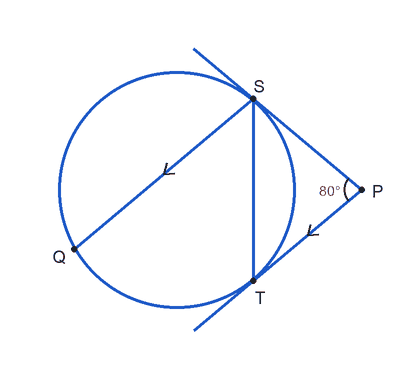
In the given diagram, PS and PT are the tangents to the circle. and . The value of is :
 Solve with AI
Answer
(A)
(B)
(C)
- Correct
(D)
Answer: (D)
Concept: These facts are used here.
- Two tangents from a point: the two tangents drawn from an outside point to a circle are equal in length.
- Isosceles triangle: the angles opposite equal sides are equal.
- Parallel lines: a transversal makes equal alternate angles.
Step 1 — Find the base angles of triangle PST.
PS and PT are tangents from P, so and is isosceles. Its two base angles share what is left of .
Step 2 — Use SQ ∥ PT.
ST is a transversal of the parallel lines SQ and PT, so and are alternate angles.
Watch out: is the angle at P; the angles of at S and T are the equal base angles.
Why the other options are wrong:
- (A) : is too large: equals a base angle of , and each base angle is .
- (B) : would need base angles of , which leaves for the angle at P.
- (C) : is , the angle between the tangents.
Therefore, , option (D).
- 114 marks
Question 11
In the given diagram, O is the centre of the circle. PR and PT are two tangents drawn from the external point P and touching the circle at Q and S respectively. MN is a diameter of the circle. Given and .
Find :
(a)
(b)
(c)
(d)
 Solve with AI
Written solution
Solution:
Concept: These facts are used here.
- Tangent and radius: a tangent is perpendicular to the radius drawn to its point of contact.
- Alternate segment theorem: the angle between a tangent and a chord through the point of contact equals the angle that the chord subtends in the alternate segment (the part of the circle on the other side of the chord).
- Angle at the centre: the angle that an arc subtends at the centre is double the angle it subtends at any point on the remaining part of the circle.
- Cyclic quadrilateral: opposite angles add up to .
Step 1 — Find ∠OQM (part a).
OQ is perpendicular to the tangent PR, so . Taking away leaves .
Step 2 — Find ∠QNM and ∠SNM.
The tangent QP and the chord QM make , which equals the angle QM subtends at N. In the same way the tangent SP and the chord SM make , which equals the angle SM subtends at N.
Step 3 — Find ∠QNS (part b).
NM lies inside , so the angle is the sum of its two parts.
Step 4 — Find ∠QOS (part c).
The arc QMS subtends at the centre and at N, so it is double.
Step 5 — Find ∠QMS (part d).
Q, M, S and N lie on the circle, so QMSN is a cyclic quadrilateral with M opposite N.
Watch out: Each tangent-chord angle equals the angle in the ALTERNATE segment, here the angle at N, on the far side of the chord.
Therefore, , , and .
- 123 marks
Question 12
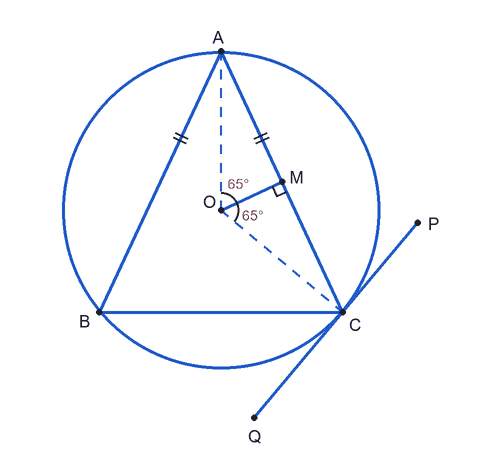
In the given diagram, an isosceles is inscribed in a circle with centre O. PQ is a tangent to the circle at C. OM is perpendicular to chord AC and . Find :
(a)
(b)
(c)
 Solve with AI
Written solution
Solution:
Concept: These facts are used here.
- Perpendicular from the centre: in the isosceles triangle formed by two radii and a chord, the perpendicular from the centre to the chord bisects the angle at the centre.
- Angle at the centre: the angle that an arc subtends at the centre is double the angle it subtends at any point on the remaining part of the circle.
- Alternate segment theorem: the angle between a tangent and a chord through the point of contact equals the angle that the chord subtends in the alternate segment (the part of the circle on the other side of the chord).
Step 1 — Find ∠AOC.
OA = OC (radii) and OM is perpendicular to AC, so OM bisects .
Step 2 — Find ∠ABC (part a).
The arc AC subtends at the centre and at B, so it is half.
Step 3 — Find ∠BAC (part b).
The triangle is isosceles with (the equal sides marked in the figure), so the base angles at B and C are equal.
Step 4 — Find ∠BCQ (part c).
The tangent CQ and the chord CB make , which equals the angle CB subtends at A in the alternate segment.
Watch out: is only HALF of ; OM splits the angle at the centre into two equal parts.
Therefore, , and .
- 133 marks
Question 13
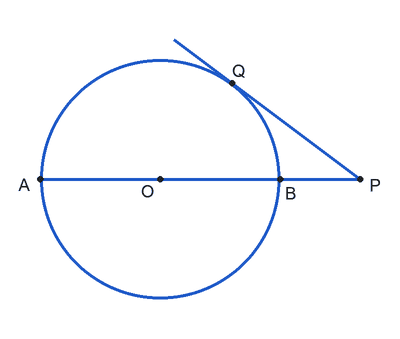
The figure shows a circle of radius 9 cm with O as the centre. The diameter AB produced meets the tangent PQ at P. If PA = 24 cm, find the length of tangent PQ.
 Solve with AI
Written solution
Solution:
Concept: These facts are used here.
- Tangent and radius: a tangent is perpendicular to the radius drawn to its point of contact.
- Pythagoras' theorem: .
- Tangent and secant: if a secant through an outside point P meets the circle at A and B, and PT is a tangent, then .
Step 1 — Find OP.
A, O, B and P lie on one line, and OA is a radius, so OP is PA minus OA.
Step 2 — Use the right angle at Q.
OQ is a radius to the point of contact, so and OP is the hypotenuse of .
Step 3 — Check with the tangent-secant rule.
PB is PA minus the diameter AB, and must equal .
This equals , as it should.
Watch out: OP is not PA; subtract the radius OA first.
Therefore, the length of the tangent PQ is cm.
- 144 marks
Question 14
X, Y, Z and C are the points on the circumference of a circle with centre ‘O’. AB is a tangent to the circle at ‘X’ and . Given and . Find:
(a)
(b)
(c)
(d)
 Solve with AI
Written solution
Solution:
Concept: These facts are used here.
- Tangent and radius: a tangent is perpendicular to the radius drawn to its point of contact.
- Angle sum: the angles of a triangle add up to , and those of a quadrilateral add up to .
- Angle at the centre: the angle that an arc subtends at the centre is double the angle it subtends at any point on the remaining part of the circle.
- Alternate segment theorem: the angle between a tangent and a chord through the point of contact equals the angle that the chord subtends in the alternate segment (the part of the circle on the other side of the chord).
- Isosceles triangle: the angles opposite equal sides are equal.
Step 1 — Find ∠BOX (part a).
OX is perpendicular to the tangent AB, so . The angle sum of gives the angle at O.
Step 2 — Find ∠CYX (part b).
C lies on OB, so the arc CX subtends at the centre. Y is on the remaining part of the circle, so the angle at Y is half.
Step 3 — Find ∠ZYX (part c).
The tangent XA and the chord XZ make , which equals the angle XZ subtends at Y in the alternate segment.
Step 4 — Find ∠YXZ.
ZY = XY, so in the angles at X and Z are equal and share what is left after .
Step 5 — Find ∠OXY (part d).
The tangent XB and the chord XY make , which equals the angle XY subtends at Z.
The right angle OXB is made of and , so take away from .
Watch out: is HALF of , because C lies on OB and Y is on the circle.
Therefore, , , and .
- 153 marks
Question 15
In the given diagram ‘O’ is the centre of the circle. Chord SR produced meets the tangent XTP at P.

(a) Prove that
(b) Prove that
(c) If cm and cm, find the length of the tangent PT.
Solve with AIWritten solution
Solution:
Concept: These facts are used here.
- Alternate segment theorem: the angle between a tangent and a chord through the point of contact equals the angle that the chord subtends in the alternate segment (the part of the circle on the other side of the chord).
- Similar triangles (AA): two triangles with two pairs of equal angles are similar, and their corresponding sides are in proportion.
Step 1 — Prove the triangles similar (part a).
In and the angle at P is common. The tangent TP and the chord TR make , which equals the angle TR subtends at S in the alternate segment, so .
Two pairs of angles are equal, so (AA), with P matching P, T matching S and R matching T.
Step 2 — Prove the product rule (part b).
Corresponding sides of the similar triangles are in proportion.
Cross-multiplying gives the result.
Step 3 — Find PT (part c).
Put in the given lengths.
Watch out: Match the vertices by the equal angles: T in matches S in .
Therefore, , , and cm.
- 164 marks
Question 16
In the given diagram, O is the centre of the circle and the tangent DE touches the circle at B. If . Find the values of and .
 Solve with AI
Written solution
Solution:
Concept: These facts are used here.
- Tangent and radius: a tangent is perpendicular to the radius drawn to its point of contact.
- Angle sum: the angles of a triangle add up to , and those of a quadrilateral add up to .
- Angle at the centre: the angle that an arc subtends at the centre is double the angle it subtends at any point on the remaining part of the circle.
- Angle in a semicircle: the angle that a diameter subtends at any point on the circle is .
- Alternate segment theorem: the angle between a tangent and a chord through the point of contact equals the angle that the chord subtends in the alternate segment (the part of the circle on the other side of the chord).
Step 1 — Find ∠BOD.
OB is a radius to the point of contact, so . The angle sum of gives the angle at O.
Step 2 — Find x.
C lies on OD, so the arc BC subtends at the centre and at A. The angle at A is half.
Step 3 — Find ∠BCA.
AC is a diameter, so , and the angle sum of gives the angle at C.
Step 4 — Find y.
The tangent BE and the chord BA make , which equals the angle BA subtends at C in the alternate segment.
Watch out: The angle x is HALF of ; the angle is at the centre, not at A.
Therefore, and .
- 174 marks
Question 17
In the given figure 'O' is the centre of the circle. PQ is a tangent to the circle at B and . If , find the unknown angles , , and .
 Solve with AI
Written solution
Solution:
Concept: These facts are used here.
- Alternate segment theorem: the angle between a tangent and a chord through the point of contact equals the angle that the chord subtends in the alternate segment (the part of the circle on the other side of the chord).
- Angle at the centre: the angle that an arc subtends at the centre is double the angle it subtends at any point on the remaining part of the circle.
- Cyclic quadrilateral: opposite angles add up to .
- Equal radii: two radii and a chord form an isosceles triangle, so the angles opposite the radii are equal.
Step 1 — Find x.
The tangent BQ and the chord BC make , which equals the angle BC subtends at A in the alternate segment.
Step 2 — Find y.
The arc BC subtends at the centre and at A, so y is double.
Step 3 — Find ∠ABC.
AB = AC, so the base angles at B and C are equal.
Step 4 — Find z.
A, B, C and D lie on the circle, so ABCD is a cyclic quadrilateral with D opposite B.
Step 5 — Find w.
OB and OC are radii, so the base angles of are equal.
EB is a diameter, so BE passes through O, and is the part of left after .
Watch out: The angle z sits opposite the angle at B in ABCD, so take from , not the at A.
Therefore, , , and .
- 181 mark
Question 18
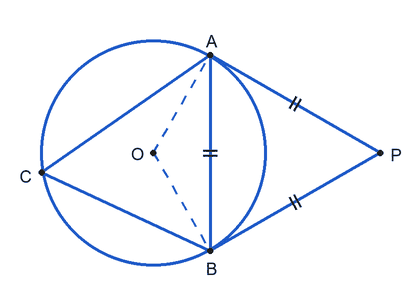
In the given diagram, PA and PB are the tangents to the circle with centre O, such that . The value of is:
- 193 marks
Question 19
In the given diagram, AB is a tangent to the circle at P. If and , find:

(a)
(b)
(c)
- 204 marks
Question 20
In the given diagram, PT is a tangent to the circle and QT is a secant meeting the circle at R, such that cm and cm.
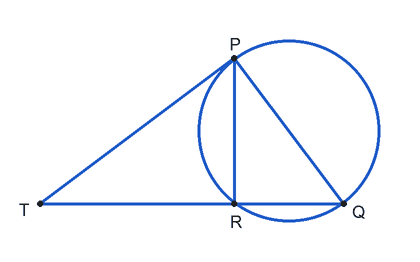
(a) Prove that: .
(b) Find the length of PT.