
Question 563 marksEasy
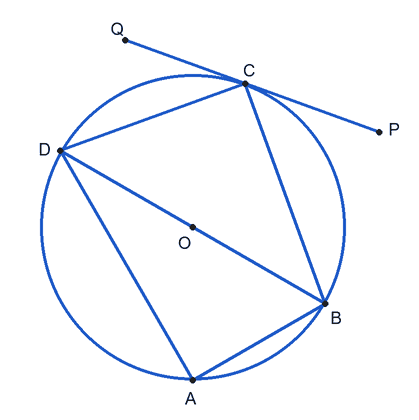
In the given figure, ABCD is a cyclic quadrilateral, PQ is tangent to the circle at point C and BD is its diameter. If ∠DCQ = 40° and ∠ABD = 60°, find :
(i) ∠DBC
(ii) ∠BCP
(iii) ∠ADB
Confirming your payment
Sign up now and get 250 free tokens.
Tangents and Intersecting Chords · Question 56 of 76
In the given figure, ABCD is a cyclic quadrilateral, PQ is tangent to the circle at point C and BD is its diameter. If ∠DCQ = 40° and ∠ABD = 60°, find :
(i) ∠DBC
(ii) ∠BCP
(iii) ∠ADB
Solution:
Concept: Alternate segment theorem: The angle between a tangent and a chord drawn from the point of contact is equal to the angle which that chord subtends in the alternate segment (the part of the circle on the other side of the chord). The angle in a semicircle is a right angle: a diameter subtends 90° at every other point of the circle.
Step 1 — Part (i): use the alternate segment.
CQ is the tangent at C and CD is a chord. The angle between them, ∠DCQ = 40°, equals the angle CD subtends in the alternate segment, at B.
Step 2 — Part (ii): use the semicircle.
BD is a diameter, so ∠BCD = 90°. P, C and Q lie on one straight line, so the three angles at C on that side add up to 180°.
Step 3 — Part (iii): use the semicircle again.
BD is a diameter, so ∠BAD = 90°. The angles of ΔABD add up to 180°.
Check: ∠BCP should also equal ∠BDC (alternate segment for chord CB). In ΔBCD, ∠BDC is 180° − 90° − 40°, which is 50°. It agrees with part (ii).
Watch out: ∠DCQ pairs with ∠DBC, the angle at B on the other side of chord CD from Q.
Therefore, (i) ∠DBC = 40°; (ii) ∠BCP = 50°; (iii) ∠ADB = 30°.