Answer: (A) Both the statements are true.
Concept: From a point outside a circle exactly two tangents can be drawn, and these two tangents are equal in length. The line joining that point to the centre also bisects the angle between the two tangents.
Step 1 — See that OP is a tangent to both circles.
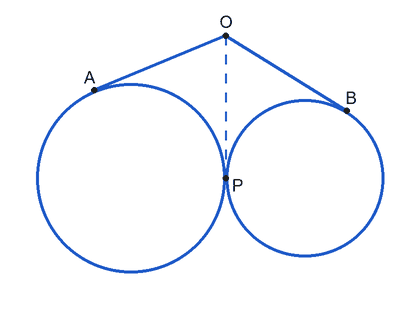
The circles touch at P and have a common tangent there. As shown, O lies on this common tangent, so OP touches the first circle at P and also touches the second circle at P.
Step 2 — Judge statement 2.
From O, OA and OP are two tangents to the first circle, so OP = OA. Also OB and OP are two tangents to the second circle, so OP = OB. Statement 2 is true.
Step 3 — Judge statement 1.
Statement 2 gives OB = OP and OP = OA, so OB = OA, which is 10 cm. Statement 1 is true.
Watch out: OA and OB are tangents to DIFFERENT circles; they are equal only because both equal the common tangent OP.
Why the other options are wrong:
- (B) Both the statements are false: both statements are true (Steps 2 and 3).
- (C) Statement 1 is true, and statement 2 is false: statement 2 is true as well: OP equals both OA and OB.
- (D) Statement 1 is false, and statement 2 is true: statement 1 is true as well: OB = OA, which is 10 cm.
Therefore, both the statements are true, option (A).