Answer: (B) A is false, R is true.
Concept: When two circles touch each other, the point of contact lies on the line joining their centres. If they touch externally, the distance between the centres = sum of the radii; if they touch internally, it is the difference of the radii.
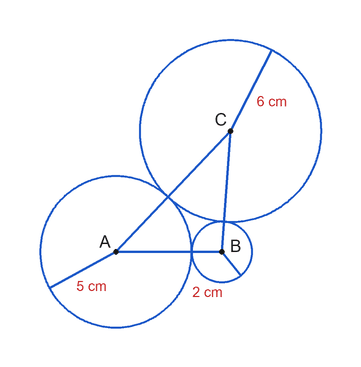
Step 1 — Find the sides of ΔABC.
Each pair of circles touches externally, so each side is the sum of two radii.
AB=5+2=7
BC=2+6=8
CA=6+5=11
Step 2 — Find the perimeter.
We add the three sides.
Perimeter=7+8+11=26
The sum of the radii is half of this perimeter:
5+2+62×13=13=26
Step 3 — Judge A and R.
Assertion A says the perimeter is the sum of the radii, 13 cm, so A is false. Reason R says it is twice the sum of the radii, 26 cm, so R is true: each radius is counted in two sides.
Watch out: Each radius appears in TWO sides of the triangle, so the radii are counted twice.
Why the other options are wrong:
- (A) A is true, R is false: A is false (13 cm ≠ 26 cm) and R is true, the opposite of this option.
- (C) Both A and R are true and R is the correct reason for A: A is false, so 'both true' cannot be right.
- (D) Both A and R are true and R is the incorrect reason for A: A is false, so 'both true' cannot be right.
Therefore, A is false and R is true, option (B).