
Question 333 marksMedium
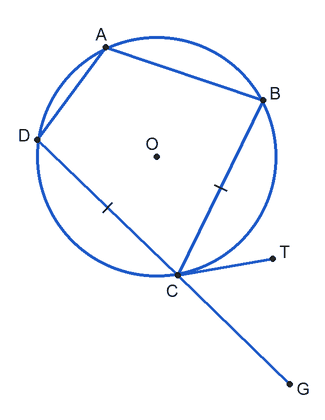
In the figure, ABCD is a cyclic quadrilateral with BC = CD. TC is tangent to the circle at point C and DC is produced to point G. If ∠BCG = 108° and O is the centre of the circle, find :
(i) angle BCT
(ii) angle DOC
Confirming your payment
Sign up now and get 250 free tokens.
Tangents and Intersecting Chords · Question 33 of 76
In the figure, ABCD is a cyclic quadrilateral with BC = CD. TC is tangent to the circle at point C and DC is produced to point G. If ∠BCG = 108° and O is the centre of the circle, find :
(i) angle BCT
(ii) angle DOC
Solution:
Concept: Alternate segment theorem: The angle between a tangent and a chord drawn from the point of contact is equal to the angle which that chord subtends in the alternate segment (the part of the circle on the other side of the chord). The angle which an arc subtends at the centre is double the angle which it subtends at any point on the remaining part of the circle.
Step 1 — Find ∠BCD.
D, C and G lie on one line, so ∠BCD and ∠BCG add up to 180°.
Step 2 — Find ∠CBD and ∠CDB.
BC = CD, so ΔBCD is isosceles and its base angles ∠CBD and ∠CDB are equal. They share the rest of 180°.
Step 3 — Part (i): use the alternate segment.
CT is the tangent at C and CB is a chord. The angle between them, ∠BCT, equals the angle CB subtends in the alternate segment, at D.
Step 4 — Part (ii): use the angle at the centre.
Arc DC subtends ∠DOC at the centre and ∠DBC at B, so ∠DOC is twice ∠DBC.
Watch out: ∠BCG = 108° is outside the triangle BCD; the angle inside it at C is 180° − 108° = 72°.
Therefore, (i) ∠BCT = 54°; (ii) ∠DOC = 108°.