
Question 493 marksEasy
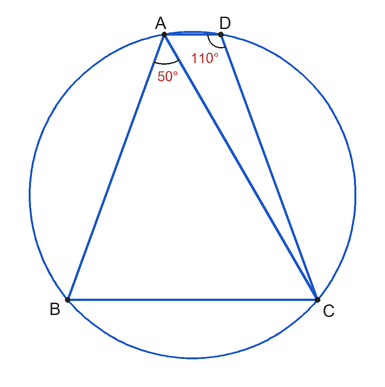
ABCD is a cyclic quadrilateral in which BC is parallel to AD, angle ADC = 110° and angle BAC = 50°. Find angle DAC and angle DCA.
Confirming your payment
Sign up now and get 250 free tokens.
Tangents and Intersecting Chords · Question 49 of 76
ABCD is a cyclic quadrilateral in which BC is parallel to AD, angle ADC = 110° and angle BAC = 50°. Find angle DAC and angle DCA.
Solution:
Concept: In a cyclic quadrilateral the opposite angles add up to 180°, and an exterior angle equals the interior opposite angle. When two lines are parallel, co-interior angles on a transversal add up to 180°.
Step 1 — Find ∠ABC.
B and D are opposite vertices of the cyclic quadrilateral ABCD, so ∠ABC + ∠ADC = 180°.
Step 2 — Find ∠DAB.
BC ∥ AD and AB is a transversal, so the co-interior angles ∠DAB and ∠ABC add up to 180°.
Step 3 — Find ∠DAC.
∠DAC is the part of ∠DAB left after ∠BAC.
Step 4 — Find ∠DCA.
The angles of ΔADC add up to 180°.
Check: BC ∥ AD, so ∠ACB should equal ∠DAC (alternate angles). In ΔABC, ∠ACB is 180° − 70° − 50°, which is 60°. It agrees.
Watch out: ∠DAB comes from the PARALLEL sides (co-interior angles); the cyclic rule pairs ∠ADC with ∠ABC.
Therefore, ∠DAC = 60° and ∠DCA = 10°.