
Opening your dashboard
Class 10 Biology Chapter 14: Human Evolution Solutions
25 textbook questions with step-by-step answers, free to read, for ICSE 2026-27.
Get talked through Ch 14, not just shown the answer
Reading a finished solution is not the same as being able to do it. The AI tutor takes one question at a time and works it with you, in your own words, until you can.
- Ask it out loud, in your own words
- It gives you the next step, not the answer
- Stuck on part (ii)? Start there
25 questions with solutions
1–10 marks · Mixed difficulty
- 11 mark
Question 1
Which of the following is not a vestigial organ ?
Solve with AIAnswer
(A) Vermiform appendix
- Correct
(B) Caecum
(C) Wisdom teeth
(D) Ear pinna
Answer: (B) Caecum
Concept: vestigial organs have stopped being of any use to their possessor but still persist, generation after generation, in a reduced form.
Step 1 — List the human vestigial organs.
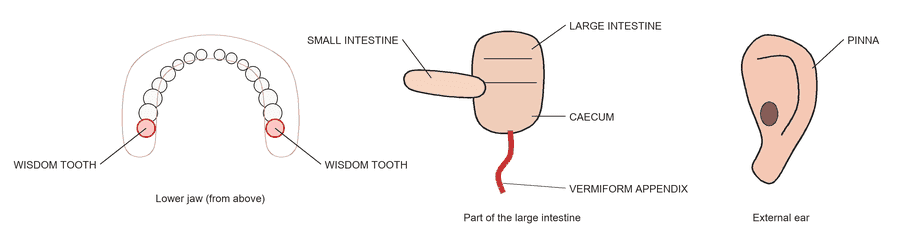
The well-known vestigial organs of man are the wisdom teeth, the vermiform appendix and the muscles of the ear pinna.
Step 2 — Look at the caecum.
The caecum is the first part of the large intestine, a pouch where the small intestine joins it; the appendix only projects from its blind end. The caecum itself is part of the working gut, so it is not vestigial.

Watch out: The appendix hangs from the caecum, but only the appendix is the vestigial organ.
Why the other options are wrong:
- (A) Vermiform appendix: the vermiform appendix is functionless in humans, though the corresponding organ of herbivores such as the sheep helps to digest cellulose; so it is vestigial.
- (C) Wisdom teeth: wisdom teeth, the last molars, appear late, are often small or missing, and are hardly needed for chewing; so they are vestigial.
- (D) Ear pinna: we cannot move the pinna to catch sound, because its muscles are poorly developed and functionless; so it is vestigial.
Therefore, the caecum is not a vestigial organ, option (B).
- 21 mark
Question 2
The selective agent that was responsible for causing the change in peppered moth was :
Solve with AIAnswer
(A) Lichens
(B) Humans
- Correct
(C) Birds
(D) Pollution
Answer: (C) Birds
Concept: A selective agent is whatever actually removes the less fit individuals. In the peppered moth (Biston betularia), natural selection acted through the birds that eat the moths.
Step 1 — Before the industrial revolution.
The light moth was hidden on the pale, lichen-covered tree trunks, while the dark moth was easily seen and eaten by birds, so the dark form stayed rare.
Step 2 — After the industrial revolution.
Pollution killed the lichens and soot darkened the trunks; now the dark moth was hidden and the light moth became the easy prey of birds.
Step 3 — Name the agent.
In both periods it was the birds that picked off the moths they could see, so the birds were the selective agent.

Watch out: Pollution changed the background, but it did not remove any moths; the birds did.
Why the other options are wrong:
- (A) Lichens: lichens only formed the pale background on the trunks; they removed no moths.
- (B) Humans: human industry caused the pollution, but humans did not pick out the moths.
- (D) Pollution: pollution changed the surroundings (killed lichens, darkened trunks); the selection itself was done by the birds.
Therefore, the selective agent was the birds, option (C).
- 31 mark
Question 3
The first scientist who proposed his theory for evolution was ;
Solve with AIAnswer
(A) Darwin
- Correct
(B) Lamarck
(C) Mendel
(D) Wallace
Answer: (B) Lamarck
Concept: Lamarck was the first scientist to put forward a theory of evolution: the theory of inheritance of acquired characters (1809).
Step 1 — Date Lamarck's theory.
The French biologist Jean-Baptiste de Lamarck (1744–1829) published his theory in 1809.
Step 2 — Compare with Darwin.
Charles Darwin (1809–1882) published his theory of natural selection later, in "The Origin of Species" (1859). So Lamarck's theory came first.
Watch out: Darwin is the 'Father of Evolution', but Lamarck's theory came earlier.
Why the other options are wrong:
- (A) Darwin: Darwin's theory of natural selection came later, in 1859.
- (C) Mendel: Mendel gave the laws of inheritance (genetics), not a theory of evolution.
- (D) Wallace: Wallace proposed natural selection together with Darwin in 1858, about fifty years after Lamarck.
Therefore, the first scientist to propose a theory of evolution was Lamarck, option (B).
- 41 mark
Question 4
The theory proposed by Lamarck is :
Solve with AIAnswer
(A) Autogenesis theory
(B) Germplasm theory
- Correct
(C) Theory of inheritance of acquired characters
(D) Theory of abiogenesis
Answer: (C) Theory of inheritance of acquired characters
Concept: Lamarck proposed that evolution happens through the inheritance of acquired characters.
Step 1 — State his two principles.
He explained his idea with two principles: use and disuse, and inheritance of acquired characters.
Step 2 — See how they work together.
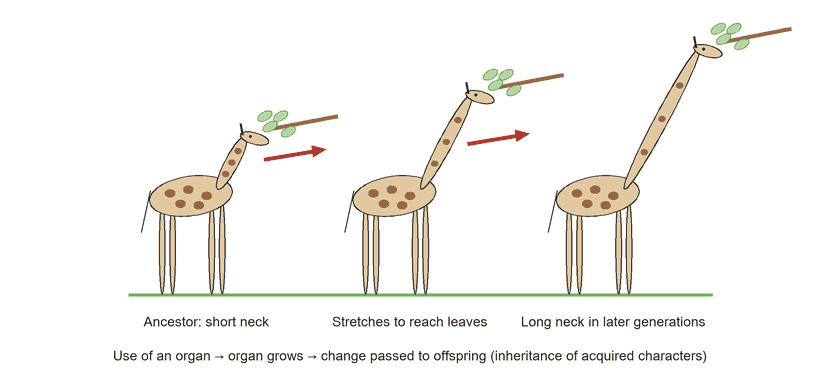
Organs that are used a lot grow larger and stronger, and those not used waste away; these changes, gained during life, were thought to pass to the offspring. His classic example was the long neck of the giraffe.
Why the other options are wrong:
- (A) Autogenesis theory: autogenesis is an idea about the origin of life (life arising from non-living matter), not Lamarck's theory of evolution.
- (B) Germplasm theory: the germplasm theory was given by Weismann, who in fact argued against the inheritance of acquired characters.
- (D) Theory of abiogenesis: abiogenesis deals with life arising from non-living matter, not with how species change.
Therefore, Lamarck's theory is the theory of inheritance of acquired characters, option (C).
- 51 mark
Question 5
Charles Darwin explained the origin of species through :
Solve with AIAnswer
(A) Mutation
- Correct
(B) Natural selection
(C) Acquired characters
(D) Hybridization
Answer: (B) Natural selection
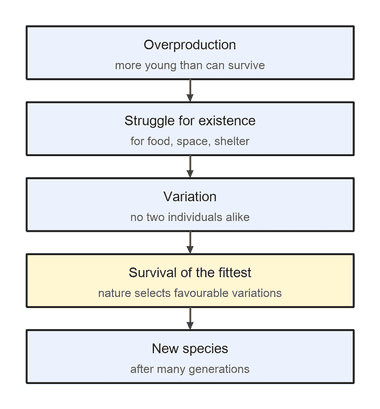
Concept: In "The Origin of Species" (1859) Charles Darwin explained the origin of new species by natural selection: nature selects the fittest and rejects the weaker individuals.
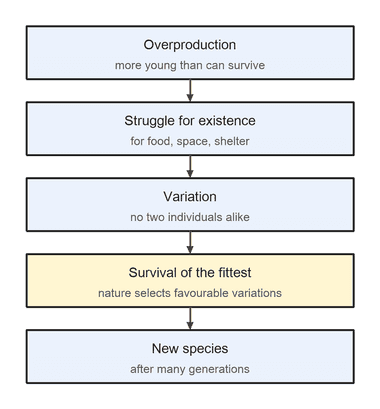
Step 1 — Overproduction leads to a struggle.
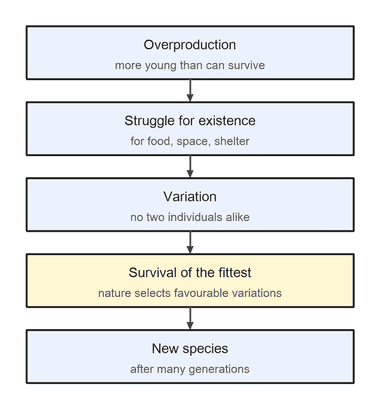
Organisms produce far more young than can survive, so there is a struggle for existence for food and space.
Step 2 — Variation decides who survives.
Individuals vary; those with useful variations survive (survival of the fittest) and pass them on.
Step 3 — New species form.
Over many generations enough characters change to turn the species into a new one.
Why the other options are wrong:
- (A) Mutation: Darwin could not explain where variations come from; mutation was added later by others (Neo-Darwinism).
- (C) Acquired characters: the inheritance of acquired characters is Lamarck's theory, not Darwin's.
- (D) Hybridization: hybridization is the crossing of two varieties; Darwin did not use it to explain the origin of species.
Therefore, Darwin explained the origin of species through natural selection, option (B).
- 61 mark
Question 6
Which one of the following was not explained by Darwinism ?
Solve with AIAnswer
(A) Natural selection
(B) Struggle for existence
- Correct
(C) Use and disuse
(D) Survival of the fittest
Answer: (C) Use and disuse
Concept: use and disuse is one of the two principles of Lamarck's theory, not part of Darwinism.
Step 1 — List the ideas of Darwinism.
Darwin's theory rests on overproduction, struggle for existence, variation and survival of the fittest (natural selection).
Step 2 — Place 'use and disuse'.
'Use and disuse' says that organs used a lot grow and unused ones waste away; Lamarck explained it with the giraffe. So it is the one idea in the list that Darwinism did not explain.
Why the other options are wrong:
- (A) Natural selection: natural selection is the central idea of Darwinism.
- (B) Struggle for existence: the struggle for existence is one of Darwin's main points: living things compete because food and space are limited.
- (D) Survival of the fittest: survival of the fittest is Darwin's point that only individuals with useful variations survive.
Therefore, use and disuse was not explained by Darwinism, option (C).
- 71 mark
Question 7
Which of the following human ancestral stages came just before the modern man ?
Solve with AIAnswer
- Correct
(A) Cro-magnon
(B) Ramapithecus
(C) Homo habilis
(D) Neanderthal man
Answer: (A) Cro-magnon
Concept: Modern man (Homo sapiens sapiens) came after Cro-Magnon man, the stage just before him in the book's sequence.
Step 1 — Write the stages in order.
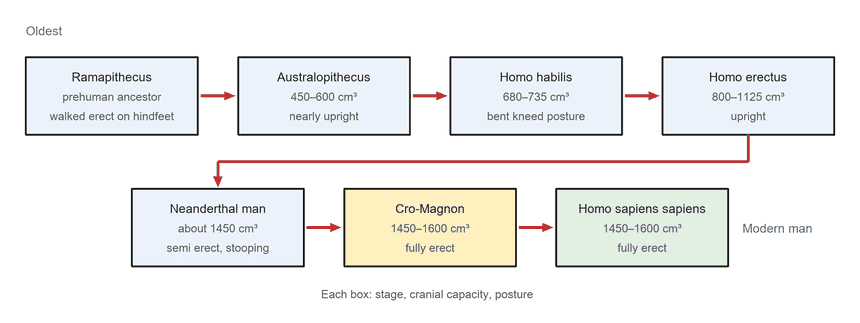
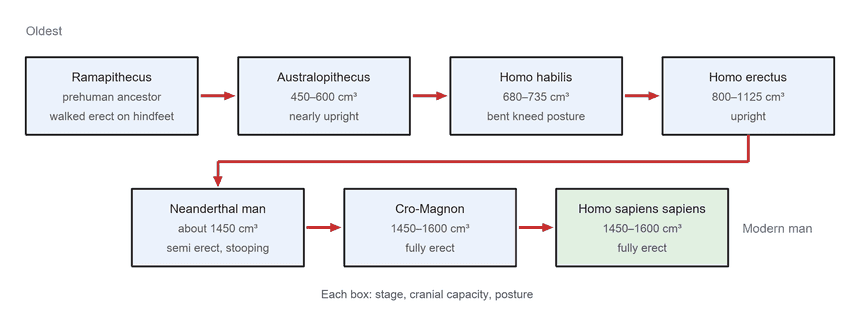
The book's sequence is: Ramapithecus → Australopithecus → Homo habilis → Homo erectus → Neanderthal man → Cro-Magnon → Homo sapiens sapiens (modern man).
Step 2 — Pick the stage just before modern man.
Cro-Magnon comes last before modern man; its cranial capacity (1450–1600 cm³) and fully erect posture are the same as ours.
Watch out: Neanderthal man came before Cro-Magnon, so he is not the stage immediately before modern man.
Why the other options are wrong:
- (B) Ramapithecus: Ramapithecus is the earliest, prehuman stage of the series.
- (C) Homo habilis: Homo habilis, the first man-like ancestor, came much earlier, just after Australopithecus.
- (D) Neanderthal man: Neanderthal man came before Cro-Magnon, so he is two stages before modern man.
Therefore, the stage just before modern man is Cro-Magnon, option (A).
- 81 mark
Question 8
The scientist who is regarded as the "Father of Evolution" is :
Solve with AIAnswer
(A) Gregor Mendel
(B) Walther Flemming
- Correct
(C) Charles Darwin
(D) Jean-Baptiste Lamarck
Answer: (C) Charles Darwin
Concept: Charles Darwin (1809–1882) is regarded as the "Father of Evolution".
Step 1 — Recall his work.
Darwin proposed the theory of natural selection in "The Origin of Species" (1859).
Step 2 — See why the title stays with him.
He could not explain the source of variations; later genetics did, and his theory was extended into Neo-Darwinism. Even so, Darwin is still called the Father of Evolution.
Watch out: Lamarck's theory came first, but the title 'Father of Evolution' is given to Darwin.
Why the other options are wrong:
- (A) Gregor Mendel: Gregor Mendel is called the 'Father of Genetics' for his laws of inheritance.
- (B) Walther Flemming: Walther Flemming is known for his work on chromosomes and cell division (mitosis), not evolution.
- (D) Jean-Baptiste Lamarck: Lamarck was the first to propose a theory of evolution, but the title is given to Darwin.
Therefore, the 'Father of Evolution' is Charles Darwin, option (C).
- 91 mark
Question 9
Industrial melanism was highlighted by :
Solve with AIAnswer
(A) Polar bear
(B) Butterfly
- Correct
(C) Peppered moth
(D) Giraffe
Answer: (C) Peppered moth
Concept: industrial melanism is the replacement of the light form of the peppered moth (Biston betularia) by its dark form in industrial areas.
Step 1 — The situation in 1850.
Around Manchester the dark form was rare, because birds easily spotted it on the lichen-covered trunks.
Step 2 — What pollution changed.
Soot killed the lichens and blackened the trunks, so the dark form became the better hidden one.
Step 3 — The result.
The dark form survived better, left more offspring and almost replaced the light form; this is industrial melanism, a classical example of natural selection.
Why the other options are wrong:
- (A) Polar bear: the polar bear has no link with industrial pollution or with this study.
- (B) Butterfly: the insect studied was a moth, Biston betularia, not a butterfly.
- (D) Giraffe: the giraffe is Lamarck's example of use and disuse, not of industrial melanism.
Therefore, industrial melanism was highlighted by the peppered moth, option (C).
- 101 mark
Question 10
The famous book "The Origin of Species" was written by :
Solve with AIAnswer
(A) Carl Linnaeus
- Correct
(B) Charles Darwin
(C) Jean-Baptiste Lamarck
(D) Gregor Mendel
Answer: (B) Charles Darwin
Concept: Charles Darwin published "The Origin of Species" in 1859.
Step 1 — Recall where his ideas came from.
As a young man Darwin sailed round the world as a naturalist and saw how living things differed from one island to another.
Step 2 — Link the book to the theory.
From these observations he proposed natural selection, which he set out in this book.
Why the other options are wrong:
- (A) Carl Linnaeus: Carl Linnaeus (1707–1778) devised the system of scientific names (he named man Homo sapiens); he did not write this book.
- (C) Jean-Baptiste Lamarck: Lamarck proposed the theory of inheritance of acquired characters; this book is not his.
- (D) Gregor Mendel: Mendel worked on inheritance in the garden pea and gave the laws of inheritance.
Therefore, "The Origin of Species" was written by Charles Darwin, option (B).
- 111 mark
Question 11
The following questions are Assertion-Reason based questions. Choose the answer based on the codes given below.
(1) A is True and R is False (2) A is False and R is True
(3) Both A and R are True (4) Both A and R are False
Assertion (A): Lamarck's theory of inheritance of acquired characters is mainly based on "survival of the fittest".
Reason (R): Lamarck has explained his principle of 'use and disuse' with the example of Giraffe's neck.
Solve with AIAnswer
(A) (1) A is True and R is False
- Correct
(B) (2) A is False and R is True
(C) (3) Both A and R are True
(D) (4) Both A and R are False
Answer: (B) (2) A is False and R is True
Concept: In an assertion–reason item, judge the Assertion (A) and the Reason (R) separately as true or false. Here the four choices only ask whether each statement is true, so we do not have to decide whether R explains A. Here, "survival of the fittest" belongs to Darwin; "use and disuse" belongs to Lamarck.
Step 1 — Judge the Assertion (A).
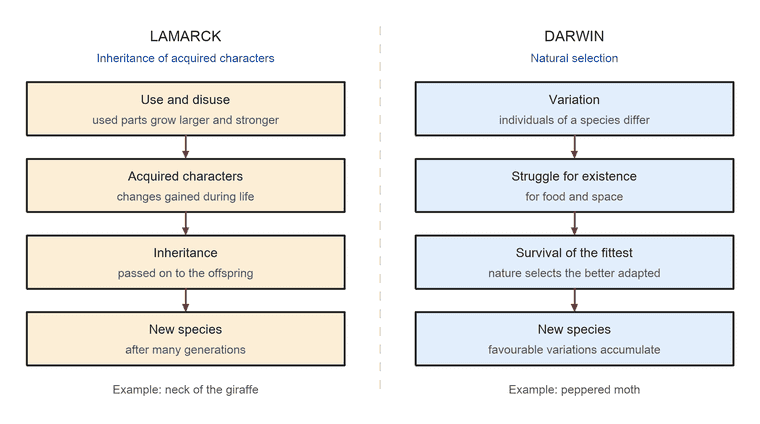
False. Lamarck's theory rests on use and disuse and the inheritance of acquired characters; 'survival of the fittest' is part of Darwin's theory of natural selection.
Step 2 — Judge the Reason (R).
True. Lamarck explained use and disuse with the giraffe: constant stretching of the neck and forelimbs over many generations made them longer, so that the animals could reach higher leaves.
Watch out: Match each phrase to its scientist before judging; A gives Darwin's idea to Lamarck.
Why the other options are wrong:
- (A) (1) A is True and R is False: It calls the Assertion true, but the Assertion is false; and it calls the Reason false, but the Reason is true.
- (C) (3) Both A and R are True: It calls the Assertion true, but the Assertion is false.
- (D) (4) Both A and R are False: It calls the Reason false, but the Reason is true.
Therefore, A is false and R is true, option (B).
- 121 mark
Question 12
The following questions are Assertion-Reason based questions. Choose the answer based on the codes given below.
(1) A is True and R is False (2) A is False and R is True
(3) Both A and R are True (4) Both A and R are False
Assertion (A): The analogous organ to the vermiform appendix in herbivorous mammals is quite helpful in digesting cellulose. But it is considered a vestigial organ in humans.
Reason (R): Vermiform appendix is a wide worm-like tubular structure, projecting from the blind part of the colon (a part of large intestine). Its function is the same as that of the colon, i.e. absorption of water and some remnants of digested food.
Solve with AIAnswer
- Correct
(A) (1) A is True and R is False
(B) (2) A is False and R is True
(C) (3) Both A and R are True
(D) (4) Both A and R are False
Answer: (A) (1) A is True and R is False
Concept: In an assertion–reason item, judge the Assertion (A) and the Reason (R) separately as true or false. Here the four choices only ask whether each statement is true, so we do not have to decide whether R explains A. Here, the vermiform appendix is a narrow worm-like tube projecting from the blind end of the caecum, and it is functionless in humans.
Step 1 — Judge the Assertion (A).
True. In herbivorous mammals such as the sheep the corresponding organ helps to digest cellulose, while in humans it is a functionless (vestigial) organ. (Strictly, the matching organ is homologous, not 'analogous', but the sense of the statement is correct.)
Step 2 — Judge the Reason (R).
False. It has three errors: the appendix is a narrow tube, not a wide one; it projects from the blind end of the caecum, not of the colon; and it has no such function in humans.

Watch out: A vestigial organ has no useful function, so any statement giving it a working function is false.
Why the other options are wrong:
- (B) (2) A is False and R is True: It calls the Assertion false, but the Assertion is true; and it calls the Reason true, but the Reason is false.
- (C) (3) Both A and R are True: It calls the Reason true, but the Reason is false.
- (D) (4) Both A and R are False: It calls the Assertion false, but the Assertion is true.
Therefore, A is true and R is false, option (A).
- 131 mark
Question 13
The following questions are Assertion-Reason based questions. Choose the answer based on the codes given below.
(1) A is True and R is False (2) A is False and R is True
(3) Both A and R are True (4) Both A and R are False
Assertion (A): The theory of natural selection, proposed by Charles Darwin, is a fundamental mechanism driving human evolution.
Reason (R): Natural selection operates through the preservation of favourable variations that enhance an organism's ability to survive and reproduce, leading to the gradual adaptation of populations to their environments over time.
Solve with AIAnswer
(A) (1) A is True and R is False
(B) (2) A is False and R is True
- Correct
(C) (3) Both A and R are True
(D) (4) Both A and R are False
Answer: (C) (3) Both A and R are True
Concept: In an assertion–reason item, judge the Assertion (A) and the Reason (R) separately as true or false. Here the four choices only ask whether each statement is true, so we do not have to decide whether R explains A. Here, natural selection means that nature preserves individuals with favourable variations and removes the weaker ones.
Step 1 — Judge the Assertion (A).
True. Darwin's natural selection explains how evolution occurs in all species, including man.
Step 2 — Judge the Reason (R).
True. Individuals with favourable variations survive and reproduce more, pass these on, and over many generations the population becomes better suited to its surroundings.
Step 3 — Does R explain A?
R describes how natural selection works, so it also explains A; option (3) needs only that both are true.
Why the other options are wrong:
- (A) (1) A is True and R is False: It calls the Reason false, but the Reason is true.
- (B) (2) A is False and R is True: It calls the Assertion false, but the Assertion is true.
- (D) (4) Both A and R are False: It calls the Assertion false, but the Assertion is true; and it calls the Reason false, but the Reason is true.
Therefore, both A and R are true, option (C).
- 142 marks
Question 14
Mention four main postulates of Darwin's theory.
Solve with AIWritten solution
Solution:
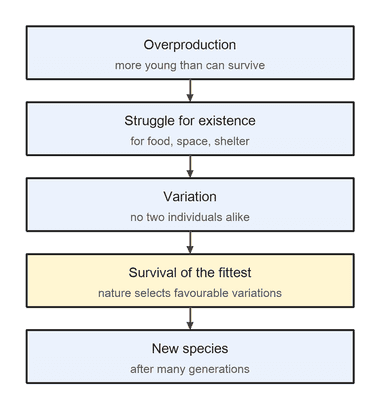
Concept: Darwin's theory of natural selection rests on four observable facts, each leading to the next.
Step 1 — Overproduction.
Living things produce far more young than can survive; for example, an oyster lays 60 to 80 million eggs in one spawn.
Step 2 — Struggle for existence.
Because numbers rise while food and space stay almost the same, individuals compete for food, shelter and breeding places, within a species (intraspecific) and between species (interspecific).
Step 3 — Variation.
No two individuals are exactly alike; some differences help survival and some harm it, and they appear in every generation.
Step 4 — Survival of the fittest (natural selection).
Only individuals with useful variations survive and reproduce, passing those variations on; over many generations this gives rise to new species.
Watch out: These are Darwin's points; 'use and disuse' belongs to Lamarck and must not be listed here.
Therefore, the four postulates are overproduction, struggle for existence, variation and survival of the fittest (natural selection).
- 155 marks
Question 15
The range of cranial capacities in the following ancestral forms were
(a) Australopithecus ..........
(b) Homo habilis ..........
(c) Homo erectus ..........
(d) Cro-magnon ..........
(e) Homo sapiens sapiens ..........
Solve with AIWritten solution
Solution:
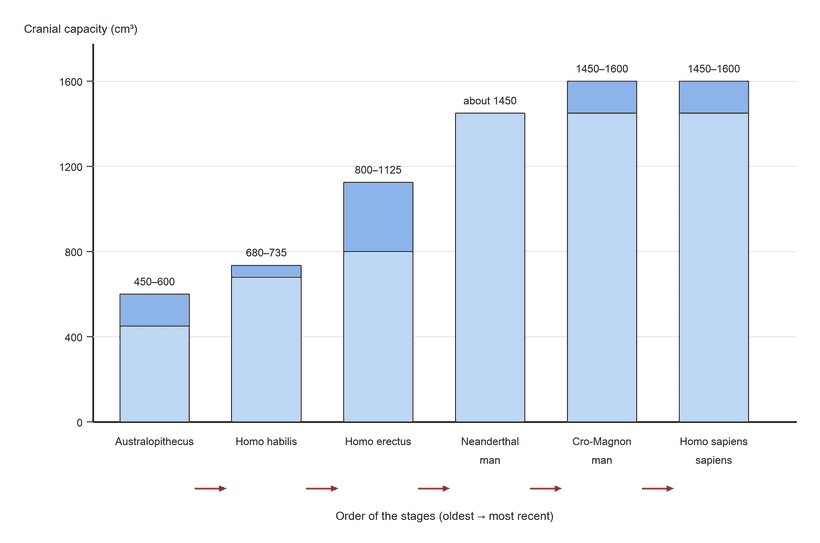
Concept: cranial capacity is the volume of the brain box of the skull; it rose steadily during human evolution. The values below are the ranges given in the book.
Step 1 — (a) Australopithecus.
450–600 cm³; a small ancestor, about 120 cm tall, that walked nearly upright.
Step 2 — (b) Homo habilis.
680–735 cm³; the first man-like ancestor, with a larger head and a less protruding face.
Step 3 — (c) Homo erectus.
800–1125 cm³; it walked fully upright, hunted and used fire.
Step 4 — (d) Cro-Magnon.
1450–1600 cm³; it had a large skull, a rounded forehead and a prominent chin.
Step 5 — (e) Homo sapiens sapiens.
1450–1600 cm³; modern man has the same range as Cro-Magnon, with a much enlarged cerebrum.
Step 6 — Notice the trend.
The lower limit rises from 450 cm³ to 1450 cm³, a little more than three times. Since Cro-Magnon and modern man share the same range, the later evolution of man was mainly cultural rather than in the size of the brain.
Watch out: Cro-Magnon and modern man have the same range; do not give modern man a larger figure.
Therefore, (a) 450–600 cm³, (b) 680–735 cm³, (c) 800–1125 cm³, (d) 1450–1600 cm³, (e) 1450–1600 cm³.
- 162 marks
Question 16
Mention the two principles through which Lamarck explained his ideas.
Solve with AIWritten solution
Solution:
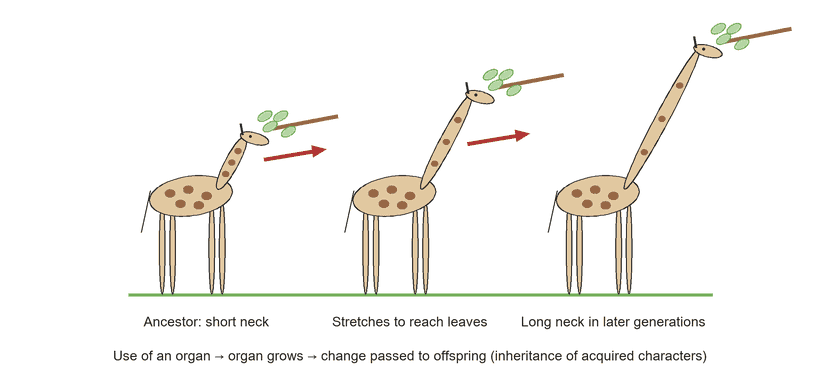
Concept: Lamarck explained his theory of inheritance of acquired characters through two principles.
Step 1 — First principle: use and disuse.
Parts of the body that are used a lot become larger and stronger, while parts not used weaken and waste away. Lamarck's example: giraffes kept stretching their necks and forelimbs to feed from trees, so these grew longer and stronger.
Step 2 — Second principle: inheritance of acquired characters.
Changes gained in this way during life were thought to pass on to the offspring; so the long neck and forelimbs reappeared, and grew further, generation after generation.
Therefore, the two principles are use and disuse, and inheritance of acquired characters.
- 171 mark
Question 17
Name any three vestigial organs found in humans.
Solve with AIWritten solution
Solution:
Concept: vestigial organs have stopped being of any use to their possessor but persist in a reduced form generation after generation.
Step 1 — Name three.
The vermiform appendix, the wisdom teeth and the muscles of the ear pinna.
Step 2 — Say why each is vestigial.
The appendix is functionless in humans; the wisdom teeth (last molars) are hardly needed for chewing; and the pinna cannot be moved to catch sound because its muscles are poorly developed. Other accepted examples are the nictitating membrane of the eye and the tail bones (coccyx).
Therefore, three vestigial organs of humans are the vermiform appendix, the wisdom teeth and the ear-pinna muscles.
- 181 mark
Question 18
Give the scientific name of the organism which is cited as the classical example of "Natural Selection".
Solve with AIWritten solution
Solution:
Concept: The classical example of natural selection is the peppered moth, studied around Manchester.
Step 1 — Give the scientific name.
The peppered moth is Biston betularia.
Step 2 — Say why it is the classical example.
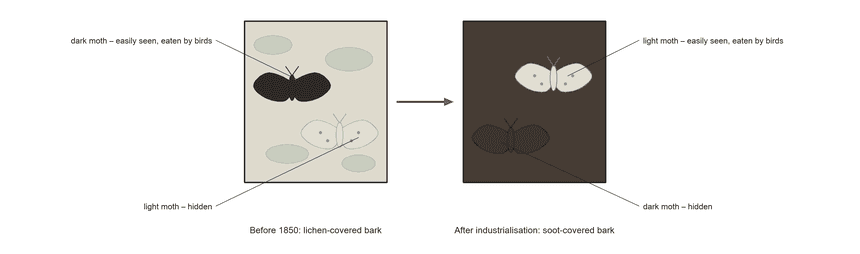
On pale, lichen-covered trunks the light moths were hidden and birds ate the dark ones. After soot blackened the trunks, the dark moths were hidden and survived better. Nature, through the birds, selected the better hidden form: this is industrial melanism.
Watch out: Write the genus with a capital letter and the species with a small letter, both in italics: Biston betularia.
Therefore, the organism is the peppered moth, Biston betularia.
- 193 marks
Question 19
Tick mark (√) the correct option in the following statements :
(a) The fossil history of humans is complete / fragmentary.
(b) the first remarkable human fossil was that of H.habilis/H. africanus.
(c) Evolution is an ever continuing/promptly ending process.
Solve with AIWritten solution
Solution:
Concept: Choose the word that agrees with what is known about human fossils and about evolution.
Step 1 — (a) Fossil history of humans.
The fossil record of man is incomplete; Ramapithecus, for example, is known only from a few teeth and pieces of jaw. So it is fragmentary √, though enough to trace the path of human evolution.
Step 2 — (b) The first remarkable human fossil.
In the book's account the first remarkable fossil of the human line is that of H. habilis √, the first man-like ancestor placed in the genus Homo. "H. africanus" is not a species of Homo; the name belongs to Australopithecus africanus.
Step 3 — (c) Nature of evolution.
Evolution is a slow process that has never stopped, so it is ever continuing √.
Therefore, (a) fragmentary, (b) H. habilis, (c) ever continuing.
- 2010 marks
Question 20
Define the following terms :
(a) Evolution
(b) Vestigial organs
(c) Speciation
(d) Bipedalism
(e) Natural selection
Solve with AIWritten solution
Solution:
Concept: Write each definition with its key words, then add one line showing what it means.
Step 1 — (a) Evolution.
Evolution is the slow and continuous process by which complex forms of life have arisen from simpler forms over millions of years; for example, modern man evolved from ape-like ancestors through a series of stages.
Step 2 — (b) Vestigial organs.
Vestigial organs are organs that have stopped being of use to their possessor but persist, generation after generation, in a reduced form; they are remnants of organs that worked in the ancestors, such as the vermiform appendix, wisdom teeth and ear-pinna muscles in man.
Step 3 — (c) Speciation.
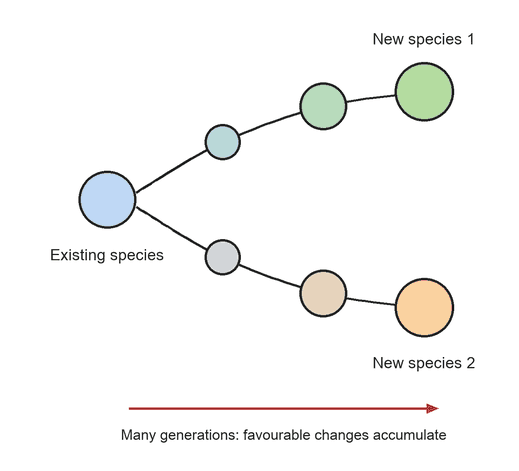
Speciation is the origin of new species by gradual modification: as surroundings change, new useful features are selected, and over many generations enough characters change to form a new species.
Step 4 — (d) Bipedalism.
Bipedalism is the ability to walk upright on the two hind limbs, which frees the forelimbs; in man it came with the lumbar curve of the backbone.
Step 5 — (e) Natural selection.
Natural selection is the process by which nature preserves the fittest individuals (those with favourable variations), which survive and reproduce, and removes the weaker ones; for example, the better hidden peppered moths escaped the birds and left more offspring.
Therefore, the five definitions are the bold statements in Steps 1 to 5.
- 216 marks
Question 21
Distinguish between :
(a) Australopithecus and Cro-Magnon (Chin)
(b) Australopithecus and Modern man (Body hair)
(c) Homo habilis and Homo sapiens sapiens (Posture)
Solve with AIWritten solution
Solution:
Concept: Compare each pair only on the feature given in brackets. From Australopithecus to modern man the chin develops, body hair is reduced and the posture becomes fully erect.
Step 1 — (a) Chin.
The face drew back over time, and the chin appeared:
Australopithecus Cro-Magnon Chin absent; face projecting (prognathous). Well-developed, prominent chin; face straight (orthognathous). 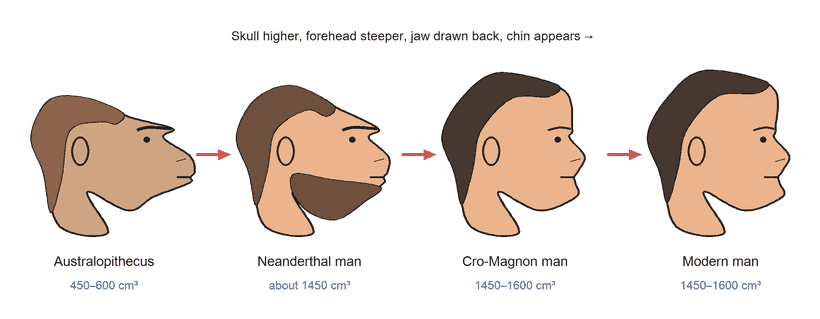
Step 2 — (b) Body hair.
The body covering was gradually lost:
Australopithecus Modern man Body covered with hair. Body hair highly reduced. 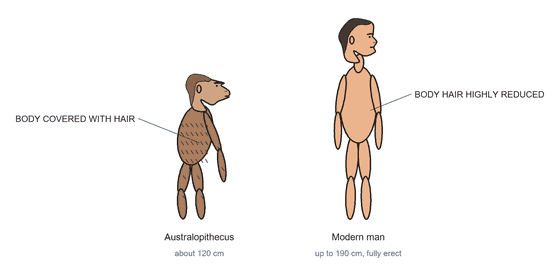
Step 3 — (c) Posture.
The stance became upright:
Homo habilis Homo sapiens sapiens Bent-kneed posture; walked on two legs, only slightly more upright than Australopithecus. Fully erect posture; perfect two-legged walking. Watch out: A projecting face goes with no chin; the chin appears only when the jaw draws back.
Therefore, (a) chin absent v. prominent chin; (b) hairy body v. highly reduced body hair; (c) bent-kneed v. fully erect posture.
- 222 marks
Question 22
Differentiate between Lamarck's Theory and Darwin's Theory.
Solve with AIWritten solution
Solution:
Concept: Lamarck explained evolution by changes acquired during life and passed on; Darwin explained it by nature selecting variations that already exist.
Step 1 — Compare the two theories.
Each row compares the same point:
Lamarck's theory Darwin's theory Theory of inheritance of acquired characters. Theory of natural selection. Based on use and disuse: organs used grow, unused ones waste away, and these changes are inherited. Based on variation: individuals differ, and only the fittest survive the struggle for existence. New species arise by acquiring new characters over many generations. New species arise by the accumulation of favourable variations over many generations. Example: the long neck of the giraffe. Example: the peppered moth (industrial melanism). 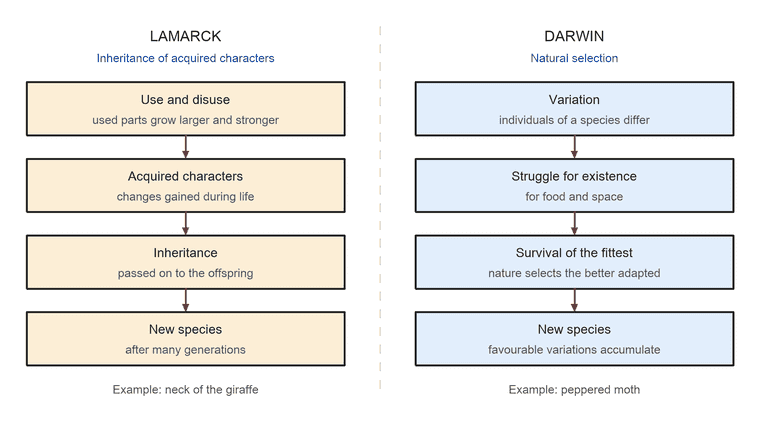
Step 2 — State the key difference.
For Lamarck the organism changes first and passes the change on; for Darwin the differences are already there, and nature picks the fittest.
Therefore, Lamarck: acquired characters are inherited (use and disuse); Darwin: nature selects existing favourable variations (natural selection).
- 235 marks
Question 23
Given below are two figures (A and B) representing the two stages in the evolution of human beings.

Answer the following :
(a) Mention any two contrasting characters between the two stages.
(b) Write all the stages of human evolution in their correct sequence.
(c) State any two characteristic features of stage B.
Solve with AIWritten solution
Solution:
Concept: A is an early ape-like ancestor that walks on all four limbs; B is modern man (Homo sapiens sapiens) with a fully erect posture.
Step 1 — (a) Two contrasting characters.
Compare posture, body hair and head:
Stage A Stage B Stooping; walks on all four limbs. Fully erect; walks on two legs, forelimbs free. Body covered with hair. Body hair highly reduced. Small brain box; projecting face, no chin. Large brain box (1450–1600 cm³); flat face, prominent chin. Step 2 — (b) Stages of human evolution in sequence.
From the earliest to the latest:
Ramapithecus → Australopithecus → Homo habilis → Homo erectus → Neanderthal man → Cro-Magnon → Homo sapiens sapiens (modern man)
Step 3 — (c) Two features of stage B.
Any two: walking on two legs with an S-curved spine and a fully erect posture; cranial capacity 1450–1600 cm³ with a much enlarged cerebrum; a steep forehead, reduced brow ridges and a prominent chin; greatly reduced body hair. Walking upright freed the hands, and the larger brain went with tool use and speech.
Therefore, (a) four-limbed, hairy, small-brained A v. erect, nearly hairless, large-brained B; (b) the sequence in Step 2; (c) e.g. fully erect bipedal posture and a cranial capacity of 1450–1600 cm³.
- 247 marks
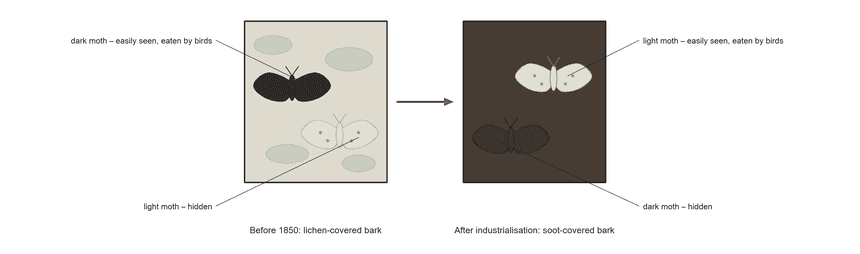
Question 24
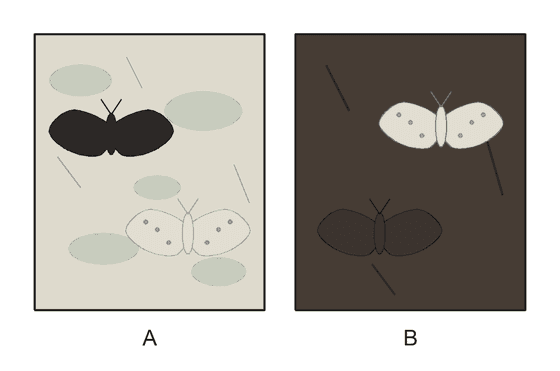
Given below are two figures (A and B) showing a phenomenon that was first observed in Manchester before and after the year 1850.
Answer the following :
(a) What name has been given to this phenomenon?
(b) Give the common name and the scientific name of the insect involved in this phenomenon.
(c) Briefly mention why the changes shown in the two figures appeared.
(d) The following phenomenon provides a classical explanation of a scientific theory given by a certain scientist.
(i) Name and explain the said theory.
(ii) Give the name of the scientist who gave this theory.
Solve with AIWritten solution
Solution:
Concept: On pale, lichen-covered bark (A) the light moth is hidden and the dark moth easily seen; on soot-darkened bark (B) the dark moth is hidden and the light moth easily seen.
Step 1 — (a) Name of the phenomenon.
It is industrial melanism.
Step 2 — (b) The insect.
Common name: peppered moth; scientific name: Biston betularia.
Step 3 — (c) Why the change appeared.
Before industrialisation the trunks were covered with pale lichens, so the light moths were hidden and birds ate the dark ones. Pollution then killed the lichens and blackened the trunks with soot, so the dark moths were hidden and the light ones were eaten by birds. The dark form survived better, left more offspring and almost replaced the light form.
Step 4 — (d)(i) The theory and its explanation.
It is the theory of natural selection (Darwinism). Organisms overproduce, so there is a struggle for existence; individuals vary (here, in colour); those best suited to the surroundings survive and pass on their features, so over many generations the favourable variation spreads.
Step 5 — (d)(ii) The scientist.
The theory was given by Charles Darwin.
Watch out: The moths did not change colour during their lives; the dark form was always there and was simply selected.
Therefore, (a) industrial melanism; (b) peppered moth, Biston betularia; (c) soot darkened the bark, so birds now ate the light moths; (d) natural selection, by Charles Darwin.
- 257 marks
Question 25
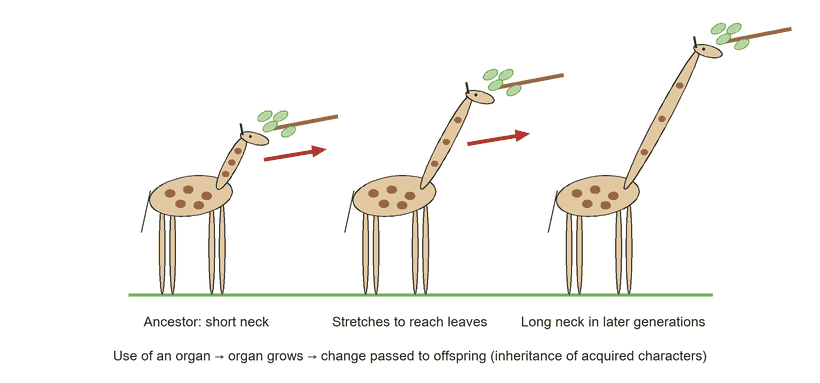
Observe the figure given below and answer the questions that follow :

(a) What is the figure depicting ?
(b) What was the reason that the giraffe stretched their neck and forelimbs ?
(c) What is the name of the theory that is being depicted in the figure ?
(d) Who explained the theory ?
(e) What is the conclusion of this theory ?
Solve with AIWritten solution
Solution:
Concept: The figure shows Lamarck's explanation of the long neck of the giraffe by use and disuse.
Step 1 — (a) What the figure depicts.
It shows the evolution of the giraffe's long neck: over the generations the neck gets longer as the giraffes stretch for higher leaves.
Step 2 — (b) Why the giraffes stretched.
Their ancestors fed on plants at ground level; when this vegetation ran short, they began feeding from trees and kept stretching their necks and forelimbs to reach the higher leaves.
Step 3 — (c) Name of the theory.
The theory of inheritance of acquired characters (use and disuse), also called Lamarckism.
Step 4 — (d) Who explained it.
Jean-Baptiste de Lamarck.
Step 5 — (e) Conclusion of the theory.
Organs that are used a lot become larger and stronger, while unused ones weaken; such acquired changes are passed on to the offspring, and over many generations they add up to give a new species (here, the long-necked giraffe).
Watch out: Biologists today do not accept that changes gained during life are inherited; the question asks only for Lamarck's own conclusion.
Therefore, (a) evolution of the giraffe's neck; (b) to reach higher leaves when ground plants ran short; (c) inheritance of acquired characters; (d) Lamarck; (e) used organs develop and the acquired changes are inherited, giving new species.
What Class 10 Biology Ch 14 covers
The sections of the chapter, in the order the book takes them. Every question above comes from one of these.
- 01What Is Evolution
- 02Theories of Evolution
- 03Lamarck's Theory of Inheritance of Acquired Characters
- 04Vestigial Organs
- 05Darwin's Theory of Natural Selection
- 06Human Evolution
More ways to study this chapter
The same chapter asked three other ways. Practise it, revise it, and see what the board has set on Ch 14 before.
- Competency-Based Questions (CBQ)Case study questions: a situation, and the part of the chapter that answers it.40questionsOpen
- Previous Year QuestionsQuestions that have actually appeared in board papers, each tagged with its year.19questionsOpen
- Practice QuestionsExtra questions per chapter, for when one attempt at a method is not enough.44questionsOpen
Ch 14 in past ICSE papers
The same chapter as the board has actually asked it. These are worded differently from the textbook exercise, which is the point of reading them.
- 11 mark
Board paper question 1
Correct and rewrite the statement by changing the biological term that is underlined for each statement:
The theory of Inheritance of Acquired Characters was proposed by Watson and Crick.
Solve with AIWritten solution
Solution:
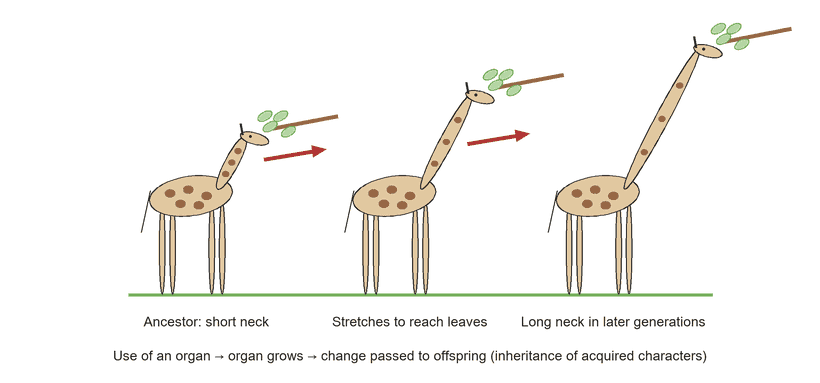
Concept: Jean Baptiste de Lamarck (1744–1829) gave the first theory of evolution (1809). It had two principles: use and disuse of organs (an organ that is used a lot grows larger and stronger; one that is not used becomes weak) and inheritance of acquired characters (such changes are passed on to the offspring).
Step 1 — Find what is wrong.
The statement credits the theory of inheritance of acquired characters to Watson and Crick. They worked out the double-helix structure of DNA in 1953, which has nothing to do with this theory.
Step 2 — Put in the correct name.
The theory that characters acquired during an animal's lifetime are passed on to its young was proposed by Lamarck. His example was the giraffe: generations of stretching to reach high leaves were said to have lengthened its neck.
Watch out: Darwin's theory is natural selection, not inheritance of acquired characters; do not swap the two names.
Therefore, the correct statement is: The theory of Inheritance of Acquired Characters was proposed by Lamarck.
- 25 marks
Board paper question 2
Given below are two stages in the evolution of man. Study them and answer the questions that follow:

(i) Identify Australopithecus and Neanderthal man from the above pictures.
(ii) Mention two characteristic features each for the two stages.
(iii) Who proposed the theory of 'Natural Selection'?
(iv) Name the organism used as an example to explain 'Industrial Melanism'.
(v) Give two examples of vestigial organs in humans.
Solve with AIWritten solution
Solution:
Concept: The stages of human evolution are told apart by the head: an older, ape-like stage has a small brain box, a projecting jaw and no chin; a later stage has a larger, higher skull and a flatter face. The fossil stages of human evolution, from the oldest to the most recent, are: Australopithecus → Homo habilis → Homo erectus → Neanderthal man → Cro-Magnon man → Homo sapiens sapiens (modern man). Along this series the brain box (cranial capacity) grows, the face and jaws draw back, a chin appears, and the posture becomes fully erect.
Step 1 — Part (i): identify the two pictures.
We compare the faces in the picture.
- A — Neanderthal man: a large head with a human-looking face, a low sloping forehead and heavy brow ridges.
- B — Australopithecus: an ape-like face with a strongly projecting (prognathous) jaw, a flat forehead and no chin.

Step 2 — Part (ii): two features of Australopithecus (B).
Any two of these features describe the early, ape-like stage:
- short, about 120 cm tall, and walked upright on two legs;
- small brain box, cranial capacity only about 450–600 cm³, close to that of an ape;
- projecting (prognathous) jaws with no chin, and brow ridges over the eyes;
- body covered with hair.
Step 3 — Part (ii): two features of Neanderthal man (A).
Any two of these features describe the later stage:
- a large head, cranial capacity about 1450 cm³;
- a low, flat, sloping forehead with heavy brow ridges;
- almost no chin and a strong lower jaw;
- a short, sturdy body about 160 cm tall, walking upright on two legs.
Step 4 — Part (iii): natural selection.
The theory of natural selection was proposed by Charles Darwin (in On the Origin of Species, 1859).
Step 5 — Part (iv): industrial melanism.
The example used is the peppered moth, Biston betularia. Before the industrial revolution the tree trunks were covered with pale lichens. The light moths were hidden on them, while the rare dark moths stood out and were eaten by birds. Smoke then killed the lichens and soot blackened the bark. Now the dark moths were hidden and the light ones were picked off, so the dark form survived better, left more offspring and became the common form.
Step 6 — Part (v): vestigial organs in humans.
Two vestigial organs of man are the vermiform appendix and the wisdom teeth (the muscles of the ear pinna are another example).
Watch out: The jaw decides it: the strongly projecting jaw with no chin is the older, ape-like Australopithecus.
Note: older books describe Neanderthal man as stooping; that picture came from one arthritic skeleton, and Neanderthals are now known to have walked fully upright.
Therefore, (i) A is Neanderthal man and B is Australopithecus; (ii) Australopithecus: about 120 cm tall, cranial capacity about 450–600 cm³, projecting jaws with no chin; Neanderthal man: cranial capacity about 1450 cm³, sloping forehead with heavy brow ridges, almost no chin; (iii) Charles Darwin; (iv) the peppered moth, Biston betularia; (v) vermiform appendix and wisdom teeth.
- 31 mark
Board paper question 3
Given below are sets of five terms each. Rewrite the terms in correct order in a logical sequence beginning with the first word that is underlined:
(iv) Australopithecus, Cro-Magnon Man, Homo erectus, Neanderthal Man, Homo sapiens.
Solve with AIWritten solution
Solution:
Concept: The fossil stages of human evolution, from the oldest to the most recent, are: Australopithecus → Homo habilis → Homo erectus → Neanderthal man → Cro-Magnon man → Homo sapiens sapiens (modern man). Along this series the brain box (cranial capacity) grows, the face and jaws draw back, a chin appears, and the posture becomes fully erect.
Step 1 — Start from the underlined term.
The sequence begins with Australopithecus, the oldest and most ape-like of the five, with a cranial capacity of only about 450–600 cm³.
Step 2 — Place the remaining stages by age and brain size.
Homo erectus (about 800–1125 cm³) came next, then Neanderthal man (about 1450 cm³), then Cro-Magnon man (1450–1600 cm³, fully erect, prominent chin). Modern man, Homo sapiens, is the last stage.
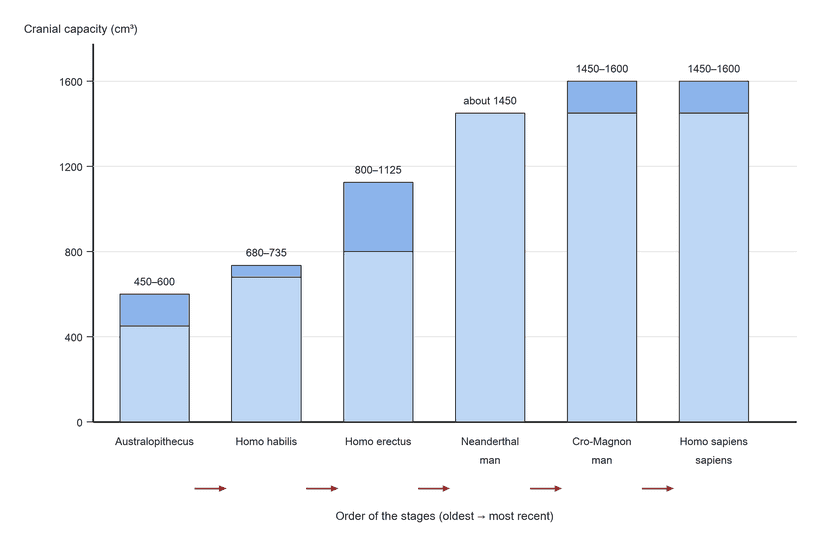
Watch out: Neanderthal man came BEFORE Cro-Magnon man; the order of these two is the usual slip.
Note: today Neanderthal man is seen as a close cousin branch of our line rather than our direct ancestor, and Cro-Magnon man as an early member of our own species; the sequence above is the order in which these forms appeared, which is what the question asks.
Therefore, the sequence is: Australopithecus → Homo erectus → Neanderthal Man → Cro-Magnon Man → Homo sapiens.
- 41 mark
Board paper question 4
Match the items given in column A with the most appropriate ones in Column B and REWRITE the correct matching pairs:
Column A: (i) Biston betularia
Column B: Calcium; balance of the body; Light independent reaction; diffusion of gases; gonad; Peppered moth; Light dependent reaction; Chlorophyll
Solve with AIWritten solution
Solution:
Concept: Industrial melanism is the spread of the dark (melanic) form of an insect in areas where industrial smoke has darkened the surroundings. The classic case is the peppered moth, Biston betularia, of industrial England (around Manchester).
Step 1 — Recognise the name.
Biston betularia is the scientific name of the peppered moth, so the matching item in Column B is 'Peppered moth'.
Step 2 — Recall why it is famous.
Before the industrial revolution the tree trunks were covered with pale lichens. The light moths were hidden on them, while the rare dark moths stood out and were eaten by birds. Smoke then killed the lichens and soot blackened the bark. Now the dark moths were hidden and the light ones were picked off, so the dark form survived better, left more offspring and became the common form. This change is industrial melanism, a case of natural selection seen within a human lifetime.
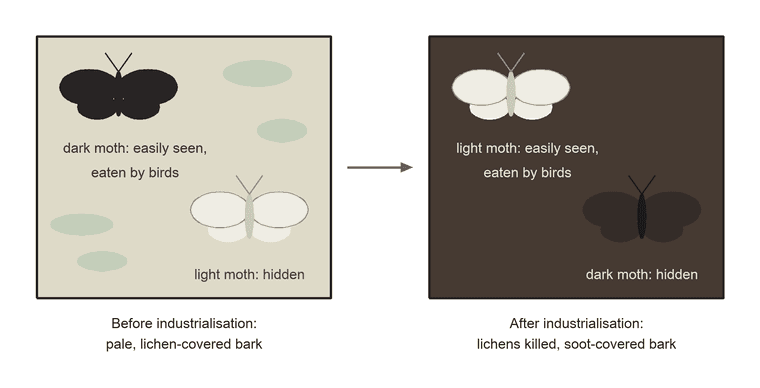
Therefore, the matching pair is Biston betularia — Peppered moth.
- 51 mark
Board paper question 5
Give the biological reasons for the following statements:
(v) Homo sapiens sapiens is the most highly evolved form of man.
Solve with AIWritten solution
Solution:
Concept: Modern man (Homo sapiens sapiens) is the last stage of human evolution. It shows every major trend of the series (erect posture, a large and highly developed brain, a flat face with a chin, reduced body hair) in its most advanced form, and it alone built up language, farming and civilisation.
Step 1 — Posture and body.
Modern man has a fully erect posture with an S-curved spine, so it walks on two legs perfectly and the hands are free. The thumb is opposable, which gives a precise grip for making and using tools.
Step 2 — Brain.
Its brain box is large (1450–1600 cm³, the same range as Cro-Magnon man), and the cerebrum is highly developed. This gives the highest power of reasoning, memory and planning of all living beings.
Step 3 — Skull and face.
The forehead is high and steep, the brow ridges are reduced, the jaws are small and drawn back, and there is a prominent chin. Body hair is highly reduced.
Step 4 — Culture.
Because of its highly developed brain, modern man developed articulate speech and language, made metal tools, grew crops, domesticated animals and built a civilisation. No earlier stage did all of this.
Watch out: The reason is not simply 'the biggest brain': Neanderthal and Cro-Magnon brains were about as large. It is the highly developed cerebrum together with the fully erect posture, speech and culture.
Therefore, Homo sapiens sapiens is the most highly evolved form of man because it has a fully erect posture, a large brain with a highly developed cerebrum, and the power of speech, reasoning and culture.
- 61 mark
Board paper question 6
Industrial Melanism was observed in:
Solve with AIAnswer
(A) Mice
- Correct
(B) Peppered Moth
(C) House Flies
(D) Crow
Answer: (B) Peppered Moth
Concept: Industrial melanism is the spread of the dark (melanic) form of an insect in areas where industrial smoke has darkened the surroundings. The classic case is the peppered moth, Biston betularia, of industrial England (around Manchester).
Step 1 — Recall where it was seen.
Industrial melanism was studied in the peppered moth around the industrial towns of England, such as Manchester.
Step 2 — Recall what happened.
Before the industrial revolution the tree trunks were covered with pale lichens. The light moths were hidden on them, while the rare dark moths stood out and were eaten by birds. Smoke then killed the lichens and soot blackened the bark. Now the dark moths were hidden and the light ones were picked off, so the dark form survived better, left more offspring and became the common form.
Watch out: The birds were the predators that ate the moths; it was the moth that changed colour.
Why the other options are wrong:
- (A) Mice: mice were used by Weismann in his tail-cutting experiment against Lamarck's theory, not to show industrial melanism.
- (C) House Flies: house flies are not the example; no change in their colour was studied on soot-covered trees.
- (D) Crow: a crow is a bird. Birds were the predators that picked off the moths; they did not change colour themselves.
Therefore, industrial melanism was observed in the peppered moth, option (B).
All 19 board paper questions for this chapter, solved the same way.
Class 10 Biology Ch 14 questions students ask
How many questions are there in Class 10 Biology Ch 14?
25 questions. Every one is solved step by step on this page.
Are these Class 10 Biology solutions free?
Yes. Every question and its full working is free to read, with no account needed.
Can I download the Class 10 Biology Ch 14 solutions as a PDF?
There is no PDF to download. Every solution is on this page instead, which means it is searchable, always the current syllabus, and readable on a phone. Use your browser's print option if you want it on paper.