
Opening your dashboard
Class 10 Biology Chapter 14 Human Evolution: Practice Questions
44 questions on Chapter 14, each worked through on its own page with the AI tutor. Class 10 Biology, ICSE 2026-27.
44 questions
1–5 marks · Mixed difficulty
- 11 mark
Question 1
Bloom's level: Remember
The theory that life originated from non-living organic matter through a series of physical and chemical changes is called the :
- 21 mark
Question 2
Bloom's level: Remember
In the animal kingdom, modern man belongs to the order :
- 31 mark
Question 3
Bloom's level: Remember
The first human ancestors who hunted animals and used fire were :
- 41 mark
Question 4
Bloom's level: Remember
In the sequence of human evolution, the stage that came immediately after Homo erectus is :
- 51 mark
Question 5
Bloom's level: Understand
Which statement best describes evolution ?
- 61 mark
Question 6
Bloom's level: Understand
Many mammals turn their ear pinna to gather sound waves, but humans cannot, though the muscles for it are still present in a poorly developed form. The human pinna is therefore an example of :
- 71 mark
Question 7
Bloom's level: Understand
Which idea belongs to Darwin's theory but not to Lamarck's ?
- 81 mark
Question 8
Bloom's level: Apply
Snakes are believed to have evolved from ancestors that had legs. How would Lamarck explain the absence of legs in snakes ?
- 91 mark
Question 9
Bloom's level: Apply
A skull has a cranial capacity of about , a steep forehead, reduced brow ridges, a flattened face and a prominent chin. It most likely belongs to :
- 101 mark
Question 10
Bloom's level: Analyse
Assertion (A): Although every species produces far more offspring than can survive, the number of individuals of a species stays roughly constant over a long period in a stable environment.
Reason (R): Food and space remain almost constant, so many offspring die in the struggle for existence.
- 111 mark
Question 11
Bloom's level: Analyse
Assertion (A): Wisdom teeth are considered vestigial organs in humans.
Reason (R): Wisdom teeth are the last molars to appear, at the age of about 17–20 years.
- 121 mark
Question 12
Bloom's level: Evaluate
Assertion (A): Homo erectus was given this name because it stood erect.
Reason (R): Homo erectus had a well-developed, prominent chin like that of modern man.
- 132 marks
Question 13
Bloom's level: Understand
Darwin could not explain the sources of variation, and his theory was later modified. Explain how it was modified, and why Darwin is still regarded as the "Father of Evolution".
- 142 marks
Question 14
Bloom's level: Understand
How does the belief in special creation differ from the autogenesis theory in what it says about (a) how life began and (b) whether species change ?
- 152 marks
Question 15
Bloom's level: Understand
Explain why the common ancestors of apes and early humans had to come down from the trees, and how this started the change towards walking on two feet.
- 162 marks
Question 16
Bloom's level: Understand
Explain why there can be no evolution by natural selection without variation.
- 172 marks
Question 17
Bloom's level: Apply
A Paramecium divides into two about three times in 48 hours. Starting with one Paramecium, how many would there be after 4 days if every individual survived and kept dividing at this rate ? Why does this never happen in a real pond ?
- 182 marks
Question 18
Bloom's level: Apply
Ducks have webbed feet that help them swim. Use Lamarck's two principles to explain how Lamarck would account for the webbed feet of ducks.
- 192 marks
Question 19
Bloom's level: Apply
Take the average cranial capacity of Australopithecus as and that of modern man as .
How many times larger is the brain case of modern man ? A newly found skull measures — to which ancestor does it most likely belong ?
- 202 marks
Question 20
Bloom's level: Apply
In a series of rock layers, a scientist finds that fossils from the deepest (oldest) layers are of simple organisms, while the upper (younger) layers contain more complex forms related to them. What does this tell us, and which old belief does it go against ?
- 212 marks
Question 21
Bloom's level: Analyse
During human evolution, the canine teeth became smaller, jaw power was lost and a chin developed. Analyse how these three changes are linked to each other and to diet.
- 222 marks
Question 22
Bloom's level: Evaluate
A blacksmith develops very strong arm muscles through years of hard work. His friend says, "His son will surely be born with strong arms." Whose theory supports the friend's view ? Do biologists accept it today ? Justify.
- 234 marks
Question 23
Bloom's level: Apply
Case: A farmer sprays a new insecticide on his cotton field, which has about 10,000 insect pests. About 2% of them happen to be naturally resistant to it and survive; all the others die. The survivors breed. After a few years, the same insecticide hardly kills any pests in his field.
(a) How many pests survived the first spray ?
(b) Did the insecticide create the resistance in the insects ? Explain.
(c) Explain, using Darwin's ideas, why the insecticide stopped working after a few years.
- 244 marks
Question 24
Bloom's level: Apply
A museum has three fossil skulls, labelled X, Y and Z :
Skull Cranial capacity Chin Forehead and brow ridges X about almost no chin; strong lower jaw low, slanting forehead; prominent brow ridges Y about no chin; protruding face low forehead; brow ridges over the eyes Z about almost no chin receding forehead; prominent brow ridges (a) Identify the human ancestor to which each skull belongs.
(b) Arrange X, Y and Z from the oldest to the most recent.
(c) Which feature in the table shows the clearest steady change from oldest to most recent ? What does this change mean ?
- 254 marks
Question 25
Bloom's level: Analyse
Case: Ritu had severe pain in the lower right side of her abdomen. The doctor found that her appendix was infected and removed it in an operation. Ritu recovered fully and now digests her food normally. Her grandfather wonders why humans have an appendix at all.
(a) Why can Ritu live and digest food normally without her appendix ?
(b) From which part of the alimentary canal does the appendix arise ? In which kind of animal is the corresponding organ useful, and for what ?
(c) Analyse what the presence of such organs tells us about our ancestors.
- 264 marks
Question 26
Bloom's level: Analyse
Compare the skeleton of an ape with that of a modern man.
(a) List four features of the human skeleton that are linked with upright, two-footed walking.
(b) Explain how freeing the forelimbs from walking would have helped early humans.
(c) Of the changes from an ape-like form to the human form, which one do you think is linked most closely with the development of culture ? Give your reason.
- 274 marks
Question 27
Bloom's level: Evaluate
Case: Two students explain why the dark-winged peppered moth (Biston betularia) became common near Manchester after the Industrial Revolution.
- Raghav : "The light moths tried hard to hide on the soot-covered trunks, so their wings slowly turned dark, and they passed this dark colour on to their young."
- Tanvi : "A few dark moths were already present. On sooty trunks birds could not see them easily, so more dark moths survived and bred, and their number rose."
(a) Whose explanation follows Lamarck and whose follows Darwin ?
(b) Which explanation is correct ? Justify, using a fact stated in the chapter.
(c) What is the name of this phenomenon, and what acted as the agent of selection ?
- 284 marks
Question 28
Bloom's level: Apply
An excavation team finds a skeleton with : four curves in the spine, a cranial capacity of about , hind limbs longer than the forelimbs, and a broad chest with a flattened sternum. Nearby they find metal tools and the bones of domesticated goats.
(a) To which stage of human evolution does the skeleton belong ? Give two reasons.
(b) Explain how the four curves in the spine and the skull resting on top of the vertebral column suit this human's way of moving and seeing.
(c) What do the metal tools and domesticated goats tell us about this stage of evolution ?
- 295 marks
Question 29
Bloom's level: Create
Lamarck claimed that characters acquired during an organism's life are passed on to its offspring. Design an experiment, using fruit flies (which breed every two weeks), to test this claim.
(a) State the acquired character you will produce and how.
(b) Describe the experimental and control groups and how long you will continue the experiment.
(c) State the result you would expect and the conclusion you would draw about Lamarck's theory.
- 305 marks
Question 30
Bloom's level: Create
Construct a comparison table for Australopithecus, Homo erectus, Neanderthal man and modern man, with rows for : cranial capacity, chin, height and posture, and body hair. Below the table, write two general trends shown by the table.
- 311 mark
Question 31
The vermiform appendix is functionless in humans. In herbivorous mammals such as the sheep, the corresponding organ is quite helpful in :
- 321 mark
Question 32
The simian gap, which was absent in Australopithecus, is a gap present in apes between the :
- 331 mark
Question 33
Assertion (A): Modern man possesses binocular vision.
Reason (R): In modern man the eyes face the front.
- 342 marks
Question 34
(i) Name the two prominent theories put forward to explain organic evolution, and the scientist who proposed each of them.
(ii) Which animal did the earlier of these two scientists use as his classic example ? Name the famous book published by the other scientist in 1859.
- 352 marks
Question 35
A species of fish has lived for a very large number of generations in a cave where no light ever reaches. The fish of this species now have very small eyes which cannot see.
(i) State the principle of Lamarck that would account for the eyes becoming small in the fish living in the dark.
(ii) By which other principle would Lamarck explain why the young ones of these fish are also born with small eyes ? State this principle.
- 362 marks
Question 36
(i) Why are the wisdom teeth so called ? State one way in which they differ from the other molars.
(ii) The pinna of the human ear is regarded as a vestigial organ. Give a reason.
- 372 marks
Question 37
(i) The scientific study of human origin is based on fossils. From which two continents were these fossils primarily obtained, and about how long ago is man supposed to have originated from ape-like ancestors ?
(ii) Name the prehuman ancestor that is known only from a few teeth and some fragments of jaw. How did it walk ?
- 384 marks
Question 38
The figure shows two moths, X and Y, of the species Biston betularia resting on the trunk of a tree. The tree stood near Manchester some years after the industrial revolution.
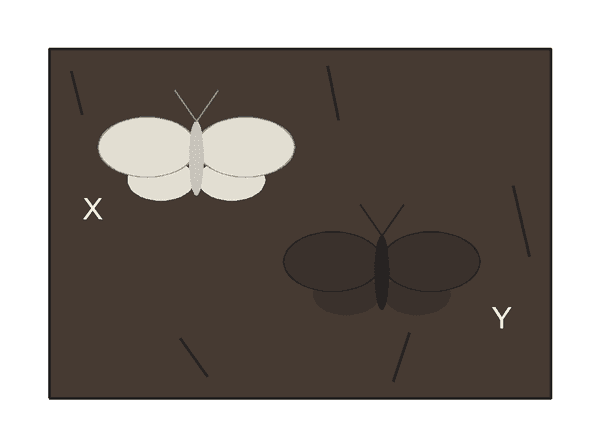
(i) What had made the tree trunks of this area so dark ? What used to cover the tree trunks earlier ?
(ii) Which of the two moths, X or Y, is more likely to be picked off by a bird ? State how this affected the numbers of the two varieties in this area over many generations.
(iii) Name this phenomenon. What did Darwin call the process by which nature selects only those variations which are suitable ?
- 393 marks
Question 39
The chart shows the ranges of cranial capacity of three human ancestors, marked P, Q and R. They are Australopithecus, Homo erectus and Homo habilis, but not in that order.
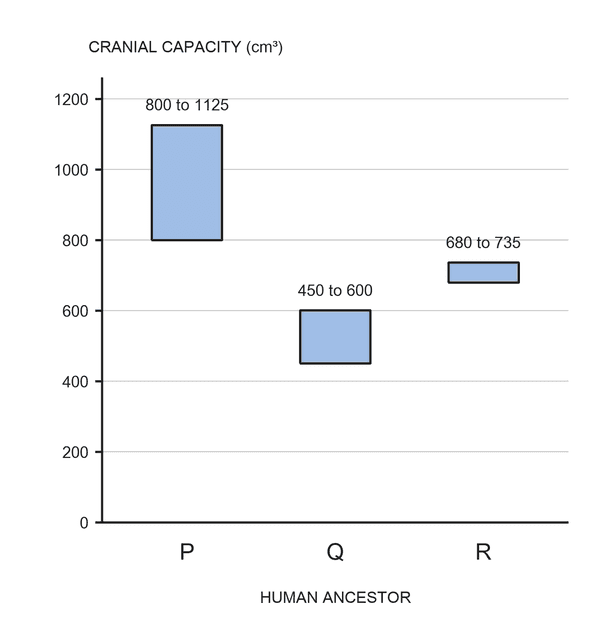
(i) Identify P, Q and R.
(ii) Arrange P, Q and R in the order in which they appeared during human evolution. Which of them was the first to hunt animals and use fire ?
(iii) The cranial capacity of the Neanderthal man was about . By how much is this greater than the highest cranial capacity shown for P ?
- 404 marks
Question 40
Modern man, Homo sapiens sapiens, evolved from the Cro-Magnon man towards the end of the last Glacial period.
(i) About how long ago, and in which region, is the man of today believed to have first appeared ?
(ii) In the form of a table, compare the Neanderthal man and the modern man with regard to (1) forehead and brow ridges and (2) chin.
(iii) The evolution of man after the Cro-Magnon involved the evolution of culture rather than of anatomy. Mention any two cultural advances made by modern man.
- 411 mark
Question 41
Class 10 Sample Paper 1 · Section A
Lamarck's theory of evolution is also called the
- 421 mark
Question 42
Class 10 Sample Paper 1 · Section A
Fill in the blank:
Darwin proposed the theory of origin of species by ...........
- 431 mark
Question 43
Class 10 Sample Paper 1 · Section A
What do you mean by organic evolution?
- 445 marks
Question 44
Class 10 Sample Paper 1 · Section B
In the given picture two stages of human evolution, A and B, are shown. Answer the questions that follow.
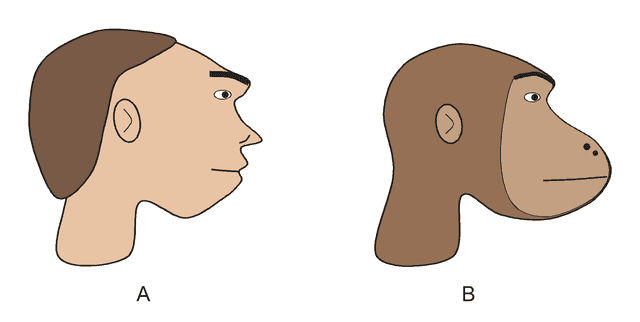
(i) Identify Australopithecus and Neanderthal man from the picture.
(ii) Mention two characteristic features of each of them.
(iii) Who proposed the theory of natural selection?
(iv) What are vestigial organs? Name two vestigial organs in human beings.