
Question 2010 marksEasy
Define the following terms :
(a) Evolution
(b) Vestigial organs
(c) Speciation
(d) Bipedalism
(e) Natural selection
Confirming your payment
Sign up now and get 250 free tokens.
Human Evolution · Question 20 of 25
Define the following terms :
(a) Evolution
(b) Vestigial organs
(c) Speciation
(d) Bipedalism
(e) Natural selection
Solution:
Concept: Write each definition with its key words, then add one line showing what it means.
Step 1 — (a) Evolution.
Evolution is the slow and continuous process by which complex forms of life have arisen from simpler forms over millions of years; for example, modern man evolved from ape-like ancestors through a series of stages.
Step 2 — (b) Vestigial organs.
Vestigial organs are organs that have stopped being of use to their possessor but persist, generation after generation, in a reduced form; they are remnants of organs that worked in the ancestors, such as the vermiform appendix, wisdom teeth and ear-pinna muscles in man.
Step 3 — (c) Speciation.
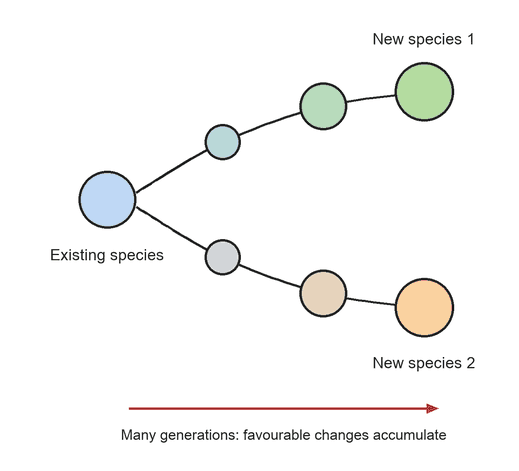
Speciation is the origin of new species by gradual modification: as surroundings change, new useful features are selected, and over many generations enough characters change to form a new species.
Step 4 — (d) Bipedalism.
Bipedalism is the ability to walk upright on the two hind limbs, which frees the forelimbs; in man it came with the lumbar curve of the backbone.
Step 5 — (e) Natural selection.
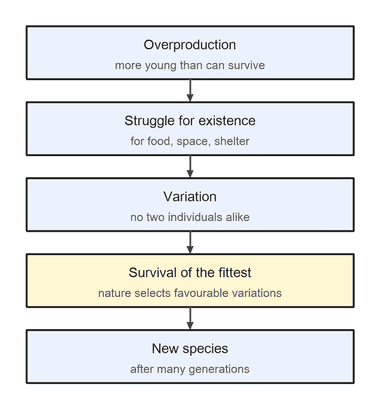
Natural selection is the process by which nature preserves the fittest individuals (those with favourable variations), which survive and reproduce, and removes the weaker ones; for example, the better hidden peppered moths escaped the birds and left more offspring.
Therefore, the five definitions are the bold statements in Steps 1 to 5.