
Question 61 markMCQAsked 2024Easy
Industrial Melanism was observed in:
Confirming your payment
Sign up now and get 250 free tokens.
Previous Year Questions · Question 6 of 19
Industrial Melanism was observed in:
(A) Mice
(B) Peppered Moth
(C) House Flies
(D) Crow
Answer: (B) Peppered Moth
Concept: Industrial melanism is the spread of the dark (melanic) form of an insect in areas where industrial smoke has darkened the surroundings. The classic case is the peppered moth, Biston betularia, of industrial England (around Manchester).
Step 1 — Recall where it was seen.
Industrial melanism was studied in the peppered moth around the industrial towns of England, such as Manchester.
Step 2 — Recall what happened.
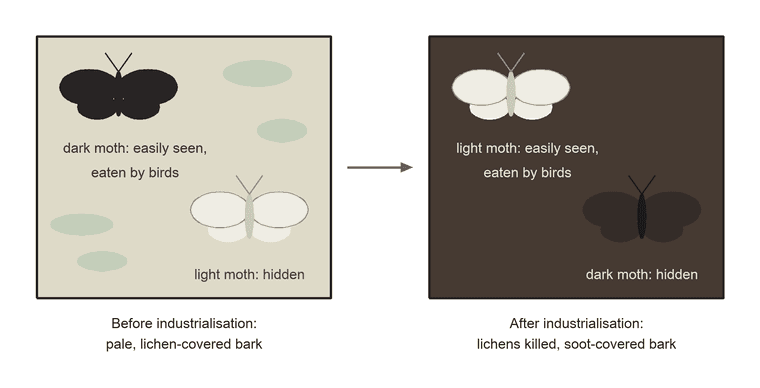
Before the industrial revolution the tree trunks were covered with pale lichens. The light moths were hidden on them, while the rare dark moths stood out and were eaten by birds. Smoke then killed the lichens and soot blackened the bark. Now the dark moths were hidden and the light ones were picked off, so the dark form survived better, left more offspring and became the common form.
Watch out: The birds were the predators that ate the moths; it was the moth that changed colour.
Why the other options are wrong:
Therefore, industrial melanism was observed in the peppered moth, option (B).