
Opening your dashboard
Class 10 Biology Chapter 14 Human Evolution: Competency-Based Questions (CBQ)
40 questions on Chapter 14, each worked through on its own page with the AI tutor. Class 10 Biology, ICSE 2026-27.
40 questions
1–5 marks · Mixed difficulty
- 11 mark
Question 1
Cognitive domain: Application
A female frog in a village pond lays about eggs in one season, and many frogs breed there every year. Yet a nature club that counts the adult frogs of the pond each July finds roughly the same number, about , year after year. Which of the facts on which Darwin based his theory explains most directly why nearly all the tadpoles never become adult frogs ?
- 21 mark
Question 2
Cognitive domain: Analysis
The bar graph shows the highest cranial capacity recorded in your chapter for five stages of human evolution, arranged from the oldest to the most recent.
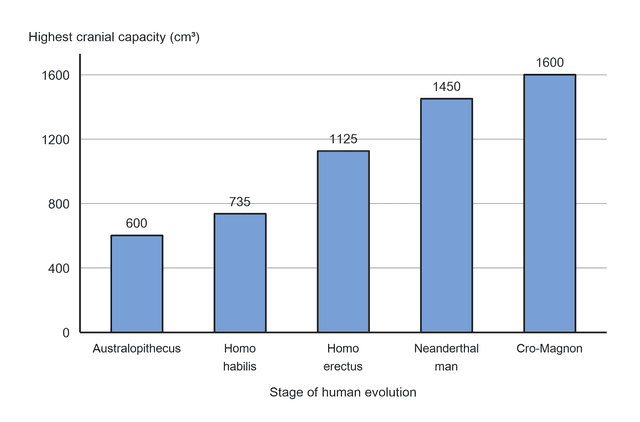
Between which two successive stages is the rise in the highest cranial capacity the greatest, and what does the chapter record about the later of these two stages ?
- 31 mark
Question 3
Cognitive domain: Application
Biologists exploring a deep cave find a kind of fish that lives in complete darkness. It has very small eyes that are covered by skin and cannot see, while its relatives in the river outside have large working eyes. Using the ideas of your chapter, the eyes of the cave fish are best described as :
- 41 mark
Question 4
Cognitive domain: Analysis
A museum shows a series of fossil casts, from the oldest to the youngest. The guide says, "Every row of this chart shows a change in the direction of modern man."
Row Feature Oldest fossil Youngest fossil P Forehead Steep Low and receding Q Canine teeth Large Small R Chin Absent Well developed S Lumbar curve of the vertebral column Slight Distinct Which row does not support the guide's statement ?
- 51 mark
Question 5
Cognitive domain: Understanding
Assertion (A): Lamarck would expect a wading bird that kept stretching its legs to stay above the water to leave behind young ones with slightly longer legs.
Reason (R): According to Lamarck, the modifications that an organism develops during its own life cannot be passed on to its offspring.
- 61 mark
Question 6
Cognitive domain: Understanding
Assertion (A): A skull cannot be identified as that of Cro-Magnon or of modern man from its cranial capacity alone.
Reason (R): Cro-Magnon man lived in caves and did not know agriculture or the domestication of animals.
- 71 mark
Question 7
Cognitive domain: Application
The elephant is the slowest breeder: it produces only young ones in its life of about years. In a forest reserve the number of elephants has stayed roughly constant for a very long time.
So, on average, only ______ of the six young ones of a pair of elephants survive to replace their parents, and the other ______ are lost in the struggle for existence.
- 81 mark
Question 8
Cognitive domain: Application
In a fossil lower jaw the teeth are arranged in a smoothly rounded parabola, the canines do not project beyond the level of the other teeth, and there is no space between the incisors and the canines on either side.
The space that is missing is called the ______ gap; since this gap is present in apes, the dentition of the fossil is ______-like.
- 91 mark
Question 9
Cognitive domain: Understanding
A student builds a toy robot that stands on two legs. It balances much better after she gives its "backbone" a gentle bend in the lower-back region, and its two "arms" are then free to carry things.
In human evolution, the erect posture was likewise made possible by the development of the ______ curve, and bipedal locomotion freed the ______ from the ground.
- 102 marks
Question 10
Cognitive domain: Application
The cheetah has long, strong legs and can outrun the swift antelopes on which it feeds. Suppose its ancestors had shorter, weaker legs.
Explain how Lamarck would account for the long, strong legs of the cheetah, and how Darwin would account for them.
- 112 marks
Question 11
Cognitive domain: Evaluation
A magazine article carries the heading: "Humans have evolved from the monkeys and apes that we see in the zoo today."
Is this heading correct according to your chapter ? Justify your answer with two points.
- 122 marks
Question 12
Cognitive domain: Analysis
A student prepares this table while comparing humans with some other mammals.
Structure In humans In some other mammals Vermiform appendix A narrow worm-like tube with no function Quite helpful in digesting cellulose, as in sheep Muscles of the pinna Complete but poorly developed; cannot move the pinna Move the pinna to gather sound waves What pattern is common to both rows ? What does this pattern suggest about the ancestors of humans ?
- 135 marks
Question 13
Cognitive domain: Analysis
Case: To study the peppered moth (Biston betularia), marked moths of the light and the dark variety were released in two woods. Wood 1 is near factories; its tree trunks are dark with soot and have no lichens. Wood 2 is far from any factory; its tree trunks are covered with lichens. After some days, as many marked moths as possible were caught again. Assume that the marked moths that were not caught again had mostly been eaten by birds.
Wood Variety Marked moths released Marked moths caught again 1 (sooty trunks) Light 200 32 1 (sooty trunks) Dark 200 68 2 (lichen-covered trunks) Light 200 50 2 (lichen-covered trunks) Dark 200 24 (a) Calculate the percentage of marked moths caught again for each of the four rows.
(b) Which variety survived better in each wood ? Explain why, naming the agent through which natural selection acted.
(c) A student says, "The soot settled on the light moths of Wood 1 and turned them dark." Give one reason from the case or from your chapter to show that this is wrong.
(d) Name the phenomenon shown by Wood 1. Predict what will happen to the two varieties in Wood 1 if the pollution is controlled and lichens grow on the trunks again.
- 144 marks
Question 14
Cognitive domain: Evaluation
Case: A school science club is preparing display cards for four skull models. The teacher asks the members to check the first draft against the textbook.
Card Stage Cranial capacity Statement written on the card 1 Australopithecus to About 120 cm tall, walked nearly straight, had a prominent chin 2 Homo erectus to Walked fully upright; the first to hunt animals and use fire 3 Neanderthal man about About 160 cm tall, prominent brow ridges, almost no chin 4 Cro-Magnon to Good hunters who grew crops and kept cattle (a) Two of the cards carry a wrong statement. Identify them and rewrite the wrong part of each correctly.
(b) A visitor reads the cards and says, "The brain of Neanderthal man was much smaller than that of modern man." Use the figures to judge this remark.
(c) The club wants to use cranial capacity as the only feature for arranging skulls in the order of evolution. Evaluate this choice, giving one point in its favour and one point against it, and suggest one feature that could be used along with it.
- 155 marks
Question 15
Cognitive domain: Creativity
Case: For Science Week, a group of Class 10 students must design a classroom activity that demonstrates natural selection without using any living animal. They have: a large sheet of old newspaper, a large sheet of plain black chart paper, small discs punched out of newspaper, similar discs punched out of black paper, a stopwatch and a bowl.
(a) State what the sheets, the two kinds of discs and the student who picks up the discs should each represent.
(b) Describe how the group should carry out the activity on the newspaper sheet so that the test is fair, and state what they should record.
(c) State the result you expect on the newspaper sheet. How can the group then show the effect of a change in the environment, like the one that took place around Manchester ?
(d) Suggest how the activity can be continued to show the change over several "generations", and state one way in which this model is unlike natural selection in nature.
- 162 marks
Question 16
CISCE Competency-Focused Practice Questions (2024) · Cognitive domain: Evaluate
Justify the statement – “Vermiform appendix is a vestigial organ in humans.”
- 171 mark
Question 17
Cognitive domain: Understanding
Rohan watches a tadpole in a jar change into a small frog in about two months. He says, "I have seen evolution happen in my own jar."
Why is Rohan's statement not correct ?
- 181 mark
Question 18
Cognitive domain: Analysis

The graph shows the percentage of dark-winged moths in a sample caught in a factory town every years. (Hypothetical data.) The trunks of the trees in the town became darker with soot as more factories were built.
In which period did the percentage of dark moths rise fastest, and what is the best reason ?
- 191 mark
Question 19
Cognitive domain: Application
A quiz card has three statements.
Statement 1: Life began from non-living organic matter through a long series of physical and chemical changes.
Statement 2: An organ that is used a great deal grows larger and stronger, and the change is passed on to the young ones.
Statement 3: Individuals better suited to the environment survive and breed, so their good qualities are passed on.
Which option matches the statements, in order, with autogenesis theory, Lamarck's theory and Darwin's theory ?
- 201 mark
Question 20
Cognitive domain: Application
A museum shows a timeline of three panels, with the oldest on the left. Each panel describes the way of life of one stage of human evolution, but the names have been left out.
Panel 1: The first of our ancestors to hunt animals and use fire.
Panel 2: Cave dwellers who were good hunters and made tools of finely chipped stone, but did not know farming.
Panel 3: People who smelted ores to make metal tools, cultivated plants, domesticated animals and built cities.
Which option names the three stages in order, from Panel 1 to Panel 3 ?
- 211 mark
Question 21
Cognitive domain: Evaluation
Raman says: "Fossils of early humans have been found only here and there, and many are missing. So nothing can be known about how man evolved."
Which is the best response to Raman ?
- 221 mark
Question 22
Cognitive domain: Understanding
Assertion (A): The further evolution of man after Cro-Magnon man involves the evolution of culture rather than of the body.
Reason (R): Cro-Magnon man lived mainly in Europe and was a good hunter.
- 231 mark
Question 23
Cognitive domain: Evaluation
Assertion (A): According to Darwin, a single small variation that appears in one generation is enough to change a species into a new one.
Reason (R): According to Darwin, nature selects the advantages, and after many generations enough characters change to give rise to a new species.
- 241 mark
Question 24
Cognitive domain: Application
A farmer grows a large banana plantation. All the plants were raised by vegetative propagation from a single parent plant, so they are almost exactly alike in every character. A new fungal disease reaches the area, and none of the plants can resist it. (Hypothetical situation.)
Which statement best describes what natural selection can do in this plantation ?
- 251 mark
Question 25
Cognitive domain: Evaluation
A pond dries up every summer. Two kinds of frog live in it. Frog X is large and strong but cannot dig into mud. Frog Y is small but digs into the damp mud and stays there until the rains come. After a very dry summer, only frogs of kind Y are alive. (Hypothetical situation.)
Which statement about this is correct ?
- 261 mark
Question 26
Cognitive domain: Understanding
Which statement correctly describes how evolution and Darwin's theory of natural selection are related ?
- 272 marks
Question 27
Cognitive domain: Application
When we feel cold, tiny muscles at the base of our body hairs contract and raise the hairs, giving 'goosebumps'. In furry mammals such as cats, the same kind of muscles raise the fur, which then traps a thicker layer of air and keeps the animal warm. In humans, whose body hair is very thin and sparse, goosebumps give almost no warmth.
(a) Explain why these muscles are regarded as vestigial in humans.
(b) Name the major change in human evolution, given in your chapter, that made these muscles almost useless.
- 282 marks
Question 28
Cognitive domain: Application
In a forest reserve, two male tigers fight over the same stretch of forest and the deer in it. In the same reserve, a tiger and a leopard both hunt the same deer.
Name the kind of competition in each case, and state one thing they are competing for.
- 292 marks
Question 29
Cognitive domain: Evaluation
A student writes: "The only major change from an ape-like ancestor to modern man was that man learned to walk on two legs."
Australopithecus had a cranial capacity of to cm, and modern man has to cm.
Using these data, evaluate the student's statement. Name two other major changes.
- 302 marks
Question 30
Cognitive domain: Application
A river slowly changed its course and split a population of small rodents into two groups that could no longer meet. On one side was a cool, wet forest and on the other a dry, open grassland. After a very large number of generations, the rodents on the two sides differed in so many characters that scientists counted them as two different species. (Hypothetical situation.)
(a) Quote the words in the case which show that the change was slow and gradual, and name the process by which a new species arises in this way.
(b) Using Darwin's theory, explain why the two groups became different.
- 312 marks
Question 31
Cognitive domain: Application
Charles Darwin was born in and published The Origin of Species in . Jean Baptiste de Lamarck lived from to .
(a) How old was Darwin when his book was published?
(b) How many years before this had Lamarck died, and whose theory was proposed first?
- 322 marks
Question 32
Cognitive domain: Understanding
In one river valley, archaeologists find that small groups of hunters who moved from place to place were later replaced by farming villages, and later still by a town on the river bank. (Hypothetical situation.)
(a) Using your chapter, explain how farming led to permanent settlements, towns and a large growth in human numbers.
(b) State one way in which this change could make the struggle for existence harder for other species living in the valley.
- 333 marks
Question 33
Cognitive domain: Application
Aisha waits on a railway platform. Without moving her body, she turns her head to the right to watch the train coming, and then to the front to look at a small child, using both eyes together.
(a) State the feature of her neck that lets her do this.
(b) Name the kind of vision that uses both eyes facing the front.
(c) State the feature of her skull and spine that lets her stand with the head upright.
- 343 marks
Question 34
Cognitive domain: Creativity
Imagine that you are a member of a Homo erectus family. Write a diary entry of 4 to 5 lines for one day of your life. Your entry must bring in three facts from the chapter about Homo erectus: one about how you look, one about how you stand and walk, and one about what you do for food and warmth.
- 353 marks
Question 35
Cognitive domain: Analysis
A student lists six changes seen during human evolution.
1. Increase in cranial capacity
2. Use of fire
3. Development of a chin
4. Cultivation of plants
5. Reduction in body hair
6. Smelting of ores to make metal tools
(a) Sort the six items into changes in the body and changes in the way of life (culture).
(b) Scientists learn about human evolution mainly from fossils. A fossil keeps the bones, but the soft parts of the body, such as the skin, decay. Which one of the body changes in your answer to (a) could not be seen in a fossil skeleton? Give a reason, and name the part of the skeleton in which each of the other two body changes can be seen.
(c) Cro-Magnon man lived mainly in Europe during the last Glacial period, had a less hairy body, and knew how to use the hide of animals. Suggest how the use of hides could have helped him to survive.
- 363 marks
Question 36
Cognitive domain: Analysis
Four cards show the facts and result of Darwin's theory, but they are mixed up.
Card 1: Individuals of a species differ from one another in small ways, even the young ones of the same parents.
Card 2: The fitter individuals survive, breed and pass their good qualities to their young ones.
Card 3: Space and food remain almost constant, so individuals compete with one another to live.
Card 4: Far more young ones are produced than can ever survive.
(a) Arrange the cards in the order in which your chapter gives Darwin's facts, ending with the result.
(b) Name the fact described on Card 3 and on Card 1.
(c) Name the process described on Card 2, and state what happens after many generations.
- 373 marks
Question 37
Cognitive domain: Evaluation
Case: A bonsai banyan tree has been kept only cm tall for years by regular trimming of its shoots and roots. A student sows five seeds from this bonsai and five seeds from a full-sized banyan tree in the same soil, and gives all of them the same water and light. After one year the seedlings are measured. (Hypothetical data.)
Parent tree Heights of the five seedlings (cm) Bonsai , , , , Full-sized tree , , , , (a) Find the average height of the seedlings in each group.
(b) Lamarck's theory says that characters acquired during an organism's life are passed on to its offspring. Do these results support it? Explain.
(c) Is the small size of the bonsai a variation on which natural selection could act? Give a reason.
- 385 marks
Question 38
Cognitive domain: Analysis
Case: A farm pond can hold at most fish, because of its space and food. The farmer puts fish into it. Suppose that the number of fish doubles every year and that none dies. (Hypothetical data.)
Year Number of fish (a) In which year do the fish first exceed what the pond can hold?
(b) By what percentage does the number in that year exceed the capacity?
(c) Name the two facts of Darwin's theory that this pond shows, in the order in which they occur.
(d) The fish in the crowded pond are not all alike: some can feed in the dim corners where others cannot. State what will happen to these fish and name the process.
- 394 marks
Question 39
Cognitive domain: Analysis
Case:

The bar chart shows the height that the chapter gives for four stages of human evolution. For modern man it shows the upper limit, since the chapter gives his height as "up to cm".
(a) Find the rise in height from each stage to the next.
(b) Find the percentage rise in height from Australopithecus to Cro-Magnon man.
(c) Homo habilis and Homo erectus, which are not shown, came between Australopithecus and Neanderthal man. The chapter's table gives the height of each as to cm. If bars for them were added at cm, would the rising trend of the chart be broken? Explain.
- 405 marks
Question 40
Cognitive domain: Analysis
Case: A small island has strong winds. A group of beetles lived there: some had wings and some had no wings. After a series of storms, the beetles were counted again. Assume that the winged beetles that could not be found had been blown into the sea. (Hypothetical data.)
Kind of beetle Before the storms Alive after the storms Winged Wingless (a) Find the percentage of each kind that survived.
(b) Find the percentage of the survivors that are wingless, and compare it with the percentage of wingless beetles before the storms.
(c) Explain the change using Darwin's theory.
(d) Assume that wingless parents have wingless young and winged parents have winged young. Predict how the share of wingless beetles on the island will change if such storms come every year for many years, and give a reason.