Solution:
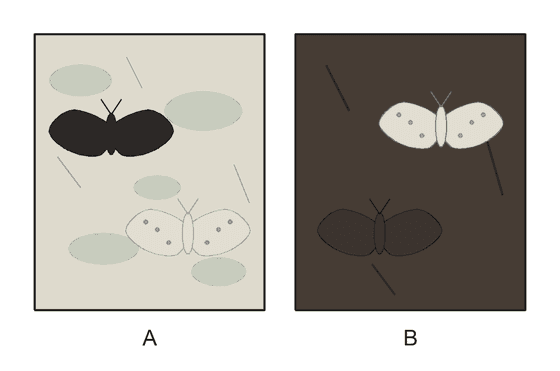
Concept: On pale, lichen-covered bark (A) the light moth is hidden and the dark moth easily seen; on soot-darkened bark (B) the dark moth is hidden and the light moth easily seen.
Step 1 — (a) Name of the phenomenon.
It is industrial melanism.
Step 2 — (b) The insect.
Common name: peppered moth; scientific name: Biston betularia.
Step 3 — (c) Why the change appeared.
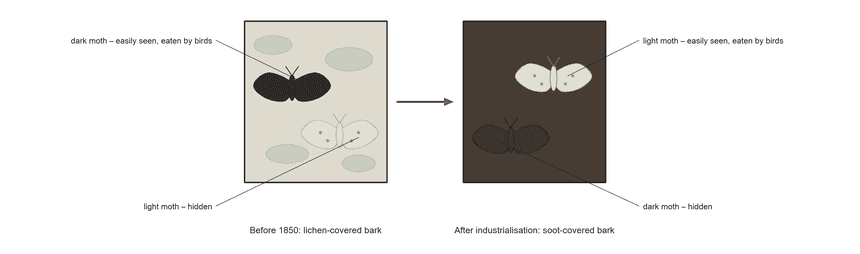
Before industrialisation the trunks were covered with pale lichens, so the light moths were hidden and birds ate the dark ones. Pollution then killed the lichens and blackened the trunks with soot, so the dark moths were hidden and the light ones were eaten by birds. The dark form survived better, left more offspring and almost replaced the light form.
Step 4 — (d)(i) The theory and its explanation.
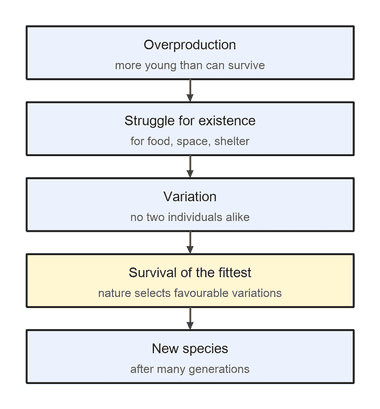
It is the theory of natural selection (Darwinism). Organisms overproduce, so there is a struggle for existence; individuals vary (here, in colour); those best suited to the surroundings survive and pass on their features, so over many generations the favourable variation spreads.
Step 5 — (d)(ii) The scientist.
The theory was given by Charles Darwin.
Watch out: The moths did not change colour during their lives; the dark form was always there and was simply selected.
Therefore, (a) industrial melanism; (b) peppered moth, Biston betularia; (c) soot darkened the bark, so birds now ate the light moths; (d) natural selection, by Charles Darwin.