Solution:
Concept: A is an early ape-like ancestor that walks on all four limbs; B is modern man (Homo sapiens sapiens) with a fully erect posture.
Step 1 — (a) Two contrasting characters.
Compare posture, body hair and head:
| Stage A | Stage B |
|---|
| Stooping; walks on all four limbs. | Fully erect; walks on two legs, forelimbs free. |
| Body covered with hair. | Body hair highly reduced. |
| Small brain box; projecting face, no chin. | Large brain box (1450–1600 cm³); flat face, prominent chin. |
Step 2 — (b) Stages of human evolution in sequence.
From the earliest to the latest:
Ramapithecus → Australopithecus → Homo habilis → Homo erectus → Neanderthal man → Cro-Magnon → Homo sapiens sapiens (modern man)
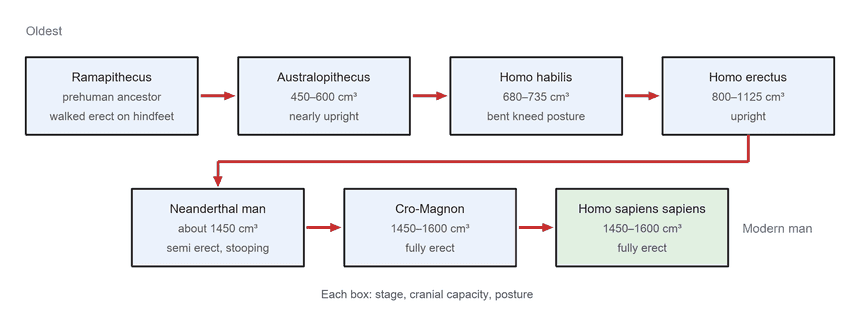
Step 3 — (c) Two features of stage B.
Any two: walking on two legs with an S-curved spine and a fully erect posture; cranial capacity 1450–1600 cm³ with a much enlarged cerebrum; a steep forehead, reduced brow ridges and a prominent chin; greatly reduced body hair. Walking upright freed the hands, and the larger brain went with tool use and speech.
Therefore, (a) four-limbed, hairy, small-brained A v. erect, nearly hairless, large-brained B; (b) the sequence in Step 2; (c) e.g. fully erect bipedal posture and a cranial capacity of 1450–1600 cm³.

