Answer: (B) (2) A is False and R is True
Concept: In an assertion–reason item, judge the Assertion (A) and the Reason (R) separately as true or false. Here the four choices only ask whether each statement is true, so we do not have to decide whether R explains A. Here, "survival of the fittest" belongs to Darwin; "use and disuse" belongs to Lamarck.
Step 1 — Judge the Assertion (A).
False. Lamarck's theory rests on use and disuse and the inheritance of acquired characters; 'survival of the fittest' is part of Darwin's theory of natural selection.
Step 2 — Judge the Reason (R).
True. Lamarck explained use and disuse with the giraffe: constant stretching of the neck and forelimbs over many generations made them longer, so that the animals could reach higher leaves.
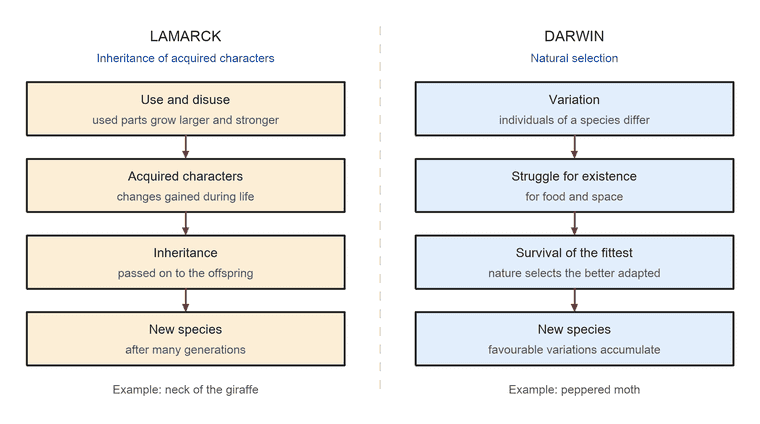
Watch out: Match each phrase to its scientist before judging; A gives Darwin's idea to Lamarck.
Why the other options are wrong:
- (A) (1) A is True and R is False: It calls the Assertion true, but the Assertion is false; and it calls the Reason false, but the Reason is true.
- (C) (3) Both A and R are True: It calls the Assertion true, but the Assertion is false.
- (D) (4) Both A and R are False: It calls the Reason false, but the Reason is true.
Therefore, A is false and R is true, option (B).
