
Question 155 marksEasy
The range of cranial capacities in the following ancestral forms were
(a) Australopithecus ..........
(b) Homo habilis ..........
(c) Homo erectus ..........
(d) Cro-magnon ..........
(e) Homo sapiens sapiens ..........
Confirming your payment
Sign up now and get 250 free tokens.
Human Evolution · Question 15 of 25
The range of cranial capacities in the following ancestral forms were
(a) Australopithecus ..........
(b) Homo habilis ..........
(c) Homo erectus ..........
(d) Cro-magnon ..........
(e) Homo sapiens sapiens ..........
Solution:
Concept: cranial capacity is the volume of the brain box of the skull; it rose steadily during human evolution. The values below are the ranges given in the book.
Step 1 — (a) Australopithecus.
450–600 cm³; a small ancestor, about 120 cm tall, that walked nearly upright.
Step 2 — (b) Homo habilis.
680–735 cm³; the first man-like ancestor, with a larger head and a less protruding face.
Step 3 — (c) Homo erectus.
800–1125 cm³; it walked fully upright, hunted and used fire.
Step 4 — (d) Cro-Magnon.
1450–1600 cm³; it had a large skull, a rounded forehead and a prominent chin.
Step 5 — (e) Homo sapiens sapiens.
1450–1600 cm³; modern man has the same range as Cro-Magnon, with a much enlarged cerebrum.
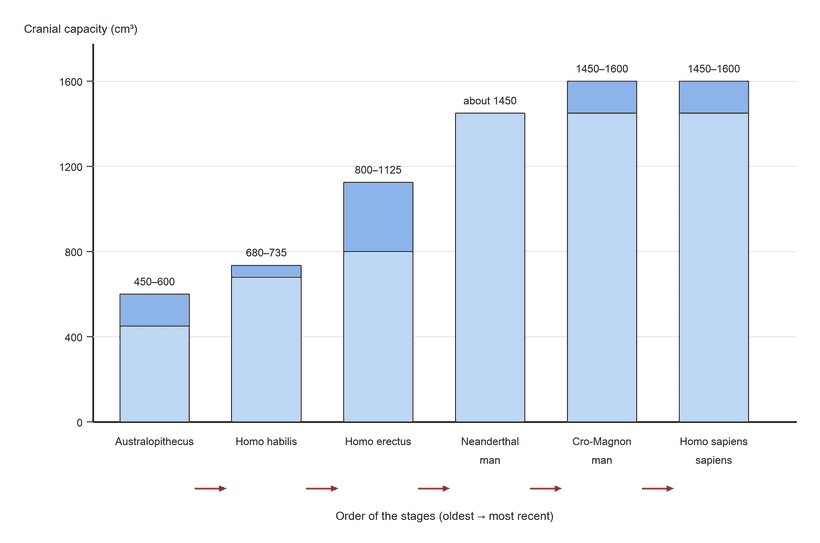
Step 6 — Notice the trend.
The lower limit rises from 450 cm³ to 1450 cm³, a little more than three times. Since Cro-Magnon and modern man share the same range, the later evolution of man was mainly cultural rather than in the size of the brain.
Watch out: Cro-Magnon and modern man have the same range; do not give modern man a larger figure.
Therefore, (a) 450–600 cm³, (b) 680–735 cm³, (c) 800–1125 cm³, (d) 1450–1600 cm³, (e) 1450–1600 cm³.