
Opening your dashboard
Class 10 Biology Chapter 1: Cell – The Structural and Functional Unit of Life Solutions
10 textbook questions with step-by-step answers, free to read, for ICSE 2026-27.
Get talked through Ch 1, not just shown the answer
Reading a finished solution is not the same as being able to do it. The AI tutor takes one question at a time and works it with you, in your own words, until you can.
- Ask it out loud, in your own words
- It gives you the next step, not the answer
- Stuck on part (ii)? Start there
10 questions with solutions
1–10 marks · Mixed difficulty
- 11 mark
Question 1
Assertion (A): Human red blood cells are circular and biconcave.
Reason (R): This shape prevents the easy passage of these cells through blood capillaries.
Solve with AIAnswer
- Correct
(A) (1) A is True and R is False
(B) (2) A is False and R is True
(C) (3) Both A and R are True
(D) (4) Both A and R are False
Answer: (A) (1) A is True and R is False
Concept: In an assertion–reason item, judge the Assertion (A) and the Reason (R) separately as true or false; only when both are true do we ask whether R correctly explains A.
Step 1 — Judge the Assertion.
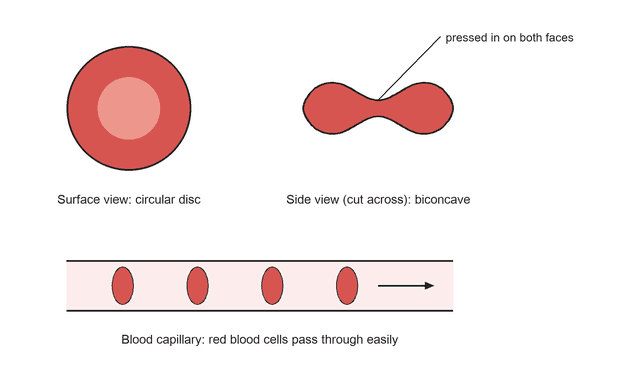
A is true. Seen from the surface, a human red blood cell (RBC) is a round, circular disc. Seen from the side it is biconcave: pressed in on both faces, so it is thinner in the middle than at the rim.
Step 2 — Judge the Reason.
R is false. The biconcave disc shape does not prevent the passage of RBCs through capillaries; it does the opposite. A thin, flexible disc can bend and slip through the very narrow capillaries easily, and its large surface area suits its job of picking up and carrying oxygen.
Step 3 — Decide the option.
A is true and R is false, so the matching option is (A) (1).
Watch out: Read R carefully: the shape makes passage through capillaries easier, so the word 'prevents' makes R false.
Why the other options are wrong:
- (B) (2) A is False and R is True: it says A is false, but human red blood cells really are circular and biconcave.
- (C) (3) Both A and R are True: it says R is true as well, but the shape helps passage through capillaries; it does not prevent it.
- (D) (4) Both A and R are False: it says A is false too, but only R is false.
Therefore, the answer is (A): A is true and R is false.
- 21 mark
Question 2
Assertion (A): Nucleolus does not produce ribosomes.
Reason (R): Nucleolus participates in protein synthesis by forming and storing R.N.A.
Solve with AIAnswer
(A) (1) A is True and R is False
- Correct
(B) (2) A is False and R is True
(C) (3) Both A and R are True
(D) (4) Both A and R are False
Answer: (B) (2) A is False and R is True
Concept: In an assertion–reason item, judge the Assertion (A) and the Reason (R) separately as true or false; only when both are true do we ask whether R correctly explains A.
Step 1 — Judge the Assertion.
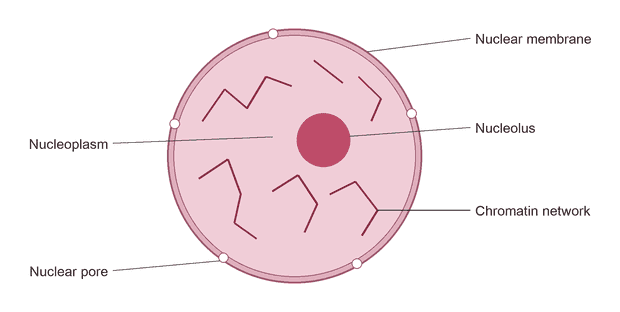
A is false. The nucleolus, a round body inside the nucleus, produces ribosomes. This is one of its main functions, so saying it does not produce ribosomes is wrong.
Step 2 — Judge the Reason.
R is true. The nucleolus forms and stores RNA (ribonucleic acid). This RNA is needed to build ribosomes and to direct protein synthesis, so in this way the nucleolus takes part in protein synthesis. (The proteins themselves are assembled on the ribosomes.)
Step 3 — Decide the option.
A is false and R is true, so the matching option is (B) (2).
Why the other options are wrong:
- (A) (1) A is True and R is False: it has the two statements the wrong way round: A is the false one and R is the true one.
- (C) (3) Both A and R are True: it says A is true, but the nucleolus does produce ribosomes.
- (D) (4) Both A and R are False: it says R is false, but forming and storing RNA is a real function of the nucleolus.
Therefore, the answer is (B): A is false and R is true.
- 31 mark
Question 3
Assertion (A): Iodine solution makes the nucleus more distinct.
Reason (R): Nucleus contains starch which becomes blue-black upon absorbing the iodine solution.
Solve with AIAnswer
- Correct
(A) (1) A is True and R is False
(B) (2) A is False and R is True
(C) (3) Both A and R are True
(D) (4) Both A and R are False
Answer: (A) (1) A is True and R is False
Concept: In an assertion–reason item, judge the Assertion (A) and the Reason (R) separately as true or false; only when both are true do we ask whether R correctly explains A.
Step 1 — Judge the Assertion.
A is true. In an onion peel mounted only in water, the nucleus is faint and hard to see. A stain such as iodine (or eosin) solution is taken up by the nucleus, so after staining the nucleus stands out clearly in every cell.
Step 2 — Judge the Reason.
R is false. The nucleus does not contain starch; it contains chromatin fibres (DNA with proteins). Starch is stored outside the nucleus, in the cytoplasm, as granules in the colourless plastids (leucoplasts). The blue-black colour is the test for starch, so it cannot be the reason why the nucleus shows up.

Step 3 — Decide the option.
A is true and R is false, so the matching option is (A) (1).
Watch out: The blue-black colour of iodine is the test for starch; the nucleus simply takes up the stain and looks darker.
Why the other options are wrong:
- (B) (2) A is False and R is True: it says A is false, but iodine solution does make the nucleus more distinct.
- (C) (3) Both A and R are True: it says R is true as well, but the nucleus has no starch.
- (D) (4) Both A and R are False: it says A is false too, but only R is false.
Therefore, the answer is (A): A is true and R is false.
- 41 mark
Question 4
Assertion (A): Cell membrane is freely permeable.
Reason (R): Cell membrane permits free movement of the solutions across the membrane when two solutions of different tonicity are separated through it.
Solve with AIAnswer
(A) (1) A is True and R is False
(B) (2) A is False and R is True
(C) (3) Both A and R are True
- Correct
(D) (4) Both A and R are False
Answer: (D) (4) Both A and R are False
Concept: In an assertion–reason item, judge the Assertion (A) and the Reason (R) separately as true or false; only when both are true do we ask whether R correctly explains A.
Step 1 — Judge the Assertion.
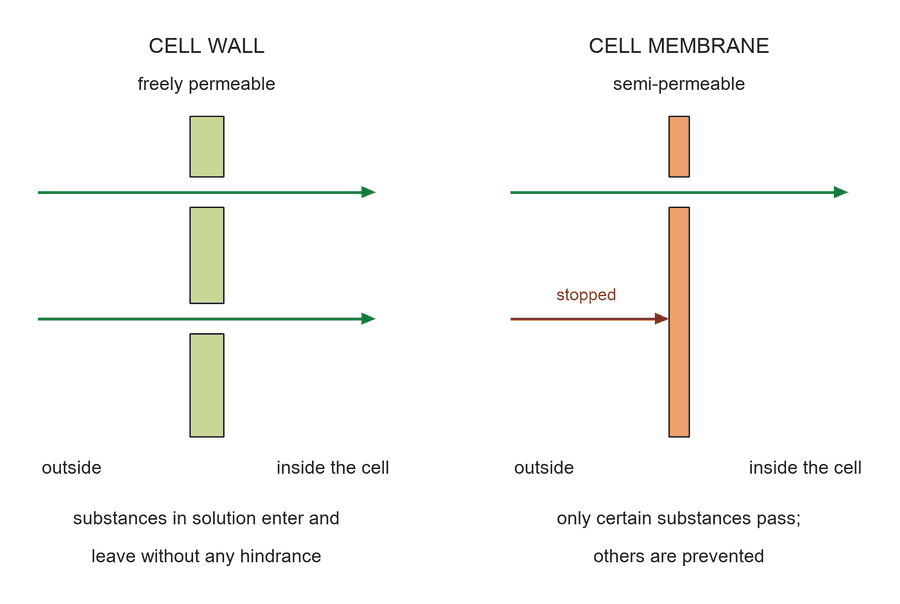
A is false. The cell membrane (plasma membrane) is semi-permeable (selectively permeable): it lets only certain substances through and holds others back. It is the cell wall of a plant cell that is freely permeable.
Step 2 — Judge the Reason.
R is false. When two solutions of different tonicity (strength) are separated by the cell membrane, the solutions do not move freely across it. Mainly the water (the solvent) moves across, by osmosis, while most dissolved substances are held back. So the membrane does not permit free movement of the solutions.
Step 3 — Decide the option.
Both A and R are false, so the matching option is (D) (4).
Watch out: Do not mix up the two layers: cell wall = freely permeable; cell membrane = semi-permeable.
Why the other options are wrong:
- (A) (1) A is True and R is False: it says A is true, but the cell membrane is semi-permeable, not freely permeable.
- (B) (2) A is False and R is True: it says R is true, but a semi-permeable membrane does not let the solutions move across freely.
- (C) (3) Both A and R are True: it says both are true, but neither statement is true.
Therefore, the answer is (D): both A and R are false.
- 51 mark
Question 5
Assertion (A): Scattered Golgi body in animal cells are called as ‘dictyosomes’.
Reason (R): Plant cells have dictyosomes because the entire central space is occupied by a large vacuole.
Solve with AIAnswer
(A) (1) A is True and R is False
- Correct
(B) (2) A is False and R is True
(C) (3) Both A and R are True
(D) (4) Both A and R are False
Answer: (B) (2) A is False and R is True
Concept: In an assertion–reason item, judge the Assertion (A) and the Reason (R) separately as true or false; only when both are true do we ask whether R correctly explains A.
Step 1 — Judge the Assertion.
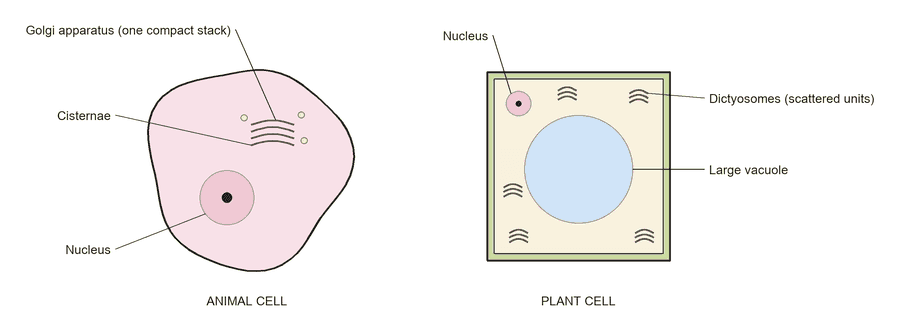
A is false. Dictyosomes are the scattered units of the Golgi body found in plant cells, not in animal cells. In an animal cell the Golgi apparatus is one compact stack of flattened membrane sacs near the nucleus.
Step 2 — Judge the Reason.
R is true. A mature plant cell has a large central vacuole that fills most of the space. The cytoplasm is pushed to the edge as a thin lining, so the Golgi body cannot form one compact stack; it lies scattered in this lining as small separate units, the dictyosomes. This is how the book explains it.
Step 3 — Decide the option.
A is false and R is true, so the matching option is (B) (2).
Why the other options are wrong:
- (A) (1) A is True and R is False: it has the two statements the wrong way round: A is the false one and R is the true one.
- (C) (3) Both A and R are True: it says A is true, but dictyosomes belong to plant cells, not animal cells.
- (D) (4) Both A and R are False: it says R is false, but plant cells do have dictyosomes and a large central vacuole.
Therefore, the answer is (B): A is false and R is true.
- 610 marks
Question 6
Identify the cellular structures with the help of the following clues :
(a) It synthesizes the respiratory enzymes.
(b) It is made up of lipoproteins.
(c) A non-living rigid layer surrounding the plasma membrane.
(d) Supportive framework for the cell.
(e) It consists of cisternae, vesicles and vacuoles.
(f) It destroys foreign substances.
(g) It gives turgidity to the plant cells.
(h) It is made up of DNA threads.
(i) It contains chromatin fibres.
(j) It initiates and regulates cell division.
Solve with AIWritten solution
Solution:
Concept: Each clue is the main feature or the chief function of one part of the cell. Recall what each part does, then match it to the clue.
Step 1 — (a) It synthesizes the respiratory enzymes.
This is the mitochondrion (plural mitochondria). Mitochondria make the enzymes of respiration and use them to release energy from food (pyruvic acid) as ATP, so they are called the seat of aerobic respiration.
Step 2 — (b) It is made up of lipoproteins.
This is the cell membrane (plasma membrane). It is a very thin, flexible, living membrane made of lipids and proteins (lipoproteins); its fine pores make it semi-permeable.
Step 3 — (c) A non-living rigid layer surrounding the plasma membrane.
This is the cell wall. It is the outermost layer of a plant cell, made mainly of cellulose; it is non-living, rigid and freely permeable, and gives the cell its shape.
Step 4 — (d) Supportive framework for the cell.
This is the endoplasmic reticulum (ER). Its network of tubules runs through the cytoplasm and forms a supporting framework; it also makes and transports proteins and fats.
Step 5 — (e) It consists of cisternae, vesicles and vacuoles.
This is the Golgi apparatus (Golgi complex). It is a stack of flattened sacs (cisternae) with vesicles and vacuoles, and it makes and secretes enzymes and hormones.
Step 6 — (f) It destroys foreign substances.
These are the lysosomes. They are small sacs full of digestive enzymes, which break down foreign substances and worn-out parts inside the cell.
Step 7 — (g) It gives turgidity to the plant cells.
This is the vacuole. The large vacuole fills with water (cell sap) and presses the cytoplasm against the cell wall, which keeps the cell firm (turgid).
Step 8 — (h) It is made up of DNA threads.
These are the chromatin fibres (which condense into chromosomes when the cell divides). Each fibre is a long thread of DNA with proteins.
Step 9 — (i) It contains chromatin fibres.
This is the nucleus. Its network of chromatin fibres carries the genes, and in this way the nucleus controls the activities of the cell.
Step 10 — (j) It initiates and regulates cell division.
This is the centrosome, found near the nucleus in animal cells only. Its centrioles form the asters and spindle fibres that organise cell division.
Watch out: (h) and (i) are linked but different: chromatin fibres are made of DNA threads, while the nucleus contains the chromatin fibres.
Therefore, the structures are: (a) mitochondria, (b) cell membrane, (c) cell wall, (d) endoplasmic reticulum, (e) Golgi apparatus, (f) lysosomes, (g) vacuole, (h) chromatin fibres, (i) nucleus, (j) centrosome.
- 75 marks
Question 7
Give two examples of each :
(a) Unicellular animals
(b) Unicellular plants
(c) Cell organelles
(d) Cell inclusions
(e) Stains which make the nucleus distinct.
Solve with AIWritten solution
Solution:
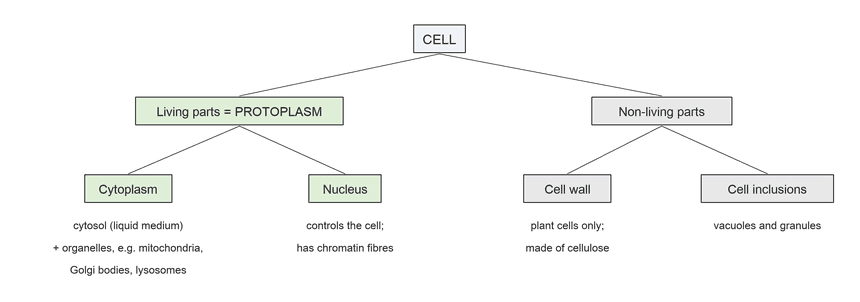
Concept: Unicellular organisms are made of only one cell, which does every life activity. Inside a cell, the organelles are living structures with definite jobs, while the cell inclusions are non-living parts.
Step 1 — (a) Unicellular animals.
Amoeba and Paramecium are animals whose whole body is one cell; that single cell feeds, moves, respires and reproduces.
Step 2 — (b) Unicellular plants.
Chlamydomonas and Chlorella are green plants (algae) made of a single cell; each cell has chlorophyll and makes its own food.
Step 3 — (c) Cell organelles.
Mitochondria and the Golgi apparatus are organelles: each is a living structure with its own job (energy release; secretion). Ribosomes, lysosomes and endoplasmic reticulum are also correct.
Step 4 — (d) Cell inclusions.
Vacuoles and granules (such as starch grains or fat droplets) are cell inclusions, because they are the non-living parts of a cell.
Step 5 — (e) Stains which make the nucleus distinct.
Iodine solution and eosin are stains. The nucleus takes up the stain more than the rest of the cell, so it shows up clearly, for example in an onion peel.
Watch out: Vacuoles are non-living cell inclusions, so do not give them as organelles.
Therefore, (a) Amoeba, Paramecium; (b) Chlamydomonas, Chlorella; (c) mitochondria, Golgi apparatus; (d) vacuoles, granules; (e) iodine, eosin.
- 810 marks
Question 8
Name the following :
(a) A plastid without pigment.
(b) A pigment which is not found in plastids.
(c) The orange-red pigment found in the chromoplast.
(d) Scattered Golgi complex, found in plant cells.
(e) Amoeboid blood cells of human body.
(f) The smallest cell of human body.
(g) Bean-shaped cells of stomata.
(h) The part of cytoplasm which is devoid of the organelles.
(i) The folds/finger-like projections from the inner wall of the mitochondria.
(j) The tubules of Golgi complex.
Solve with AIWritten solution
Solution:
Concept: Each part asks for the name of one cell part, pigment or type of cell from the chapter. Recall its defining feature and name it.
Step 1 — (a) A plastid without pigment.
This is the leucoplast. Leucoplasts are colourless plastids, found mainly in storage organs, and they store starch.
Step 2 — (b) A pigment which is not found in plastids.
This is anthocyanin. It is a violet-blue (or red) pigment dissolved in the cell sap of the vacuole, not held in any plastid.
Step 3 — (c) The orange-red pigment found in the chromoplast.
This is carotene. Chromoplasts hold two pigments: carotene (orange-red) and xanthophyll (yellow).
Step 4 — (d) Scattered Golgi complex, found in plant cells.
These are the dictyosomes: in plant cells the Golgi complex occurs as these small scattered units.
Step 5 — (e) Amoeboid blood cells of human body.
These are the white blood cells (leucocytes). They change shape like an Amoeba, using pseudopodia, and can squeeze out through capillary walls.
Step 6 — (f) The smallest cell of human body.
This is the red blood cell (RBC), as the book states; it is only about 7 micrometres across.
Step 7 — (g) Bean-shaped cells of stomata.
These are the guard cells. A pair of bean-shaped guard cells surrounds each stomatal pore and opens or closes it.
Step 8 — (h) The part of cytoplasm which is devoid of the organelles.
This is the cytosol, the liquid part of the cytoplasm in which the organelles lie.
Step 9 — (i) The folds of the inner wall of the mitochondria.
These are the cristae. The mitochondrion has two walls, and the inner wall is folded into cristae to give a large surface for respiration.

Step 10 — (j) The tubules of Golgi complex.
These are the cisternae, the flattened tubules (sacs) that make up the Golgi stack, together with vesicles and vacuoles.
Watch out: Carotene is orange-red and xanthophyll is yellow; anthocyanin is in the vacuole, not in a plastid.
Therefore, (a) leucoplast, (b) anthocyanin, (c) carotene, (d) dictyosomes, (e) white blood cells, (f) red blood cell, (g) guard cells, (h) cytosol, (i) cristae, (j) cisternae.
- 910 marks
Question 9
Define the following terms :
(a) Cell
(b) Organelles
(c) Cytoplasm
(d) Protoplasm
(e) Nucleus
Solve with AIWritten solution
Solution:
Concept: A good definition names the structure and says what it is or what it does. One more line of explanation or an example makes it complete.
Step 1 — Define cell.
Cell: the structural and functional unit of life, the smallest unit of a living body that can carry out all life activities.
All living things are made of cells, and every cell comes from a cell that existed before it.
Step 2 — Define organelles.
Organelles: the specialised living structures in a cell, each doing a definite function.
For example, mitochondria release energy and the Golgi body makes and secretes enzymes and hormones. Organelles are to a cell what organs are to the body.
Step 3 — Define cytoplasm.
Cytoplasm: the semi-fluid living substance of the cell lying inside the cell membrane and outside the nucleus, which holds the organelles.
Many enzyme-controlled reactions take place in it; its liquid part, without the organelles, is the cytosol.
Step 4 — Define protoplasm.
Protoplasm: the whole living substance of a cell, that is, the cytoplasm and the nucleus together.
The non-living parts, such as vacuoles and granules (cell inclusions), and the cell wall are not part of it.

Step 5 — Define nucleus.
Nucleus: a large, usually spherical, dense body in the cell, bounded by a double nuclear membrane and containing chromatin fibres (DNA), which controls all the activities of the cell.
The nuclear membrane has pores. Inside are the nucleoplasm, one or more nucleoli and the chromatin network. A cell whose nucleus is removed soon dies.
Watch out: Protoplasm includes the nucleus; cytoplasm does not.
Therefore, the five terms are defined as above: cell (unit of life), organelles (living parts with definite functions), cytoplasm (living matter outside the nucleus), protoplasm (cytoplasm plus nucleus) and nucleus (the controlling body of the cell).
- 108 marks
Question 10
Distinguish between the following pairs :
(a) Plant cell and animal cell
(b) Cell wall and cell membrane
(c) Centrosome and chromosome
(d) Chloroplast and chromoplast
Solve with AIWritten solution
Solution:
Concept: To distinguish two things, compare them point against point on the same feature in a table. Two clear differences per pair earn the marks; more are given for revision.
Step 1 — Plant cell and animal cell.
The table compares the two cells feature by feature:
Feature Plant cell Animal cell Size Usually larger. Usually smaller. Cell wall Cell wall of cellulose outside the cell membrane. No cell wall; the cell membrane is outermost. Cytoplasm A thin lining pushed to the edge by the vacuole. Denser; fills almost the whole cell. Plastids Plastids (e.g. chloroplasts) usually present. No plastids. Centrosome Absent. Present. Vacuoles Large and prominent. Small and temporary, if any. 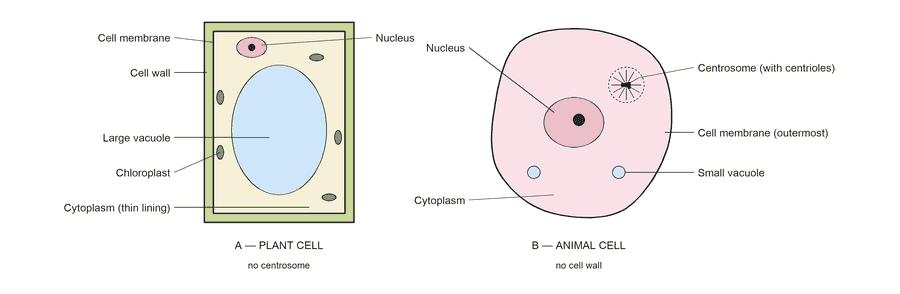
Step 2 — Cell wall and cell membrane.
Compare the two outer layers in the same way:
Feature Cell wall Cell membrane Nature Non-living, rigid. Living, thin and flexible. Made of Mainly cellulose. Lipoproteins. Permeability Freely permeable. Semi-permeable (selectively permeable). Found in Plant cells only. All cells. Function Gives rigidity and shape. Controls the entry and exit of substances. Step 3 — Centrosome and chromosome.
These two only sound alike; compare where they are and what they do:
Feature Centrosome Chromosome Location In the cytoplasm, near the nucleus. Inside the nucleus. Found in Animal cells only; has one or two centrioles. Plant and animal cells; made of DNA (chromatin) that condenses during division. Function Starts and regulates cell division; forms the spindle with the asters. Carries the genes that pass characters from parents to offspring. Step 4 — Chloroplast and chromoplast.
Both are plastids of plant cells; compare their colour, place and job:
Feature Chloroplast Chromoplast Pigment Green; contains chlorophyll. Yellow, orange or red; contains carotene and xanthophyll. Found in Green parts, mainly leaves. Flowers and fruits. Function Traps sunlight for photosynthesis. Gives colour to flowers and fruits, which attracts pollinating insects and animals. Watch out: Write each difference as a matched pair on the same feature; 'plant cell has a cell wall' must be set against 'animal cell has no cell wall'.
Therefore, the four pairs differ as shown in the tables, the key points being: cell wall and plastids (plant cell vs animal cell), non-living and freely permeable vs living and semi-permeable (cell wall vs membrane), cell division vs heredity (centrosome vs chromosome), and photosynthesis vs colour (chloroplast vs chromoplast).
What Class 10 Biology Ch 1 covers
The sections of the chapter, in the order the book takes them. Every question above comes from one of these.
- 01Cells – A Basic Study in Biology
- 02Cells – How Many
- 03Cells – How Small
- 04Cell Shapes
- 05Gross Structure of Cell – The Three Essential Parts
- 06Finer Structure of Cell – The Organelles
More ways to study this chapter
The same chapter asked three other ways. Practise it, revise it, and see what the board has set on Ch 1 before.
- Competency-Based Questions (CBQ)Case study questions: a situation, and the part of the chapter that answers it.40questionsOpen
- Previous Year QuestionsQuestions that have actually appeared in board papers, each tagged with its year.1questionOpen
- Practice QuestionsExtra questions per chapter, for when one attempt at a method is not enough.40questionsOpen
Ch 1 in past ICSE papers
The same chapter as the board has actually asked it. These are worded differently from the textbook exercise, which is the point of reading them.
- 11 mark
Board paper question 1
Choose the ODD one out from the following terms given and name the CATEGORY to which the others belong:
Example: Nose, Tongue, Arm, Eye
Answer: Odd Term – Arm, Category – Sense organs
Centrosome, Cell wall, Cell membrane, Large vacuoles
Solve with AIWritten solution
Solution:
Concept: A plant cell and an animal cell share many parts (nucleus, cytoplasm, cell membrane), but some parts are found in only one of them. A plant cell has a cellulose cell wall and a large central vacuole; an animal cell has a centrosome and no cell wall.
Step 1 — Ask where each term is found.
We take the four terms one by one and ask which kind of cell has each of them.
- Centrosome — present near the nucleus of an animal cell; absent in the cells of flowering plants.
- Cell wall — a rigid layer of cellulose found outside the cell membrane of a plant cell.
- Cell membrane — present in both; in a plant cell it lies just inside the cell wall.
- Large vacuoles — a plant cell has a large central vacuole; an animal cell has only small, temporary vacuoles, if any.
Step 2 — Find the group the three belong to.
Cell wall, cell membrane and large vacuoles are all present together in a plant cell, so the three of them describe the parts of a plant cell. The centrosome is the only term that a plant cell does not have.

Step 3 — Name the odd term and the category.
The odd term is therefore the centrosome. It contains a pair of centrioles, which form the asters and help to form the spindle when an animal cell divides.
Watch out: The cell membrane is found in animal cells too, so it is not the odd one; the question asks which three belong TOGETHER, and only a plant cell has all three of cell wall, cell membrane and large vacuoles.
Therefore, the odd term is Centrosome, and the category of the other three is Parts of a plant cell.
Class 10 Biology Ch 1 questions students ask
How many questions are there in Class 10 Biology Ch 1?
10 questions. Every one is solved step by step on this page.
Are these Class 10 Biology solutions free?
Yes. Every question and its full working is free to read, with no account needed.
Can I download the Class 10 Biology Ch 1 solutions as a PDF?
There is no PDF to download. Every solution is on this page instead, which means it is searchable, always the current syllabus, and readable on a phone. Use your browser's print option if you want it on paper.