
Opening your dashboard
Class 10 Biology Chapter 1 Cell – The Structural and Functional Unit of Life: Competency-Based Questions (CBQ)
40 questions on Chapter 1, each worked through on its own page with the AI tutor. Class 10 Biology, ICSE 2026-27.
40 questions
1–5 marks · Mixed difficulty
- 11 mark
Question 1
Cognitive domain: Application
A thorn pricks Farhan's finger and some bacteria enter the wound. A white blood cell reaches the spot and takes a bacterium into its cytoplasm. Within a short time the bacterium is broken down inside the cell. Which organelle of the white blood cell does this work, and how ?
- 21 mark
Question 2
Cognitive domain: Analysis
Imran drew the cell shown below from memory and named it "A generalised plant cell". His teacher said that one of the four numbered parts does not belong in this drawing.
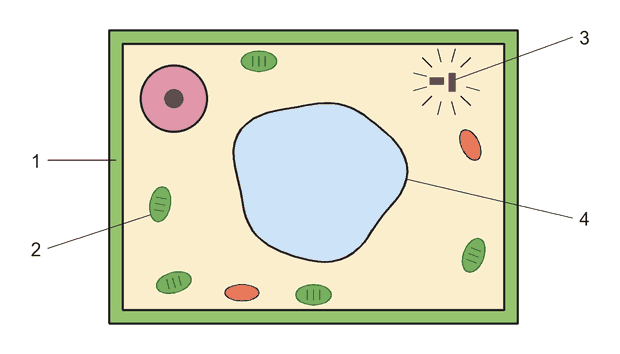
Which part must Imran remove ?
- 31 mark
Question 3
Cognitive domain: Application
In a research laboratory, liver cells are gently broken open and all their organelles and nuclei are removed. Only the clear liquid medium of the cells is left. When glucose is added to this liquid, pyruvic acid is formed, but the energy of the pyruvic acid is not released as ATP. Which statement explains both observations ?
- 41 mark
Question 4
Cognitive domain: Analysis
A scientist cut one large Amoeba into two pieces of about the same size with a fine glass needle. Both pieces were kept in the same dish of pond water.
Piece Nucleus What happened later X Present Fed, grew to full size and divided into two Y Absent Did not grow or divide, and died Which conclusion do these results support ?
- 51 mark
Question 5
Cognitive domain: Understanding
Assertion (A): Mitochondria are able to make some of their own proteins.
Reason (R): Mitochondria are double walled, and their inner wall is thrown into folds called cristae.
- 61 mark
Question 6
Cognitive domain: Understanding
Assertion (A): In a cell of onion peel, the nucleus is seen towards one side and not in the centre.
Reason (R): Large vacuoles fill much of a plant cell, so the cytoplasm is left only as a thin lining pushed to the periphery.
- 71 mark
Question 7
Cognitive domain: Application
A chart in a science museum uses these figures for an average-sized adult human: about trillion red blood cells in the body and about billion nerve cells in the brain cortex. (1 trillion billion)
So, for every one nerve cell of the brain cortex, the body has about ______ red blood cells.
- 81 mark
Question 8
Cognitive domain: Understanding
At the site of an infection, some blood cells leave the blood by squeezing out through the walls of the capillaries. Other blood cells stay in the blood and keep slipping easily through the narrowest capillaries, carrying oxygen.
The cells that squeeze out are the ______ blood cells, and they can do so because they are ______ in shape.
- 91 mark
Question 9
Cognitive domain: Analysis
Neha looked at thin pieces of two petals under a microscope. In the yellow petal, the colour was seen only inside small bodies lying in the cytoplasm. In the violet-blue petal, these bodies had no colour; the colour was in the clear space enclosed by the tonoplast.
So the yellow colour is due to ______ in the chromoplasts, while the violet-blue colour is due to ______ in the vacuoles.
- 102 marks
Question 10
Cognitive domain: Evaluation
In a quiz, Riya answers: "Nerve cells are the longest cells, so a nerve cell must also be the largest cell in the living world."
Is Riya's reasoning correct ? Justify your answer, naming the largest single cell.
- 112 marks
Question 11
Cognitive domain: Application
Mohan scraped his knee while playing. A week later the wound was covered with new skin. His younger sister says, "The new skin was made from the dried blood and the ointment on the wound."
Using the main points about cells given in your chapter, explain to her where the new skin cells came from.
- 122 marks
Question 12
Cognitive domain: Evaluation
Dev stained an onion peel with iodine solution and examined it under the low power of a microscope. He noted: "The cells are somewhat rectangular and firmly bound together. Each cell has a prominent outer boundary and a nucleus lying towards one side. I could not see any green bodies." He concluded: "There are no chloroplasts, so these must be animal cells."
Is Dev's conclusion justified ? Use two of his own observations to support your answer.
- 135 marks
Question 13
Cognitive domain: Analysis
Case: A research student studied very thin sections of three different cells, P, Q and R, under a powerful microscope. She counted some of the structures seen in one section of each cell.
Cell Cell wall Mitochondria Lysosomes Chloroplasts P Absent 120 6 0 Q Absent 15 60 0 R Present 20 2 35 (a) Which cell is from a plant ? Give two pieces of evidence from the table.
(b) One of these cells is from the muscle of the heart, which contracts without rest. Identify it and give a reason.
(c) Cell Q is a white blood cell. How is its large number of lysosomes related to its work ?
(d) A classmate says, "Cell R does not need mitochondria, because its chloroplasts already trap energy." Explain why she is wrong.
- 145 marks
Question 14
Cognitive domain: Application
Case: In a plant research laboratory, living leaf cells are treated with an enzyme that digests only cellulose. The figure shows a cell X before the treatment and the same cell, Y, after it. Cell Y is alive.
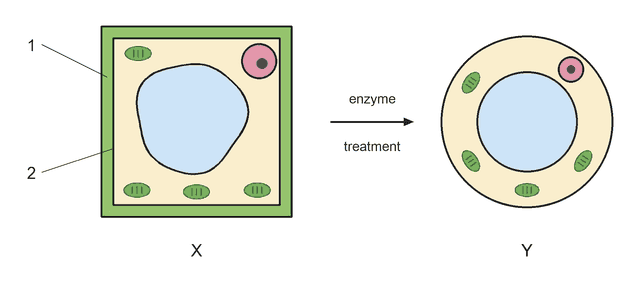
(a) Name the layer 1 that the enzyme has removed. Why was layer 2 not digested by this enzyme ?
(b) What is the appropriate term for the cell Y ? Explain why Y is no longer box-shaped like X.
(c) Compare layers 1 and 2 on two points: whether they are living, and their permeability.
(d) The workers find that the cells Y are damaged far more easily than the cells X. Give a reason.
- 155 marks
Question 15
Cognitive domain: Creativity
Case: For the school science week, Class X must make a poster titled "Cell City", in which an animal cell is shown as a busy city. Each part of the cell must be shown as a place or service of the city that does a matching job.
(a) Choose any five parts of the animal cell. For each one, suggest the place or service of the city that should represent it, and give the reason.
(b) The next class wants to change the poster into a "Plant Cell City". State two things that must be added and one that must be removed, and suggest how each addition could be shown.
(c) State two ways in which a city is unlike a living cell, so that visitors are not misled by the poster.
- 161 mark
Question 16
Cognitive domain: Analysis
The drawing shows a small part of an onion peel as seen under the low power of a microscope. Cell X is shaded. The arrow along cell X has small marks, and the distance between two neighbouring marks is exactly the length of the scale bar shown below the drawing. The scale bar stands for in the real peel.
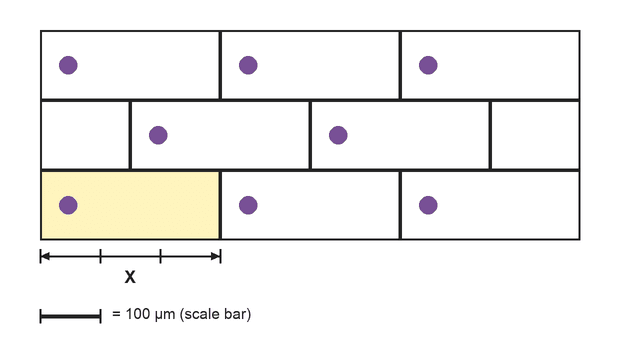
What is the real length of cell X ?
- 171 mark
Question 17
Cognitive domain: Application
A science club tested a piece of mushroom, a piece of goat liver and a spinach leaf. (Hypothetical experiment.) Under the microscope all three were seen to be made of cells. When the cells were broken open, the same kinds of chemicals (proteins, carbohydrates, fats and DNA) were found in all three, and in all three the cells released energy by breaking down glucose.
Which main point about cells in your chapter does this result support best ?
- 181 mark
Question 18
Cognitive domain: Evaluation
Two students were discussing why the human body has about different types of cells. Tara said: "Every body begins as a single cell, and all the other cells are formed from it. So all cells must have the same shape and size."
Which reply to Tara is the best ?
- 191 mark
Question 19
Cognitive domain: Analysis
A thin slice of onion peel was kept in a solution that contained three dissolved substances. After some time the cell wall and the cytoplasm were tested for each substance. (Hypothetical data.)
Substance in the solution Found in the cell wall Found in the cytoplasm Common salt Yes Yes Glucose Yes Yes A blue dye Yes No Which conclusion do the observations support ?
- 201 mark
Question 20
Cognitive domain: Analysis
A digestive enzyme is a protein made inside a gland cell and sent out of the cell. Mohit wants to list, in the correct order, the cell parts involved in making this enzyme and sending it out of the cell. Which order is correct ?
- 211 mark
Question 21
Cognitive domain: Understanding
Assertion (A): A mature plant cell and an animal cell both have one very large central vacuole.
Reason (R): Plant cells have few but large vacuoles, while animal cells have smaller ones.
- 221 mark
Question 22
Cognitive domain: Analysis
Assertion (A): Substances can pass between the nucleus and the cytoplasm although the nucleus is enclosed by a nuclear membrane.
Reason (R): The nuclear membrane is double layered and has nuclear pores.
- 231 mark
Question 23
Cognitive domain: Analysis
The figure shows a cell at an early stage of cell division. Part P (marked twice) is a pair of short rods with fine rays around it. Q is the nucleus, R is the outer boundary of the cell and S marks the thick rod-like bodies inside the nucleus.
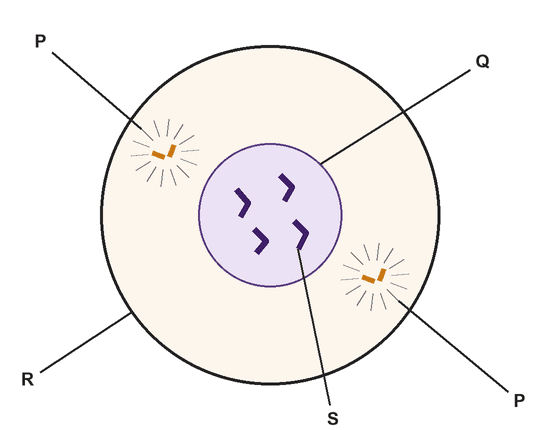
Jaya says, "This is a cell from the root tip of an onion plant." Which feature in the figure shows that she is wrong ?
- 241 mark
Question 24
Cognitive domain: Application
A scientist treats living cells with a chemical that breaks down only the lipoproteins of the cell. Every other part of the cell is left unharmed. Which result is most likely ?
- 251 mark
Question 25
Cognitive domain: Application
Sheetal mounted a thin onion peel in a drop of water and dropped the coverslip flat onto it from above. Under the low power of the microscope she saw the rectangular cells, and also several perfectly round, clear circles with thick dark outlines. The circles were of different sizes, lay across the cell walls without following them, and shifted a little when she pressed the coverslip gently.
What are these circles, and how could she have avoided them ?
- 262 marks
Question 26
Cognitive domain: Understanding
Amoeba is a single-celled organism. It has no heart, no stomach and no other organs, yet it feeds, grows, moves and divides. Kiran says, "Without organs, an organism cannot carry out its life activities."
Using the idea that the cell is the structural and functional unit of life, correct Kiran's statement.
- 272 marks
Question 27
Cognitive domain: Analysis
An Amoeba keeps changing its shape as it moves, pushing out finger-like projections in different directions. A cell of an onion peel, however, stays rectangular and cannot change its shape in this way.
Name the part of the onion cell that prevents the change of shape and give two of its features. Why can an animal cell change its shape ?
- 282 marks
Question 28
Cognitive domain: Understanding
An electron micrograph shows an irregular network of tubules, each with a single membrane. The network is continuous with the membrane around the nucleus and spreads through the cytoplasm towards the cell membrane. Some of its tubules have tiny dense granules attached on the outside, while others have none.
(a) Name the network, and name the two kinds of tubules.
(b) State one function of the network.
- 292 marks
Question 29
Cognitive domain: Evaluation
Rohit drew a few cells of an onion peel. He drew each cell as a round ball with a gap between the balls, put the nucleus in the centre of each cell, and drew a centrosome with two centrioles next to each nucleus.
Point out any two mistakes in his drawing and correct each of them.
- 302 marks
Question 30
Cognitive domain: Analysis
Pooja stained a cell of an onion peel and looked at its nucleus under a powerful microscope. She saw a fine, thread-like network and one dark round body, but no thick rod-shaped bodies. She wrote: "This cell has no chromosomes."
(a) Name the two structures that she saw in the nucleus.
(b) Is her statement correct ? Give a reason.
- 312 marks
Question 31
Cognitive domain: Application
A potato tuber and the liver of an animal both store food inside their cells in the form of small granules.
(a) Name the food stored as granules in a cell of the potato tuber, and in a cell of the liver.
(b) A drop of iodine solution was put on a thin slice of the potato tuber and on a thin slice of the liver. Many blue-black spots appeared on the potato slice, but none on the liver slice. Iodine solution turns starch blue-black. Explain why the liver slice gave no blue-black spots although its cells also hold food granules.
- 323 marks
Question 32
Cognitive domain: Analysis
The table gives the approximate number of cells in the body of three organisms. (The number for the housefly is hypothetical.)
Organism Approximate number of cells Amoeba Housefly Adult human (a) Which of these organisms is unicellular ?
(b) The human body has how many times as many cells as the housefly ?
(c) Which main point of your chapter does the table support ?
- 333 marks
Question 33
Cognitive domain: Analysis
A student made a list of the parts of a plant cell: cell wall, mitochondria, vacuole, nucleus, starch granule, cytoplasm.
(a) Which of these are living parts of the cell (together called the protoplasm), and which are non-living ?
(b) Give the common term for the non-living parts that are not the cell wall.
(c) Why is the cell wall called a non-living part even though it belongs to a living cell ?
- 343 marks
Question 34
Cognitive domain: Evaluation
A student prepared a table to compare plant cells and animal cells. Three rows of her table are wrong. (Hypothetical table.)
Feature Plant cell Animal cell Cell wall Present, made of cellulose Absent Plastids Usually present Absent Centrosome Present Absent Vacuoles Small and temporary Large and prominent Cytoplasm Fills almost the entire cell Only a thin lining pushed to the periphery Find the three wrong rows and give the correct entries for each of them.
- 353 marks
Question 35
Cognitive domain: Analysis
Case: A researcher compares two gland cells under an electron microscope. (Hypothetical observations.)
- Cell M, from a gland in the lining of the stomach, makes a digestive enzyme, which is a protein, and sends it out of the cell.
- Cell N, from an oil gland of the skin, makes an oily secretion, which is a fat, and sends it out; it sends out almost no protein.
In one of the two cells, most tubules of the endoplasmic reticulum are covered with tiny dense granules. In the other cell, most of the tubules are bare.
(a) Which cell, M or N, has most of its endoplasmic reticulum covered with granules ? Name the granules and give a reason for your choice.
(b) The endoplasmic reticulum of the other cell is mostly bare. Using the functions of the endoplasmic reticulum, suggest what this bare endoplasmic reticulum does in that cell.
(c) A liver cell has a large amount of both kinds of endoplasmic reticulum. What does this suggest about the substances that a liver cell makes ?
- 363 marks
Question 36
Cognitive domain: Analysis
A researcher treats cells with a drug that stops only the nucleoli from working. All the other parts of the cells are unharmed.
(a) Which cell parts will be produced in fewer numbers ?
(b) Which cell activity will therefore fall ?
(c) The cells do not die at once, but become unhealthy after some time. Give a reason.
- 374 marks
Question 37
Cognitive domain: Analysis
Case: The figure shows an animal cell, drawn from an electron microscope picture. Six parts are marked with the numbers to .
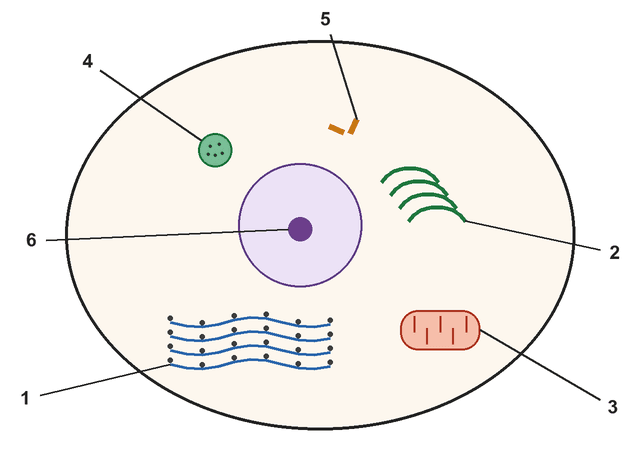
(a) Name the parts , and .
(b) Which numbered part would you not expect to find in a cell of a flowering plant ? State one function of this part.
(c) A poison stops part from working but harms no other part. Name the activity of the cell that is affected first, and say why a muscle cell, which works without rest, would be hit harder than a skin cell.
- 384 marks
Question 38
Cognitive domain: Evaluation
Case: A student reads about a chemical called LyX, which makes the membranes around the lysosomes of a cell burst. (Hypothetical chemical.) She suggests, "We should spray LyX on the whole body of a patient to destroy the harmful cells."
(a) What will happen to a cell whose lysosomes burst ? Give a reason.
(b) Name two useful jobs that lysosomes do in healthy cells of the body.
(c) Evaluate the student's suggestion. Do you agree with it ? Give a reason.
- 395 marks
Question 39
Cognitive domain: Creativity
Case: For a school microscope exhibition, Riya's group is making a cell identification key. A key is a short list of numbered questions. Each question can be answered only yes or no by looking at the cell, and each answer leads either to the next question or to the name of the slide. The group's notes on four slides are given below. (Hypothetical observations.)
Slide Source of the cells Cell wall Green chloroplasts Long, branched extensions W Peel of an onion scale leaf Present Absent Absent X Green leaf of a mustard plant Present Present Absent Y Lining of the human cheek Absent Absent Absent Z Human spinal cord Absent Absent Present (a) Using only the features in the table, write a key of three yes/no questions that names each of the four slides correctly.
(b) A classmate suggests the question "Does the cell have a nucleus?" for the key. Explain why this question is of no use here.
(c) A fifth slide, V, is a smear of fresh human blood. It shows a living white blood cell, which has no cell wall, no chloroplasts and no long extensions, so your key would name it as slide Y. Add one more yes/no question to your key, say where it goes, and explain why it separates V from Y.
- 404 marks
Question 40
Cognitive domain: Application
Case: Preeti drew one cell of an onion peel as seen under a microscope. She measured her drawing: the cell is cm long, and the nucleus in it is cm across. The real length of the cell is .
The magnification of a drawing is the length in the drawing divided by the real length, both in the same unit. Use . (Hypothetical measurements.)
(a) Find the magnification of her drawing.
(b) Find the real width of the nucleus.
(c) In her drawing the nucleus is one-tenth as long as the cell. Use your answers to (a) and (b) to check whether the real nucleus is also one-tenth of the real length of the cell, and explain the result.