
Question 11 markMCQMedium
Assertion (A): Human red blood cells are circular and biconcave.
Reason (R): This shape prevents the easy passage of these cells through blood capillaries.
Confirming your payment
Sign up now and get 250 free tokens.
Cell – The Structural and Functional Unit of Life · Question 1 of 10
Assertion (A): Human red blood cells are circular and biconcave.
Reason (R): This shape prevents the easy passage of these cells through blood capillaries.
(A) (1) A is True and R is False
(B) (2) A is False and R is True
(C) (3) Both A and R are True
(D) (4) Both A and R are False
Answer: (A) (1) A is True and R is False
Concept: In an assertion–reason item, judge the Assertion (A) and the Reason (R) separately as true or false; only when both are true do we ask whether R correctly explains A.
Step 1 — Judge the Assertion.
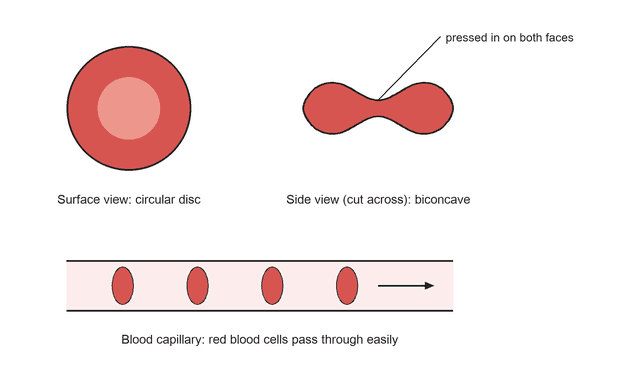
A is true. Seen from the surface, a human red blood cell (RBC) is a round, circular disc. Seen from the side it is biconcave: pressed in on both faces, so it is thinner in the middle than at the rim.
Step 2 — Judge the Reason.
R is false. The biconcave disc shape does not prevent the passage of RBCs through capillaries; it does the opposite. A thin, flexible disc can bend and slip through the very narrow capillaries easily, and its large surface area suits its job of picking up and carrying oxygen.
Step 3 — Decide the option.
A is true and R is false, so the matching option is (A) (1).
Watch out: Read R carefully: the shape makes passage through capillaries easier, so the word 'prevents' makes R false.
Why the other options are wrong:
Therefore, the answer is (A): A is true and R is false.