
Opening your dashboard
Class 10 Biology Chapter 1 Cell – The Structural and Functional Unit of Life: Practice Questions
40 questions on Chapter 1, each worked through on its own page with the AI tutor. Class 10 Biology, ICSE 2026-27.
40 questions
1–5 marks · Mixed difficulty
- 11 mark
Question 1
Bloom's level: Remember
Most multicellular organisms, including human beings, begin their life as :
- 21 mark
Question 2
Bloom's level: Remember
Which of the following is one of the main points about cells given in this chapter?
- 31 mark
Question 3
Bloom's level: Remember
The largest single cell in the living world today is the :
- 41 mark
Question 4
Bloom's level: Understand
The guard cells around a stomatal pore are bean-shaped because this shape helps them to :
- 51 mark
Question 5
Bloom's level: Apply
Cells of a gland that secretes large amounts of digestive enzymes would be expected to have a very well-developed :
- 61 mark
Question 6
Bloom's level: Apply
A cell has a cellulose wall, a large central vacuole and many colourless plastids full of starch, but no chloroplasts. It most likely comes from :
- 71 mark
Question 7
Bloom's level: Understand
A plant cell placed in pure water swells but does not burst. This is mainly because :
- 81 mark
Question 8
Bloom's level: Analyse
A student mounts an unstained onion peel in water. Under the low power of a microscope, he can see the cell walls clearly but can hardly make out the nuclei. The most likely reason is that :
- 91 mark
Question 9
Bloom's level: Apply
The nucleus of an Amoeba X is removed and transplanted into another Amoeba Y whose own nucleus had been removed earlier. What will happen?
- 101 mark
Question 10
Bloom's level: Understand
Assertion (A): Lysosomes are called "suicide bags" of the cell.
Reason (R): When a cell is old or injured, the enzymes of its lysosomes rapidly destroy its own organelles.
- 111 mark
Question 11
Bloom's level: Evaluate
Assertion (A): An elephant has many more cells in its body than a mouse.
Reason (R): The cells of an elephant are much larger than the cells of a mouse.
- 121 mark
Question 12
Bloom's level: Analyse
Assertion (A): The cytoplasm is the medium for the initial steps of respiration.
Reason (R): Mitochondria are present in the cytoplasm.
- 131 mark
Question 13
Bloom's level: Remember
Name the substance of which the cell wall is mainly made, and state how the cell wall differs from the cell membrane in permeability.
- 142 marks
Question 14
Bloom's level: Understand
Explain the statement "The cell is the structural and functional unit of life", giving one example for each part.
- 152 marks
Question 15
Bloom's level: Understand
A hen's egg is said to be a single cell, yet only the central yellow sphere is the actual cell. Explain why the white (albumen) and the shell are not counted as part of the cell.
- 162 marks
Question 16
Bloom's level: Apply
An average adult human body has about 37.2 trillion cells, of which about 25 trillion are red blood cells. (a) What percentage of the body's cells are red blood cells? (Give your answer to one decimal place.) (b) About how many cells of all the other kinds are there?
- 172 marks
Question 17
Bloom's level: Apply
A single animal cell is grown in a culture dish. It and every cell formed from it divide into two once every 12 hours. (a) How many cells will there be after 5 days? (b) After how many divisions will the number of cells first exceed 1000?
- 182 marks
Question 18
Bloom's level: Understand
How is cytosol different from cytoplasm? Explain briefly.
- 192 marks
Question 19
Bloom's level: Analyse
Red blood cells and white blood cells both travel in the blood, yet red blood cells are biconcave discs while white blood cells are amoeboid. Analyse how each shape suits the job of that cell.
- 202 marks
Question 20
Bloom's level: Evaluate
To save time, Kabir tore a thick piece from the outer surface of an onion scale leaf, placed it on a dry slide and looked at it under the microscope without a coverslip. Judge his method: point out two mistakes and say how each should be corrected.
- 211 mark
Question 21
Bloom's level: Apply
A chemical is added to a culture of cells which destroys only their ribosomes. Which cell activity will stop first? Give the reason.
- 221 mark
Question 22
Bloom's level: Understand
Why is the nucleus called the "key to the life of a cell"?
- 234 marks
Question 23
Bloom's level: Apply
Case: Tanvi helps at her uncle's vegetable shop. She notices that raw tomatoes are green but turn bright red as they ripen, and that potatoes, which grow underground, are white inside and full of starch.
(a) Name the plastid that makes the raw tomato green and the pigment it contains.
(b) Name the plastid that gives the ripe tomato its red colour, name a pigment in it, and state how such colour helps the plant.
(c) Name the plastid found in the potato cells. Why is it suitable for an underground part of the plant?
- 244 marks
Question 24
Bloom's level: Apply
Case: In a science documentary, a scientist works with three Amoebae, P, Q and R. She removes the nucleus of P and leaves it alone. She removes the nucleus of Q and puts it into R, whose own nucleus she had removed a little earlier.
(a) What will happen to Amoeba P? Give the reason.
(b) What will happen to Amoeba R and to Amoeba Q?
(c) What single conclusion can be drawn about the nucleus from this experiment? Why is this conclusion important for all cells?
- 254 marks
Question 25
Bloom's level: Analyse
Cells are usually tiny. To see why, imagine three cube-shaped "cells" of sides 1 , 2 and 4 .
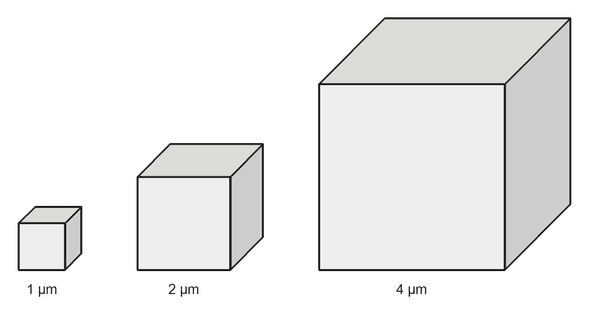
(a) Find the surface area, volume and surface area : volume ratio of each cube, and present them in a table.
(b) What happens to the surface area : volume ratio each time the side is doubled?
(c) Using your answer, explain why being small helps a cell take in and give out substances.
- 264 marks
Question 26
Bloom's level: Analyse
A student recorded the following features of two cells, X and Y, seen in prepared slides :
Feature Cell X Cell Y Outer covering Cell membrane only Cell wall outside the cell membrane Vacuoles Small and temporary One large central vacuole Position of nucleus Near the centre Pushed to one side Centrosome Present Absent (a) Which cell is from a plant and which from an animal? Give two reasons from the table.
(b) State two more differences you would expect between X and Y, other than those in the table.
(c) Explain why the nucleus of cell Y lies to one side.
- 273 marks
Question 27
Bloom's level: Evaluate
Two students made these statements during a class discussion :
Statement 1: "The cell wall is like a security guard – it decides which substances may enter the plant cell."
Statement 2: "An animal cell has no cell wall, so it has nothing to give it its shape."
(a) Judge Statement 1 and correct it if necessary.
(b) Judge Statement 2 and correct it if necessary.
(c) Which part of the cell actually behaves like the "security guard"? Justify your answer.
- 285 marks
Question 28
Bloom's level: Create
Plan a laboratory activity to observe the epidermal cells of an onion under a microscope.
(a) Write the steps you will follow, from cutting the onion to placing the slide under the microscope.
(b) State two precautions and the reason for each.
(c) Construct a table showing what you expect to see under the low power and under the high power of the microscope.
- 295 marks
Question 29
Bloom's level: Create
Design a three-dimensional model of an animal cell for a science exhibition, using common household materials.
(a) Choose a material for the cell membrane, the cytoplasm, the nucleus (with nucleolus), mitochondria and the endoplasmic reticulum, and give a reason for each choice based on the structure of that part.
(b) Name one part you would deliberately leave out of your animal-cell model and one part you would add only if it were a plant cell.
(c) Prepare a key card for your model listing each part with its chief function.
- 303 marks
Question 30
Bloom's level: Apply
Use what you have learnt in this chapter to explain each of these everyday observations :
(a) A drooping spinach leaf becomes firm and crisp again after being kept in water for some time.
(b) At the site of a cut, white blood cells collect outside the blood vessels.
(c) A single nerve cell can run all the way from the spinal cord to a toe.
- 311 mark
Question 31
The body of an average-sized adult human is made up of about how many different types of cells ?
- 321 mark
Question 32
Which one of the following pairs of cell organelles contain their own DNA ?
- 331 mark
Question 33
Assertion (A): A plant cell has a definite shape.
Reason (R): The cell wall of a plant cell is freely permeable.
- 342 marks
Question 34
(i) Sort the following organisms into unicellular and multicellular organisms :
Paramecium, Volvox, Chlamydomonas, mosquito
(ii) A full-grown mango tree and a rose plant are both multicellular. Which of the two has the greater number of cells ? State the rule you have used.
- 352 marks
Question 35
(i) The cell membrane is said to be semi-permeable. What is meant by this term ? Write one other term used for the same property.
(ii) What is cytosol ? State one function of the cytoplasm.
- 362 marks
Question 36
A student mounted a thin peel from a fleshy scale leaf of an onion in a drop of water, stained it with iodine solution and examined it under the low power of a microscope. The figure shows what she saw.

(i) Name the parts numbered 1 and 2. What is the effect of the iodine solution on part 2 ?
(ii) State two features of these cells, seen in the figure, which are common to almost all plant cells.
- 372 marks
Question 37
The figure shows the structure of the nucleus of a cell that is not dividing.

(i) Name the parts numbered 1 to 4.
(ii) What does part 4 change into when the cell divides ? State one function of part 3.
- 384 marks
Question 38
Three structures P, Q and R found in the cytoplasm of an animal cell are described in the table below.
Structure Description P stacks of flattened membrane sacs, with tubules, vesicles and vacuoles Q membranous sacs budded off from P, containing about 40 different types of enzymes R small, dense, spherical granules composed mainly of RNA, not bound by a membrane (i) Identify P, Q and R.
(ii) Why is Q called the "suicide bag" of the cell ? State one other function of Q.
(iii) At which two places in a cell is R found ? What is its function ?
- 393 marks
Question 39
The shape of a cell is often related to the function it performs. For each of the following cells, state its shape and explain how this shape helps the cell in its work.
(i) Human red blood cell
(ii) White blood cell
(iii) Nerve cell
- 404 marks
Question 40
Plastids and vacuoles are two prominent structures of a plant cell.
(i) Name the three kinds of plastids and state one function of each.
(ii) Name the yellow pigment and the orange-red pigment found in plastids. How do the plastids that contain them help a plant indirectly ?
(iii) Name the covering of a vacuole. State one function of the vacuoles in a plant cell.