
Question 41 markMCQMedium
Assertion (A): Cell membrane is freely permeable.
Reason (R): Cell membrane permits free movement of the solutions across the membrane when two solutions of different tonicity are separated through it.
Confirming your payment
Sign up now and get 250 free tokens.
Cell – The Structural and Functional Unit of Life · Question 4 of 10
Assertion (A): Cell membrane is freely permeable.
Reason (R): Cell membrane permits free movement of the solutions across the membrane when two solutions of different tonicity are separated through it.
(A) (1) A is True and R is False
(B) (2) A is False and R is True
(C) (3) Both A and R are True
(D) (4) Both A and R are False
Answer: (D) (4) Both A and R are False
Concept: In an assertion–reason item, judge the Assertion (A) and the Reason (R) separately as true or false; only when both are true do we ask whether R correctly explains A.
Step 1 — Judge the Assertion.
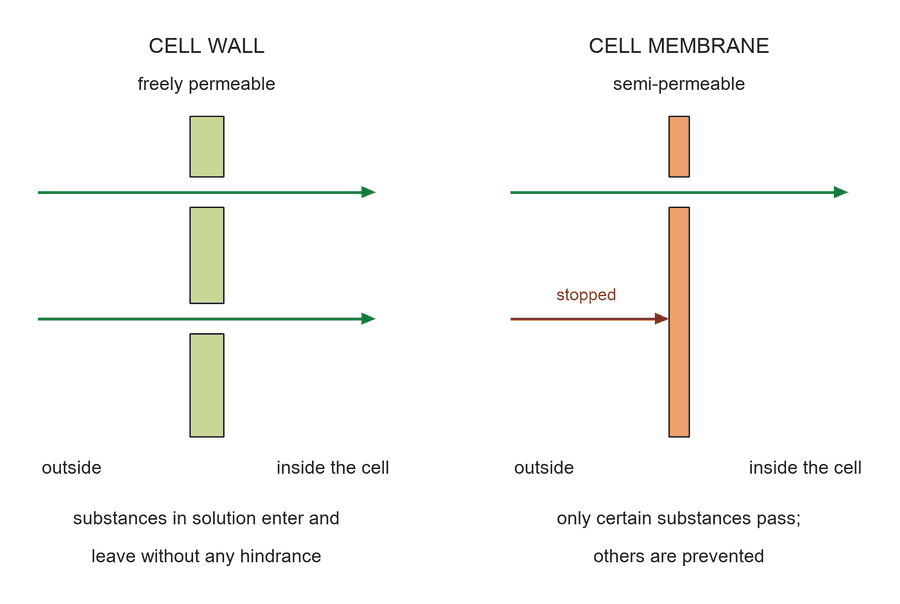
A is false. The cell membrane (plasma membrane) is semi-permeable (selectively permeable): it lets only certain substances through and holds others back. It is the cell wall of a plant cell that is freely permeable.
Step 2 — Judge the Reason.
R is false. When two solutions of different tonicity (strength) are separated by the cell membrane, the solutions do not move freely across it. Mainly the water (the solvent) moves across, by osmosis, while most dissolved substances are held back. So the membrane does not permit free movement of the solutions.
Step 3 — Decide the option.
Both A and R are false, so the matching option is (D) (4).
Watch out: Do not mix up the two layers: cell wall = freely permeable; cell membrane = semi-permeable.
Why the other options are wrong:
Therefore, the answer is (D): both A and R are false.