
Question 75 marksEasy
Give two examples of each :
(a) Unicellular animals
(b) Unicellular plants
(c) Cell organelles
(d) Cell inclusions
(e) Stains which make the nucleus distinct.
Confirming your payment
Sign up now and get 250 free tokens.
Cell – The Structural and Functional Unit of Life · Question 7 of 10
Give two examples of each :
(a) Unicellular animals
(b) Unicellular plants
(c) Cell organelles
(d) Cell inclusions
(e) Stains which make the nucleus distinct.
Solution:
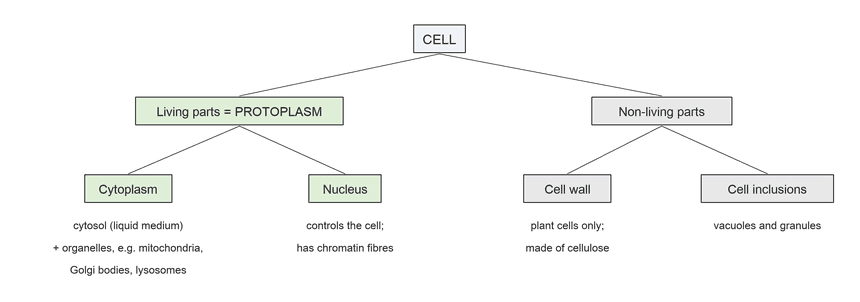
Concept: Unicellular organisms are made of only one cell, which does every life activity. Inside a cell, the organelles are living structures with definite jobs, while the cell inclusions are non-living parts.
Step 1 — (a) Unicellular animals.
Amoeba and Paramecium are animals whose whole body is one cell; that single cell feeds, moves, respires and reproduces.
Step 2 — (b) Unicellular plants.
Chlamydomonas and Chlorella are green plants (algae) made of a single cell; each cell has chlorophyll and makes its own food.
Step 3 — (c) Cell organelles.
Mitochondria and the Golgi apparatus are organelles: each is a living structure with its own job (energy release; secretion). Ribosomes, lysosomes and endoplasmic reticulum are also correct.
Step 4 — (d) Cell inclusions.
Vacuoles and granules (such as starch grains or fat droplets) are cell inclusions, because they are the non-living parts of a cell.
Step 5 — (e) Stains which make the nucleus distinct.
Iodine solution and eosin are stains. The nucleus takes up the stain more than the rest of the cell, so it shows up clearly, for example in an onion peel.
Watch out: Vacuoles are non-living cell inclusions, so do not give them as organelles.
Therefore, (a) Amoeba, Paramecium; (b) Chlamydomonas, Chlorella; (c) mitochondria, Golgi apparatus; (d) vacuoles, granules; (e) iodine, eosin.