Solution:
Concept: Each clue is the main feature or the chief function of one part of the cell. Recall what each part does, then match it to the clue.
Step 1 — (a) It synthesizes the respiratory enzymes.
This is the mitochondrion (plural mitochondria). Mitochondria make the enzymes of respiration and use them to release energy from food (pyruvic acid) as ATP, so they are called the seat of aerobic respiration.
Step 2 — (b) It is made up of lipoproteins.
This is the cell membrane (plasma membrane). It is a very thin, flexible, living membrane made of lipids and proteins (lipoproteins); its fine pores make it semi-permeable.
Step 3 — (c) A non-living rigid layer surrounding the plasma membrane.
This is the cell wall. It is the outermost layer of a plant cell, made mainly of cellulose; it is non-living, rigid and freely permeable, and gives the cell its shape.
Step 4 — (d) Supportive framework for the cell.
This is the endoplasmic reticulum (ER). Its network of tubules runs through the cytoplasm and forms a supporting framework; it also makes and transports proteins and fats.
Step 5 — (e) It consists of cisternae, vesicles and vacuoles.
This is the Golgi apparatus (Golgi complex). It is a stack of flattened sacs (cisternae) with vesicles and vacuoles, and it makes and secretes enzymes and hormones.
Step 6 — (f) It destroys foreign substances.
These are the lysosomes. They are small sacs full of digestive enzymes, which break down foreign substances and worn-out parts inside the cell.
Step 7 — (g) It gives turgidity to the plant cells.
This is the vacuole. The large vacuole fills with water (cell sap) and presses the cytoplasm against the cell wall, which keeps the cell firm (turgid).
Step 8 — (h) It is made up of DNA threads.
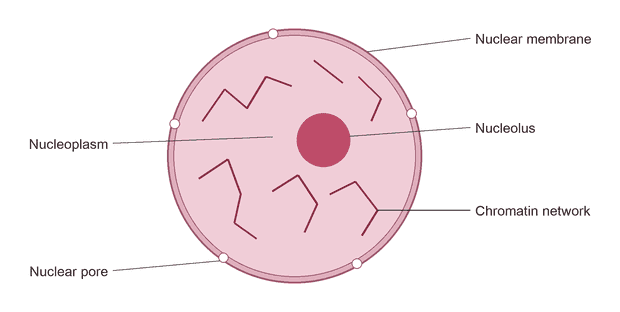
These are the chromatin fibres (which condense into chromosomes when the cell divides). Each fibre is a long thread of DNA with proteins.
Step 9 — (i) It contains chromatin fibres.
This is the nucleus. Its network of chromatin fibres carries the genes, and in this way the nucleus controls the activities of the cell.
Step 10 — (j) It initiates and regulates cell division.
This is the centrosome, found near the nucleus in animal cells only. Its centrioles form the asters and spindle fibres that organise cell division.
Watch out: (h) and (i) are linked but different: chromatin fibres are made of DNA threads, while the nucleus contains the chromatin fibres.
Therefore, the structures are: (a) mitochondria, (b) cell membrane, (c) cell wall, (d) endoplasmic reticulum, (e) Golgi apparatus, (f) lysosomes, (g) vacuole, (h) chromatin fibres, (i) nucleus, (j) centrosome.
