Solution:
Concept: Each part asks for the name of one cell part, pigment or type of cell from the chapter. Recall its defining feature and name it.
Step 1 — (a) A plastid without pigment.
This is the leucoplast. Leucoplasts are colourless plastids, found mainly in storage organs, and they store starch.
Step 2 — (b) A pigment which is not found in plastids.
This is anthocyanin. It is a violet-blue (or red) pigment dissolved in the cell sap of the vacuole, not held in any plastid.
Step 3 — (c) The orange-red pigment found in the chromoplast.
This is carotene. Chromoplasts hold two pigments: carotene (orange-red) and xanthophyll (yellow).
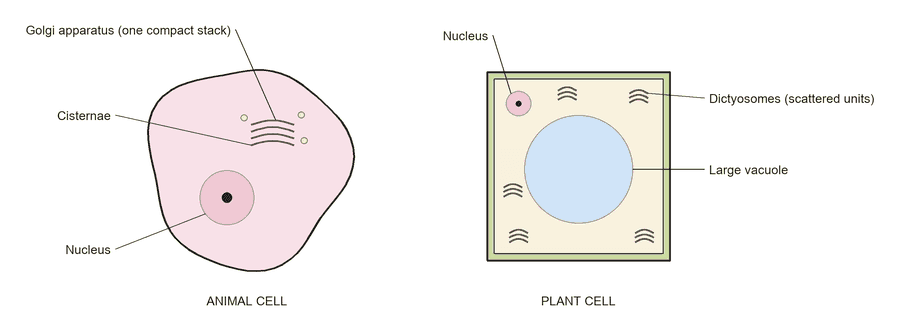
Step 4 — (d) Scattered Golgi complex, found in plant cells.
These are the dictyosomes: in plant cells the Golgi complex occurs as these small scattered units.
Step 5 — (e) Amoeboid blood cells of human body.
These are the white blood cells (leucocytes). They change shape like an Amoeba, using pseudopodia, and can squeeze out through capillary walls.
Step 6 — (f) The smallest cell of human body.
This is the red blood cell (RBC), as the book states; it is only about 7 micrometres across.
Step 7 — (g) Bean-shaped cells of stomata.
These are the guard cells. A pair of bean-shaped guard cells surrounds each stomatal pore and opens or closes it.
Step 8 — (h) The part of cytoplasm which is devoid of the organelles.
This is the cytosol, the liquid part of the cytoplasm in which the organelles lie.
Step 9 — (i) The folds of the inner wall of the mitochondria.
These are the cristae. The mitochondrion has two walls, and the inner wall is folded into cristae to give a large surface for respiration.

Step 10 — (j) The tubules of Golgi complex.
These are the cisternae, the flattened tubules (sacs) that make up the Golgi stack, together with vesicles and vacuoles.
Watch out: Carotene is orange-red and xanthophyll is yellow; anthocyanin is in the vacuole, not in a plastid.
Therefore, (a) leucoplast, (b) anthocyanin, (c) carotene, (d) dictyosomes, (e) white blood cells, (f) red blood cell, (g) guard cells, (h) cytosol, (i) cristae, (j) cisternae.
